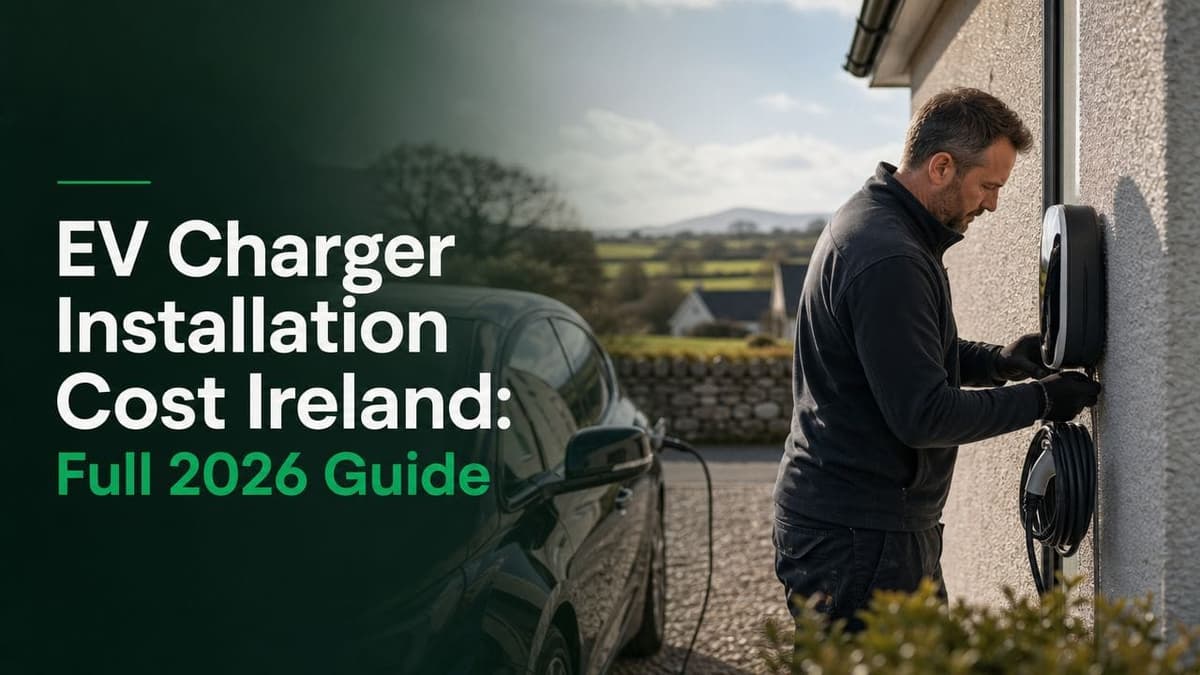
Installing a home EV charger in Ireland involves mounting a wall unit, running a dedicated circuit from your consumer unit, and commissioning the charger so it safely delivers power to your car. Most Irish homes need a single-phase 7.4 kW charger, while homes with a three-phase supply can support an 11 kW or 22 kW unit. The job is not just a plug-in swap: the installer must assess your existing electrical installation, decide on cable routing, and fit the correct protective devices. Because the work touches your fixed wiring, it is a job for a qualified electrician who understands EV charging loads. A site visit is usually needed before a firm quote is given, as the cable run, unit location, and condition of your consumer unit all affect the scope. The charger itself is often supplied by the installer or bought separately, and the final price depends on the unit chosen and the labour involved. Homeowners in counties like Dublin, Cork, Galway, and Limerick commonly arrange this work when they buy an electric vehicle or want to charge overnight at home. The visit lets the installer confirm what is feasible and what the installation will involve.
EV charger installation: this category is busy and nearly empty
Demand for ev charger installation on ShamFix is high, and at most one provider is listed.
The price of an EV charger installation in Ireland is shaped by several factors, and no two homes are the same.
The distance from your consumer unit to the charger location is a major factor: a short run through an adjacent wall is straightforward, while a long run through a garage, attic, or across a garden adds cable, conduit, and labour.
The type of wall matters too — drilling through solid block or stone takes longer than a timber-frame partition.
If your consumer unit is old, has no spare ways, or lacks RCD protection, it may need upgrading or modifying, which adds cost.
The charger model itself varies: a basic 7.4 kW unit costs less than a smart charger with load balancing, a tethered cable, or app control.
If your home has a three-phase supply and you want a faster charger, the unit and wiring are different again.
Groundworks, such as trenching a cable to a detached garage or a driveway bollard, add cost and time.
Finally, access matters: a charger fitted at the front of the house is easier than one at the back with a narrow side entrance.
All of these are assessed at the visit, and a written quote should itemise them.
How long ev charger installation takes
A standard single-charger installation in an Irish home often takes between three and six hours, but this can stretch to a full day or more if the cable run is long, the consumer unit needs work, or groundworks are involved. If a new circuit is required and your consumer unit needs upgrading, the job may be split over two visits. The charger unit itself is usually available off the shelf, but some models may need to be ordered, adding a few days. Realistic start times depend on the electrician's schedule: in busy periods, you might wait one to three weeks for a slot. If you need the work done urgently, say so when you request a quote, as some installers keep short-notice slots. Weather can affect outdoor cable runs, especially if trenching is needed. Once the installation is complete, the electrician should test the circuit and show you how to use the charger. Allow time for a demonstration, and ask for the paperwork before they leave.
What to ask before you hire
01Before you hire anyone for EV charger installation, ask for a written quote that separates the charger unit, labour, cable, and any consumer unit work.
02A clear breakdown helps you compare like with like.
03Ask whether the price includes VAT and at what rate, since domestic electrical work is usually quoted inclusive of VAT but this should be confirmed.
04Check that the electrician has insurance that covers work at your home, and ask to see a certificate of insurance.
05Ask which professional body they are a member of, and whether they hold a current qualification in EV charging installation.
06It is reasonable to ask how they will route the cable and whether they will make good any walls or floors they disturb.
07Confirm who tidies up and removes packaging and cable offcuts.
08Ask about the warranty on the charger and on the workmanship, and whether they will provide a certificate of compliance for the circuit.
09Finally, ask for a realistic start date and how long the job will take, so you can plan around your car's charging needs.
Do I need a dedicated circuit for an EV charger in Ireland?
Yes, an EV charger should have its own dedicated circuit from the consumer unit. This circuit includes the correct cable size, a protective device, and usually an RCD or RCBO. Sharing an existing circuit is not recommended because the charger draws a high continuous load. A dedicated circuit also makes fault-finding and future upgrades easier. The installer will confirm what your consumer unit can support during the site visit.
Can I install an EV charger myself in Ireland?
No, installing an EV charger is not a DIY job in Ireland. The work involves connecting to your fixed wiring, which must be done by a qualified electrician to ensure safety and compliance. A self-installed charger may invalidate your home insurance and could be dangerous. It is also unlikely to meet the requirements for a certificate of compliance. Always use a competent electrician for this work.
How much does an EV charger installation cost in Ireland?
Costs vary widely depending on the charger model, cable run, and any consumer unit upgrades. A basic installation with a short cable run is at the lower end, while a long run, groundworks, or a three-phase charger pushes the price up. You should get a written quote after a site visit so the price reflects your home. Ask for a breakdown of parts and labour.
What type of EV charger is best for my home?
Most Irish homes suit a 7.4 kW single-phase charger, which can fully charge a typical EV overnight. If you have a three-phase supply, an 11 kW or 22 kW charger may be possible, but check your car's onboard charger limits. Smart chargers with load balancing can help manage electricity use. Tethered units have a built-in cable, while untethered units use your own cable. Discuss your driving habits with the installer.
Will installing an EV charger affect my home insurance?
A professionally installed charger should not adversely affect your home insurance, but you must inform your insurer about the installation. Some insurers may ask for proof that a qualified electrician carried out the work. If you install it yourself or use an unqualified person, your policy could be affected. Always keep the certificate of compliance and any warranty documents. Check with your insurer before work starts.
How long does it take to install an EV charger?
A straightforward installation usually takes three to six hours. If the cable run is long, the consumer unit needs upgrading, or groundworks are required, it can take a full day or more. Some jobs are split over two visits. The electrician will give you a time estimate after the site visit. Plan for the car to be off-charge during the work.
Offer ev charger installation on ShamFix
This listing is for ev charger installation work in Ireland. Register so customers posting in this category can find your profile.