Compare kitchen sink replacement quotes in Ireland with clear guidance on labour, supply, hidden extras and realistic timing.
/11 min read
Replacing a kitchen sink in an Irish home is usually a contained plumbing task, but the final bill depends on whether the homeowner buys the sink and taps or a tradesperson supplies and fits them. For a straightforward like-for-like swap, most homeowners should budget within the aggregate Irish market estimate below, while a change of sink size, tap layout or waste position can push the figure higher. Homeowners planning a wider refresh can review kitchen renovation options before booking a plumber.
Typical kitchen sink replacement costs in Ireland
The following aggregate Irish market estimate covers the main line items a homeowner is likely to see on a quote for replacing an existing kitchen sink. It separates supply-only from supply plus fitting.
Line item
Aggregate Irish market estimate
Labour only
€180–€520
Sink unit
€90–€420
Taps and waste kit
€75–€320
Pipework, valves and minor adjustments
€20–€90
Removal and disposal of the old sink
€20–€70
Sealant, clips and consumables
€10–€30
Total supply plus fitting
€395–€1,450
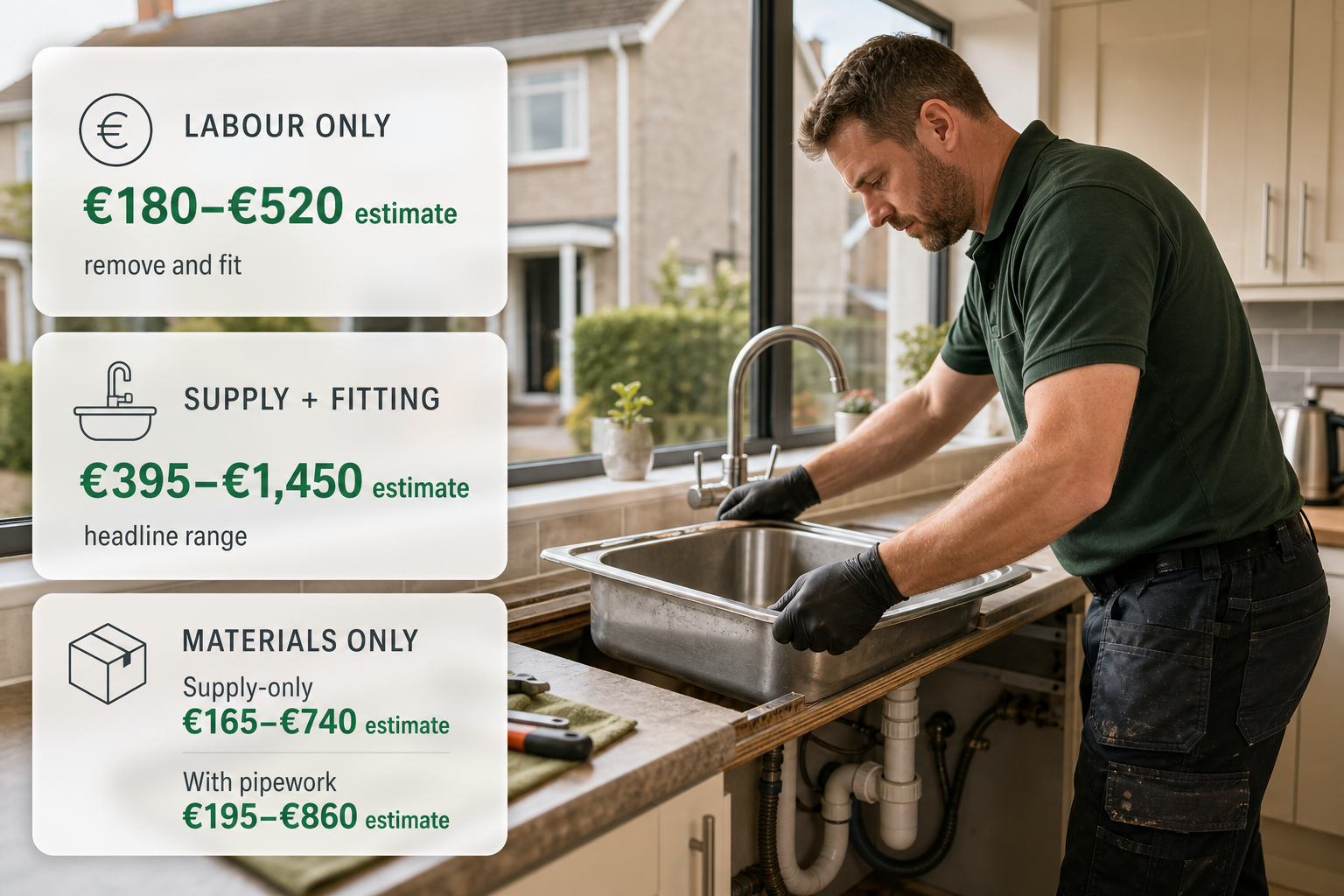
These line items sum to the headline supply-plus-fitting range: €395 at the low end and €1,450 at the high end. In the same aggregate Irish market estimate, supply-only is different. If the homeowner buys the sink, taps and waste kit directly, those three lines total €165–€740. Adding pipework, valves and consumables brings a materials-only basket to €195–€860. The labour-only line is what a plumber charges to remove the old sink and fit the new one, and it is the largest single item in most quotes.
A worked example: a stainless steel sink at €180, a mixer tap and waste kit at €80, labour at €300, valves and pipework at €40, removal at €30 and sealant at €15 gives €645, inside the fitted range.
How much of the price is plumber labour?
Labour is usually the biggest line on a kitchen sink replacement quote. In the aggregate Irish market estimate above, labour only runs from €180 to €520, which covers removing the old sink, disconnecting the water supply and waste, fitting the new sink, sealing it, reconnecting the pipework and testing for leaks. A simple like-for-like swap sits near the lower end of that labour range. A task that needs new isolation valves, a different waste position or a tap swap sits nearer the upper end. Some plumbers quote by the hour plus a call-out fee, while others give a fixed price for the whole task. The only way to know which approach is being used is to ask for the quote to be itemised.
Sink type and material
Sink type and material change both the supply cost and the fitting time. A standard inset stainless steel sink is the most common replacement in Irish homes and usually sits at the lower end of the sink unit range in the table. Stainless steel is durable, easy to clean and resistant to staining. A composite sink, often made from a resin and stone mix, sits higher in the range and may need more careful handling because it is heavier. A fireclay or ceramic sink, including Belfast and butler styles, sits at the top of the range and can require additional support or a different waste fitting. Bowl configuration also matters. A single bowl with a drainer is usually a direct swap for an existing sink of the same size. A double bowl or a bowl-and-half may need a larger cut-out, which adds worktop cutting and possibly a new waste trap. Undermount sinks need a clean cut and a secure fixing to the underside of the worktop, so they often carry more labour than an inset model. The homeowner should measure the existing sink before buying a replacement, including the cut-out size, the bowl depth and the position of the tap holes.
Like-for-like swap versus changes to cut-out, pipework, taps or waste
The cheapest kitchen sink replacement is a true like-for-like swap: same sink size, same tap positions, same waste outlet and same pipework connections. In that case, the plumber can usually reuse the existing waste trap, isolation valves and supply hoses, so the quote stays close to the lower end of the fitted range. Changes add cost. If the new sink has a different cut-out size, the worktop may need to be cut or enlarged. If the new sink is deeper, the waste pipe may need to be lowered. If the taps move from the sink deck to the worktop, new holes may be needed. If the old waste trap is brittle or the isolation valves are seized, replacement parts come from the taps and waste kit range and the pipework and valves range in the table. A change from an inset sink to an undermount sink can also mean the worktop edge needs to be finished, which may require a specialist. For homeowners planning several changes at once, the construction and home renovation category covers the wider trades that may be involved.
VAT and call-out charges: what may be included or excluded
Quotes for kitchen sink replacement in Ireland may or may not include VAT, and the difference can be significant. Some tradespeople quote a total figure that already includes VAT, while others quote a net figure and add VAT at the invoice stage. The homeowner should ask directly whether the figure is inclusive of VAT. Call-out charges are another common extra. A plumber may charge a call-out fee to attend the property, especially for a small task or a repair visit. That fee may be separate from the labour-only line in the aggregate Irish market estimate table. Parking, congestion charges in city centres, and waste disposal may also be added. Some quotes include removal and disposal of the old sink within the removal line, while others leave the old sink on site for the homeowner to dispose of. Ask whether the quote includes removing the old sink, disposing of it, supplying new isolation valves, supplying a new waste trap, and sealing the sink to the worktop. If any of those items are excluded, the final bill can rise above the fitted range.
Expected time to replace a kitchen sink
A straightforward like-for-like kitchen sink replacement can often be completed in a single appointment. The plumber needs time to isolate the water, disconnect the old taps and waste, remove the old sink, clean the worktop, fit the new sink, seal it, reconnect the pipework and test for leaks. If the new sink is the same size and the pipework lines up, the work is usually contained. If the cut-out needs to be enlarged, the waste pipe needs to be rerouted, or the taps need new holes, the task may take longer and could require a return visit. Homeowners should ask the plumber to estimate the time needed when providing the quote, and should allow access to the sink area for the full appointment. Clearing the cupboard under the sink before the plumber arrives saves time and reduces the chance of damage to stored items.
Repair versus replacement
Not every leak means the sink itself must be replaced. A dripping tap can often be repaired with a new washer or cartridge. A leaking waste trap can be repaired by tightening the connections or replacing the trap. A failed seal around the sink rim can be cut out and resealed. Those repairs are usually smaller tasks than a full replacement, but they still attract a call-out charge and labour. Replacement becomes the better option when the sink body is cracked, chipped, rusted, delaminated or badly stained, or when the homeowner wants a different size, material or bowl layout. If the leak has caused water damage to the cabinet below, the repair may be more involved than a simple sink swap. In that case, the homeowner should ask the plumber to check the cabinet base and the wall behind the sink before deciding. A repair that fixes the symptom but leaves a damaged cabinet is rarely good value.
DIY versus professional fitting
A confident DIYer can remove an old kitchen sink and fit a new one, but the task involves water supply and waste connections that can cause hidden leaks. The main saving is the labour-only line in the aggregate Irish market estimate table, which ranges from €180 to €520. To remove the old sink, the homeowner should isolate the water supply, open the tap to drain the pipework, place a bucket under the trap, disconnect the supply hoses and waste trap, cut the silicone seal, and lift the sink out. For fitting, the new sink needs a clean bed of silicone sealant, a correctly aligned waste kit, and hand-tightened connections that are not overtightened. Tools include an adjustable spanner, a basin wrench, a scraper, silicone sealant, a cloth, a bucket, gloves and eye protection. The risks of DIY are a cross-threaded waste, a pinched supply hose, a poor seal that drips into the cabinet, or a waste pipe that slopes the wrong way. If the homeowner is unsure about any of those steps, professional fitting is the safer choice. A plumber can also test the waste and supply connections under pressure, which is difficult to replicate with a basic DIY check.
What to ask for in a quote
Before accepting a quote, the homeowner should ask for the following in writing: the labour charge as a separate figure; whether the sink and taps are supplied or bought by the homeowner; whether the waste kit is new; whether isolation valves and supply hoses are included; whether the worktop cut-out is included if the new sink is a different size; whether removal and disposal of the old sink is included; whether VAT is included; whether a call-out fee applies; and what happens if additional pipework is needed. The quote should also state the expected start date, the estimated time on site, and whether the plumber will test for leaks before leaving. A good quote is itemised enough that the homeowner can compare it with the aggregate Irish market estimate table and see where the differences lie. A single lump sum with no breakdown is difficult to compare and can hide extras.
How to save money without increasing leak risk
There are several ways to reduce a kitchen sink replacement bill without cutting corners on the parts that prevent leaks. Buying the sink and taps directly can remove the retail margin, but the homeowner must check the cut-out dimensions and tap hole positions before ordering. Keeping the new sink the same size as the old one avoids worktop cutting and pipework changes. Reusing existing taps is possible if they are in good condition, but old taps often leak after being disturbed, so replacement may be cheaper in the long run. Removing the old sink before the plumber arrives can save the removal line in the table, but the homeowner should not cut the worktop or disconnect pipework unless confident. Reusing the existing waste trap is a false economy if it is brittle or scaled up. New isolation valves are a small line item in the table and make future repairs easier. The homeowner should not skip the sealant, clips and consumables line, because a poor seal is the most common cause of a call-back. Comparing at least three itemised quotes is the most reliable way to avoid overpaying. The cheapest quote is not always the best value if it excludes VAT, call-out, waste disposal or new valves.
Final checks before posting the request
When the homeowner has the measurements, a shortlist of sinks and a clear idea of the work, the next step is to compare quotes. The ShamFix home page is where homeowners can post a kitchen sink replacement request and receive responses from local tradespeople. Posting a job and listing on ShamFix is free and there is no commission; a subscription is planned for the future. ShamFix does not check or certify tradespeople, and profiles are filled in by tradespeople themselves, so homeowners should check registrations themselves and read reviews. Before booking, confirm the quote in writing, check that the tradesperson has the right insurance for the work, and agree a start time that allows clear access to the kitchen. Keep the old sink until the new one is fitted and tested, in case the new sink is damaged or the wrong size.
FAQ
Does replacing a kitchen sink always require a plumber?
Not always, but the water supply and waste connections are the parts most likely to leak if they are not fitted correctly. A competent DIYer can handle a like-for-like swap with the right tools, but a plumber is the safer option when pipework, waste position or worktop cutting is involved. If the homeowner is unsure about isolating water or sealing a waste trap, professional help is worth the labour cost.
How long does a kitchen sink replacement take?
A straightforward like-for-like swap can often be finished in one appointment. The work takes longer when the new sink has a different cut-out size, when the waste pipe must be rerouted, or when new tap holes are needed. Homeowners should ask the plumber to confirm the expected time when quoting, and should clear the cupboard under the sink beforehand.
Is it cheaper to repair or replace a leaking kitchen sink?
If the leak comes from a tap, waste trap or the seal around the sink rim, a repair is usually cheaper than a full replacement. If the sink body is cracked, chipped, rusted or delaminated, replacement is the durable answer. A repair is also poor value if the cabinet below has already suffered water damage. The homeowner should identify the source of the leak before deciding.
What pushes a kitchen sink replacement above the typical fitted range?
Worktop cutting for a different sink size, new tap holes, a deeper bowl that requires waste pipe changes, seized isolation valves, and the need for a new waste trap all add cost. A stone worktop that needs specialist cutting, or a change from an inset to an undermount sink, can also increase the bill. A quote that excludes VAT, call-out fees or waste disposal can end up above the fitted range even when the labour looks reasonable.
Work through safe checks — filter, vent, condenser, settings, power and reset — then book appliance repair or, for fixed wiring faults, an electrician.