If a tumble dryer runs but never heats, the cause is usually one of a short list of problems: restricted airflow, a programme or setting that never asked for heat, a full water container on a condenser or heat pump model, or a failed part such as the heating element, thermal cut-out, thermostat, thermistor, belt or door switch. A blown plug fuse, a tripped circuit breaker or a loose connection at a fused spur produces exactly the same cold drum. Burning smells, scorch marks, damaged wiring, repeated tripping or a total loss of power mean the dryer should be switched off and left off until a qualified professional has assessed it — a registered electrician for anything on the fixed wiring, and household appliance repair for the machine itself.
Vented, Condenser and Heat Pump Dryers Behave Differently
Before assuming a failed heater, it helps to know which type of dryer is in the utility room, because the same symptom has different likely causes in each.
A vented dryer pulls room air in, heats it, and pushes the damp air out through a hose to an outside wall, window or vent kit. Its heating depends completely on that hose being clear and the outside flap opening freely, so a crushed or lint-packed hose will cause overheating cut-outs or a load that stays wet and cool.
A condenser dryer heats the air in a closed loop and condenses the moisture into a container that the homeowner empties, or into a drain hose if it has been plumbed in. The condenser block itself needs periodic rinsing. A full container, a blocked drain hose or a clogged condenser will often stop the cycle early or leave the load cold, long before any electrical part has failed.
A heat pump dryer also condenses moisture, but it uses a sealed refrigerant circuit rather than a high-wattage element, and it runs at a much lower temperature. That means the drum, the door glass and the clothes often feel only warm rather than hot, and cycles take noticeably longer. On a heat pump model, a merely warm drum is normal and is not a fault. What is not normal is a drum that stays completely cold, a cycle that ends almost immediately, or a fault code appearing on the display — those point to a genuine problem with the heat pump system, the sensors or the airflow path.
Knowing the type also tells the homeowner where the lint hides: in the filter and the external vent on a vented machine, in the condenser block and container on a condenser machine, and in the filter, condenser and heat exchanger area on a heat pump machine.
Safe Checks to Work Through, In Order
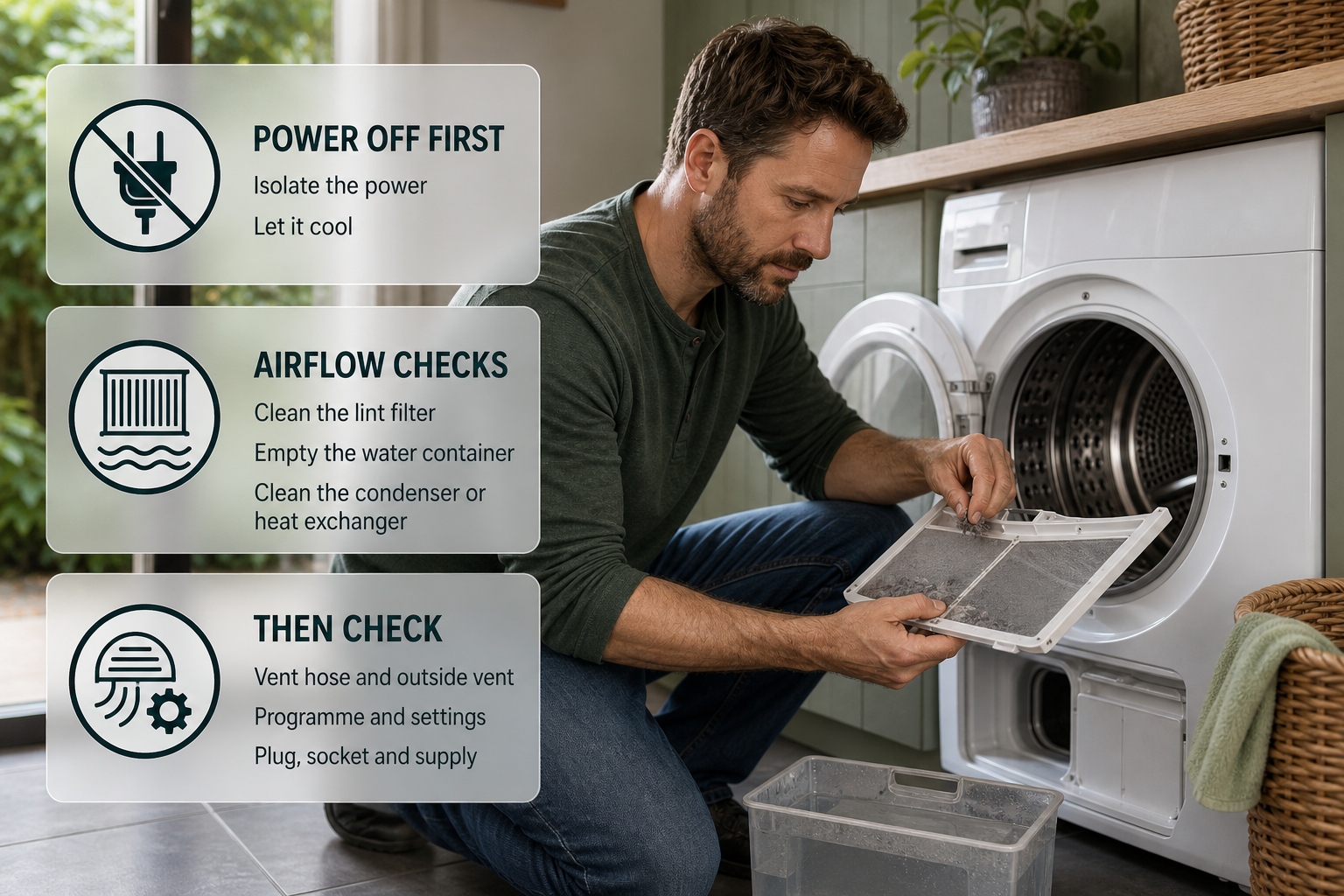
These checks are all done with the power off first. Work from the simplest airflow and setting issues towards anything electrical, and stop as soon as something looks or smells wrong.
Isolate the power and let it cool. Switch the machine off at the socket or fused spur and pull the plug if it is accessible. Let the dryer cool completely before opening anything, because internal surfaces and ducting can stay hot for a long time after a cycle. A pair of gloves is worth wearing, and a dust mask and eye protection are sensible when clearing lint from a vent or condenser, since old lint is fine, dusty and irritating.
Clean the lint filter. Remove the filter and brush the mesh clean. If it is coated with a grey film of fabric softener residue, wash it in warm soapy water, rinse it and let it dry completely before refitting — a damp or clogged filter restricts airflow badly. On most dryers the filter sits in the door opening, but some models have a second filter near the base that is easy to overlook.
Empty the water container. On condenser and heat pump dryers, lift out the container and empty it. If the dryer is plumbed to drain instead, check that the drain hose is not kinked, crushed behind the machine or blocked, and that the spout is seated properly.
Clean the condenser or heat exchanger. Follow the machine's own instructions to release and withdraw the condenser block, rinse it under warm running water until the water runs clear, shake off the excess and leave it to dry fully before refitting. It must sit square in its housing, or air will bypass it. Heat pump models usually have a removable cover with a filter in front of the heat exchanger that needs the same treatment.
Check the vent hose and the outside vent. On a vented dryer, disconnect the hose at the back and look through it for packed lint, kinks or crushing where the machine has been pushed back against the wall. Then go outside and confirm that the wall vent or window kit flap opens freely and is not blocked by lint or nesting material. A long, sagging or badly routed hose holds moisture and heat back into the machine.
Check the programme and settings. Confirm the dryer is on a heated programme rather than a cool tumble, air-dry or freshen-up setting, and that the heat setting has not been switched to low or delicate. Sensor programmes decide when to stop by reading moisture, using metal sensing bars inside the drum; if those bars are coated with softener residue, the dryer can think a wet load is dry and shut down early. Wiping the bars with a damp cloth is part of routine care.
Check the plug, socket and supply. With the machine unplugged, look at the plug and socket for discolouration, heat marks, a loose fit or a damaged cable. In Ireland a dryer plugged into a socket usually relies on a fuse in the plug, while many dryers are wired into a fused spur instead. A blown fuse or a tripped breaker normally means no power at all, not just no heat. If the breaker or RCD trips again as soon as the dryer is switched on, leave it alone and treat that as an electrical fault.
Try a basic reset. With the dryer isolated at the socket or spur, unplug it, wait a few minutes, then restore the power and start a short heated programme. If the machine cut out partway through a cycle, it may need a long, completely cool period before an internal safety cut-out will reset itself. A reset is a diagnostic step, not a fix: if the dryer goes cold again or trips the supply, stop switching it back on and arrange a repair.
Look for visible damage. A quick torch-check of the door seal, the drum, the cable and the vent connection will show up cracked seals, scorching, loose terminals or a door that no longer latches. Anything burnt, melted or loose ends the DIY stage of the investigation.
What the Symptoms Point To
The pattern of the fault narrows down where the problem sits, which is useful information to pass on when arranging a repair.
| Symptom | What it usually points to | Who should deal with it |
|---|---|---|
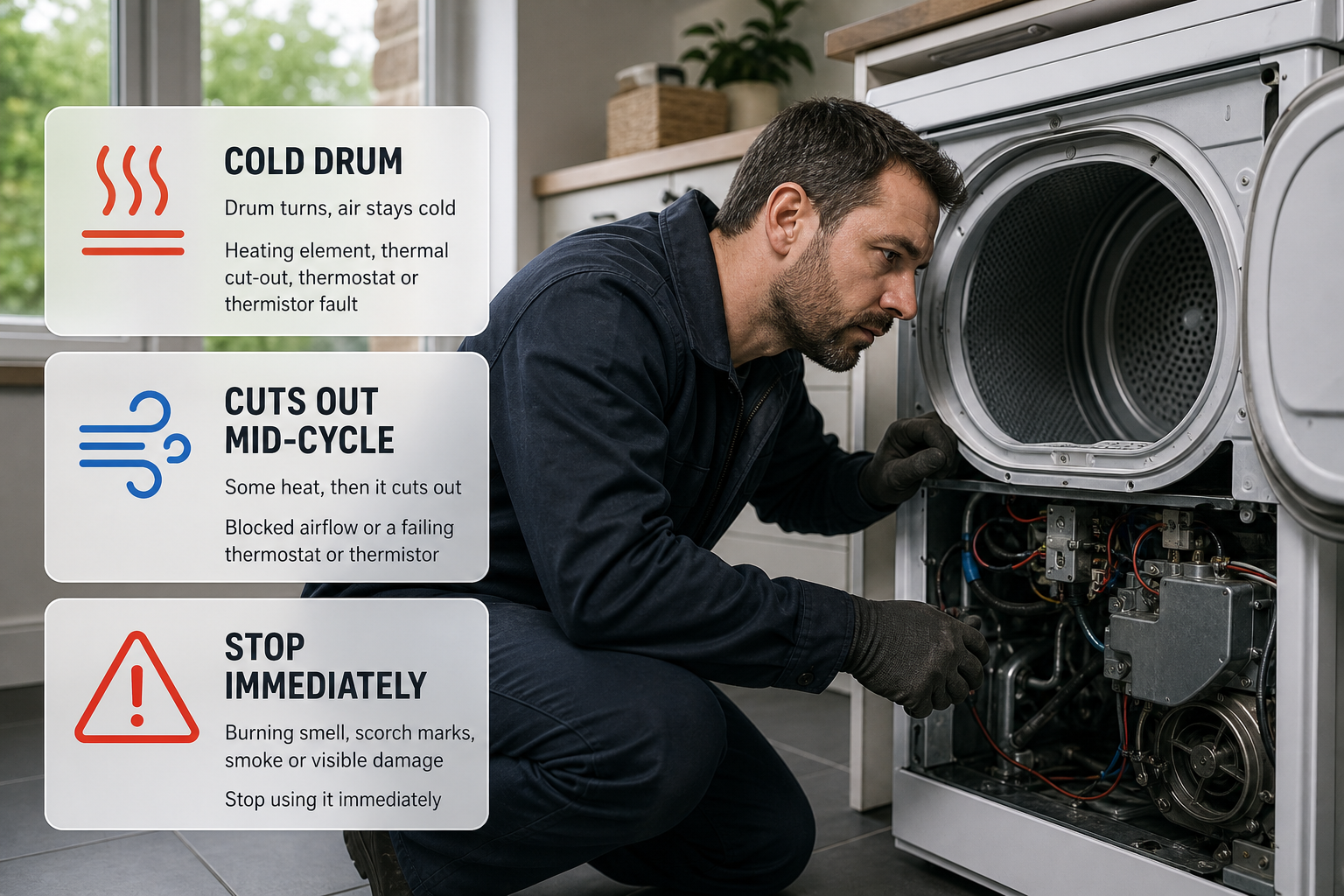
| Drum turns, air stays cold on every heated programme | Heating element, thermal cut-out, thermostat or thermistor fault | Appliance repair technician |
| Some heat, then it cuts out mid-cycle | Overheating cut-out triggered by blocked airflow, or a failing thermostat or thermistor | Check filter, condenser and vent first, then a technician |
| Drum turns, heat only appears on certain programmes | Programme or heat setting, or a control board fault | Homeowner settings check, then a technician |
| Drum does not turn and there is no heat | Belt, door switch, motor or supply problem | Appliance repair technician |
| Clothes come out warm but still wet, cycle ends early | Coated moisture sensing bars, blocked airflow or a sensor fault | Clean as above, then a technician |
| Dryer completely dead | Plug fuse, fused spur, breaker or cable | Registered electrician for the fixed wiring |
| Breaker or RCD trips when the dryer starts | Insulation, element or wiring fault | Registered electrician |
| Burning smell, scorch marks, smoke or visible damage | Serious overheating or electrical fault | Stop using it immediately |
When to Stop Using the Dryer Immediately
Some symptoms should end the troubleshooting straight away. A burning or hot plastic smell, scorch marks around the door, drum, plug or vent, smoke of any kind, damaged or brittle wiring, a plug or spur that feels hot to the touch, or a supply that trips every time the machine is switched on all mean the dryer must stay switched off and unplugged until a qualified professional has inspected it.
Repeated tripping is a warning rather than an inconvenience. Resetting the breaker over and over, fitting a higher-rated fuse, taping over a damaged cable or wedging a door switch closed to force the machine to run all remove a safety device that exists for a reason. A dryer that keeps triggering its own overheating cut-out is also a fire risk, because the cut-out is the last line of defence against lint and ducting reaching ignition temperature.