Most fridges that stop cooling do so for one of a handful of reasons: a control or thermostat setting that has drifted, warm air leaking past a worn door seal, a dust-clogged condenser, poor airflow inside the cabinet, or a failed fan, defrost circuit or compressor. Irish homeowners can safely rule out the first four before paying for any callout, and if the checks below do not bring the temperature down, a local household appliance repair service is the next step. A fridge should run at 5°C or below, and the only reliable way to know it is holding that temperature is a fridge thermometer rather than the dial.
Safe first checks: switch off, then work through the fridge
Electrical safety comes first. Unplug the appliance at the wall socket rather than pulling on the cable, and leave it disconnected while the back or base is cleaned. If the plug, socket or flex is hot, scorched, wet or smells of burning, leave everything switched off and arrange professional help. A fridge is best plugged directly into a wall socket rather than an extension lead, which can overheat under a steady load. Where a fuse or circuit breaker has tripped, reset it once; if it trips again as soon as the fridge is connected, stop and treat it as an electrical fault.
With the appliance unplugged and safe to handle, work through these in order:
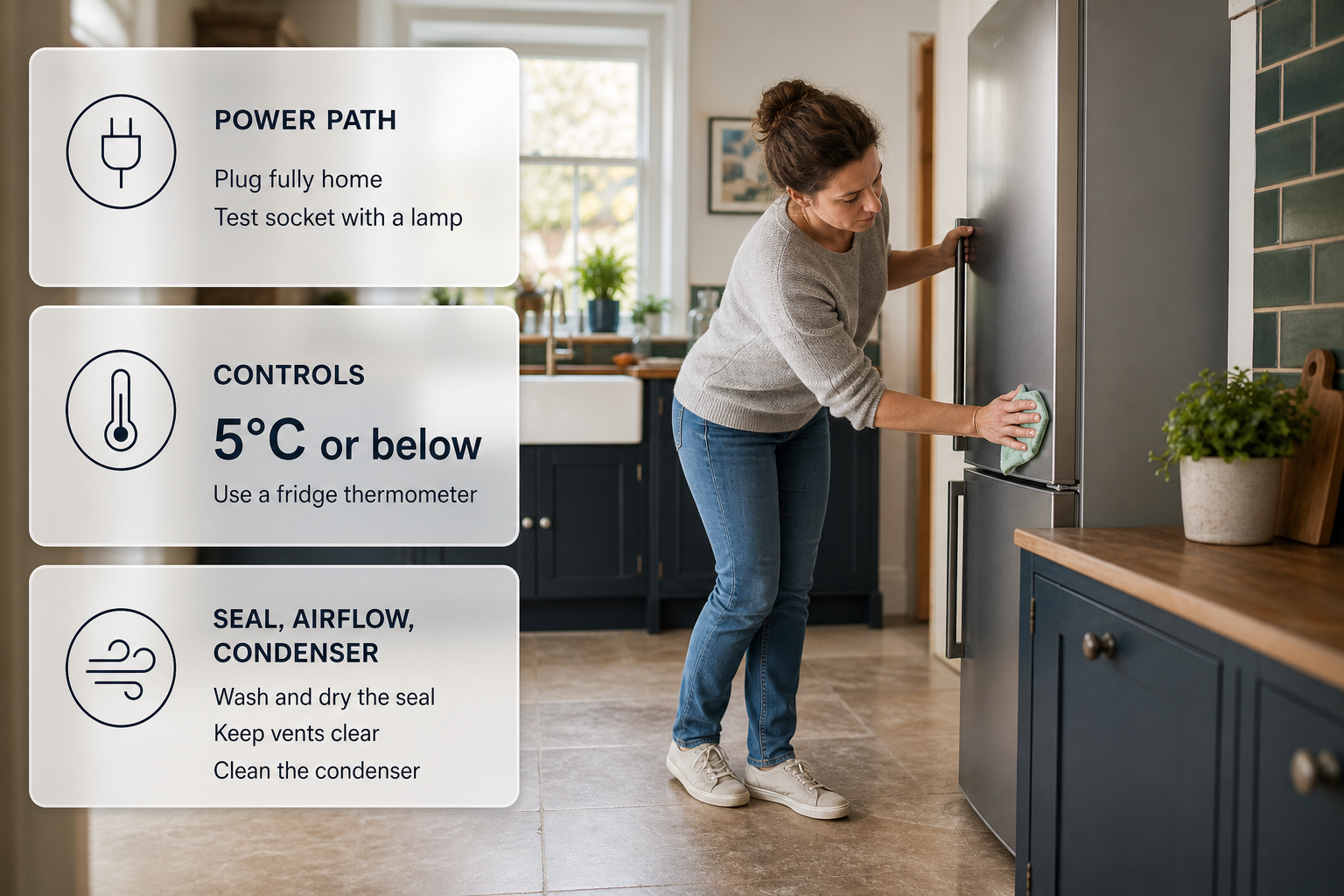
- Check the power path. Make sure the plug is fully home and test the socket with a lamp. A fridge on a switched socket that has been turned off will sit silent, and a power cut during a winter storm can leave a control panel needing a reset.
- Check the controls. Look for a dial knocked to a warm setting, a holiday or eco mode, a child lock or a digital display that has been changed. Put a fridge thermometer on a middle shelf, close the door and leave it for several hours or overnight.
- Inspect the door seal. Feel around the gasket for splits and grit, then close the door on a sheet of paper and pull gently: if it slides out with no resistance, the seal is not gripping. Wash the gasket with warm water and a little washing-up liquid, work into the folds with a soft cloth, rinse and dry it fully before closing the door, and check that nothing is holding the door ajar.
- Clear the airflow inside. Leave a gap between food and the rear wall, keep the vents clear, and do not pack the fridge so tightly that air cannot move. A few spare bottles of water help it hold temperature when it is nearly empty.
- Clean the condenser. With the fridge unplugged and pulled forward by two people, brush or vacuum the coils at the back or the grille at the base, depending on the model. Wear gloves and eye protection, and a dust mask if the area is thick with dust. Use a soft brush and a vacuum with a brush attachment; never put water on the coils or a sharp tool near the fins. Vacuum the floor behind, then push the appliance back leaving a few centimetres of clearance.
- Let it settle. Plug it back in, close the door and leave it for several hours, ideally overnight, without opening it. Then read the thermometer; if it is still above 5°C with the door shut, cleaning and adjustment will not fix it.
Position matters too. A fridge beside a cooker, radiator or boiler, or in direct sun, works harder, and one in a very cold shed or garage can behave oddly.
Why a fridge stops cooling
| What the fridge is doing | Likely cause | What a homeowner can do |
|---|---|---|
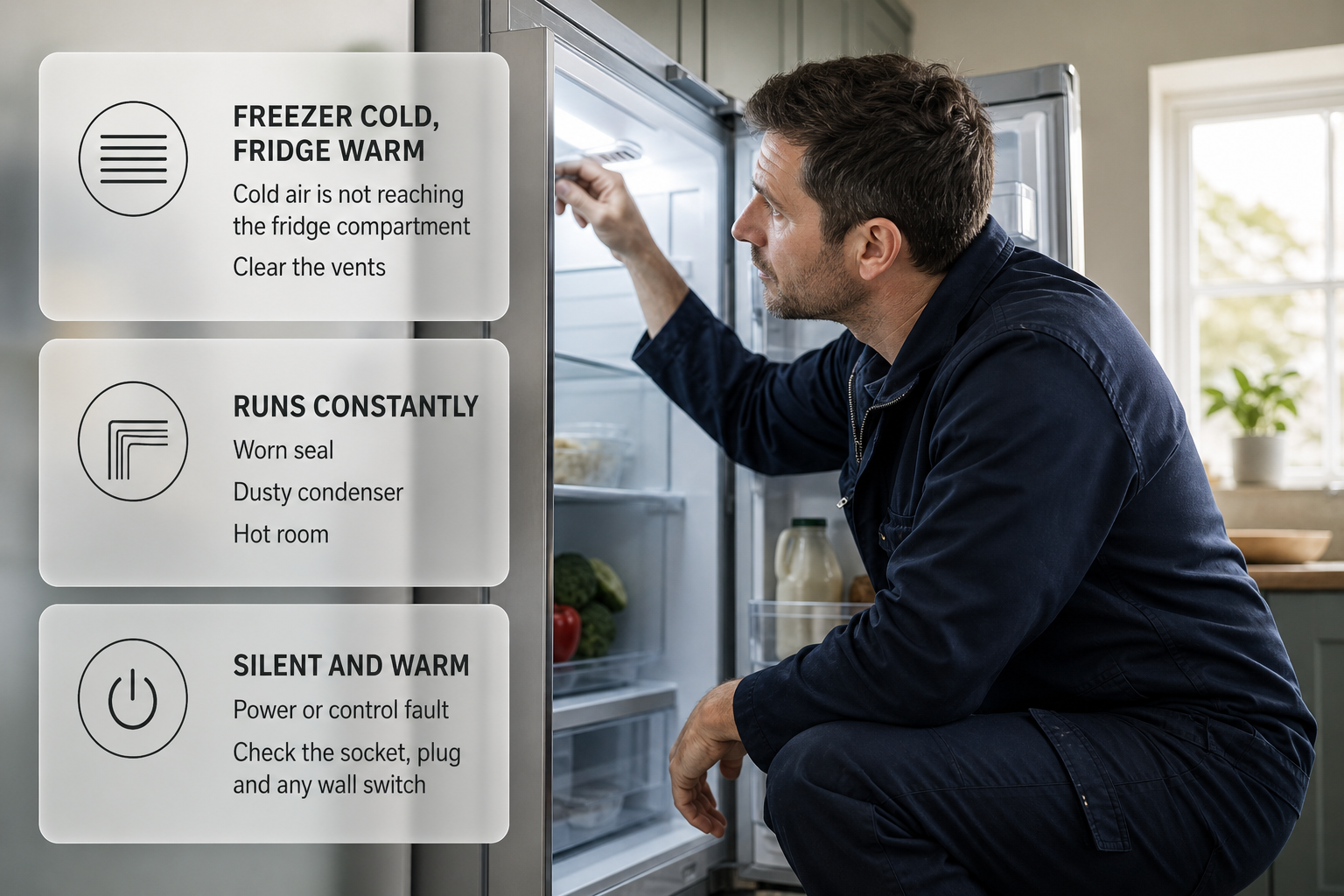
| Fridge warm, freezer cold | Cold air is not reaching the fridge compartment | Clear the vents, then book a repair if it persists |
| Fridge and freezer both warm | Thermostat, control, defrost circuit or compressor | Check the plug, socket and controls, then book a repair |
| Runs constantly and never cuts out | Worn seal, dusty condenser or a hot room | Clean the coils, wash and dry the seal |
| Cold at the back, warm at the front | Blocked vents or overloading | Leave space behind and between items |
| Ice on the rear panel that returns quickly | Defrost system fault | Defrost once, then book a repair if it comes back |
| Silent and warm | Power or control fault | Check the socket, plug and any wall switch |
Behind those symptoms sit a small number of parts. A door seal that has hardened lets warm air in all day, and dust on the condenser stops the appliance shedding heat, so both are worth tackling first because they cost nothing but time. The thermostat, evaporator fan, defrost heater and timer, and the compressor are all inside the cabinet or behind it, and none of them is a homeowner job. Work on the sealed refrigeration circuit, including a regas or a compressor change, has to be carried out by a qualified refrigeration technician; it cannot be done with tools from a kitchen drawer.
When the freezer still works but the fridge is warm
Many Irish homes run a fridge freezer with one compressor and one thermostat, and in that design the fridge compartment is cooled by air drawn from the freezer. A failed evaporator fan, an air channel that has iced over or a damper that has stuck therefore shows up as a fridge that will not cool while the freezer keeps working perfectly. Two checks are worth doing: open the fridge door and listen for the fan, and look at the rear wall of the fridge for a block of ice or a panel that is cold only in one corner. Never chip at ice with a knife or screwdriver, because the evaporator behind the panel is easy to puncture. If the vents are clear and the cabinet is still warm after a full overnight run, a technician working through appliance and device repair can test the fan, the defrost circuit and the damper.
Chilled food safety while the fridge is warm
Food safety is the reason not to put off a cooling fault. A fridge should sit at 5°C or below, and once it drifts above that, time is running on anything perishable. No single time limit applies in every kitchen, because it depends on how warm the cabinet has become, how long it has been that way and how often the door has been opened, so judge items individually rather than by the clock. Keep the door shut while waiting for a repair, move what can be moved into a working fridge or an insulated bag with ice packs, and treat anything that is warm to the touch as spoiled. Milk and dairy, cooked leftovers, cooked meats, prepared salads, cut fruit and soft cheeses that have sat in a warm cabinet should be discarded, along with any frozen food that has thawed and warmed through. When there is any doubt about an item, throw it out, because the cost of replacing food is far lower than the risk of food poisoning. Where the safety of a particular product is unclear, the Food Safety Authority of Ireland publishes guidance that is worth checking before eating it.