Appliance Repair Call Out Fee in Ireland: A Homeowner Guide
What an appliance repair call-out fee covers, when it is refunded or taken off the bill, and how to judge whether a repair quote is worth accepting.
/8 min read
An appliance repair call-out fee is the charge a repairer makes for travelling to a home, examining an appliance and identifying the fault, and it is normally payable whether or not the repair then goes ahead. Irish repairers do not publish standard tariffs, so the figures here are an aggregate Irish market estimate: a call-out with diagnosis typically falls between €50 and €90, while a complete repair — call-out, the first hour of labour and one common part — usually comes to between €110 and €270. Anyone comparing quotes for household appliance repair should read both numbers as market estimates rather than fixed prices, because the same fault can be quoted very differently from one repairer to the next.
What the call-out fee includes and what it does not
The fee is fundamentally an attendance charge: travel to the address, time on site during that first visit, basic testing with meters and hand tools, and the diagnosis that produces a quote. Many repairers also build a fixed slice of labour into it, commonly the first half hour, and then bill any further work in half-hour blocks. Some absorb the whole visit into a fixed repair price instead.
Excluded items are where quotes diverge most, and they are worth pinning down before booking:
parts, from a modest door seal up to a heating element, drain pump or control board
labour after the first visit, charged in half-hour blocks
evening, weekend and bank holiday attendance
parking or congestion charges in city centres
a return visit if a part has to be ordered in
disconnection or disposal of the old appliance where it is being replaced
Everything below is an aggregate Irish market estimate.
Line item
Typical range
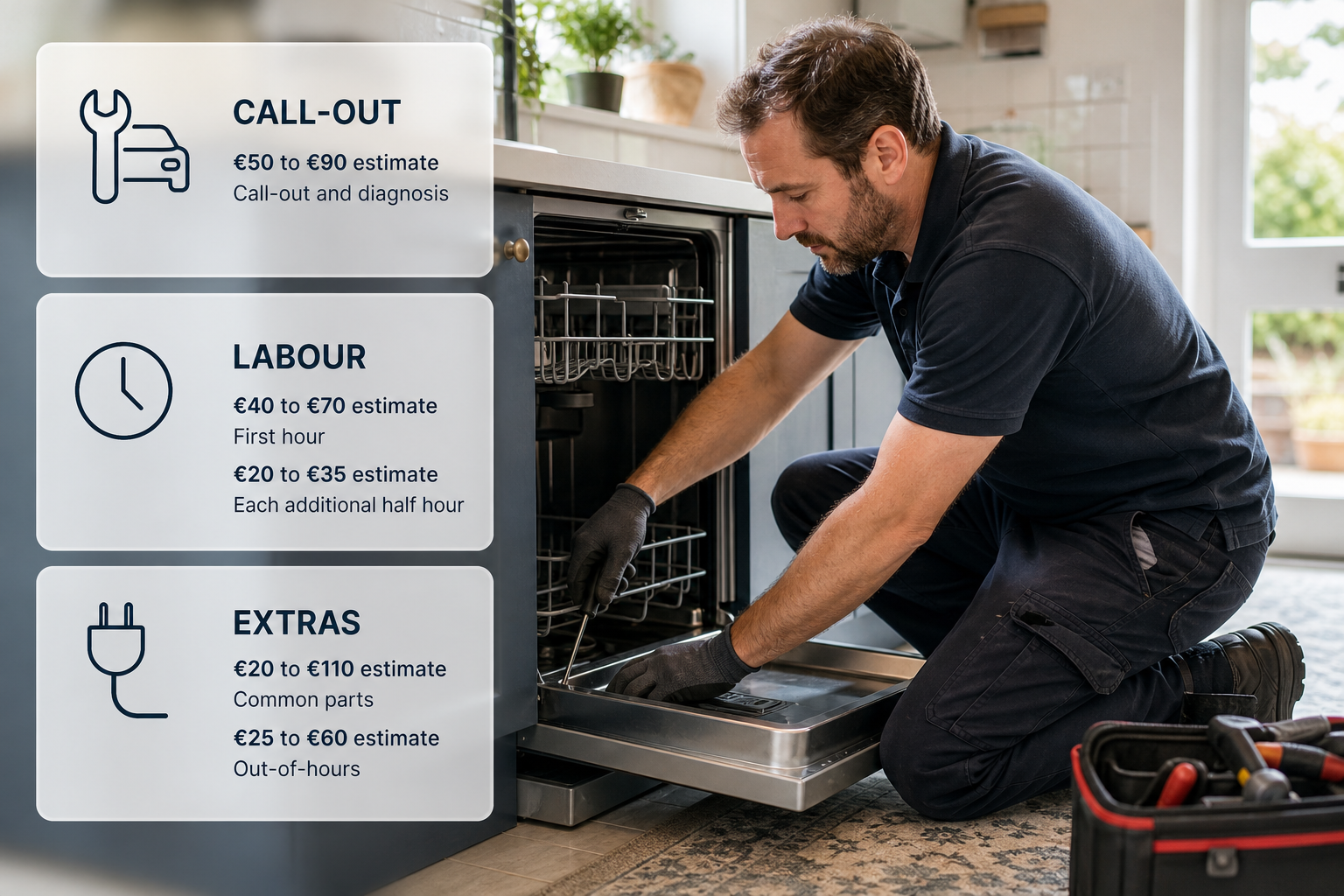
Call-out and diagnosis (first visit)
€50 to €90
First hour of labour, where it is not inside the call-out
€40 to €70
Each additional half hour of labour
€20 to €35
Common parts, such as element, pump, thermostat or door seal
€20 to €110
Out-of-hours, weekend or bank holiday attendance
€25 to €60
The call-out line, the first-hour labour line and the common parts line are the three that add up to the €110 to €270 headline repair range, so a homeowner can see exactly where a total comes from. A worked example: a washing machine with a leaking door gets a €70 call-out, €50 for the first hour and a €35 door seal, making €155 — inside the range, and typical of a job that finishes on the first visit. The per-half-hour and out-of-hours lines sit on top of that when they apply.
Is the call-out fee deducted from the repair bill?
Sometimes it is, sometimes it is not, and the difference is worth the full fee. Many Irish repairers absorb the call-out into the final invoice when they carry out the repair, so the household effectively pays it once. Others treat it as a separate attendance charge that is added on top of the repair price. Neither approach is wrong, but on a €50 to €90 fee the gap matters, so it should be agreed before the visit — a text or email confirming the position is enough to avoid an argument later.
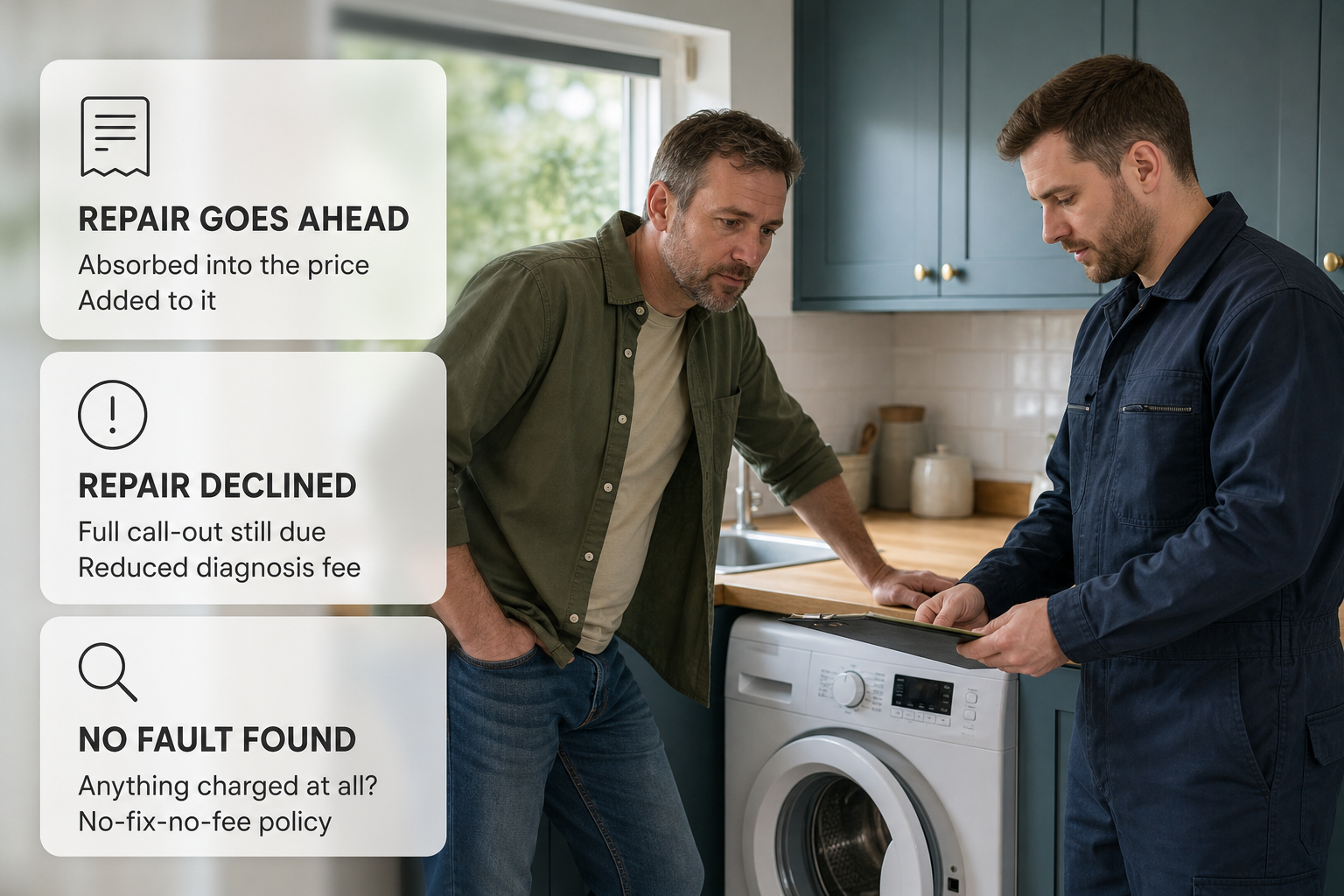
Three outcomes are worth asking about in advance:
the repair goes ahead — is the call-out absorbed into the price, or added to it?
a fault is found but the repair is declined or uneconomic — is the full call-out still due, or a reduced diagnosis fee?
no fault is found — is anything charged at all?
No fault found is more common than homeowners expect. A machine can behave perfectly on the day because the fault is intermittent, because a filter was blocked, because a door was not latched properly or because a trip switch had already reset itself. In those cases the visit still happened and the call-out is normally payable, unless the repairer has advertised a no-fix-no-fee policy. A refund is rarely automatic, so a homeowner who wants the fee back if nothing is found needs that promise made before the appointment, not after it. Simple checks worth doing first are in fridge not cooling and tumble dryer not heating.
Pricing models: fixed price, labour plus parts, no-fix-no-fee
Fixed-price repair. One figure covers the visit, the labour and the part, and it is the easiest quote to compare. Ask what happens if a second fault appears once the appliance is open, and whether the price holds if the replacement part turns out to be dearer than expected.
Labour plus parts. The call-out is charged, then labour by the hour or half hour, then parts. It is the cheapest route for a five-minute fix and the dearest when a fault is hard to trace. Ask for the hourly rate, the minimum charge, the block size, and whether parts are billed at cost or with a mark-up built in.
No-fix-no-fee. Nothing is charged when the appliance genuinely cannot be repaired, which is most attractive on older machines where parts may already be obsolete. Even here, a diagnosis charge often still applies when the fault is found and the household decides not to go ahead, so the phrase should never be taken as a blanket promise of a free visit.
How to compare two call-out quotes properly
Put both quotes side by side on the same lines: call-out and diagnosis; how much labour the call-out already covers; the rate for extra labour; how parts are priced and whether they are in stock; parking or travel charges; whether VAT is included; and whether the repair itself carries any guarantee. A quote that looks €20 cheaper on the call-out can easily cost €60 more once a second half hour and a marked-up part are added.
Give the repairer the make, model and serial number, and describe the symptom precisely — noise on spin, water not draining, an oven heating unevenly. A repairer who knows the model can often quote a fixed price in advance instead of an open-ended hourly rate, which removes most of the uncertainty about the final bill. Where several appliances are involved, or where the fault is unclear, a single visit covering more than one machine is usually better value than two separate call-outs, so it is worth asking whether a second appliance can be looked at in the same appointment.
Homeowners still deciding which trade to approach can browse the wider appliance and device repair category to see how this work sits alongside other small-repair jobs.
Getting the most out of the first visit
A little preparation makes the attendance fee go further. Clear the floor around the appliance, empty the drum or the oven, and make sure the water shut-off valve and the plug socket are reachable. Write down the model and serial number, note when the fault appears — on fill, on spin, on heat-up — and mention any recent power cut, move or plumbing work.
Built-in appliances are slower to access than freestanding ones, and a repairer who knows a unit is integrated can allow for the extra time when quoting. If a second fault is discovered while the appliance is open, ask for the additional cost to be confirmed before any further work starts, so the final bill never comes as a surprise.
Repair or replace: age, parts and value
Age and parts cost decide whether a repair is worth doing. Older appliances tend to need dearer or harder-to-source parts, take longer to diagnose, and carry a higher chance of a second failure within a year or two. When a €110 part and a €90 call-out land on a machine that has already been repaired once, the money often makes more sense going towards a replacement. On a newer appliance, by contrast, a modest part plus the call-out is usually far cheaper than buying again, and a repair also keeps a familiar model in the kitchen rather than sending the household back to choosing a new one.
If the appliance is still under warranty or was bought recently, it goes back to the retailer that sold it first, rather than to an independent repairer.
Where the price quoted before the visit and the bill afterwards do not match, or the trader will not say in advance whether the call-out comes off the repair, the household should ask for the breakdown in writing and raise it with the trader first. Complaints about unclear pricing in Ireland sit with the public consumer protection body, and a homeowner who cannot get a straight answer should confirm the position with it before deciding what to do next.
Booking a repair through ShamFix
Homeowners can post a job on ShamFix describing the appliance and the fault, and local tradespeople respond with their own terms. Posting a job and listing on ShamFix is free, there is no commission, and a subscription is planned for the future. ShamFix does not check or certify tradespeople, and profiles are filled in by tradespeople themselves, so homeowners should check registrations themselves and read reviews before booking anyone.
FAQ
Does the call-out fee include the replacement part?
No. The call-out covers attendance and diagnosis, while the part is billed separately unless a fixed-price repair was agreed in advance. Ask whether the part is carried on the van or has to be ordered, because an ordered part usually means a second visit — and sometimes a second attendance charge. It is also reasonable to ask for the old part back once the new one is fitted.
What happens if the appliance starts working again before the repairer arrives?
Cancel as early as possible, because a visit cancelled at the doorstep is often charged in full, since the repairer has already lost the slot. A call the evening before normally avoids any charge and frees the appointment for someone else. If the fault was intermittent, it is still worth mentioning exactly when it last happened, so the repairer can decide whether a visit is worthwhile at all.
Is a weekday morning cheaper than a weekend appointment?
Usually yes. Out-of-hours, evening and weekend attendance typically adds €25 to €60 on top of a normal call-out, and weekday slots also make it easier to collect a part from a supplier the same day. Booking early in the day means the repairer is less likely to arrive behind schedule, and it leaves room for a second visit if a part has to be ordered.
Should the call-out fee be paid before the visit?
No. The fee is normally paid after the visit, once the diagnosis has been explained and the repair quoted. A request for payment by transfer before anyone has seen the appliance is unusual and worth querying, as is any figure that is quoted without knowing the make and model. Getting the call-out, the labour rate and the parts approach in a message beforehand makes the final invoice much easier to check.
Work through safe checks — filter, vent, condenser, settings, power and reset — then book appliance repair or, for fixed wiring faults, an electrician.