Fitted Wardrobe Cost in Ireland: A Homeowner's Guide
Made-to-measure fitted wardrobes in Ireland typically cost €2,310 to €10,340 fitted; see what drives the price and how to compare quotes.
/9 min read
In Ireland, an aggregate Irish market estimate for a made-to-measure fitted wardrobe is €2,310 to €10,340 supplied and fitted, and many standard bedroom runs fall within the middle of that band. The figure moves with the width of the run, hinged or sliding doors, how many drawers and rails go inside, the board and finish chosen, and whether the work is a simple alcove, a full wall or a sloped-ceiling space. The fairest way to judge any quote is a written breakdown of design, carcass and doors, internals, installation, removal and VAT, compared line by line.
What a fitted wardrobe quote usually includes
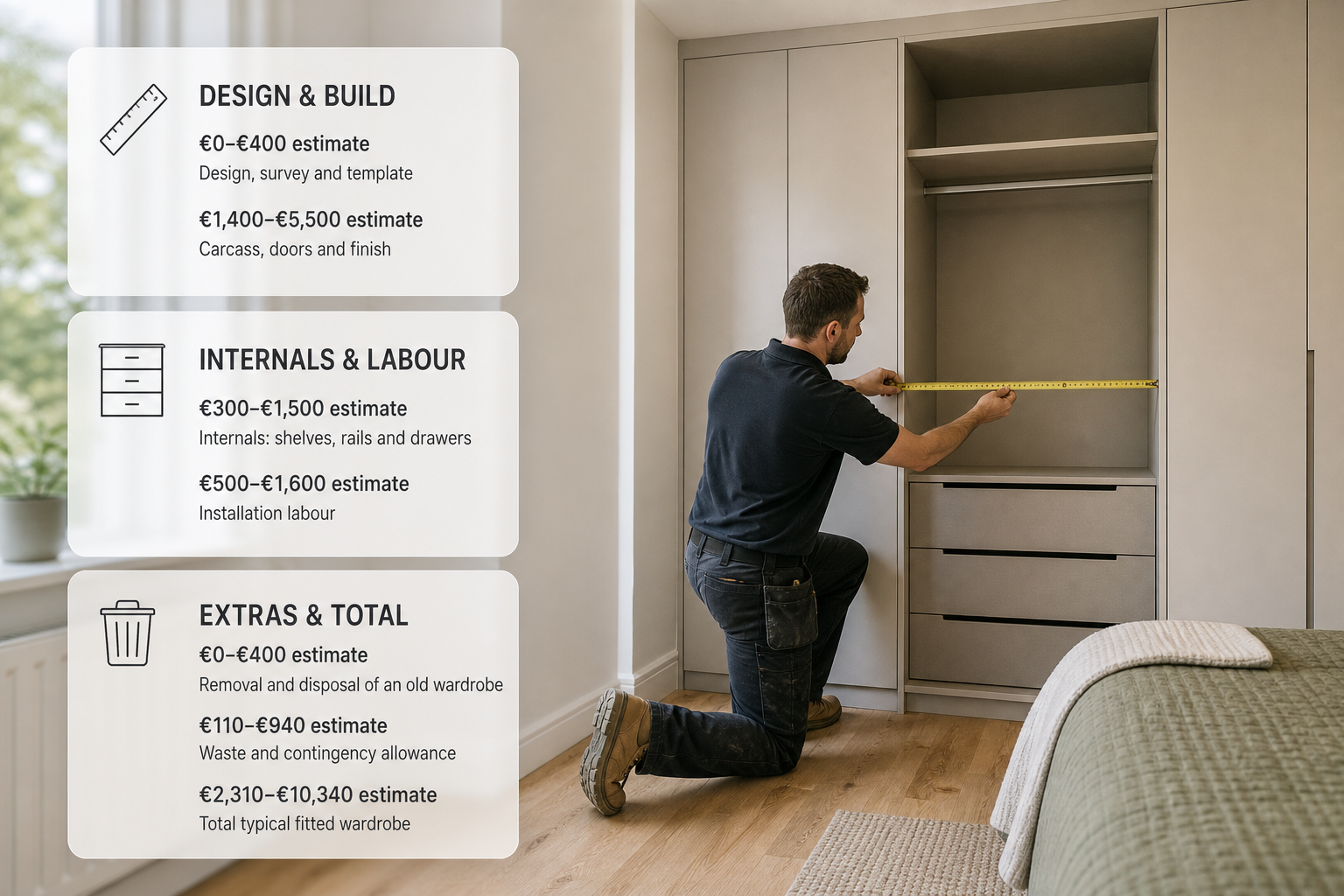
Most installers split a fitted wardrobe quote into design, carcass and doors, internal fit-out, installation, removal and a contingency allowance. The table below is an aggregate Irish market estimate for a typical made-to-measure unit in an Irish home; a local carpentry service can price the same lines for a specific room.
Line item
Typical range
Design, survey and template
€0–€400
Carcass, doors and finish
€1,400–€5,500
Internals: shelves, rails and drawers
€300–€1,500
Installation labour
€500–€1,600
Removal and disposal of an old wardrobe
€0–€400
Waste and contingency allowance
€110–€940
Total typical fitted wardrobe
€2,310–€10,340
Taken together, those line items produce the headline range: the bottom of it reflects a simple alcove job with standard doors, a rail and a shelf, while the top reflects a wide wall-to-wall build with drawer banks, pull-outs, a painted or veneered finish and awkward access. A quote that leaves out removal, contingency or VAT is not comparable with one that includes them.
Cost by size and room shape
All figures in this section are an aggregate Irish market estimate.
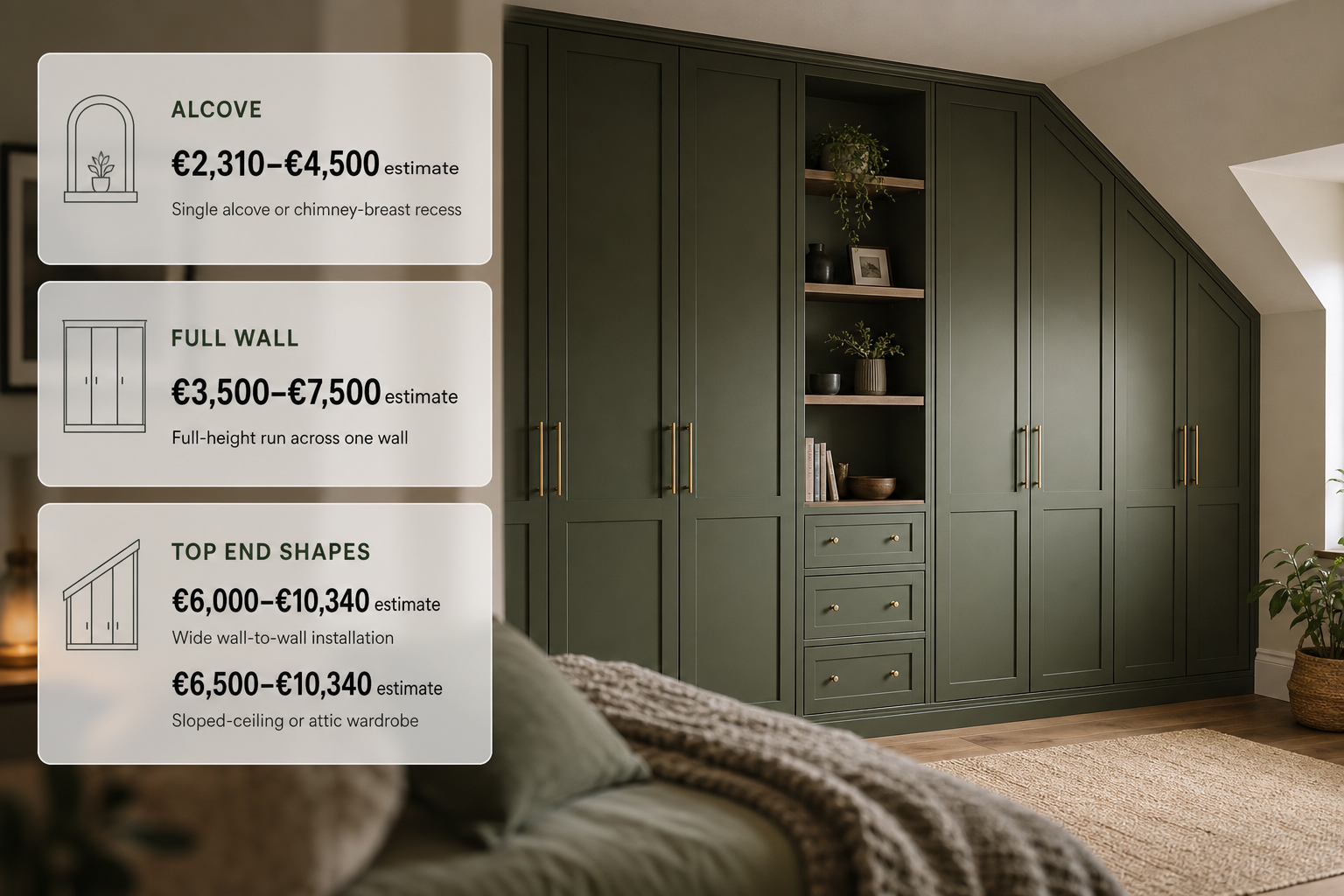
A single alcove or chimney-breast recess with two hinged doors and a simple rail-and-shelf interior: €2,310–€4,500.
A full-height run across one wall with sliding doors, a drawer bank and a mix of shelving: €3,500–€7,500.
A wide wall-to-wall installation with several sections, extra drawers and a painted finish: €6,000–€10,340.
A sloped-ceiling or attic wardrobe with angled fillers and reduced headroom: €6,500–€10,340.
Width generally matters more than height, because it decides the number of doors, hinges and internal dividers and therefore how much board and hardware is used. Height starts to add cost when the top has to be scribed to a sloped ceiling, when doors have to be extended, or when a plinth has to be built. Alcove work usually sits at the lower end because the existing walls do part of the enclosing. A true wall-to-wall run needs more panels, doors and dividers, and sloped ceilings and attic spaces sit at the top of the range because almost every panel may need an angled cut and a filler piece.
How door style, internals and materials move the price
These are aggregate Irish market estimate ranges, using the same lines as the table above.
Door style is one of the clearest drivers. Hinged doors usually sit at the lower end of the carcass, doors and finish line, €1,400–€5,500, while sliding doors, mirrored fronts and handleless systems sit at the upper end. Sliding doors need a track and often a deeper carcass, so the extra shows up in both the door line and the installation labour line, €500–€1,600. Tall doors, wide doors and doors with a painted finish also tend to need more careful hanging and adjustment on site.
Internal layout drives the internals line, €300–€1,500. A single rail with a shelf above sits at the bottom. Double rails, drawer banks, pull-out trays, shoe racks, tie racks, integrated lighting and a lockable section push towards the top. More drawers and pull-outs also add installation time, which can move the labour figure upward inside its own range.
Material and finish affect the carcass, doors and finish line, €1,400–€5,500. Melamine-faced board and matt MDF sit near the bottom; painted timber, oak veneer, lacquer, glass inserts and fully bespoke joinery sit near the top. A sprayed or hand-painted finish may also involve a decorator after installation, and that decorating cost is not part of the wardrobe quote.
Extras and hidden costs
The line-item ranges below are the same aggregate Irish market estimate figures used earlier in the table, and they are where most surprises appear after the first visit.
Design changes after templating are the most common extra: altering door sizes, internals or finishes once the design has been signed off can add to the design, survey and template line, €0–€400, particularly if materials have already been ordered. Removing and disposing of an old wardrobe is the €0–€400 line; a straightforward removal is often included, while a heavy unit coming down narrow stairs can push it to the top of that range, and skipping the service removes that cost altogether.
Electrics for internal lighting, a relocated socket or a heated mirror are not part of a joinery quote and should be priced separately by a Safe Electric registered electrical contractor. Painting, filling and decorating around the new unit are also separate unless the installer agrees otherwise in writing. Awkward access, such as narrow stairs, tight turns, a lift-free apartment or a room that has to be cleared, can push installation labour towards the upper end of €500–€1,600. The waste and contingency allowance, €110–€940, covers offcuts, packaging, small site surprises and snagging.
VAT may be included in a fitted wardrobe quote, and the treatment depends on the nature of the supply. Revenue lists a standard VAT rate of 23% and a reduced rate of 13.5% for certain building services and related items Revenue. Revenue's two-thirds rule provides that where the cost of the goods used in a service exceeds two-thirds of the total price, the goods rate applies to the entire transaction Revenue. Homeowners should therefore ask whether a written quote includes VAT and at what rate, rather than assuming two quotes are comparable at face value.
How to compare fitted wardrobe quotes
Like-for-like comparison is the only reliable way to judge fitted wardrobe cost. Each provider should give a written breakdown that mirrors the table: design, carcass and doors, internals, installation, removal, contingency and VAT. The parent construction and home renovation category covers the wider trades that come into play when a wardrobe is part of a bigger bedroom, attic or renovation project, and it is worth checking that any structural or electrical element sits with the right trade.
Check whether the quote includes templating, delivery, ceiling and skirting scribing, door adjustment, filler and silicone, and removal of packaging. Ask what happens if a wall is out of square, if the ceiling slopes more than expected, or if a door or drawer has to be remade; those are normal site issues, and the quote should say who pays. Compare the number of doors, the type of hinges and runners, the drawer count, the finish and the length of the warranty. Avoid setting a quote that excludes VAT against one that includes it, and ask for the validity period, the deposit amount and the payment schedule in writing, because a provider who will not put the breakdown in writing is hard to compare fairly.
Practical ways to keep the cost down
The figures below are the same aggregate Irish market estimate ranges used in the table.
Choose a run that follows the shape of the room rather than paying for a fully bespoke outline; hinged doors instead of sliding; a rail-and-shelf interior instead of several drawer banks; and melamine-faced board or matt MDF instead of painted timber or lacquer. Clearing the room and removing the old unit before the fitter arrives takes the removal and disposal line, €0–€400, out of the quote and keeps access time at the lower end of the installation line, €500–€1,600. Finalising the design before templating protects the design, survey and template line, €0–€400, which is the easiest line to inflate by accident.
If internal lighting is wanted, ask the electrician for a separate price so it does not disappear inside the joinery figure. One wide wall-to-wall unit is usually better value per metre than several small alcove units, because design, delivery and installation are spread across more storage. The top of the range exists for a reason: multiple angles, premium finishes and heavy drawer use all cost more, and paying for them in a room that does not need them is the simplest way to overspend.
FAQ
Is a freestanding wardrobe cheaper than a fitted one?
Upfront, a freestanding unit normally costs less than a made-to-measure fit, but the comparison is not straightforward. A fitted run uses the full height and width and closes off awkward corners, so it often replaces two pieces of freestanding furniture in the same room. In a short-term rental or a bedroom that may be rearranged, freestanding can still win; in a room with a sloped ceiling or an alcove, the fitted option tends to give more usable storage for the money.
Can I buy the carcass myself and pay only for fitting?
Sometimes, and the saving is often smaller than it looks. Online or flat-pack carcasses rarely suit an alcove exactly, so the fitter may have to cut and pack panels, source missing parts or redesign the internals on site, all of which sits inside the installation line in the table. Anyone considering this route should get the installer's written agreement to fit a third-party unit before ordering, and should agree who carries the cost if a panel arrives damaged or in the wrong size.
Does a sloped-ceiling or attic wardrobe always cost more?
Not always, but it usually sits in the upper half of the ranges because of angled cuts, filler panels and the reduced space to work in. A gentle slope that can be closed with a straight top box costs far less than a room with several angles, a low eaves section and a dormer. Asking the provider to separate standard carcass work from angled fitting makes that extra visible instead of burying it in a lump sum.
What should a deposit agreement contain?
It should state the total price, the itemised breakdown, the deposit amount and the payment stages, along with the expected installation window and what happens if measurements change on site. It should also record whether VAT is included, who removes the old unit and how snags are handled after fitting. Keeping a signed copy and holding back a final payment until snagging is finished is normal practice on a job of this size.
Getting quotes from local tradespeople
Once the design and budget are clear, the next step is comparing local quotes on the same written breakdown. Posting a job and listing on ShamFix is free, there is no commission, and a subscription is planned for the future. ShamFix does not check or certify tradespeople, profiles are filled in by tradespeople themselves, so homeowners should check registrations themselves and read reviews. The ShamFix home page is the starting point for posting a fitted wardrobe job and receiving responses from local tradespeople.