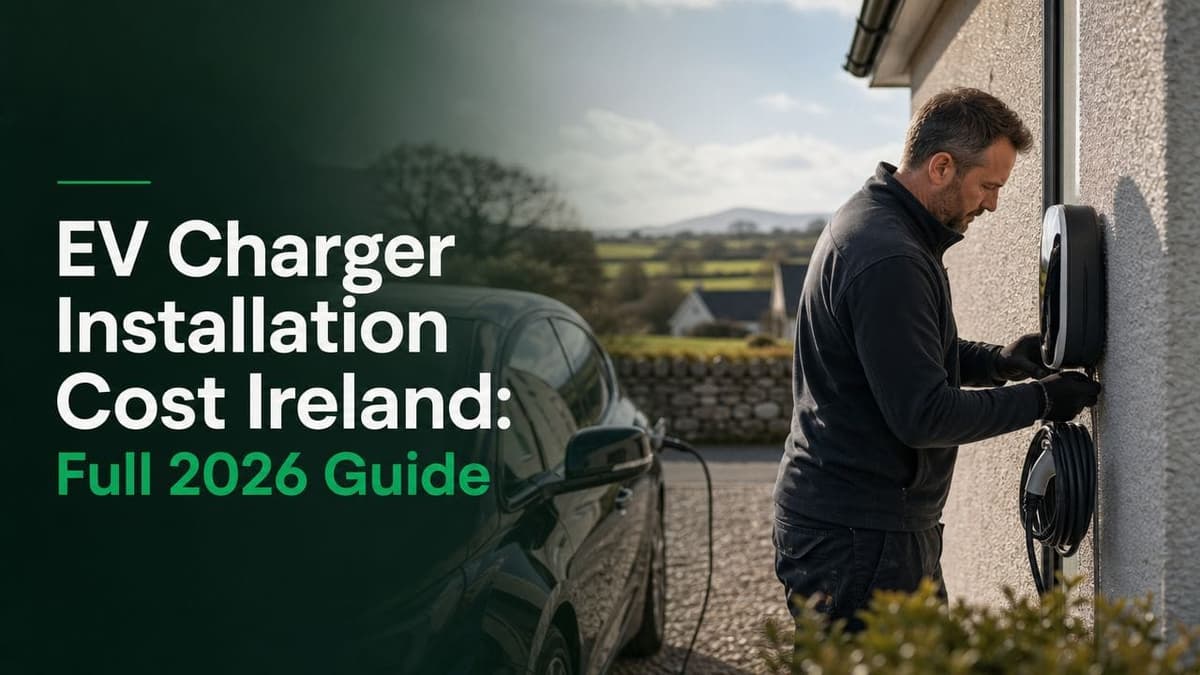
A typical home EV charger and installation in Ireland costs about €1,200 to €1,600 before the SEAI grant, and the SEAI home charger grant is €300. That still leaves a wide spread in the final bill, because the actual price depends on the house, the cable route, and whether the board needs remedial work.
That's the part most homeowners miss. Two houses can need the same charger on paper and still land miles apart in price once an electrician sees the consumer unit, the parking layout, and the earthing arrangement.
What a Home EV Charger Install Actually Involves
A proper home EV charger job has two parts, and the quote should show both. One part is the charger unit itself, usually a wall-mounted 7 kW single-phase unit for a standard Irish house. The other part is the electrical work that feeds it safely from the consumer unit, tests it, and certifies it at the end.
The hardware side
The charger itself can be tethered or untethered. A tethered unit has the cable built in, which is what most homeowners prefer because it's simpler for day-to-day use. A smart charger also includes scheduling and load management features, which matter because the home supply can't be treated like a blank slate.
The hardware price is only one slice of the bill. A tidy-looking charger mounted outside still needs the right internal protection, the right route back to the board, and a safe final test before anyone plugs in an EV.
The electrical side
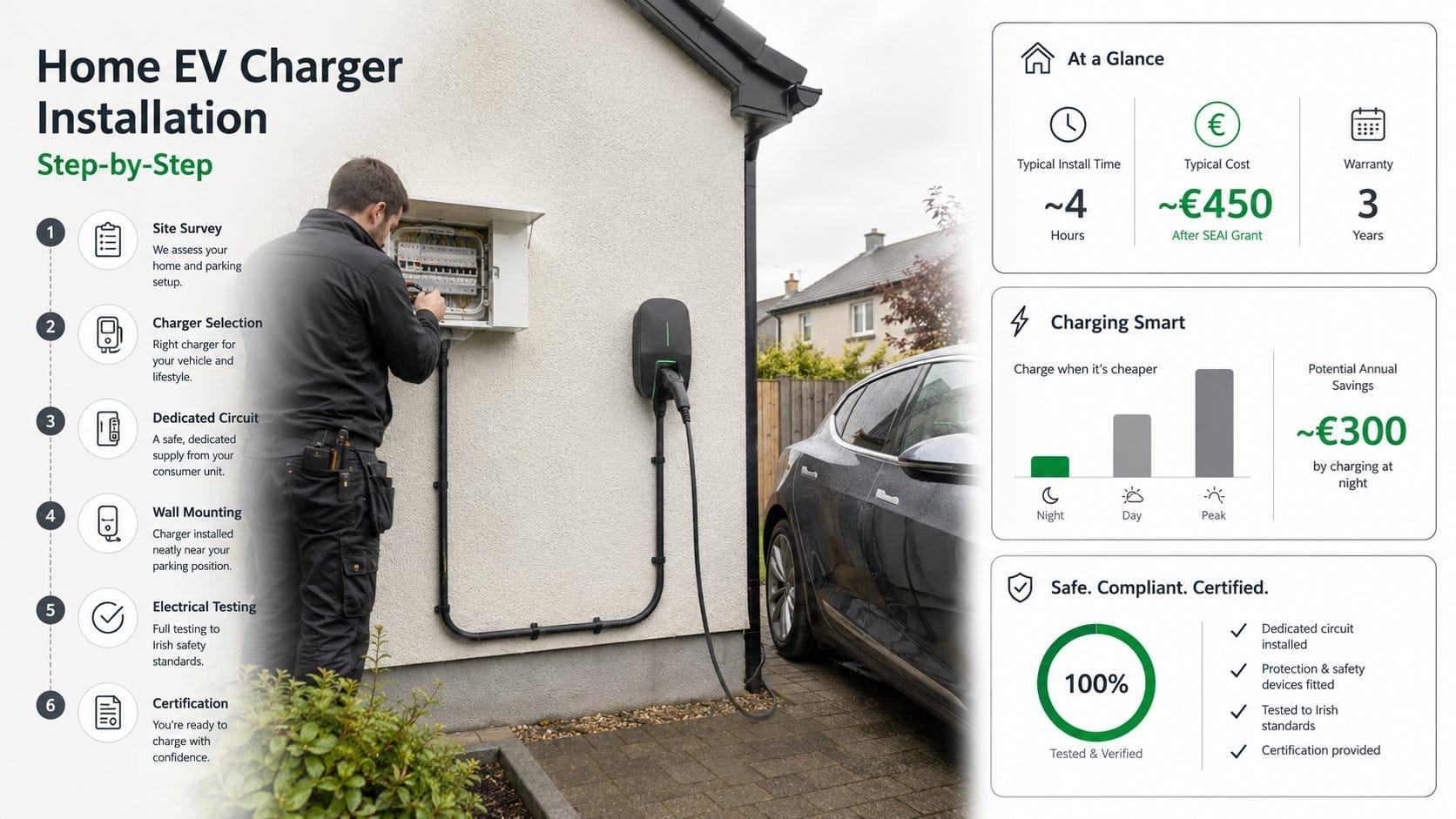
The electrician is not just hanging a box on the wall. The job usually means running a dedicated radial circuit from the consumer unit to the charger, checking earthing, fitting the required protection, and issuing the Safe Electric Completion Certificate when the work is done.
That is why a charger install is not the same as buying a gadget online. The circuit design, the distance from the board, and the safety checks drive the labour and materials cost far more than the box on the wall.
Practical rule: a neat-looking charger quote is only honest if it separates the charger unit, the cable run, and any board work.
Typical Cost Bands Across Ireland
SEAI says a typical home charger and installation in Ireland costs about €1,200 to €1,600 before the grant, and the €300 grant usually leaves a practical post-grant cost of roughly €900 to €1,300 if the full grant applies. That's the cleanest benchmark for a straightforward house install, not a luxury job and not a bodged bargain. The SEAI home charger page sets that broad market reference clearly, and its grant page confirms the cap is €300 and that it covers eligible installation costs, including charger and installation charges, up to that limit. SEAI EV charging guidance, SEAI home charger grant
A lot of Irish pricing guides are all over the place because they bundle different things together. The useful way to read a quote is to split it into hardware, labour, and extras, then check whether VAT is included on the installation side. For electrical installation work in a dwelling in Ireland, the reduced VAT rate is generally 13.5%, so the quote should say plainly whether that's already built in.
Typical Irish Home EV Charger Cost Breakdown 2026
| Cost Component | Typical Range | Notes |
|---|---|---|
| Charger unit | €600 to €900 | Quality 7 kW home charger, tethered or untethered |
| Labour | €500 to €700 | Straightforward install with a reasonable cable route |
| Electrical extras | €100 to €400 | Board, earthing, routing, or other remedials if needed |
| SEAI grant | -€300 | Fixed grant, subject to eligibility |
| Net homeowner cost | roughly €900 to €1,300 | For a typical job where the grant applies |
The cheapest advert is often the one that leaves out the board work, the cable route, or the final certification paper trail.
Site-Survey Factors That Push the Price Up
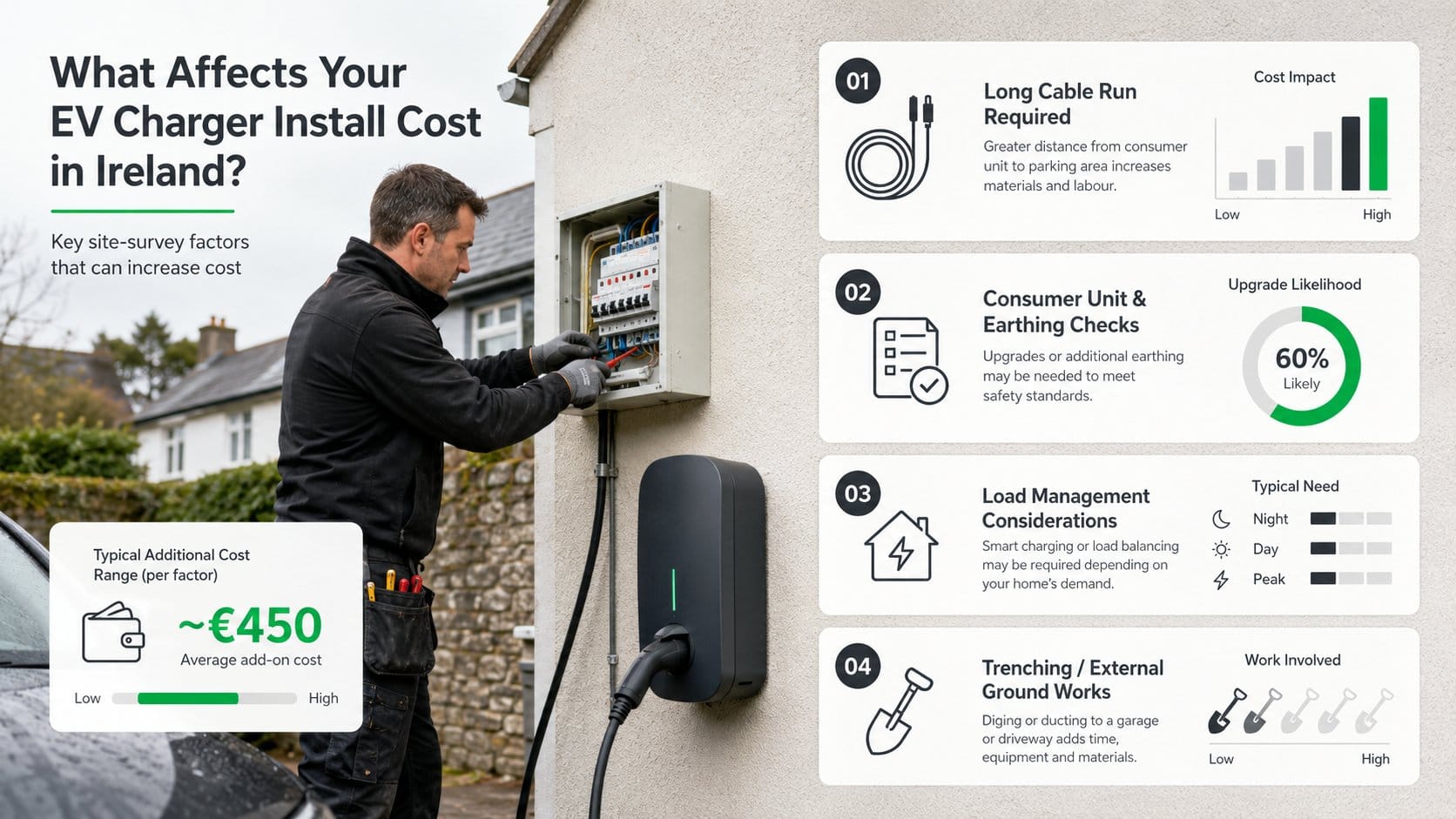
The site survey is where the cost gets revealed. An electrician is checking how far the charger sits from the consumer unit, whether the board has space and capacity, how the property is earthed, and whether the parking spot makes a simple wall run or a messy trenching job.
Cable run and routing
Distance is the biggest swing factor. A short, direct run from the board to the parking spot is cheap relative to a long route around the house, and a run to a detached garage or front gate often needs more material and more labour. If the cable has to be tucked neatly, clipped externally, or dropped through tricky access points, the price climbs quickly.
That's why the same charger can look cheap in one house and expensive in another. The hardware doesn't change, but the route from the board certainly does.
Board, earthing, and load control
A consumer unit upgrade is another common jump in cost, especially if the existing board is full or not set up for the charger circuit. Earthing can also complicate the job, particularly where an outdoor charger needs the right protection arrangement. Load management matters too when the house already has heavy electrical demand from other equipment.
A safe quote should spell out any of those items separately. If the installer just gives one neat number with no detail, the homeowner doesn't know whether the board, protection devices, or routing are already assumed.
Trenching and external work
Detached garages and long driveways are where costs really move. Trenching through lawn, gravel, tarmac, or paving is slower and messier than a simple wall-mounted install, and the electrical work has to follow the physical route, not the neatest sales pitch.
Bottom line: the quote is usually cheapest when it assumes a short cable run and no board work.
The SEAI Grant, Eligibility, and Safe Electric Certification
The SEAI Electric Vehicle Home Charger Grant is a fixed €300 contribution tied to the property and the eligible installation, not a general cashback on EV ownership. SEAI says the grant is capped at 100% of eligible installation costs, including charger and installation charges, but it still only covers up to the grant limit, so it usually offsets a small share of the full job rather than wiping it out. SEAI home charger grant
The installer must be a Safe Electric Registered Electrical Contractor. That matters because the grant process depends on proper electrical certification, and the homeowner should expect a Completion Certificate once the work is finished. An unregistered installer is the wrong move, not just for the grant, but for the paper trail a homeowner needs for a compliant installation.
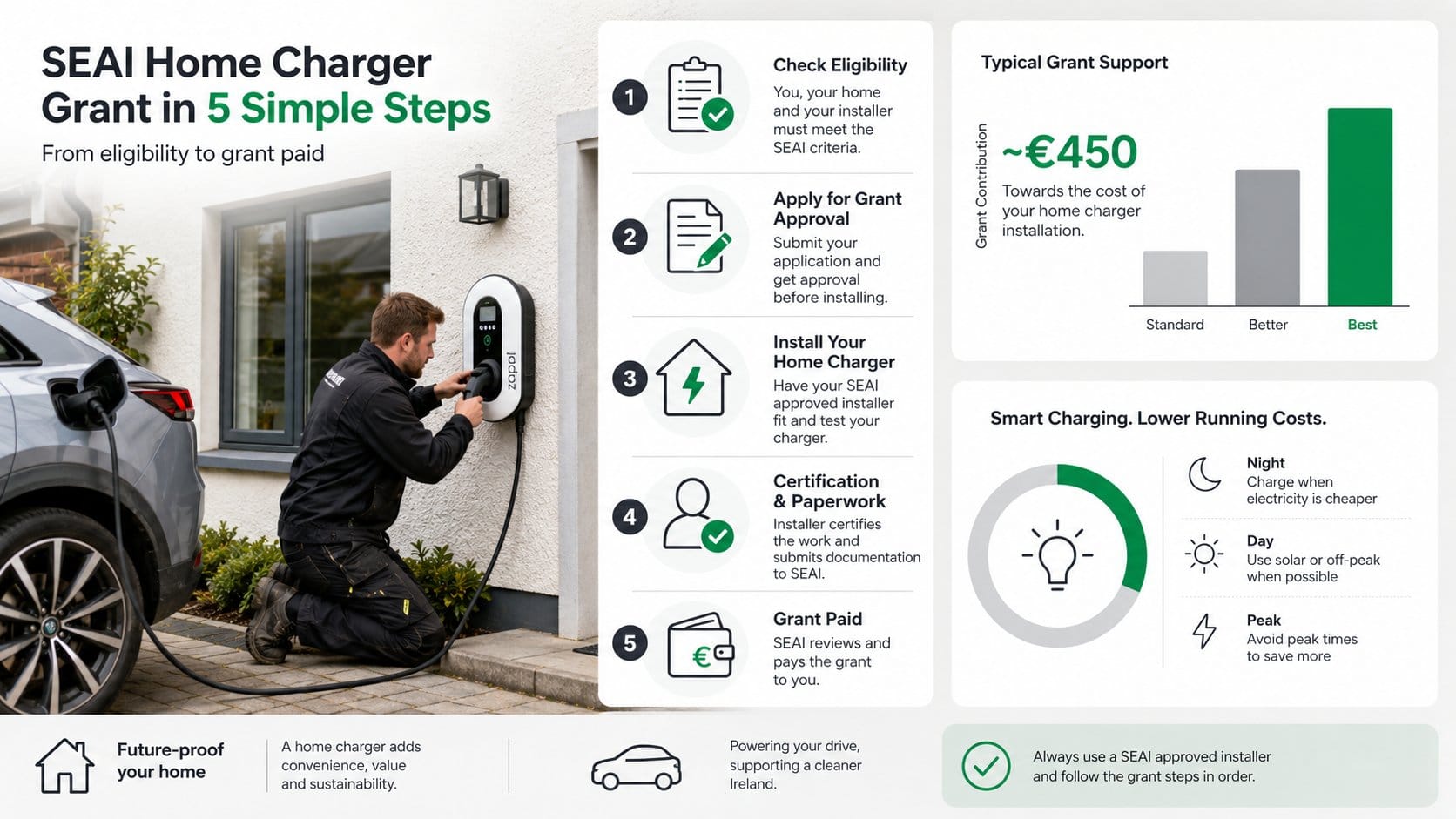
For households trying to understand the wider EV incentive picture, the guide to EV purchase incentives gives useful background, but the charger grant is separate and narrower. Apartment charging follows different rules again, with the overall grant capped at the lower of €5,000 per dwelling or €100,000, and each charge point capped at the lesser of actual cost or €600 under the SEAI apartment charging grant.
The paperwork should be clear, not vague. A homeowner should get proof of eligibility, a proper installation record, and the completion certificate before treating the job as finished. If you want a cleaner way to compare installer quotes, use a home repair pro guide to check what a tradesman should spell out upfront.
Worked Cost Examples for Common Irish Homes
A good quote only makes sense when the house type is known. The cheapest EV charger price is usually the one for a short, simple run on a house with no remedial work, while awkward layouts and older boards push the number up fast.
Typical scenarios
| Property Type | Site Conditions | Typical Pre-Grant Cost | Typical Post-SEAI €300 Cost |
|---|---|---|---|
| 1990s semi-detached | Fuse board about 4 metres from the front wall, no remedial work, standard 7 kW tethered unit | €1,200 to €1,500 | €900 to €1,200 |
| 2000s detached | Long 15 m cable run to a side-mounted charger, minor consumer-unit upgrade, earth electrode | €1,800 to €2,300 | €1,500 to €2,000 |
| Rural bungalow | 25 m trench across soft ground to a detached garage, dedicated circuit from a distant board | €2,600 to €3,400 | €2,300 to €3,100 |
The first house is the one many homeowners imagine when they hear “home charger install.” The second and third are where the quote starts to reflect the property rather than the charger itself.
A contractor who prices without seeing the site is guessing. That doesn't mean every survey turns into an expensive surprise, but it does mean homeowners should treat any tiny headline figure with caution until the route, the board, and the parking position are inspected.
The useful negotiation point is scope, not fantasy discounting. If the electrician can shorten the cable run, simplify the mounting point, or avoid unnecessary remedial work, the quote should come down accordingly.
Questions to Ask Before You Hire an Electrician
The first question is simple. Is the electrician on the Safe Electric register as a REC. If the answer is unclear, the homeowner should stop there and check it before anything is booked.
What should be on the quote
A proper quote should separate the charger hardware from labour and any remedial electrical work. It should also say whether the charger is tethered or untethered, whether the output is 7 kW for a standard home or something else for a different supply, and whether trenching, plaster patching, or board upgrades are included.
That breakdown protects the homeowner from scope creep. The cheapest number often becomes the most expensive job once extra items start appearing on site.
What should be confirmed before work starts
Safe Electric registration: Ask for the REC details and check them before paying a deposit.
Public liability insurance: Ask to see the cover, not just hear about it.
SEAI grant paperwork: Confirm who is handling the application and what proof is needed.
Completion Certificate: Ask when it will be issued and whether it is included in the price.
Warranty and charger model: Confirm the warranty length and the exact charger being installed.
A useful local reference for choosing a tradesperson is the practical electrician Dublin guide, but the same rule applies anywhere in Ireland, the paperwork matters more than the sales pitch.
Getting Quotes and What to Expect on Timeline
The easiest way to compare installers is to give each of them the same information. That means the preferred charger model or at least the required output, the ESB meter number, the MPRN, a clear photo of the consumer unit, and a rough sketch or photo of where the car will sit and where the charger would mount.
A sane quote process is straightforward. Shortlist two or three Safe Electric registered installers, ask for a written itemised quote, and make sure the €300 SEAI grant is being handled correctly on the homeowner's behalf. ShamFix is one place a homeowner can use to find an electrician in Ireland, but the comparison still has to be done line by line, not by headline price alone.
What the timeline usually looks like
Information gathering: Photos, charger preference, and site details are assembled.
Site survey: The electrician checks the board, earthing, and route.
Final quote and grant paperwork: The scope is fixed before work begins.
Installation day: A straightforward job can be done in a single visit, while awkward routes or remedial work can take longer.
Certification: The Completion Certificate should follow as part of the proper handover.
Rural jobs and west-of-Ireland jobs can take longer to book because the installer has more travel time and more variation between properties. That doesn't make them automatically dearer, but it does make a rushed quote less trustworthy.
If the reader wants a quote that reflects the house, not just the charger, ShamFix can help connect the job to local electricians across Ireland.
Are You an Electrician in Ireland?
Are you an electrician in Ireland?
Safe-Electric-registered electricians in Ireland can list their services on ShamFix. Listing on ShamFix is free and there's no commission; a subscription is planned for the future. The platform uses a two-sided review system, and ShamFix does not vet or verify provider documents, so electricians should state their own registration, insurance and experience clearly. Find out more at Create your provider profile.