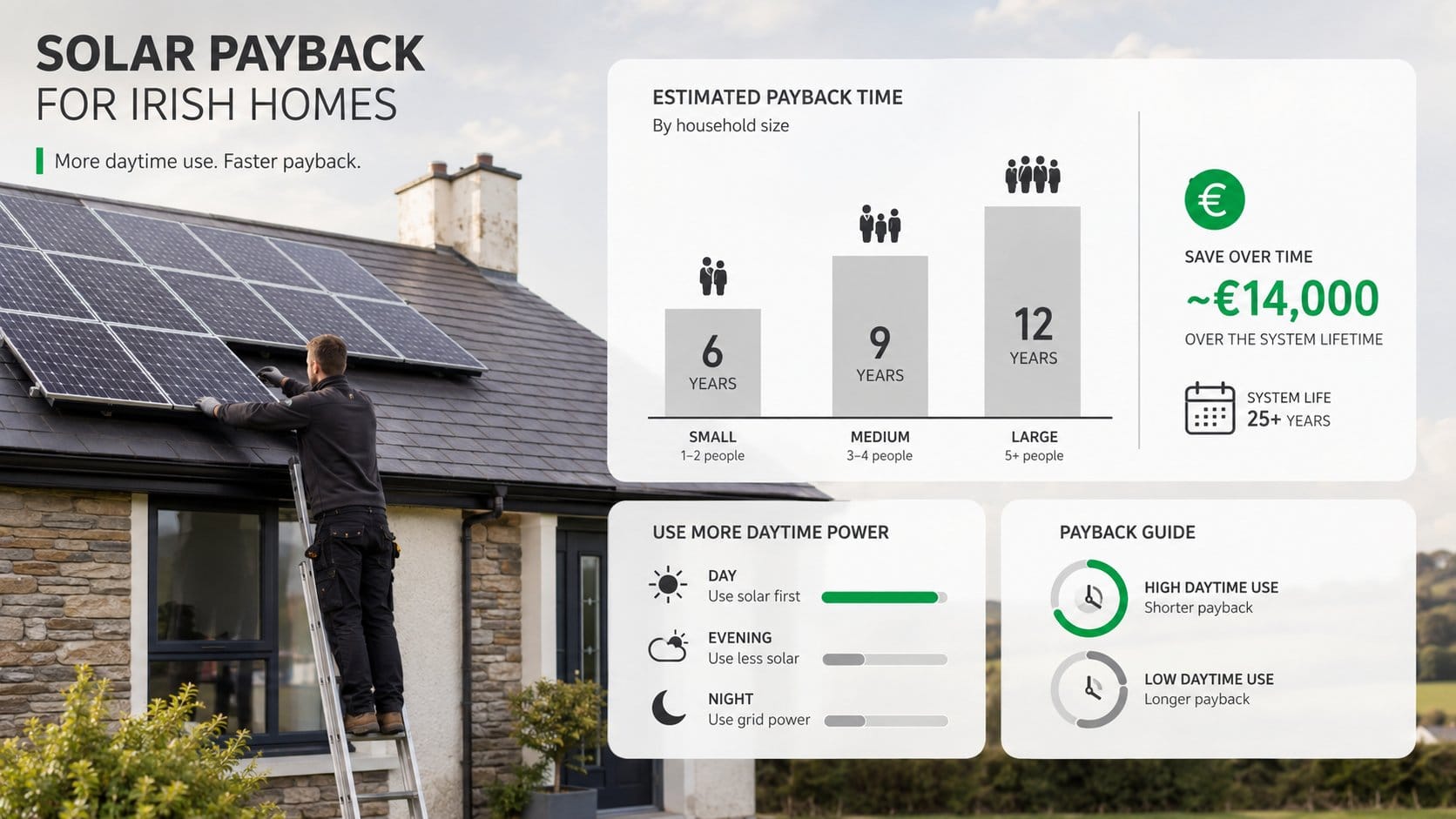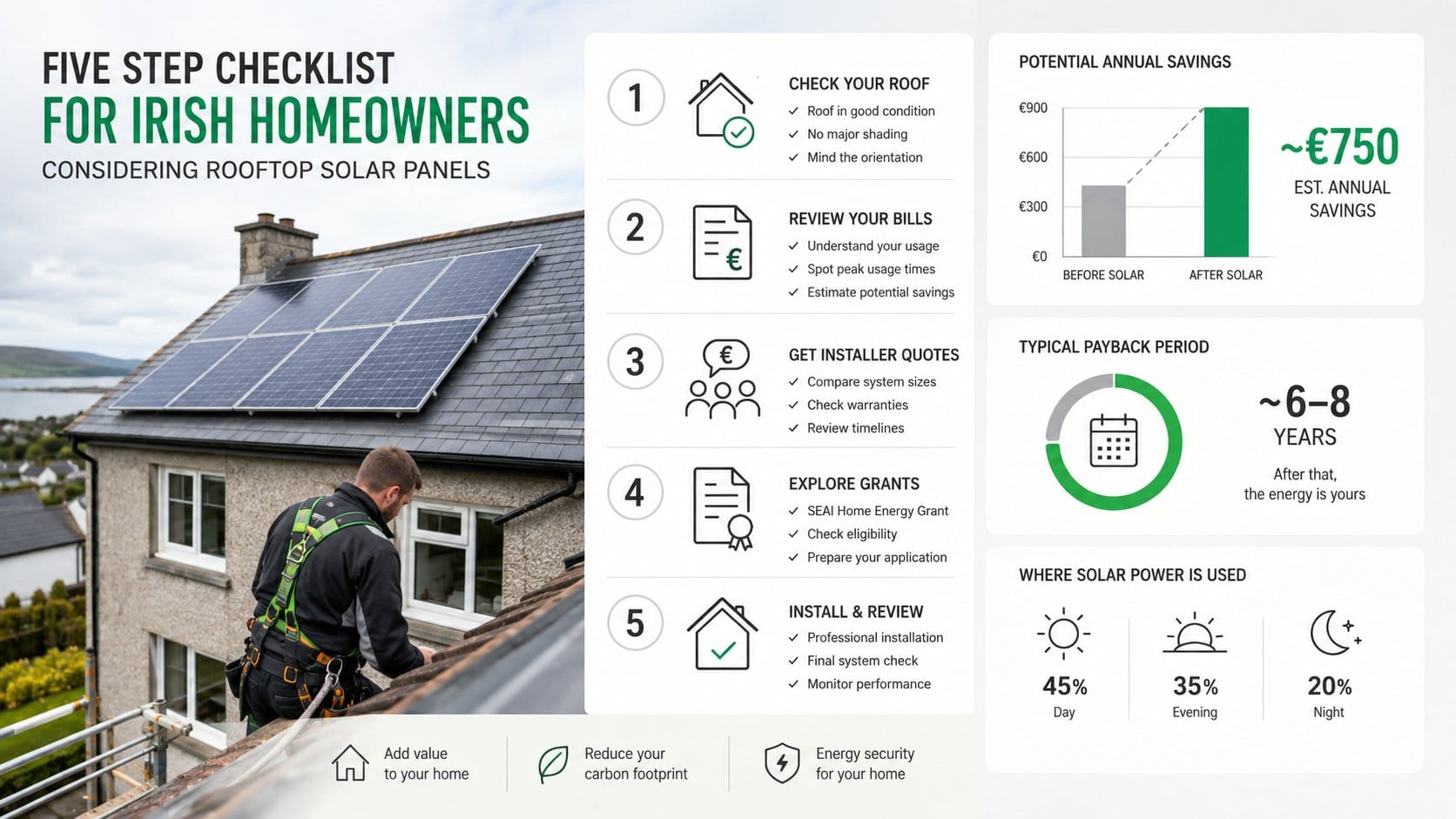
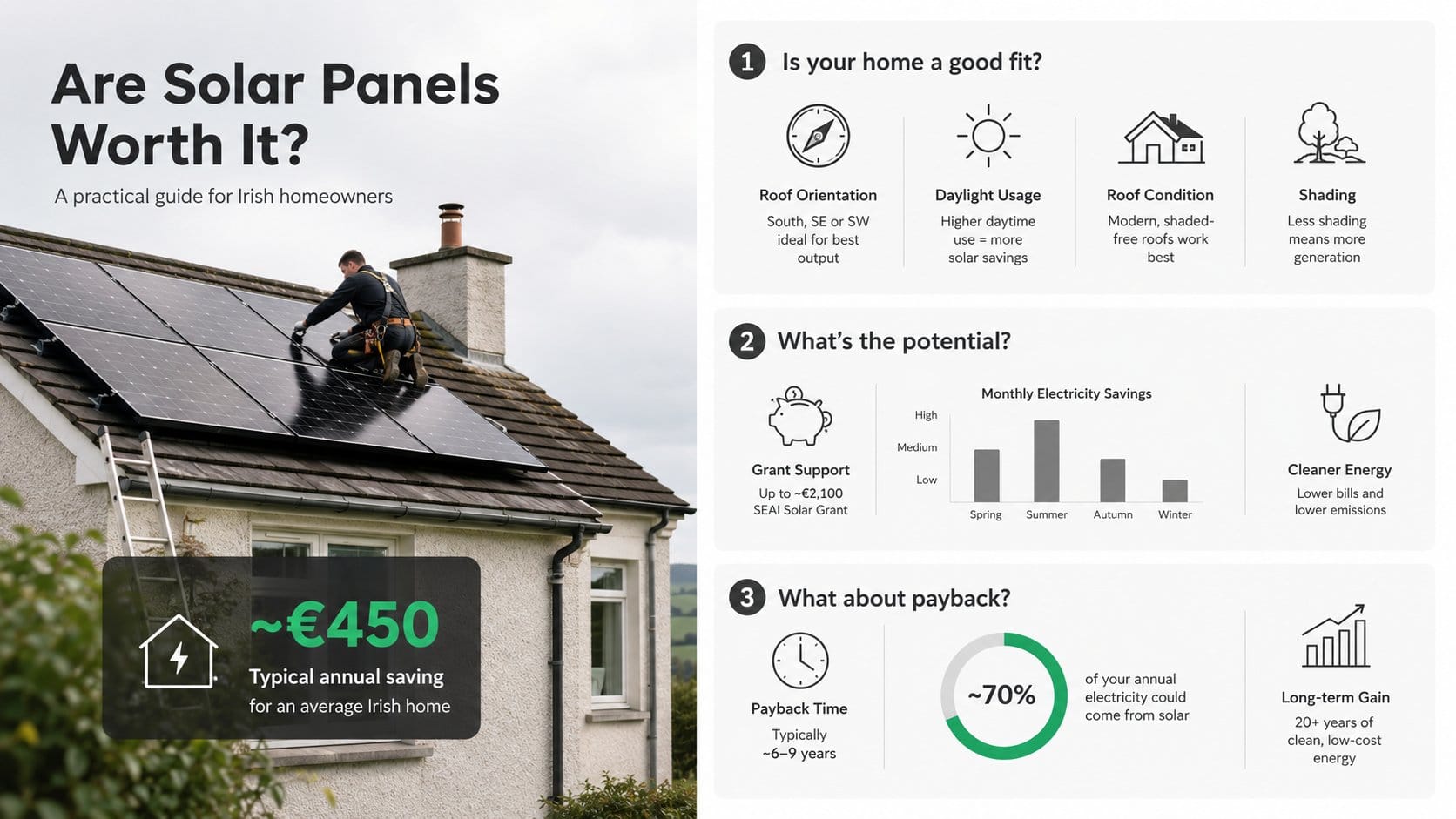
For most owner-occupier homes in Ireland with a south- or east/west-facing roof and daytime use, solar panels typically pay back in roughly 5 to 10 years after the SEAI grant. The key question is whether your own roof, bill pattern, and grant eligibility fit that average, or push it far outside it.
Homeowners often start with the same doubt. Ireland isn't a country with endless blue skies, and a glossy sales quote can make any roof sound profitable. The better test is simple, it comes down to three things, roof suitability, daytime electricity use, and grant eligibility.
What Irish Homeowners Should Ask Before Installing Solar
A solar quote can look attractive until the homeowner asks a simpler question, “Will this roof earn its keep?” In Ireland, the answer depends less on the brochure and more on whether the home can use the electricity while it is being produced. The SEAI says its solar electricity calculator estimates average annual bill savings and the simple payback period for Irish homes, which is a better way to judge the decision than relying on one headline figure. SEAI solar electricity calculator
Start with the roof
A good roof does three jobs at once. It catches daylight well, avoids heavy shading, and gives the installer a sound surface to work with. SEAI's guidance notes that a well-located 1.8 kWp system can generate around 1,500 kWh per year in Ireland, which shows how much placement matters on a moderate Irish solar resource. SEAI solar electricity calculator
Practical rule: the roof does not need to be perfect, but it does need to make sense. South-facing is strongest, east and west can still work well, and shading from chimneys, dormers, or trees can affect the value more than many people expect.
Then look at daytime usage
Solar works best when a home can use power while the panels are producing it. That usually means a household with someone home during the day, a heat pump, an EV charger, or appliances run on timers. The more of the solar output that stays in the house, the better the economics usually look, because exported energy earns less than energy you avoid buying from the grid. For practical ways to improve daytime usage and self-consumption, see Ireland electricity reduction tips.
Finally check the grant box
The SEAI grant is tied to the property and the system, not just the buyer's enthusiasm. Homes that miss the eligibility rules can still install solar, but the numbers change quickly once the subsidy disappears. That is why the first step is not a sales pitch, it is checking whether the home fits the scheme.
For a practical checklist and a homeowner-focused breakdown, see ShamFix Insights.
What a Typical Irish Solar Installation Costs in 2026
A homeowner usually needs to separate three things before judging a solar quote, the system price before grant, the price after grant, and the items that are not always obvious in the first estimate. For a typical 4 kWp array, a more realistic like-for-like range is roughly €6,500 to €7,500 before the SEAI grant, which works out at about €1,600 to €1,900 per kWp. After the current €1,800 grant cap, that usually leaves a net outlay of roughly €4,700 to €5,700. The final bill also depends on VAT, because residential solar PV has been zero-rated for VAT since May 2023. SEAI solar electricity grant For a more detailed homeowner breakdown of typical pricing, see ShamFix solar PV panels cost.
A like-for-like view helps more than a cheap headline
The lowest quote is often the least complete one. A proper price normally includes the panels, inverter, mounting, DC and AC cabling, and commissioning. It may still leave out scaffolding, roof repairs, making good, or extra electrical work if the home needs it.
| Typical 2026 cost of a 4 kWp Irish solar PV system | Typical range |
|---|---|
| Panels, inverter, mounting, cabling, commissioning | Included in the main quote |
| Pre-grant system price | Roughly €6,500 to €7,500 |
| SEAI grant reduction | Up to €1,800 |
| Net outlay after grant | Roughly €4,700 to €5,700 |
| VAT on residential solar PV | 0% |
That table is the clearest way to compare offers. If one installer is far cheaper, the useful question is usually what has been left out rather than whether they have found a special bargain.
What often pushes the price up
Some roofs need extra access work. Some homes need more electrical tidying than others. A narrow or awkward roof can also mean more labour per kWp installed, even if the panels and inverter are the same.
A fair comparison starts with the same scope on every quote. Without that, the cheapest figure can be the least useful one for a homeowner trying to judge real value.
How the SEAI Solar PV Grant Works
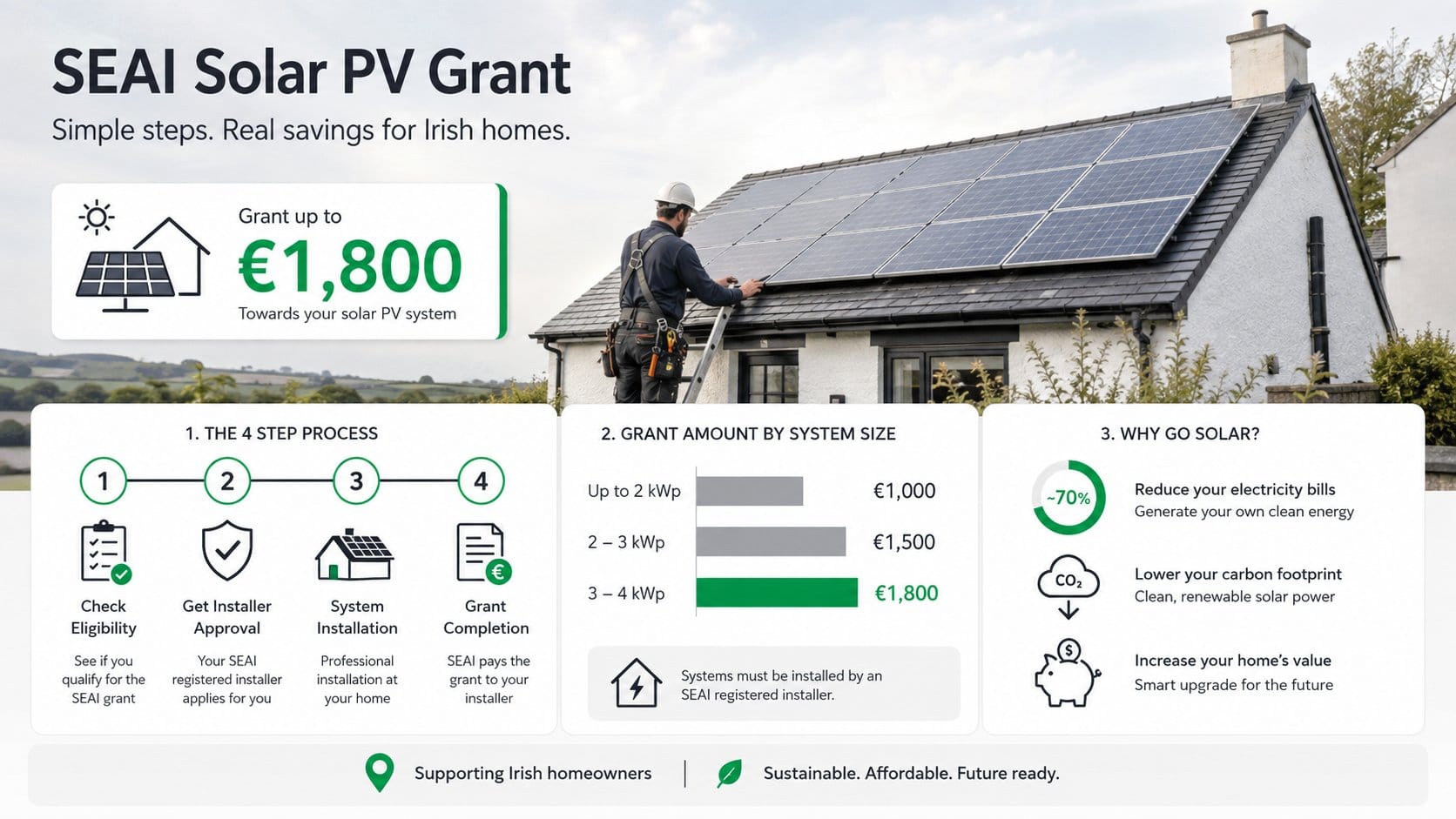
The SEAI grant is easiest to understand as a simple formula. It pays €700 per kWp for the first 2 kWp, then €200 for each additional kWp up to 4 kWp, with a grant cap of €1,800 for domestic systems. That cap is unchanged and still applies in 2026. In plain terms, the early part of the array gets the strongest support, and the support tails off as the system grows. SEAI solar electricity grant
Why the size of the array matters
A smaller system gets more grant support per unit of capacity than extra panels added later. That does not make a larger array a poor choice, it means the homeowner should size the system around roof space and electricity use, not just the grant figure. A 4 kWp system is where the grant reaches its cap, so it often becomes the practical reference point for Irish homes. Citizens Information solar panels grant
How the process usually works
The grant goes through the installer route, not as a simple cashback payment to the homeowner. The system has to be approved, installed, and completed properly before the payment is released. That means the homeowner still needs to check eligibility, paperwork, and the order of the steps, because the grant only helps if the project is handled in the right way. SEAI solar electricity grant
A simple way to think about it
If a roof can comfortably take the size of system that reaches the cap, the grant structure works well. If the roof is cramped, shaded, or awkwardly oriented, chasing a larger array just to reach the top grant level can be the wrong move.
How Much Electricity Irish Solar Panels Generate
Irish solar output is real, but it is not magic. SEAI guidance says a well-located 1.8 kWp system can generate around 1,500 kWh a year in Ireland, which gives a useful sense of the local resource. That is enough to matter on a family bill, but it still leaves room for roof quality and seasonal swings to shape the result.
What the roof changes
Two homes can buy the same system and get different results. A clean south-facing roof with little shading can produce far more usable electricity than a roof partly blocked by a chimney or tree. In Irish conditions, that difference matters because the country has a moderate solar resource, not a very sunny one.
Why self-consumption beats export for value
Exported power earns less than the bill you avoid paying, so self-use matters more than headline generation.
A home that uses solar electricity as it is being made lowers its bill directly. A home that exports a lot of daytime generation still gets paid, but the exported unit is usually worth less than the imported unit it replaces. The same panel output can therefore have different value depending on whether the household is home in the day, running appliances on timers, or mostly out.
The most common mistake is assuming all generated electricity has the same value. It doesn't, because a unit used in the house avoids a retail bill, while a unit exported is paid under a supplier export tariff.
A rough orientation view
| Orientation | Tilt angle | Est. annual output per kWp | Share of optimal (%) |
|---|---|---|---|
| South-facing, little shading | Good residential pitch | Highest practical output | Best case |
| East-facing | Good residential pitch | Lower than south, but still useful | Below optimal |
| West-facing | Good residential pitch | Lower than south, but still useful | Below optimal |
| Roof with shading | Any sensible pitch | Reduced output | Depends on shade |
The point of that table is not to chase a perfect number. It is to show that two roofs with the same panel count can still behave very differently across the year. Homes with strong daylight use can turn that generation into savings more efficiently than homes that are mostly empty during the day.