The panels are already on the roof, the inverter is working, and the evening electricity bill still looks higher than expected. That usually means the home is exporting surplus solar during daylight and buying electricity back later. Connecting a solar panel to battery system can change that pattern, but only if the battery, inverter, wiring, controls and household demand are treated as one design.
For Irish homes, the key decision isn't the biggest panel array an installer can fit. It's whether the existing system is compatible, whether the battery matches evening demand, and whether the work follows EN50549 requirements with Irish protection settings. Any electrical connection must go through a Safe Electric registered electrical contractor. A battery isn't a plug-in appliance, and a homeowner shouldn't attempt the wiring.
What a Solar Panel to Battery System Does in Ireland
For an Irish home, the important decisions are system compatibility, evening-demand sizing and compliance with EN50549 requirements with Irish protection settings. Panel wattage matters, but it does not decide whether a battery retrofit will work well. The existing inverter, available space, household load profile and connection method matter more. Any electrical connection must be completed by a Safe Electric registered electrical contractor.
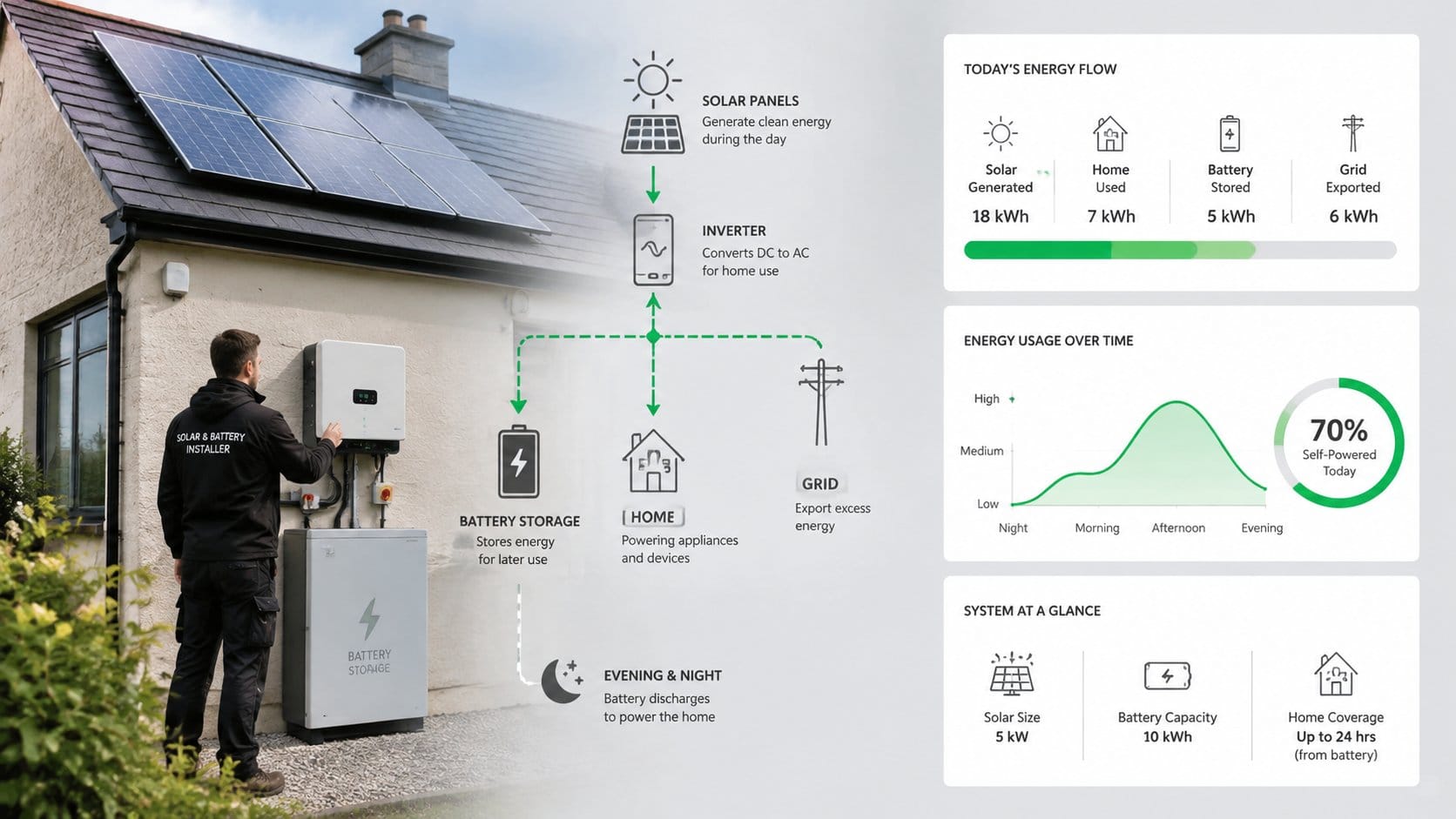
A solar-to-battery system combines photovoltaic panels, an inverter or hybrid inverter, a battery and the household electrical supply. The panels produce direct current. The inverter converts and controls that energy for household appliances, while the battery stores available surplus for later use. A hybrid inverter can manage solar generation and battery charging together. An AC-coupled retrofit may retain the existing solar inverter and add a separate battery inverter.
In daylight, the home uses solar energy first. Surplus can charge the battery, and any remaining generation may be exported to the grid once the battery reaches its usable limit. In the evening, the battery discharges to serve household loads, reducing electricity imported from the grid.
Ireland's rooftop solar market has grown from a small base to widespread adoption. The SEAI-linked Irish solar PV market data records grant-aided installations rising from 71 systems in 2018 to 34,615 in 2025, with an all-time total of 124,726 systems. The same source records Irish solar PV capacity at about 1,185 MW in 2024 and 187.9 MW in 2022. For 2023, the published SEAI position is about 0.72 GW, rather than 680 MW, as set out in SEAI's First Look Renewable Energy in Ireland Report and its First Look energy supply summary. SEAI also states that solar PV supplied 1.9% of Ireland's electricity in 2023, equivalent to about one week of national electricity demand, in its renewable energy statistics publications.
What the battery is for
The battery shifts solar energy from the middle of the day into the hours when the home needs it. That usually means evening cooking, lighting, entertainment and other domestic loads. Size the battery around that later-day demand and the system's usable capacity, rather than the maximum output of the panels.
Charging and discharging involve conversion losses, so every stored kilowatt-hour is not fully recoverable. A financial calculation must include those losses.
Practical rule: Match the battery to evening demand, inverter compatibility and the chosen coupling arrangement.
For storage terminology and system layouts, see this home battery guide from Amp'd Energy Solutions. Use an Irish registered electrical contractor for design, grid settings, wiring and commissioning.
Core Components and the AC-Coupled Versus DC-Coupled Choice
The first question is whether the battery is being added to an existing solar installation or included in a new system. That choice usually determines whether AC coupling or DC coupling makes more sense.
A DC-coupled arrangement uses a hybrid inverter to manage the solar array and battery on the DC side. An AC-coupled arrangement leaves the existing solar inverter in place and adds a separate battery inverter on the AC side. Neither option is automatically right for every Irish home.
The equipment that matters
The panel array produces DC electricity. A charge controller manages charging conditions, although the controller is often built into a modern hybrid inverter rather than installed as a separate box. The battery management system protects the cells and coordinates charging and discharging with the inverter.
The inverter is the control centre. It must communicate correctly with the battery, apply the required Irish grid protection settings and prevent unsafe operation during grid faults. Compatibility is more important than a sales brochure's headline capacity.
PWM and MPPT are different charge-control approaches. Irish homeowners shouldn't select a system solely because a component is cheaper. The relevant question is whether the controller and inverter can harvest the available PV energy effectively and work with the proposed battery.
| Factor |
DC-coupled, hybrid inverter |
AC-coupled, battery inverter add-on |
| Best fit |
New solar and battery installations |
Existing PV systems needing storage |
| Existing inverter |
Usually replaced by a compatible hybrid inverter |
Often retained, subject to compatibility checks |
| Conversion path |
Solar can charge the battery through the DC bus |
Solar power is converted to AC before battery charging |
| Retrofit disruption |
May involve changes to the existing PV equipment |
Can be less disruptive when the existing array is sound |
| Main risk |
Replacing usable equipment unnecessarily |
Communication, export-control and inverter compatibility issues |
| Design priority |
Match the hybrid inverter to panels and battery |
Confirm the separate battery inverter works with the existing system |
A DC-coupled design can be attractive for a new installation because the system is designed as one package. An AC-coupled design is often cleaner for a working PV system where the homeowner wants storage without disturbing the roof array or replacing equipment that still performs properly.
The decision homeowners can control
For a new-build or complete solar replacement, a hybrid inverter is usually the sensible starting point. For a retrofit, the installer should first identify the existing inverter, its compatible battery options, export-control arrangements and available space for safe isolation.
The system must comply with EN50549 using Irish protection settings, regardless of whether it is AC or DC coupled. The homeowner should ask for the proposed single-line diagram before approving work. If the answer is only a battery brand and a capacity figure, the design hasn't been explained properly.
Wiring, Safety, and the Safe Electric Compliance Path
A solar-to-battery retrofit crosses several safety boundaries. The DC wiring from the array, the battery connection, the inverter, the AC distribution board and the grid interface all need coordinated protection. In Ireland, this isn't a suitable job for a handyman or a homeowner working beyond an approved plug-in appliance.
SEAI's installer technical bulletin requires inverter and battery systems to comply with EN50549 with Irish protection settings. It also specifies that a battery not already installed on a fire-resistant surface must sit on a Class 0 fire-resistant substrate extending 150mm beyond the battery. The enclosure must be clean, dry and ventilated, with inaccessible terminations, vermin protection and enough clearance for maintenance. These requirements are set out in the SEAI solar PV contractor technical bulletin.
The installation sequence
The contractor should confirm the inverter and battery standards first. Next comes the compatibility assessment, including whether the proposed equipment is AC or DC coupled and whether the battery can communicate with the inverter. The physical location is then checked against manufacturer instructions, fire-surface requirements, ventilation and maintenance access.
The electrical protection and isolation arrangements follow. Depending on the design, that can include:
- Array isolation: A suitable DC isolator allows the PV side to be made safe for work.
- Battery protection: The battery requires its own isolation and correctly integrated battery management controls.
- AC protection: The inverter connection must use appropriate protection and clear labelling at the distribution board.
- Surge protection: The contractor should assess surge protection and the route into the building as part of the design.
- Documentation: The protection settings, wiring design and commissioning results should be recorded.
The supplied image URL above is required to be exact, but it contains a different identifier from the provided asset URL. The exact provided asset is:
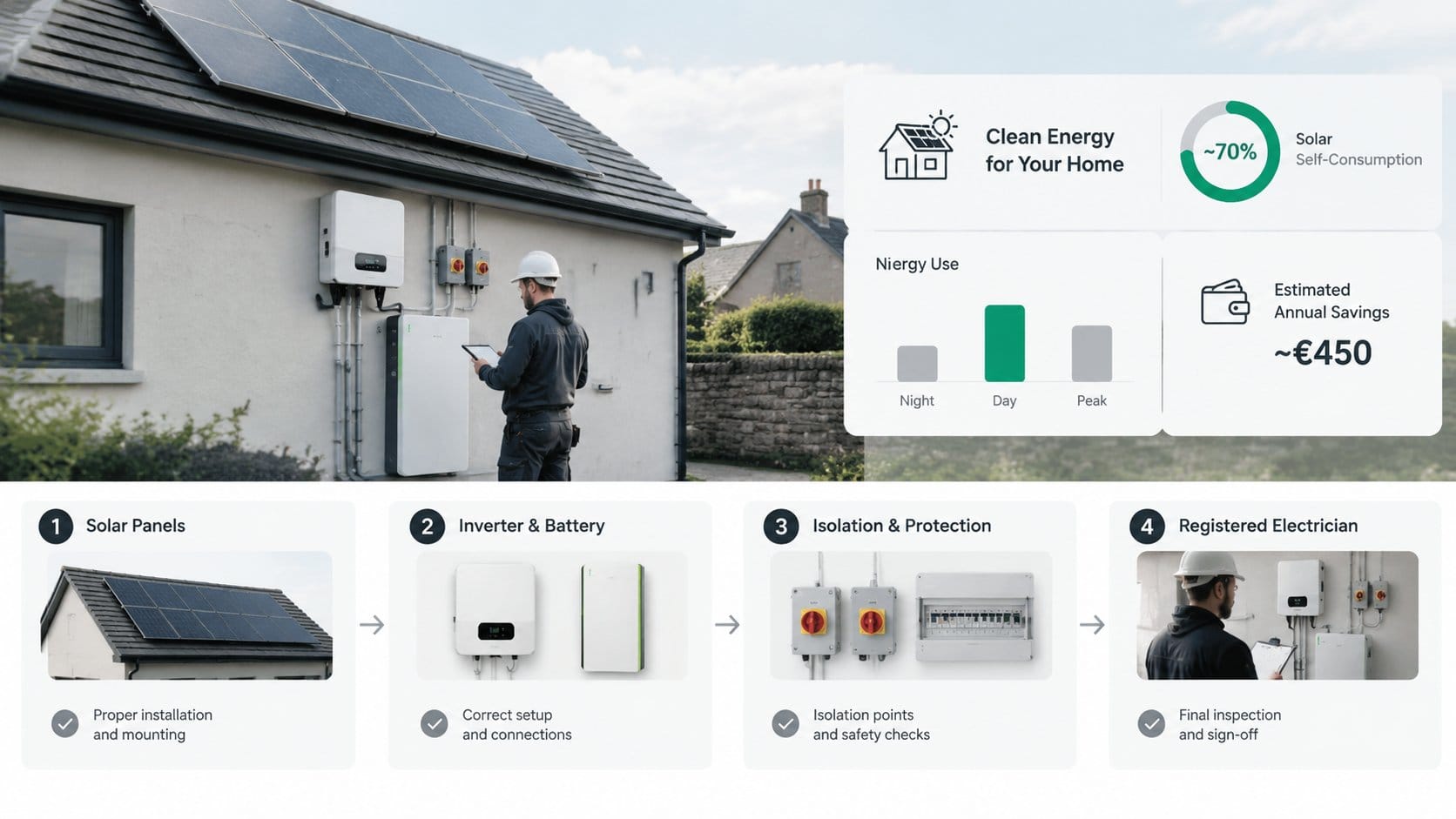
The installer should complete protection-setting checks before commissioning, not after the homeowner discovers nuisance trips or unexpected imports. A homeowner comparing electrical providers can use ShamFix's guide to finding a tradesman in Ireland, then confirm the contractor's Safe Electric registration directly with Safe Electric.
Sizing for a Typical Irish Household
Battery sizing should begin with evening electricity use, not the largest battery available. Irish guidance identifies 5 to 10 kWh as the most common battery range for a three-bedroom home paired with a 4 kWp PV system. The same guidance states that a home without storage typically self-consumes about 30% to 40% of its PV generation, while a battery can raise self-consumption to about 70% to 80%, as described in this Irish analysis of solar and storage economics (SAGE Journals).
Those figures are useful benchmarks, not a promise for every house. A battery that matches the evening load can reduce grid imports. A battery that is too large may sit partly unused, particularly where the home has modest night-time consumption.
| Household profile |
Daily evening load |
Suggested PV array |
Suggested battery |
Notes |
| Low evening demand |
Modest lighting, refrigeration and entertainment |
Existing array where compatible |
Lower end of the common range |
A larger battery may have too little work to do |
| Typical three-bedroom home |
Regular cooking, lighting and household appliances |
4 kWp benchmark |
5 kWh to 10 kWh |
Actual sizing depends on usage after sunset |
| EV household |
Vehicle charging adds substantial later-day demand |
Existing array plus demand review |
Toward the larger end of the common range |
Charging strategy matters as much as battery capacity |
| Heat-pump household |
Heating demand can alter daily load patterns |
Design around measured consumption |
May require a larger design |
The inverter and supply must be assessed together |
The most important distinction is usable capacity. A battery's advertised capacity isn't necessarily the amount available for daily discharge. The contractor should state the usable capacity, maximum charge and discharge power, reserve setting and expected operating strategy in the quotation.
Avoiding the usual sizing errors
Oversizing the battery is the obvious mistake, but undersizing can also disappoint. If the battery fills early and the home has little evening demand, much of the surplus will still be exported. If the battery is too small for regular evening use, it may empty before the household's later loads finish.
The homeowner should provide actual electricity bills and explain EV charging, immersion use, heating equipment and work-from-home patterns. A battery sized from a generic house type is less reliable than one based on the home's measured demand. For practical saving measures that can improve the value of stored energy, see ShamFix's guide to saving electricity. For budgeting context before a retrofit, the most relevant internal reference is ShamFix's solar PV panels cost guide.
SEAI Grants and Hiring a Registered Installer
The current SEAI Solar Electricity Grant is available to homeowners, including landlords, where the home was built and occupied on or before 31 December 2020. The scheme pays €700 per kWp up to 2 kWp, followed by €200 per additional kWp up to 4 kWp, with a maximum grant of €1,800, according to the SEAI Solar Electricity Grant rules.
The payment is size-based rather than a flat amount. SEAI's application guide gives a 2.5 kWp system a €1,500 grant, which confirms how the calculation works in practice. The SEAI Solar PV Scheme Guide should be checked alongside the live grant page before signing a contract.
What the grant does and doesn't cover
The grant is for solar PV. Independent Irish guidance states that there is no separate SEAI grant for a home battery in 2026, and that adding a battery doesn't increase the solar PV grant amount. The battery therefore needs to be assessed on its own cost, expected use and likely reduction in grid imports.
Citizens Information says the Solar Electricity Grant is intended to end in 2029, making the policy timetable relevant to households planning solar and storage. The Citizens Information guidance on solar panel grants is the appropriate place to check the current position.
The quotation checklist
A proper quote should separate the PV system, battery, inverter work, electrical protection, access equipment and any making-good work. Residential solar PV has a 0% VAT rate since May 2023, while construction, renovation and repair work generally carries 13.5% VAT. The homeowner should ask which rate applies to each part of the proposal and confirm that VAT is included.
Before approval, the homeowner should:
- Confirm registration: Check that the electrical contractor is registered with Safe Electric.
- Request the design: Ask for the equipment compatibility statement and single-line diagram.
- Check settings: Confirm that EN50549 Irish protection settings will be applied.
- Separate costs: Ensure scaffolding, access, waste disposal and making good aren't excluded.
- Keep paperwork: Retain the grant documents, certificate, warranty information and commissioning report.
ShamFix's guide to finding local tradespeople can help homeowners organise the search, but regulated electrical registration must be confirmed with the relevant authority.
Maintenance and Battery Lifespan in the Irish Climate
A battery works best when its installation environment is dry, ventilated and accessible. Irish homes often place equipment in garages, utility rooms or external areas, but the correct location depends on the manufacturer's instructions and the specific enclosure. Cool conditions can be helpful for battery operation, while dampness, condensation, blocked ventilation and exposure to unsuitable temperatures create avoidable risks.
The maintenance routine should be simple. Homeowners can inspect the area without opening electrical equipment, while electrical testing and internal work belong to the registered contractor.
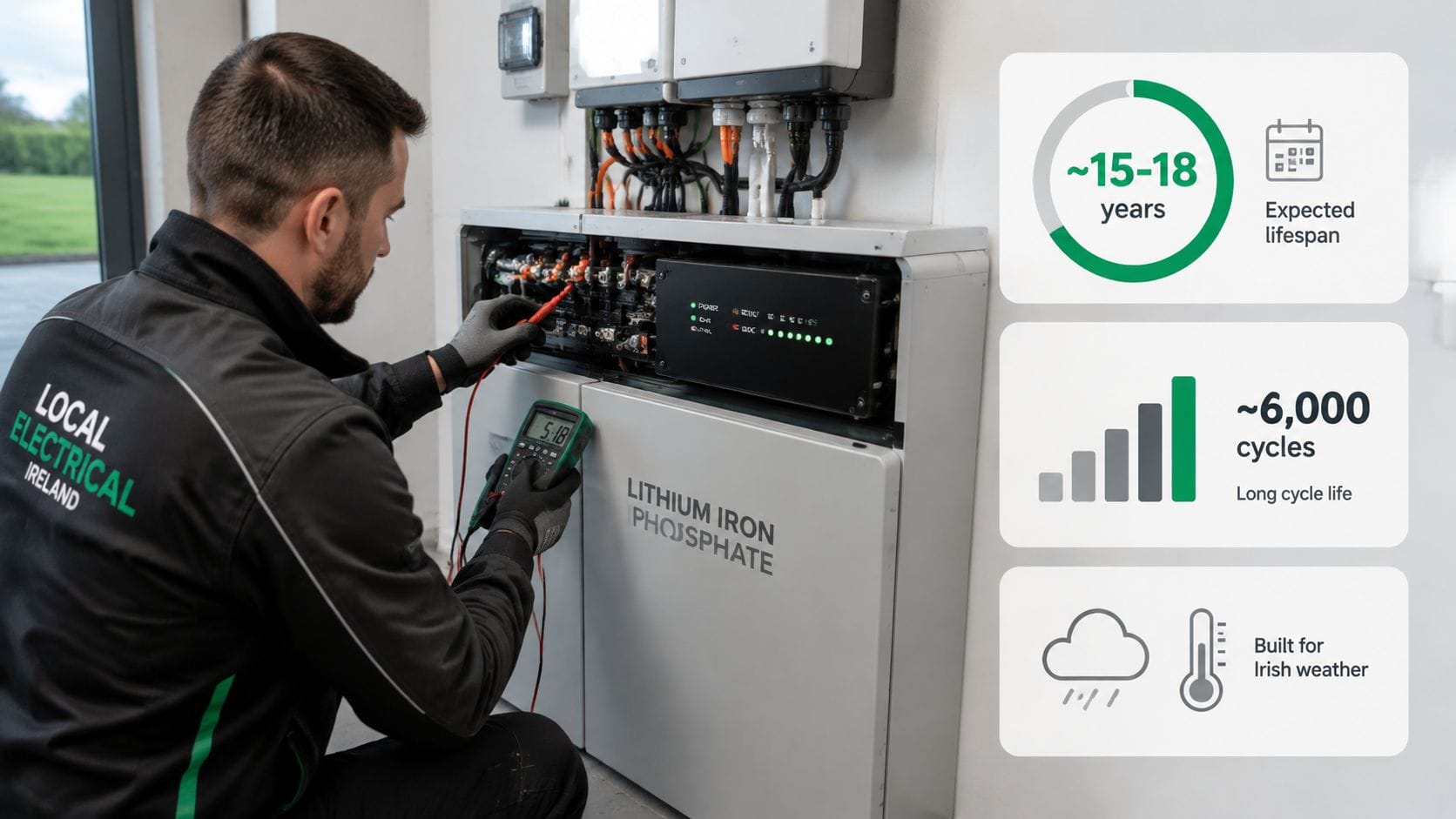
A sensible inspection cycle
A visual check should look for moisture, corrosion, impact damage, unusual noise, blocked vents or stored combustible materials near the battery. The inverter app or portal can reveal warnings that aren't visible at the equipment itself. Firmware updates should be handled according to the manufacturer's instructions, with the installer involved if the update affects operating settings.
The homeowner can keep a short log covering:
- Battery area: Dryness, ventilation and clear access.
- Inverter display: Warnings, error messages and unusual operating behaviour.
- Cabling and conduits: Visible damage or movement, without removing covers.
- Panel appearance: Dirt, debris or shading caused by nearby growth.
- Energy pattern: Unexpected imports, exports or a battery that stops charging.
An annual electrical review should be carried out by the installer or another appropriately registered electrician. It may include testing protective devices, checking connections, reviewing battery condition and confirming that the system still operates within its approved settings.
Troubleshooting without DIY intervention
| Symptom |
Possible cause |
Appropriate response |
| Battery won't charge |
Low PV production, a protection event or communication fault |
Check the app and contact the installer |
| Unexpected grid import |
Battery reserve setting, low state of charge or control issue |
Review system settings with the installer |
| Inverter warning |
Grid, temperature or equipment condition |
Record the code and don't reset repeatedly |
| Condensation or dampness |
Unsuitable location or ventilation problem |
Isolate only as directed and contact the contractor |
| Reduced solar output |
Shading, dirt or equipment fault |
Arrange inspection rather than opening equipment |
A general technical comparison can be useful for terminology, but an overseas article such as this Brisbane solar battery storage guide from AdVoltage Electrical doesn't replace Irish electrical or grant guidance. Irish homeowners should apply Irish compliance requirements to every decision.
Troubleshooting and What to Expect After Commissioning
Commissioning is the point at which the system's design becomes an operating record. The homeowner should receive a clear handover pack, not just an app login and a sales invoice.
The pack should include the Safe Electric certificate, confirmation that the inverter's EN50549 settings match the applicable Irish grid requirements, battery and inverter warranty information, and a commissioning report. The report should record relevant tests and readings, including string checks, insulation resistance and protective-device results where applicable.
The documents worth keeping
A well-organised homeowner file should contain:
- Electrical certification: The Safe Electric documentation for the completed electrical work.
- System design: The single-line diagram and equipment schedule.
- Protection settings: The applied EN50549 settings and export-control arrangement.
- Warranty records: Registration evidence for the inverter and battery.
- Commissioning results: Test readings and confirmation that the system was handed over safely.
- Operating information: Shutdown instructions, emergency contact details and maintenance requirements.
The first months can reveal how the equipment behaves under different household loads and weather conditions. Seasonal solar output changes, software updates and control settings may all affect the balance between self-use, export and grid import. The homeowner shouldn't treat an occasional change in the app as a fault, but repeated warnings, unexplained imports or a battery that stops responding deserve a logged service call.
Common faults and the correct response
| Fault or behaviour |
Plain-English explanation |
Installer action |
| Grid voltage out of range |
The inverter has detected a grid condition outside its operating limits |
Test the supply and confirm protection settings |
| Insulation warning after bad weather |
Moisture or damage may be affecting the PV circuit |
Isolate and test the affected circuit |
| Battery communication lost |
The inverter and battery aren't exchanging the required data |
Check cabling, settings and compatible firmware |
| Low state of charge overnight |
Evening demand exceeded available stored energy |
Review battery reserve, capacity and household usage |
| Export limiting |
The system is restricting export under its configured controls |
Check the meter, control device and approved settings |
A useful general maintenance checklist is available in this 2026 solar maintenance guide from South Mountain Window Cleaning, although Irish homeowners must still follow their own equipment manuals and Irish electrical requirements.
Keep the certificate pack in the same place as the grant paperwork, record every fault code and route all AC-side work through a Safe Electric registered electrician. That discipline matters more than choosing a battery based on its advertised capacity alone.
ShamFix connects homeowners with local providers through an Ireland-only marketplace and a two-sided review system, while the matching tool routes enquiries rather than guaranteeing workmanship. For help finding an electrical provider for a solar panel to battery project, visit ShamFix and compare local options with the registration and documentation checks outlined above. Electrical firms and solar installers who want to receive relevant homeowner enquiries can also learn more on the ShamFix for tradesmen page.