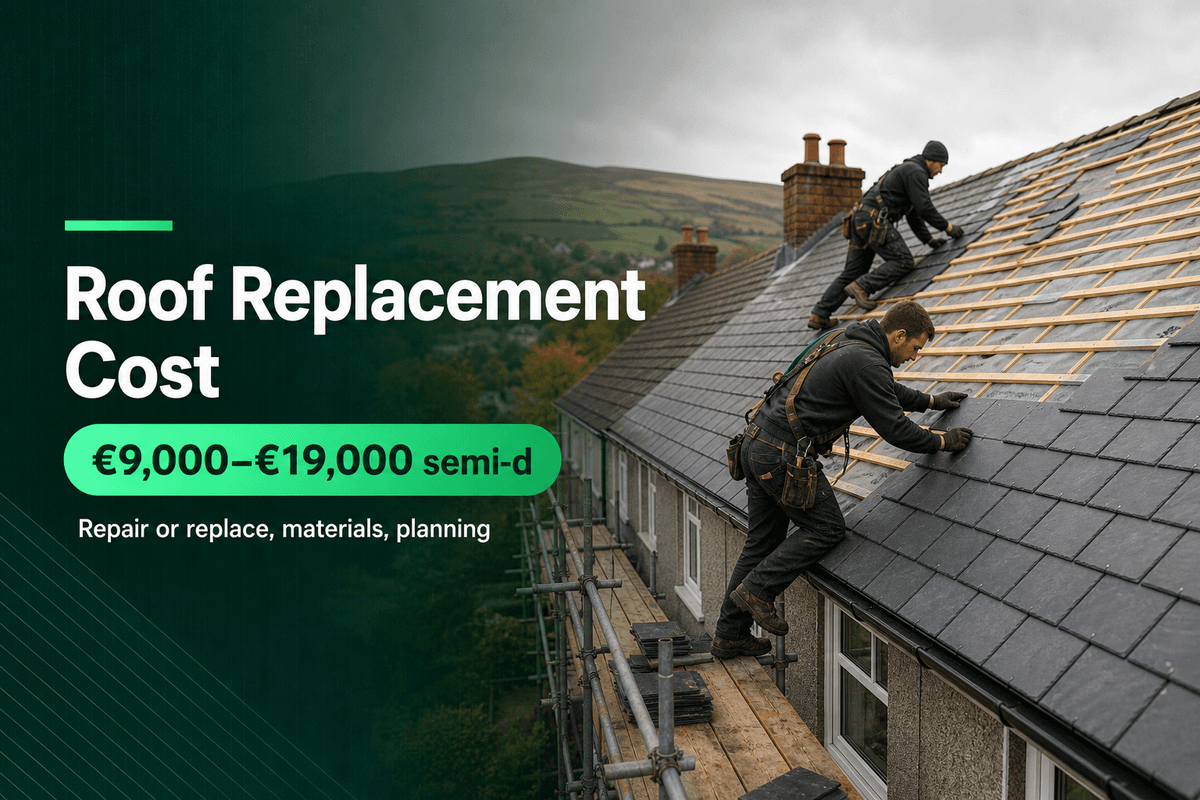
A new roof in Ireland typically costs €9,000 to €19,000 for a semi-detached house, €7,500 to €14,000 for a terraced house and €12,000 to €28,000 for a detached house, as an aggregate Irish market estimate including VAT. Natural slate, a steep or complicated roof, a chimney that needs rebuilding and new fascias and gutters all push the price towards the top of the range. Repairs are far cheaper: replacing a few slipped slates usually costs €500 to €1,100, and new lead flashing around a chimney €800 to €2,500. The first decision is whether the roof needs repairing or replacing, and an honest roofer will say which. Homeowners who want quotes for either can post the job under roofing services and compare prices.
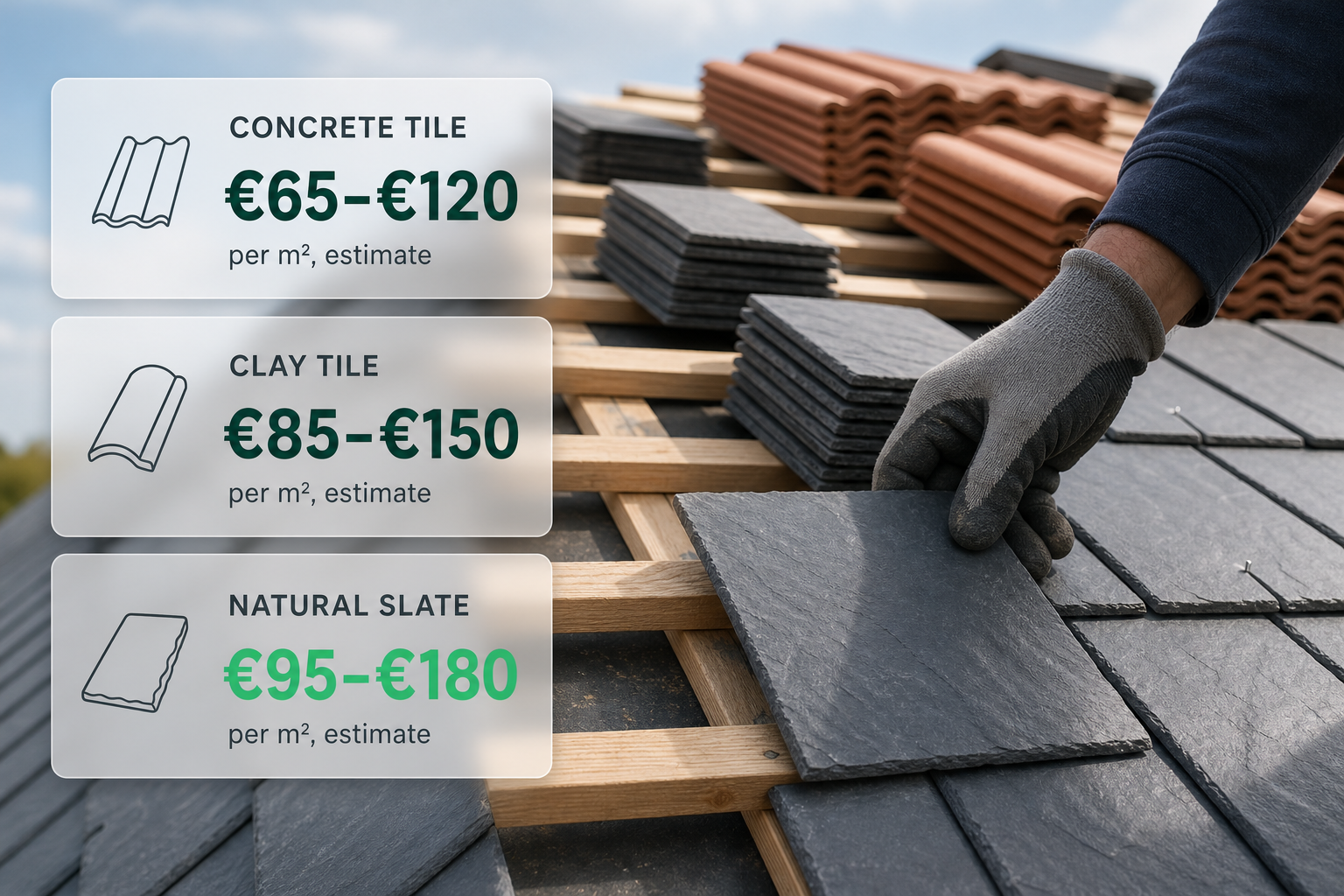
Roof replacement prices at a glance
The figures below are an aggregate Irish market estimate, VAT included, for stripping the old covering and fitting a new one on a pitched roof, unless marked otherwise.
| Work | Typical price |
|---|---|
| Full roof replacement, terraced house | €7,500–€14,000 |
| Full roof replacement, semi-detached house | €9,000–€19,000 |
| Full roof replacement, detached house | €12,000–€28,000 |
| Full roof replacement, bungalow | €11,000–€24,000 |
| Concrete tile, supplied and fitted | €65–€120 per m² |
| Fibre cement slate, supplied and fitted | €70–€120 per m² |
| Clay tile, supplied and fitted | €85–€150 per m² |
| Natural slate, supplied and fitted | €95–€180 per m² |
| Scaffolding for a typical two-storey house | €1,000–€3,000 |
| New fascia, soffit and gutters, semi-detached house | €2,000–€5,000 |
| Flat roof replacement (felt, EPDM or GRP) | €2,800–€9,000 |
A worked example: a three-bed semi-detached house with about 80 m² of pitched roof, re-roofed in concrete tiles. The roofing itself comes to roughly €5,200–€9,600, scaffolding adds €1,500–€2,500, new uPVC fascia, soffit and gutters €2,000–€4,000, and a skip and disposal of the old roof €400–€800. The total lands at about €9,100–€16,900. The same roof in natural slate would cost several thousand euro more, because the material is dearer and slower to fit.
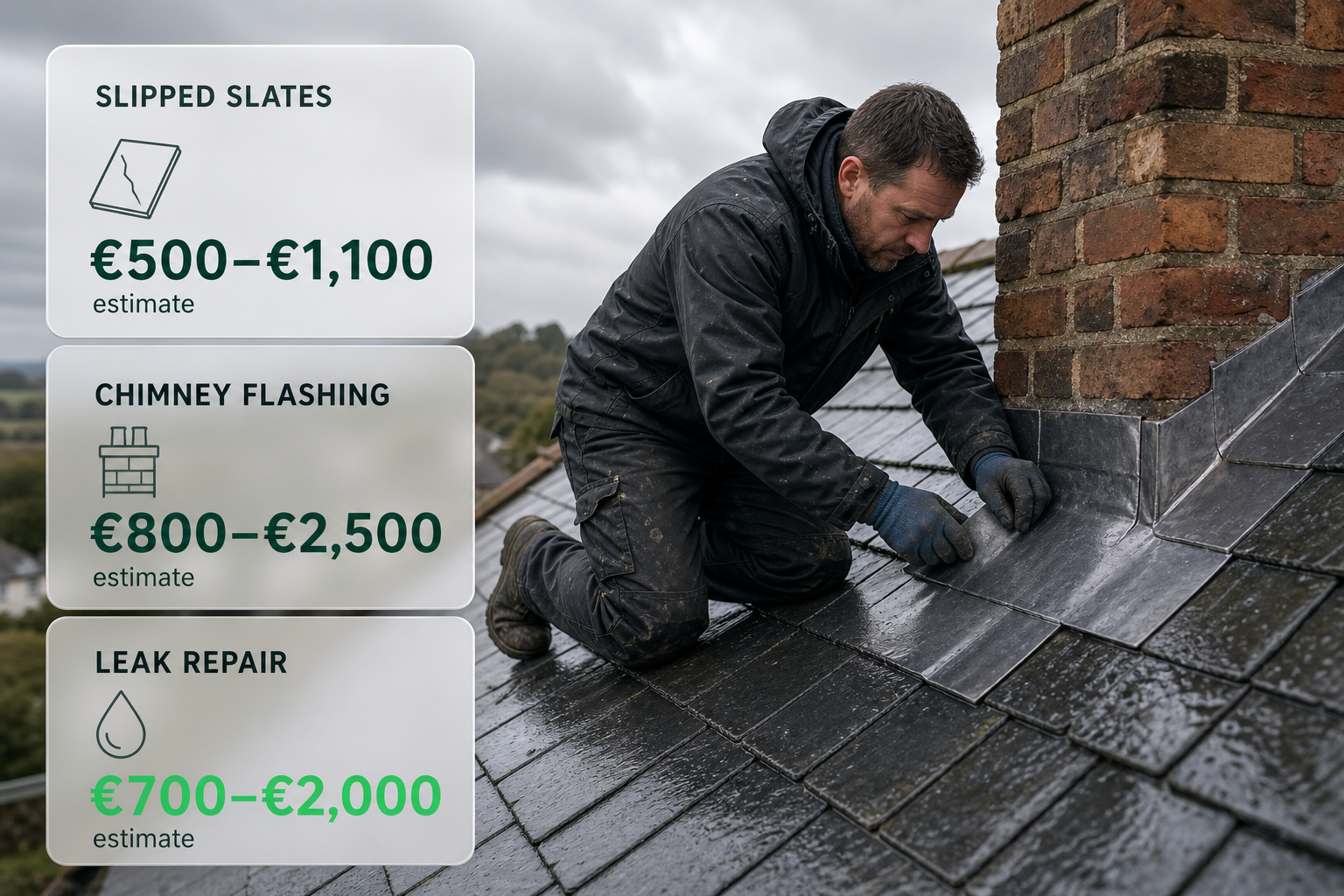
Roof repair prices
Many roofs that leak do not need replacing. The figures below are an aggregate Irish market estimate for common repairs, VAT included.
| Repair | Typical price |
|---|---|
| Replacing a few slipped or broken slates or tiles | €500–€1,100 |
| Finding and fixing a leak | €700–€2,000 |
| Repointing or replacing the ridge, or fitting a dry ridge system | €600–€2,000 |
| Replacing lead flashing around a chimney | €800–€2,500 |
| Renewing a lead or GRP valley | €800–€2,500 |
| Storm damage repair | €900–€4,000+ |
| Flat roof repair | €800–€3,500 |
Most of the cost of a small repair is access and labour rather than materials. Scaffolding or a cherry picker can cost as much as the repair itself, so it is worth asking the roofer to check and fix everything else while the access is in place.
Repair or replace?
A roof covering in Ireland usually lasts 40 to 60 years for concrete tiles, 50 years or more for clay tiles and well beyond that for good natural slate, but the nails, battens and felt underneath often fail first. Common signs that replacement is the better value:
- Repairs keep coming back, especially in different places after each storm.
- Nail fatigue on a slate roof, where slates slip one after another because the fixings have rusted through.
- Sagging between rafters, which can point to rotten battens or timbers.
- Old bitumen felt that has perished, letting water reach the timbers under any slipped slate.
- Asbestos cement slates that are cracking, which need specialist removal rather than repair.
A practical rule used by many roofers is that once repairs over a few years start approaching 40 to 50 percent of the cost of a new roof, replacement is usually the better spend. A roofer's photos of the underside of the roof, taken from the attic, are the most useful evidence when comparing advice.
What drives the price
- Roof area and pitch. Price follows square metres, and steep roofs take longer and need more safety equipment.
- Material. Natural slate costs most and takes longest to fit; concrete tiles are the usual budget choice. The trade-offs between materials are compared in roof tile and slate in Ireland.
- Complexity. Hips, valleys, dormers, rooflights and chimneys all add cutting, lead work and time.
- Access and scaffolding. Terraced streets, steep sites and three-storey houses need more scaffolding.
- What is under the covering. Rotten battens or rafters, or the need for new breathable membrane, add to the bill once the roof is stripped.
- Chimneys. Repointing, new flashing, a new cap or taking a redundant chimney down below the roofline are often added at the same time.
- Location. Dublin quotes tend to be higher than in the rest of the country.
A typical pitched roof replacement takes about 3 to 10 working days, weather permitting. A good roofer keeps the roof weathertight each evening with temporary sheeting.