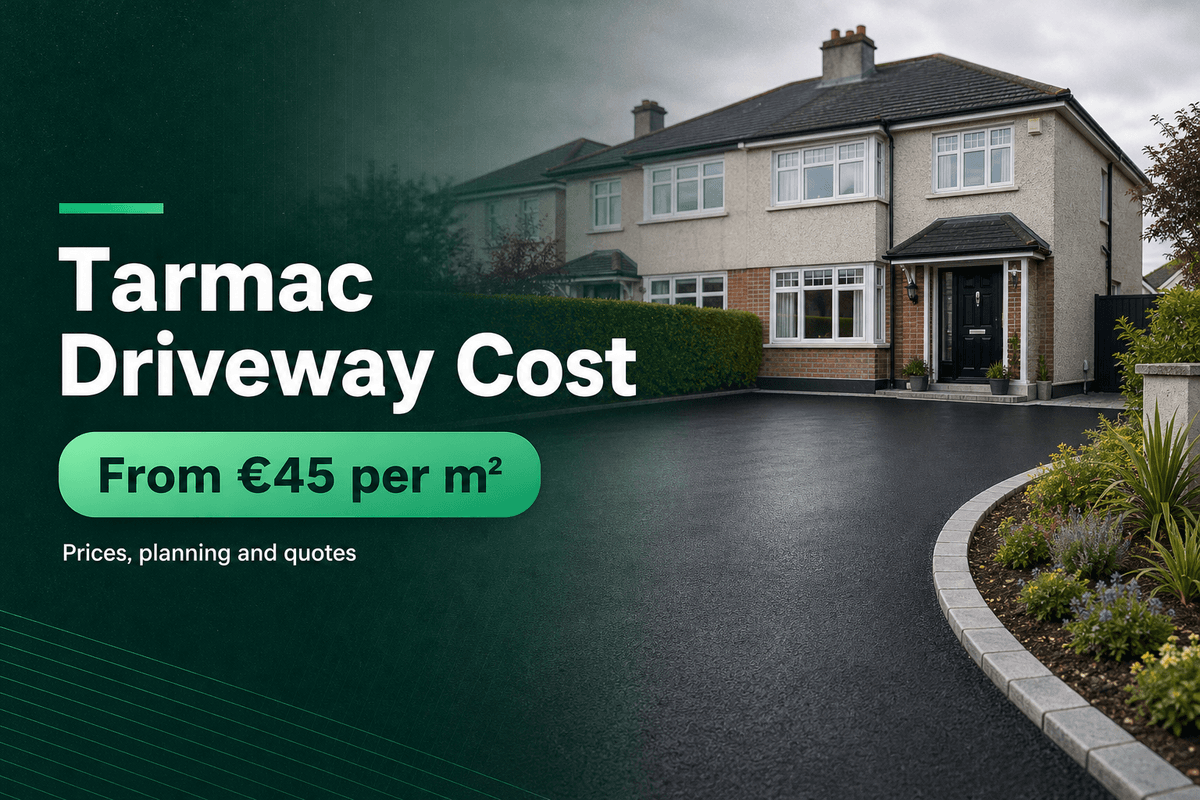
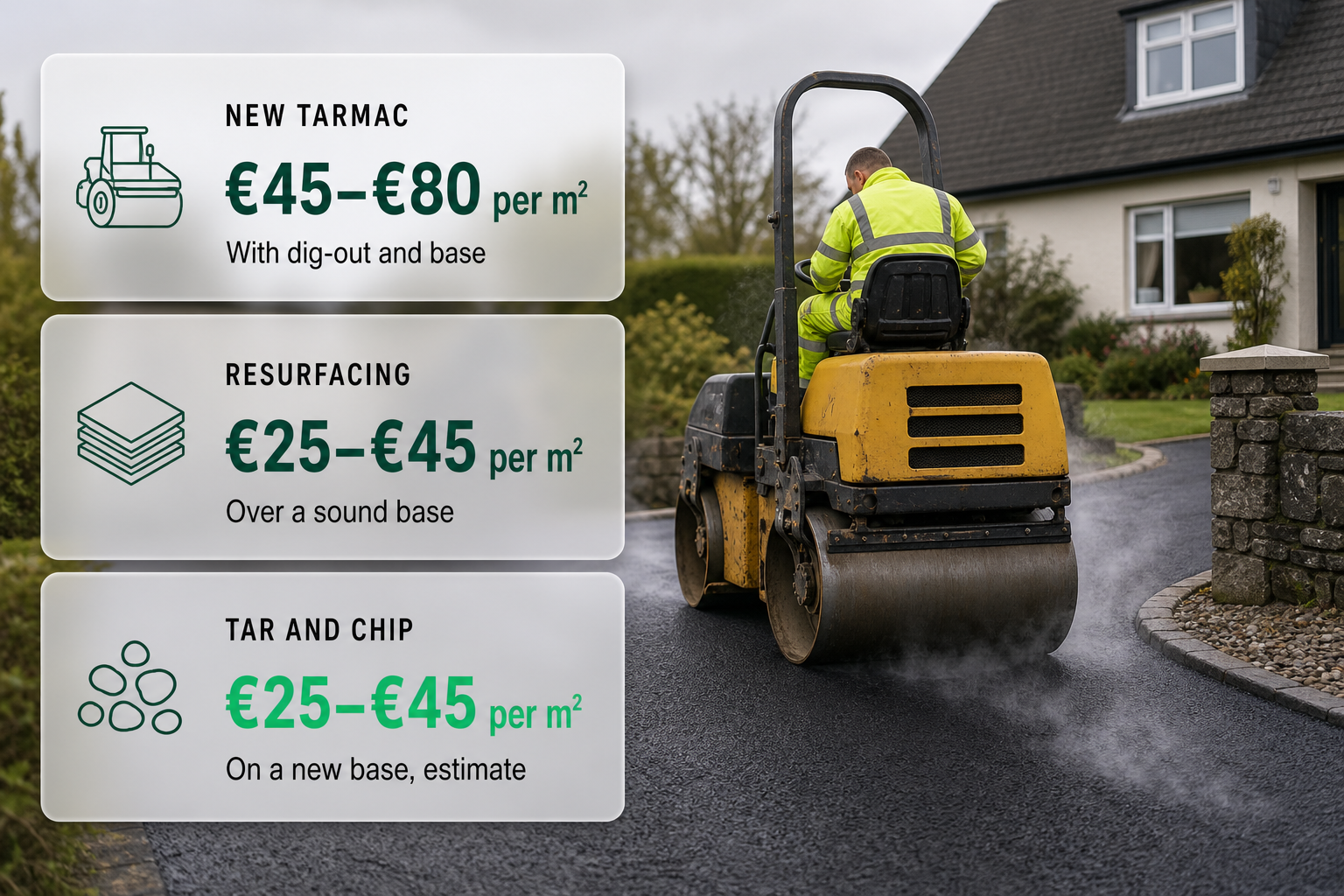
A new tarmac driveway in Ireland usually costs €45 to €80 per square metre, as an aggregate Irish market estimate including VAT, excavation, a new stone base and edging. For a typical 40 to 50 m² driveway in front of a semi-detached house, that works out at roughly €2,000 to €4,000. Resurfacing an existing tarmac drive that has a sound base is cheaper, at about €25 to €45 per m², and tar and chip, the rural favourite, usually costs €25 to €45 per m² laid on a new base. The things that move the price most are the size of the area, how much digging the old surface needs, drainage, and whether a new or wider entrance onto the road is involved. Homeowners comparing options can post the job under driveways and paving and get quotes from local contractors.
Tarmac driveway prices at a glance
The figures below are an aggregate Irish market estimate, VAT included, for a domestic driveway with normal access.
| Work | Typical price |
|---|---|
| New tarmac driveway, including dig-out and stone base | €45–€80 per m² |
| Resurfacing over a sound existing base | €25–€45 per m² |
| Tar and chip on a new base | €25–€45 per m² |
| Small driveway, about 25 m² | €1,300–€2,200 |
| Medium driveway, about 50 m² | €2,400–€4,000 |
| Large or rural driveway, about 100 m² | €4,500–€7,500 |
| Kerb or edging, supplied and fitted | €25–€50 per metre |
| Drainage channel with grating across the drive | €60–€120 per metre |
| Patch repair of potholes and cracks | €150–€600 per visit |
For comparison, one Irish builders' merchant puts installed tarmac at around €40 to €70 per m², block paving at €60 to €120 and concrete at €60 to €110, with gravel the cheapest at €20 to €40 (McMahons). Tarmac sits at the lower end of hard-wearing surfaces, which is why it remains one of the most common choices for Irish driveways.
A worked example: a semi-detached house in Cork with a 45 m² front driveway of broken concrete. Breaking out and removing the old surface costs about €500 to €1,000, a new compacted stone base and two layers of tarmac about €1,800 to €3,000, and new granite-effect kerbs along 15 metres €400 to €750. A drainage channel at the gate adds €250 to €450. The total lands at roughly €2,950 to €5,200. If the old concrete had been sound and level, an overlay could have saved the dig-out and much of the base cost.
Tarmac, tar and chip, block paving or concrete?
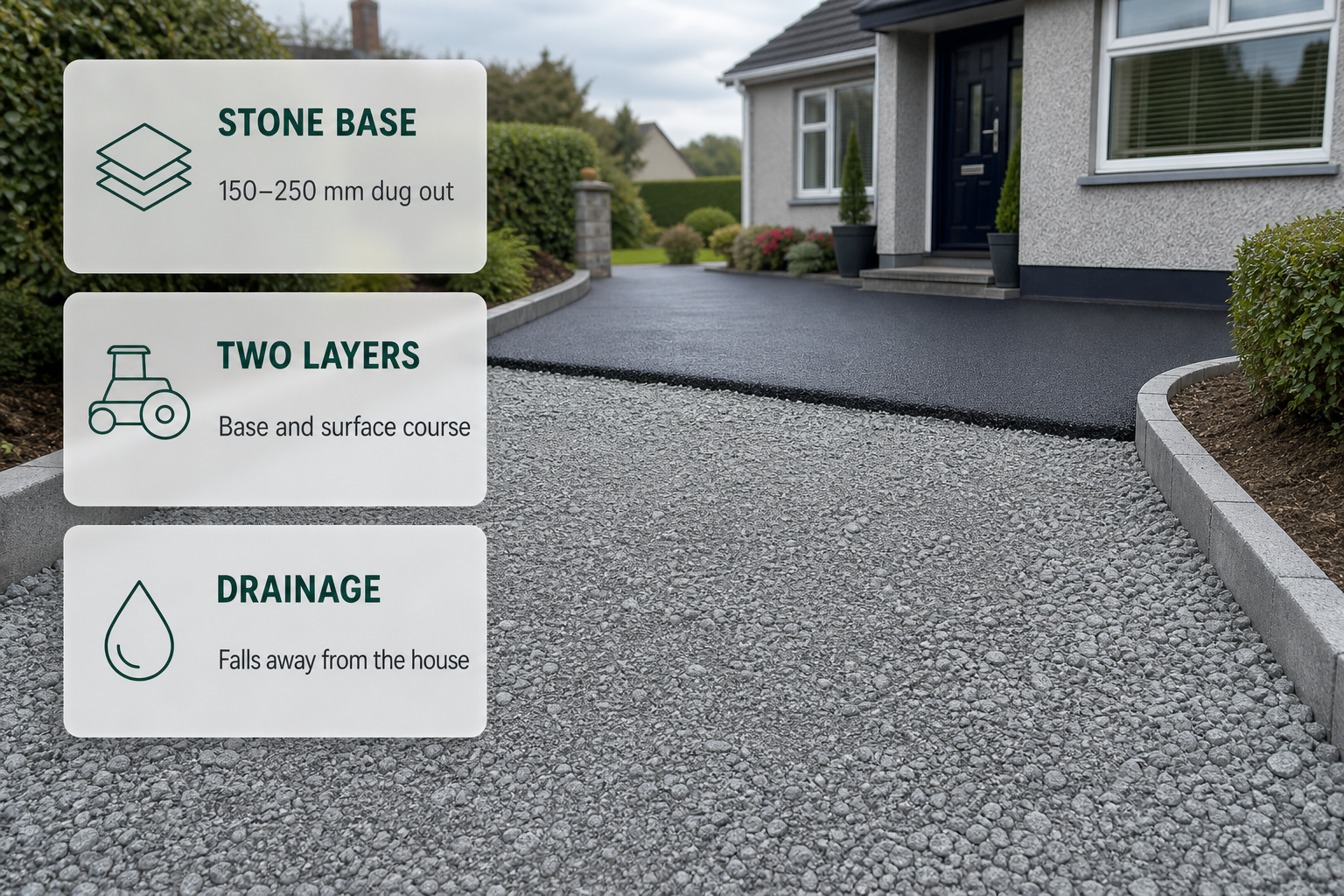
Tarmac (tarmacadam or asphalt) is laid hot in two layers, a base course and a finer surface course, on top of compacted stone. It is quick to lay, usually in one or two days, can be driven on within a day or two, and is easy to patch. It can soften in very hot weather, marks under car jacks and motorbike stands, and turns grey with age.
Tar and chip is hot bitumen sprayed over a stone base with loose chippings rolled into it. It is common on long rural driveways because it covers a large area cheaply and gives a natural gravel look with better grip than loose stone. It wears faster than tarmac and often needs a fresh coat after some years.
Block paving costs more and takes longer to lay, but individual blocks can be lifted and relaid, and it offers far more choice of colour and pattern. It needs weeding and occasional resanding of the joints. Typical prices are set out in the block paving driveway cost guide.
Concrete is hard-wearing and low-maintenance but prone to cracking if the base or joints are poor, and repairs are hard to hide.
Gravel is the cheapest surface and naturally lets water drain through, but stones spread onto the road and lawn and it is awkward for buggies and wheelchairs.
A simple rule: tarmac suits a busy family driveway on a budget, tar and chip a long rural lane, block paving a front garden where looks matter most, and gravel a large area where drainage is the priority.
What a proper tarmac driveway involves
The finished surface is only the top few centimetres. Most of the cost and most of the difference between a good and a poor job sits underneath:
- Dig-out. The old surface and soft soil are removed, usually to a depth of 150 to 250 mm.
- Membrane. A geotextile layer separates the soil from the stone, so the base does not sink into the ground.
- Stone base. Clause 804 or similar crushed stone is laid in layers and compacted with a roller or plate.
- Edging. Kerbs or edging hold the tarmac in place; without them, the edges crumble.
- Base course. A thicker, coarser layer of tarmac.
- Surface course. A finer top layer, rolled while hot, giving the smooth finish.
- Falls and drainage. The drive should slope away from the house so water runs to a channel, a gully or a soft area, not to the front door.
Quotes that skip the membrane, use a thin base or lay a single thin layer of tarmac straight onto soil can look much cheaper, but such driveways tend to sink, rut and crack within a few years.
Do you need planning permission?
Resurfacing an existing driveway with tarmac usually does not need planning permission. The rules change when the entrance onto the road changes. According to Dublin City Council, planning permission is needed to create a new dishing or to widen an existing vehicular dishing at the entrance to a property. Where an entrance has been used for at least seven years, a sworn affidavit can be used instead, and the dishing is then limited to a maximum width of 3.6 metres.
Dublin City Council carries out the footpath dishing itself, at the homeowner's expense: €611.60 for a standard domestic dishing up to 7 m², and €87.40 per additional square metre for larger ones. Granite kerbs and specialist paving cost more. Other councils run similar schemes with their own fees, so the local council is the place to check before booking the work.
Councils also pay attention to drainage. The Dublin City Council advisory booklet on parking cars in front gardens says entrance openings should be between 2.5 and 3.6 metres wide without outward-opening gates, and that large unrelieved areas of impermeable paving will not be considered acceptable in planning proposals. It encourages leaving space for planting and using permeable surfaces such as gravel and green areas. In practice, a tarmac driveway that includes a planted strip or a gravel border, and drains to a soakaway rather than onto the road, is easier to get approved where permission is needed.