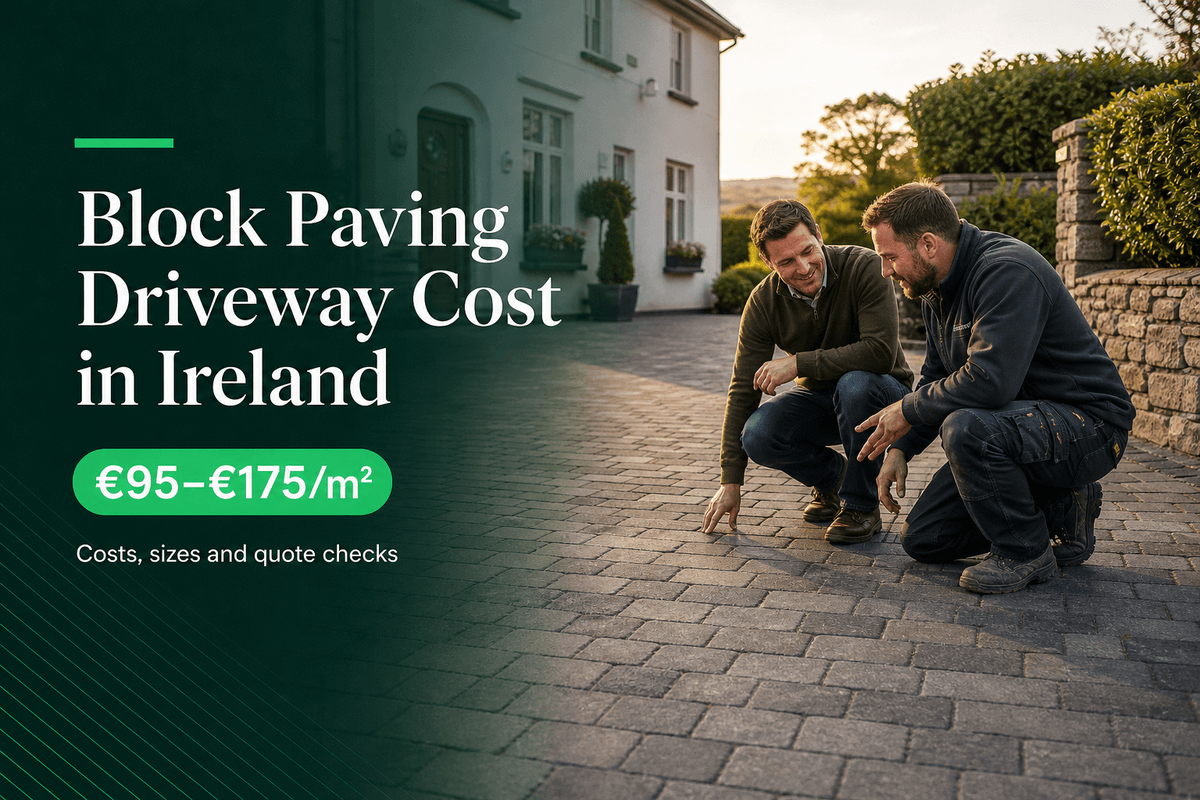
A block paving driveway in Ireland costs €95–€175 per m², so a typical 40 m² drive comes in at €3,800–€7,000 and a 70 m² drive at €6,650–€12,250. That figure covers excavation, sub-base stone, blocks, laying and clean-down on a site with reasonable access; removing an old surface, extra drainage and stepped entrances are normally charged on top. How the rate breaks down, what pushes a job towards the top of the range, and how to tell a complete quote from a thin one are set out below.
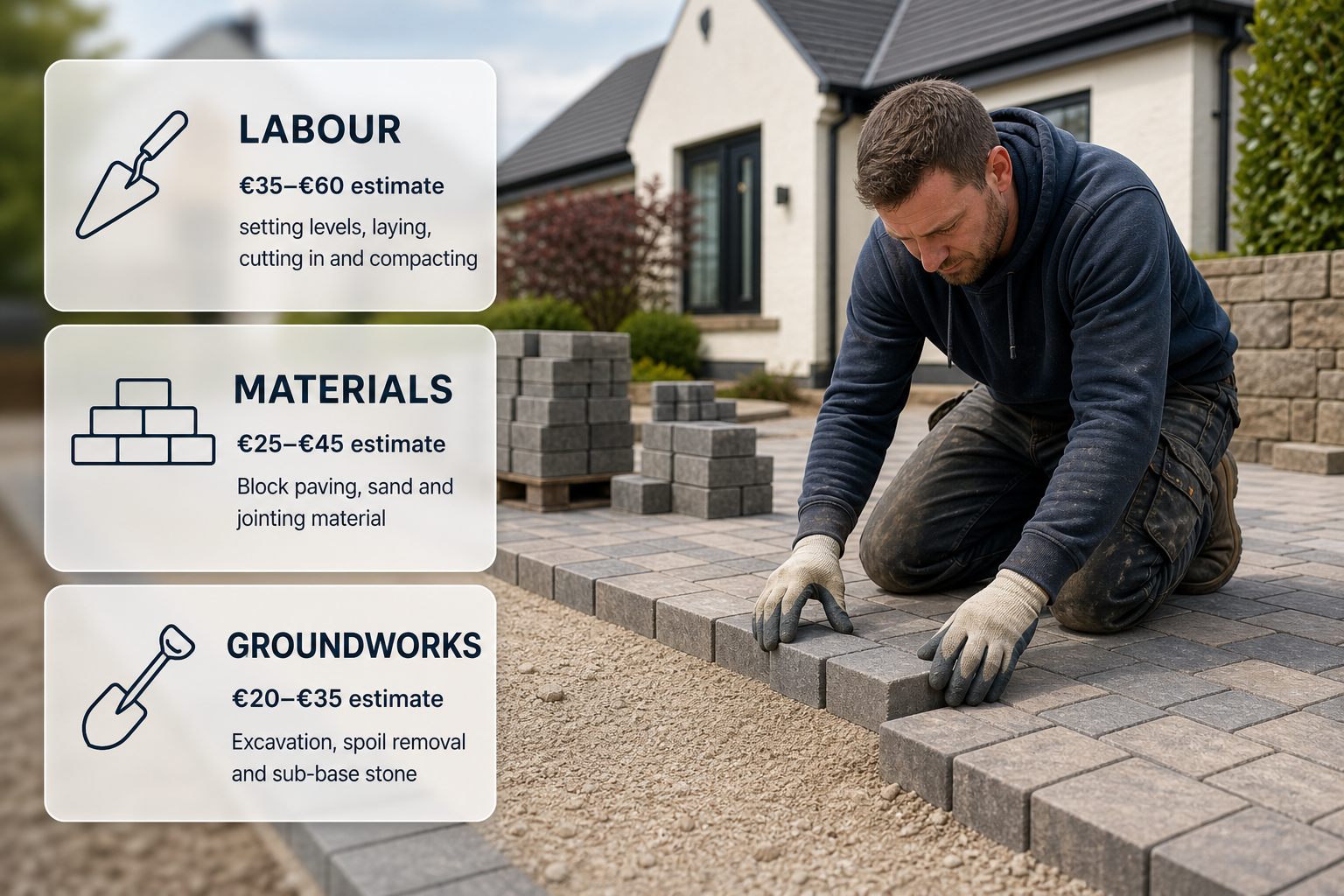
Block paving driveway cost per square metre
The figures below assume a straightforward block paving driveway installation on a fairly level site, with machinery access and at least 20 m² of paving.
The following is an aggregate Irish market estimate for a domestic driveway in Ireland.
| What the line covers | Typical range per m² |
|---|---|
| Labour only: setting levels, laying, cutting in and compacting | €35–€60 |
| Block paving, sand and jointing material | €25–€45 |
| Excavation, spoil removal and sub-base stone | €20–€35 |
| Edging, kerbs, restraints and cutting | €10–€25 |
| Drainage, falls and final clean-down | €5–€10 |
Those five lines add up to the headline rate of €95–€175 per m². At the lower end, the installer is usually working to existing levels, digging shallow, taking away little spoil and laying a simple rectangle with no steps. At the upper end, expect deeper excavation, more stone, a longer drainage run, more cutting around corners and a steeper fall to work with.
Jobs under about 20 m² are usually priced at the top of the per-square-metre range, because a machine, a minimum load of stone and a day's labour cost much the same whether the driveway is 12 m² or 20 m².
Example totals for small, medium and large driveways
Using the same aggregate Irish market estimate, whole-job totals work out as follows.
- Small driveway, about 20 m²: €1,900–€3,500
- Medium driveway, about 40 m²: €3,800–€7,000
- Large driveway, about 70 m²: €6,650–€12,250
Worked example: a 30 m² driveway sits between the small and medium cases at €2,850–€5,250 before extras.
These totals assume reasonably level ground, machine access and no major surprises below the surface. Where the driveway already exists, removing the old surface is an added cost rather than a saving against the paving itself.
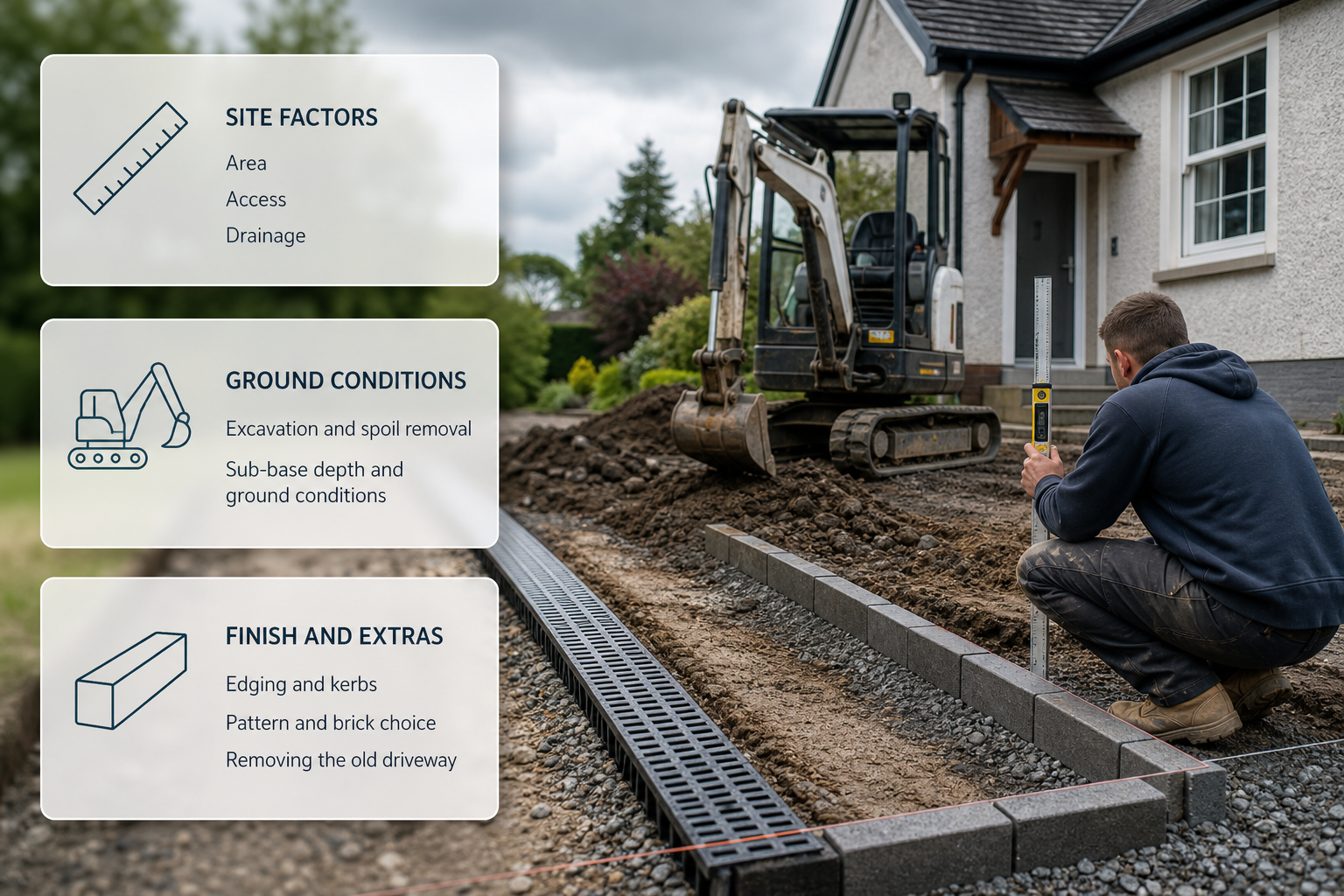
What drives the price up or down
A driveway is a groundworks job before it is a paving job, so it is priced the way other construction and home renovation work is priced: measured quantities, machine time and disposal.
Area. Paving is priced per square metre, but larger jobs carry a keener rate because machine hire, delivery of stone and setting up are spread over more paving. A 70 m² driveway costs more in total than a 20 m² driveway, yet each square metre is usually cheapest on the bigger job.
Excavation and spoil removal. Every driveway starts with digging out the old surface, topsoil or soft ground, and the spoil has to leave the site. Skip hire, grab lorry loads or a waste facility charge are real costs, and they rise with depth. Where spoil can be spread across a garden or field, the bill falls.
Sub-base depth and ground conditions. The blocks sit on a compacted stone sub-base topped with a levelling layer of sand. Soft or made-up ground, buried rubble, tree roots or a slope all mean a deeper dig and more stone, and more stone means more spoil to cart away. A driveway that needs a deeper sub-base than usual is the most common reason a quote lands above the headline rate.
Drainage. Water has to leave the driveway. Falls away from the house, a channel drain across the entrance or a soakaway where the ground is heavy all add work. A driveway that slopes towards the house needs a channel drain at the very least, which pushes the job towards the upper end of the scale.
Edging and kerbs. Block paving needs a restraint on every open edge, otherwise it creeps and spreads. Kerbs, edging blocks, haunching and the extra cutting they involve are often left out of cheap quotes and added later.
Pattern and brick choice. A simple stretcher bond in a standard block is the least expensive way to lay paving. Tumbled or riven finishes, curved patterns, contrasting borders and thicker pavers cost more in material and in time.
Access. Where a machine can reach the driveway, the dig is quick. Where the entrance is narrow, the ground slopes or the only route runs through a garage, everything is barrowed by hand and labour time climbs steeply. Access is the biggest single reason two quotes for the same driveway can differ substantially.
Removing the old driveway. Breaking out a concrete slab, lifting tarmac or pulling up old blocks adds labour and disposal. Concrete is the heaviest and most expensive of the three to remove.
The extras below sit outside the per-square-metre rate and are likewise an aggregate Irish market estimate.
- Removal of an existing driveway, including breaking out and disposal: €1,500–€4,000
- Extra drainage, such as a channel drain across the entrance or a new soakaway: €600–€1,800
- Stepped or ramped access, priced per step: €150–€400 per step
- Contingency for unforeseen ground or drainage work: 5–10% of the total