Land Drainage Cost Per Metre: Irish Field Drain Guide
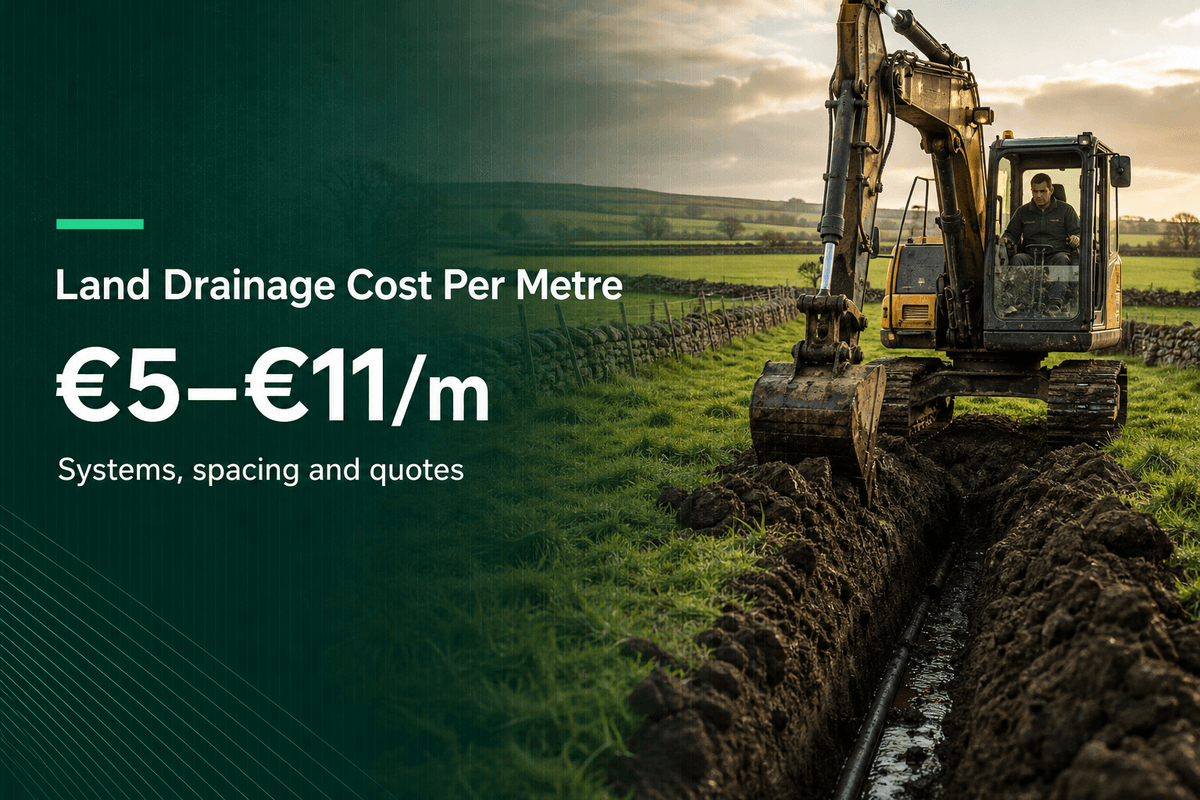
Field drains run from €5 to €7 per metre and groundwater drains €8 to €11, with spacing deciding the cost per hectare.
/7 min read
Land drainage in Ireland generally runs at €5 to €7 per metre for conventional piped field drains, €8 to €11 per metre for groundwater drains and €5 to €7 per metre for collector drains, as an aggregate Irish market estimate drawn from Teagasc guide figures. Those are guide figures rather than live quotations, so current contractor quotes can come in higher where stone, fuel and machine hire have risen. For farmers and owners of fields, paddocks and large rural sites, the per-metre rate is only half the sum: spacing sets how many metres a hectare needs, and depth, soil and ground conditions set what each of those metres costs.
What Each System Is, and When It Is Used
Conventional piped field drains. These are the standard answer on heavy, sticky soils where water sits close to the surface. A network of narrow trenches is cut across the slope, a pipe is laid in each trench and the trench is backfilled with stone to form a permeable channel, so water that would otherwise sit in the top layer of soil can move away. They suit a shallow problem in slow-draining subsoil.
Groundwater drains. Where the wetness comes from below, and a permeable layer lies deeper down feeding springs or seepage to the surface, shallow laterals will not solve it. Groundwater drains are cut deeper to tap that layer and draw the water up and away. They take longer to dig and use more stone per metre, which is the main reason they sit at a higher rate per metre than conventional piped drains.
Collector drains. Collector drains are the main arteries. The laterals feed into them and they carry the water off the field towards the outfall. They account for far fewer metres than the laterals, but those metres often run through the wettest, softest ground or cross a boundary, so they can be the slowest part of the job to finish.
Anyone weighing up several fields at once can get quotes for land drainage services once the layout has been sketched, because a contractor prices metres, spacing and outfall distance rather than hectares alone.
Converting Metres of Drain Into Hectares and Acres
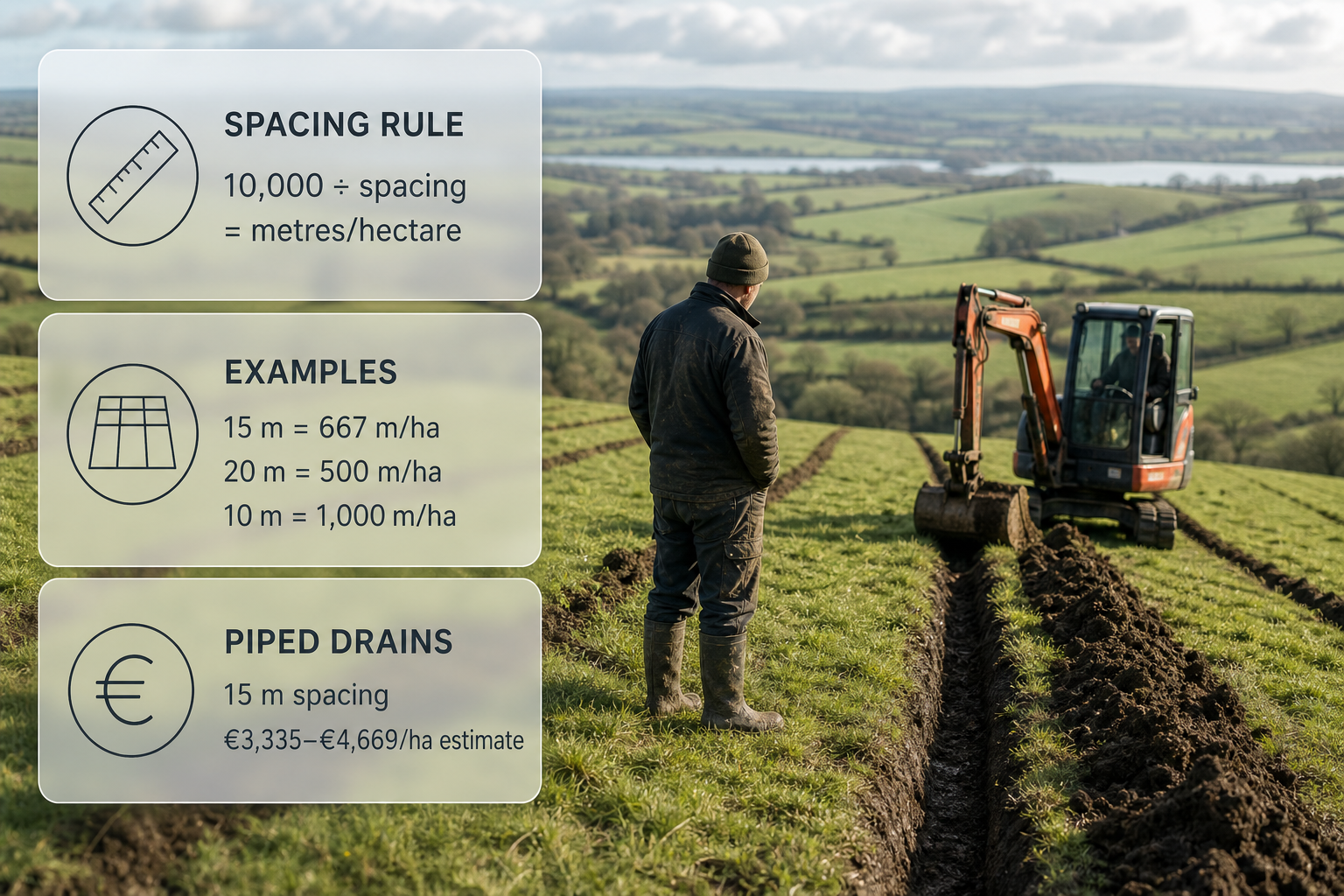
The conversion rule is simple enough to reuse: metres of drain per hectare equals 10,000 divided by the drain spacing in metres. Drains every 15 metres therefore need 10,000 ÷ 15 = 667 metres per hectare, the figure usually rounded to about 670 metres; drains every 20 metres need 500 metres per hectare; and drains every 10 metres need 1,000 metres per hectare.
The worked examples below are an aggregate Irish market estimate, built only from the Teagasc per-metre ranges. Taking a hectare as 2.47 acres:
Piped drains at a 15-metre spacing: 667 metres × €5 to €7 per metre = €3,335 to €4,669 per hectare, or about €1,350 to €1,890 per acre (roughly 270 metres of drain per acre).
Piped drains at a 10-metre spacing: 1,000 metres × €5 to €7 per metre = €5,000 to €7,000 per hectare, or about €2,025 to €2,835 per acre (roughly 405 metres per acre).
Groundwater drains at a 20-metre spacing: 500 metres × €8 to €11 per metre = €4,000 to €5,500 per hectare, or about €1,620 to €2,230 per acre (roughly 202 metres per acre).
Collector drains are additional to these figures, because they run on top of the lateral network rather than replacing part of it.
Cost Per Metre by System
The table below is an aggregate Irish market estimate based on the same Teagasc guide figures.
System
Cost per metre
Typical use
Main cost risk
Conventional piped field drains
€5 to €7 per metre
Heavy soils where water sits close to the surface
Trench depth and the volume of stone needed
Groundwater drains
€8 to €11 per metre
Deeper permeable layer that has to be tapped
Greater depth, slower digging and more stone
Collector drains
€5 to €7 per metre
Carrying water from the laterals to the outfall
Distance to a working outfall and bad ground
What Moves the Price
Depth. Every extra few centimetres of trench means more machine time, more pipe and more stone along the same metre, so two fields with identical layouts can price very differently.
Spacing. A tighter layout does not change the rate per metre, but it changes how many metres a hectare carries. Dropping from a 20-metre spacing to a 10-metre spacing doubles the metres, so the per-hectare bill doubles even if the contractor's rate stays flat.
Soil and stone. Heavy clay needs a generous stone surround to work properly, rock or a hard pan slows the digger to a crawl, and sandy ground can need different pipe bedding. Stone usually has to be hauled in, and haulage distance is charged.
Distance to a working outfall. The outfall is where the water finally leaves the field. If it is far away, blocked, or sits below the level of the field being drained, extra metres and extra excavation are needed to make the system work.
Access and ground conditions. Narrow gaps, steep slopes, soft patches where a machine sinks and wet ground that has to be travelled over all add time and add reinstatement afterwards.
Time of year. Late summer and early autumn, when the ground is driest and grazing can be managed around the work, is the cheapest window. Winter work in saturated ground costs more and causes more damage.
What a Full Quote Should List
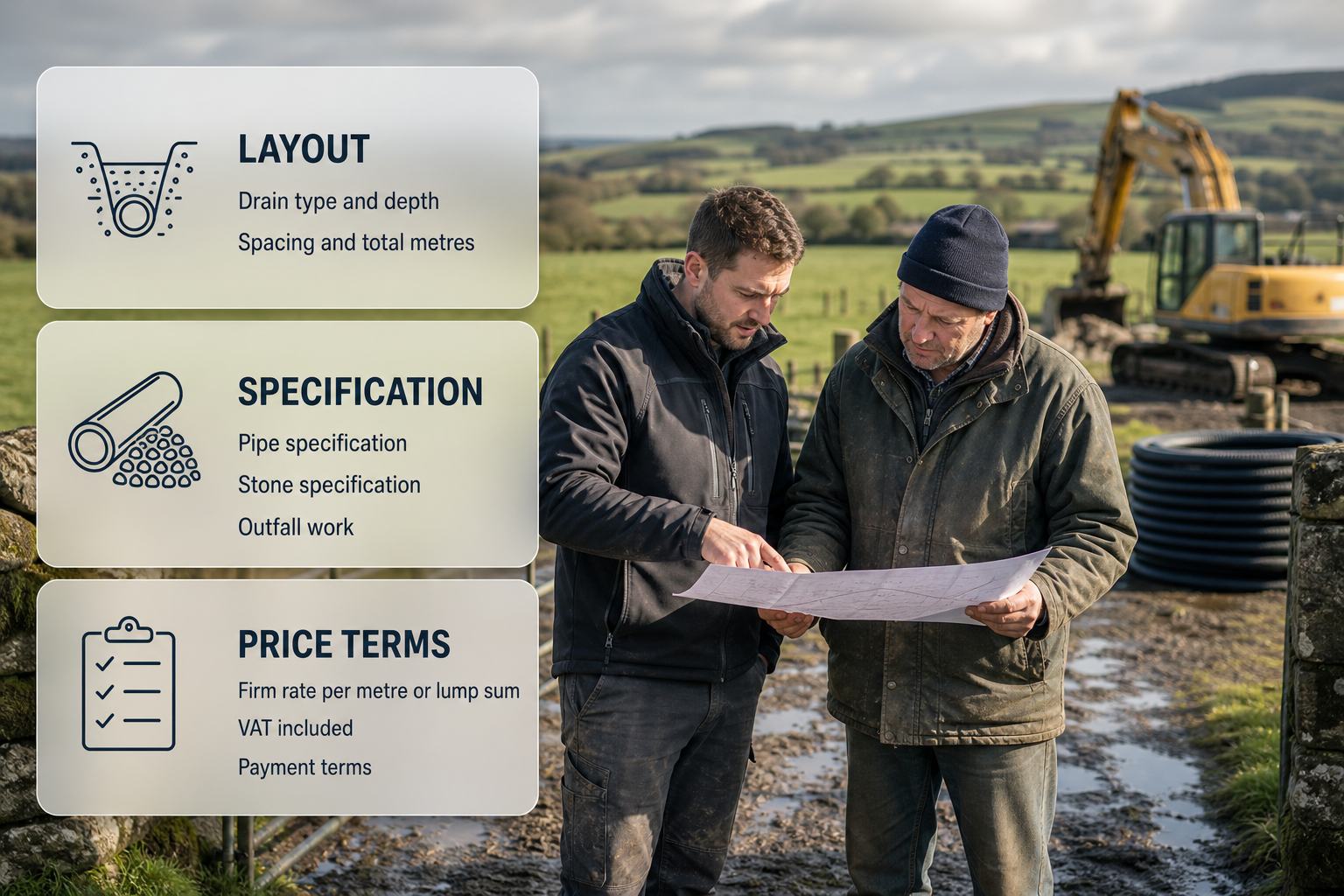
A per-metre rate on its own is not a quote. A complete one sets out the drain type and depth, the spacing and the total metres assumed, the pipe specification and the stone specification, the outfall work, and reinstatement of the ground afterwards. It should also say whether the price is a firm rate per metre or a lump sum, what is excluded (stone haulage, rock breaking, fencing, gateways), whether VAT is included, and the payment terms.
Comparing quotes only works when the layouts match. Two contractors pricing different spacings, different depths or different stone volumes are not really competing on price at all, and the lower figure may simply describe a lighter job. Holdings with several fields to do in the same season can list the work under agriculture and rural services and ask every contractor to price the same metres, spacing and depth so the numbers line up.
Why a Site Investigation Comes Before Any Price
A price given before anyone has looked at the ground is a guess. The usual approach is a handful of test pits dug with an excavator at representative points across the field, which lets the contractor read the soil profile: how deep the topsoil runs, which layer is holding the water, where the permeable layer sits, and how the slope falls towards the outfall. The outfall level and condition are checked at the same time.
Only then can spacing and depth be designed, and only then does the per-metre rate turn into a real figure. On a farm, a soil map and the location of older drains are useful starting points, but neither replaces a pit. Skipping this step usually produces one of two outcomes: a padded price that covers the contractor's uncertainty, or a cheap price for a system that will not fix the wet patch.
Two checks sit alongside the price on bigger jobs. Drainage of more than 15 hectares of agricultural land has to be screened for environmental impact assessment by the Department of Agriculture, Food and the Marine before work starts, and any work that builds or alters a watercourse, such as a new outfall into a stream, can need consent from the OPW.
Getting Land Drainage Quotes
Posting a job and listing on ShamFix is free, with no commission, and a subscription is planned for the future. ShamFix does not check or certify tradespeople; profiles are filled in by tradespeople themselves, so landowners should check registrations themselves and read reviews before agreeing to work. A job can be posted, with the field size, the spacing discussed and the outfall location, at ShamFix. Waterlogged gardens, patios and small domestic lawns are a different job from field drainage, and a field rate per metre will not describe them; garden drainage problems covers that side.
FAQ
Does the per-metre rate cover the pipe and the stone?
Sometimes, and sometimes not. Some contractors quote an all-in figure that includes pipe, stone, haulage and backfilling, while others quote the digging and laying only and charge the materials separately. Ask each one to state clearly what is inside the rate and what is extra, then compare the totals rather than the headline rate.
Is it cheaper to drain a whole field in one go?
Usually, yes. Getting a machine and a stone delivery to the site is a fixed cost whether the job runs for one day or four, so more metres in the same visit spreads that cost. The limit is the weather: pushing a long job into wet ground causes more damage, more reinstatement and often a higher final bill.
How deep do field drains need to be?
Depth follows the soil profile, not a set number. Piped laterals that deal with a shallow problem sit relatively close to the surface, while groundwater drains have to reach the permeable layer feeding the wetness, which can be considerably deeper. The test pit tells the contractor which situation applies, and depth is one of the strongest influences on the final rate per metre.
What spacing should be used?
Spacing depends on soil type, rainfall and slope. A 15-metre spacing is common on heavy ground and 20 metres is more typical on freer draining soils, with tighter layouts reserved for the wettest fields. To see the effect on the bill, divide 10,000 by the spacing: the answer is the metres of drain each hectare will carry.
When is the best time of year to drain a field?
Late summer and early autumn usually give the driest ground and the least damage to grazing. Spring can work on dry, free-draining sites but leaves less room for the grass to recover before the season ends. Mid-winter work in saturated clay is possible, but it is the most expensive time to be moving machinery across a field.