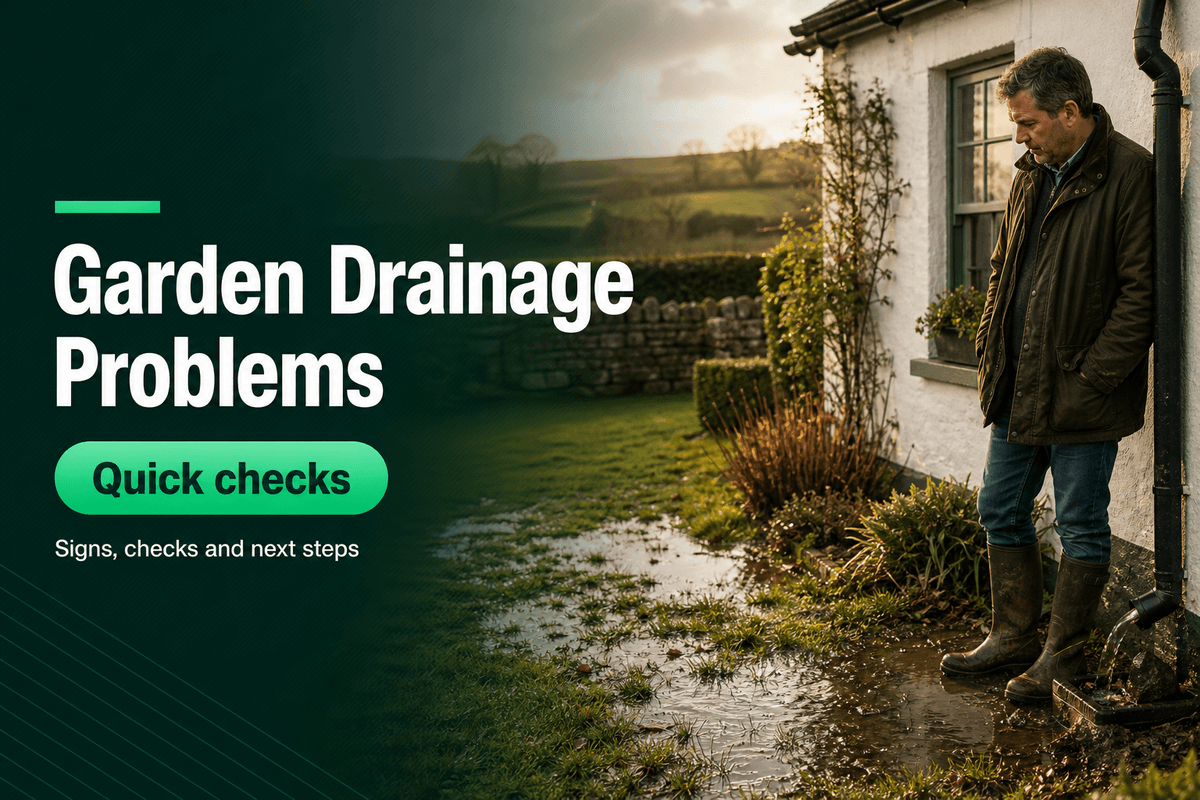
Work out whether your waterlogged garden is surface runoff, a blocked drain or a soakaway problem, and the safe checks to make before calling anyone.
/8 min read
Garden drainage problems in Ireland usually come down to one of three things: surface water that cannot soak away, a private drain that is blocked, or a soakaway or percolation area that has stopped working. Getting that first call right matters, because each one needs different skills, different equipment and a different kind of budget. This guide covers the signs of each, the safe checks a homeowner can make, the responsibility split for blocked drains, and what to do next.
Surface water runoff or a blocked drain?
The quickest way to separate the two is to ask whether the water has nowhere to go, or a route it cannot use.
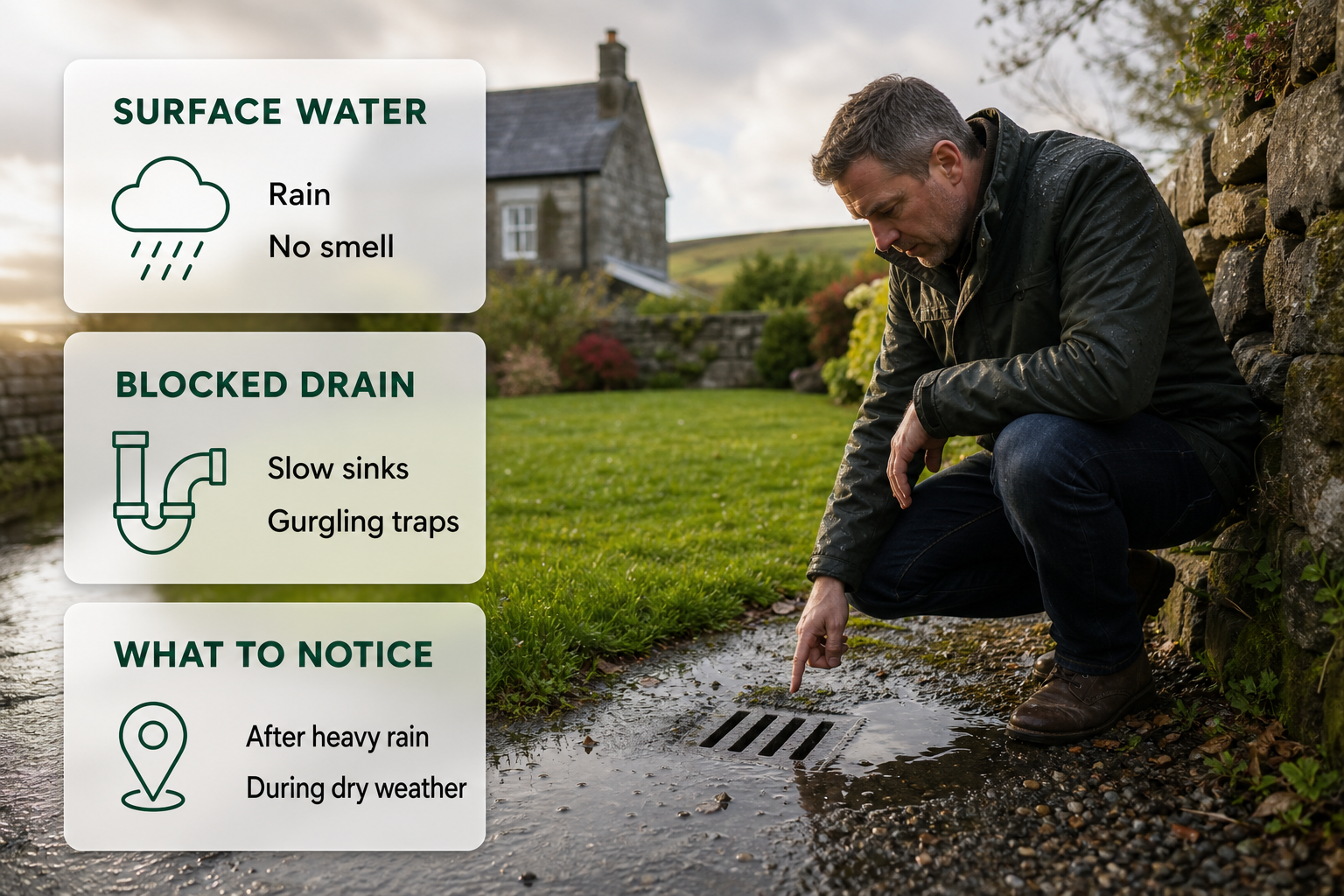
Surface water trouble is about rain with nowhere to go. It shows up during or shortly after heavy rain, often in a low corner of the garden, along a boundary, or on a lawn that has been compacted by foot traffic or machinery. It may clear slowly over the following days, but it usually does not smell, and it does not back up inside the house. A failed soakaway behaves in the same family of ways, which is why it is so often mistaken for poor soil.
A blocked drain is different. A route exists — a gully, a pipe, an inspection chamber — but water or wastewater cannot move along it. The giveaway signs are about flow and smell rather than weather: slow sinks, gurgling traps, water rising in a gully when a tap runs, or an odour near a manhole. It can happen in dry weather because it follows household use, not rainfall.
A simple rule of thumb: if the problem is tied to rainfall and there is no odour, start with surface water. If it is tied to taps, showers, toilets or the washing machine, or if it smells, start with a drain blockage. Groundworks such as regrading, surface water channels, French drains or a new soakaway fall under landscaping and construction work rather than drain clearing.
Signs that point to surface water runoff
A lawn, gravel area or patio turns spongy or ponds after heavy rain, then recovers.
Water collects at the lowest point of the garden, against a wall, or where two slopes meet.
Downpipes, patio falls or driveway runoff discharge onto a lawn instead of into a drain or soakaway.
The ground is heavy clay or compacted, so water sits on top instead of filtering down.
There is no sewage smell, no gurgling inside, and no wastewater backing up.
The problem gets worse in winter and eases during a dry spell.
Teagasc notes that soil drainage poses particular challenges for mineral soils in Ireland and that every drainage challenge is unique, so a solution that suits one garden may not suit the next (Teagasc soil drainage guidance). Soil type, slope, the level of the water table and the condition of any existing soakaway all change the answer.
Signs that point to a blocked drain
Sinks, showers, baths or toilets drain slowly, or several fixtures gurgle at the same time.
Water rises in a gully or inspection chamber when a fixture is used.
There is a sewage or musty smell near a drain, manhole or gully.
Wastewater appears in the garden or on a patio after normal household use.
The problem continues when it has not rained.
Water backs up inside the house, which is the point at which the issue becomes urgent.
Leaves, roots, fat, wipes and damaged pipes are common causes, but the location of the blockage matters as much as the cause. A blockage in a private drain serving one property is handled differently from a blockage in a public sewer, and a flooded garden is not automatically a public sewer problem just because the water is near the boundary.
When a soakaway is the real cause
A soakaway is a buried pit or chamber that takes surface water from downpipes, gullies and channels and lets it filter into the surrounding ground. It is not the same thing as a percolation area for a septic tank, and mixing the two up leads homeowners to call the wrong trade.
Soakaway failure tends to look like surface water trouble that has crept in slowly. Water ponds near the soakaway after rain even when the rest of the garden drains reasonably well. The patch above it stays soft long after the surrounding ground has dried. If a downpipe or patio gully leads to an old soakaway that has silted up, or if the ground around it is saturated, the soakaway is more likely to be the cause than the lawn or the drain.
A percolation area is a different and more serious warning. The Environmental Protection Agency lists ponding in the garden in and around the percolation area as a warning sign of a septic tank system not working properly (EPA waste water inspections and repair). That is a waste water issue, not a landscaping one, and tank covers or chambers should not be opened by an untrained person.
Safe checks before calling a contractor
Everything in this list is visual, done from ground level, and safe. It is not a diagnosis; it is information that helps a contractor quote properly.
Watch the garden during wet weather and again once the ground has had a chance to dry, and note the difference.
Note where water first appears, how deep it gets, how long it takes to clear, and whether it smells.
Clear leaves, moss and silt by hand from visible gullies, channel gratings and downpipe shoes.
Check whether slow fixtures, gurgling or smells happen at the same time as garden flooding.
Look from a safe distance at any known soakaway or percolation area, without digging or opening covers.
Keep children and pets away from standing water, especially anywhere near a waste water system.
Take dated photographs and note the weather in the days beforehand.
Do not dig test holes, rod a public sewer, open a septic tank or enter an inspection chamber. If water is anywhere near sockets, external lights, cables or a boiler, stay clear and get qualified help. If wastewater is backing up into the house, treat it as urgent. For work that goes beyond clearing a visible gully, the type of project can be compared under the construction and home renovation parent category before quotes are sought.
Who is responsible for a blocked drain?
Responsibility depends on where the blockage is. Uisce Éireann states that blocked drains can cause flooding and damage to a home, and that responsibility depends on the location of the blockage (Uisce Éireann guidance on blockages). The practical question is therefore whether the affected drain serves only the property or forms part of the public network.
Uisce Éireann is the statutory body responsible for managing and delivering water services to homes and businesses in Ireland (Local Government Ireland water services). If it is not clear whether a drain is private or public, the sensible step is to contact Uisce Éireann and describe exactly what is happening and where the water is appearing. Any proposal to connect garden drainage or surface water to a public sewer must be checked with Uisce Éireann and, where relevant, the local authority before any work starts. It is not something to settle by digging first and asking afterwards.
What drainage work tends to cost
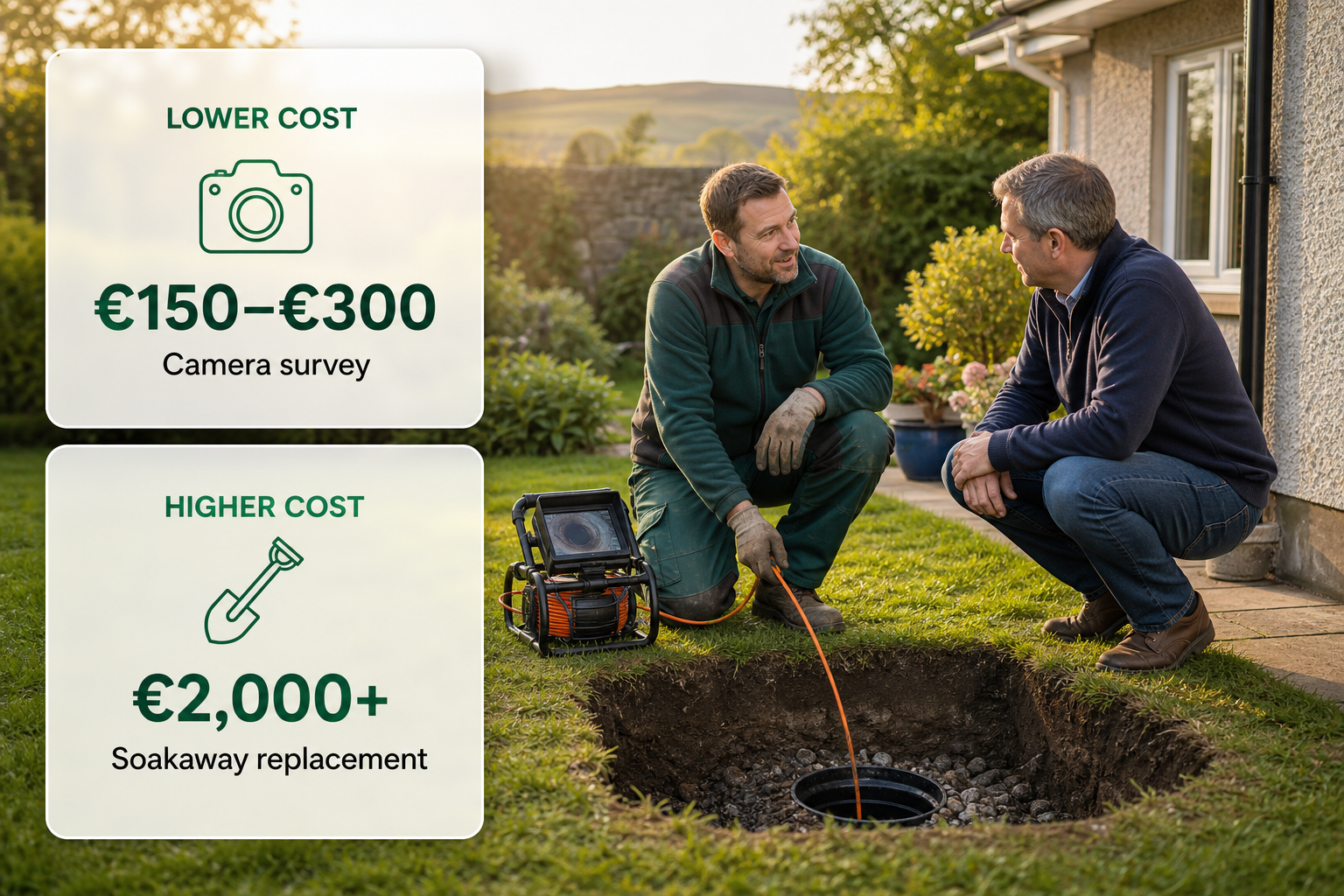
Prices for drainage work vary with access, ground conditions, pipe depth, waste disposal and whether the job is an emergency, so the table below gives a rough aggregate Irish market estimate of how the main options compare. These are estimates rather than quotes, and the order matters more than any single figure.
Work item
Relative cost band
What drives the price
Camera survey of a private drain
Lowest band
Equipment, access, time on site, written report
Clearing a private drain blockage
Lower to middle band
Call-out, jetting or rodding equipment, access, repeat visits
Surface water channel, French drain or minor regrading
Middle band
Length of run, excavation, pipe and stone, spoil disposal
Two habits keep costs under control. First, ask for a written breakdown that separates labour, materials, plant, waste and any survey or call-out charge. Second, get more than one written quote for the same described scope, so the comparison is like for like. Where a job is only clearing a visible gully it sits in the lowest band, and where a percolation area needs specialist attention it sits at the top.
What to do next
Decide which category fits the symptoms before ringing anyone. Surface water and landscaping problems generally need groundworks, regrading, channels or a new soakaway. A private drain blockage generally needs clearing, a survey or a repair. A septic tank or percolation warning needs a qualified waste water specialist, not a general garden tidy-up.
If the work is a landscaping or construction job, a homeowner can post it on ShamFix. Posting a job and listing on ShamFix is free and there is no commission; a subscription is planned for the future. ShamFix does not check or certify tradespeople, profiles are filled in by tradespeople themselves, so homeowners should check registrations themselves and read reviews.
FAQ
Is a waterlogged lawn always a broken drain?
No. Many waterlogged lawns are surface water problems caused by heavy rain, compacted ground, clay soil or a soakaway that has silted up. A blocked drain is more likely when sinks and toilets run slowly, when there is a sewage smell, or when water rises in a gully as a fixture is used. If the lawn only ponds after rain and there is no odour, start with the surface water checks.
What is the difference between a soakaway and a percolation area?
A soakaway takes rainwater from downpipes, gullies or surface channels and lets it filter into the ground. A percolation area takes treated wastewater from a septic tank system. Ponding around a percolation area is the more serious of the two because it can point to a waste water system that is not working properly, while a failed soakaway is usually a surface water and groundworks issue.
Should a homeowner dig a test hole to find the problem?
A test hole is not a safe first step. Digging can damage hidden drains, disturb a percolation area, create a trench hazard, or change how water moves and make flooding worse. Visual checks, dated photographs and notes on timing give a contractor far more to work with. Proper investigation, such as a camera survey where a drain blockage is suspected, is a job for someone with the right equipment.
How soon should a contractor be called?
If wastewater is backing up into the house, if water is close to electrics, or if there is a strong sewage smell, get help immediately. For garden ponding with no odour, it is reasonable to observe the pattern through wet weather and a dry spell first, so the description given is accurate. If the water does not clear, gets deeper, or starts to smell, call sooner rather than later.