ShamFix
Back to insights

Decking cost per square metre: an Irish price guide

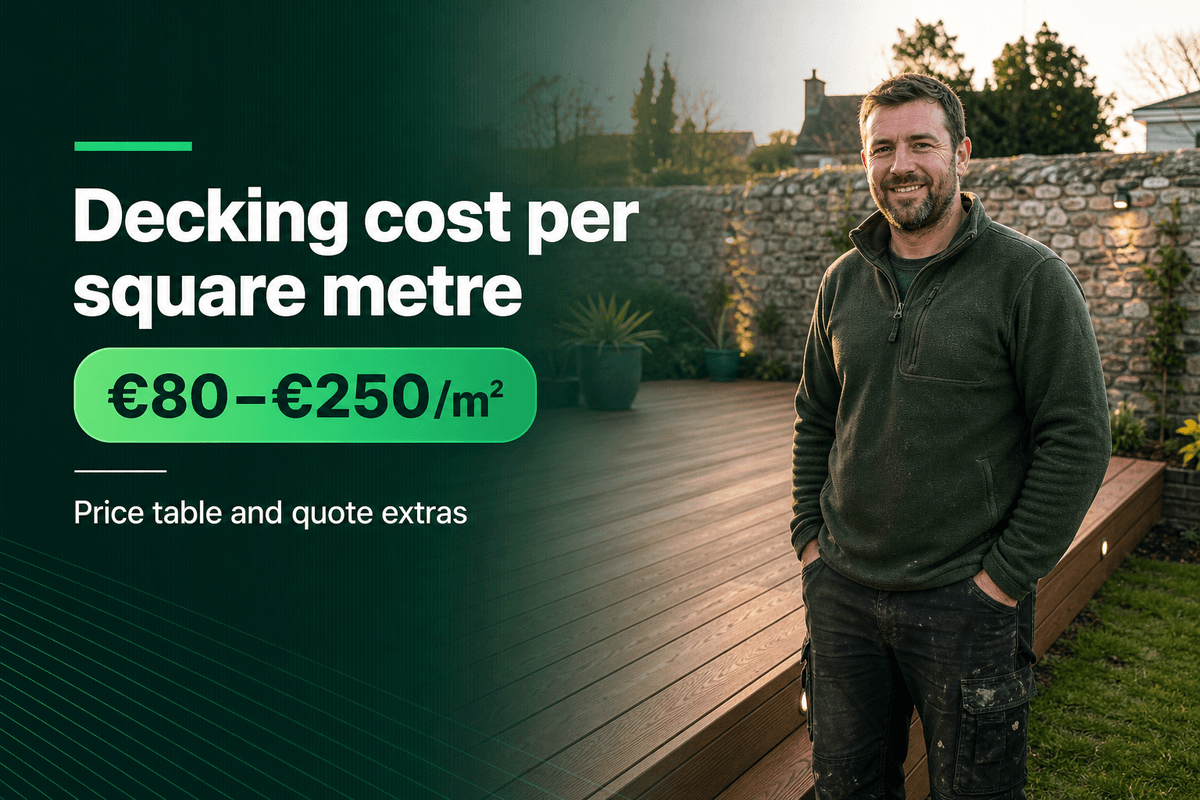
Installed decking runs about €80–€250 per m² in Ireland: softwood €80–€120, composite €150–€250. See what a quote includes and what pushes it up.

8 min read
Decking cost per square metre: an Irish price guide

Installed decking in Ireland costs roughly €80–€250 per square metre, supply and fit with VAT included, as an aggregate Irish market estimate. Treated softwood at ground level sits at the bottom of that band at €80–€120 per m², hardwood at €150–€220 per m² and composite at €150–€250 per m². Anyone budgeting decking and garden structures should read those as the rate for a simple, level, rectangular deck, because deck height, ground conditions, access and extras decide where the final figure lands.
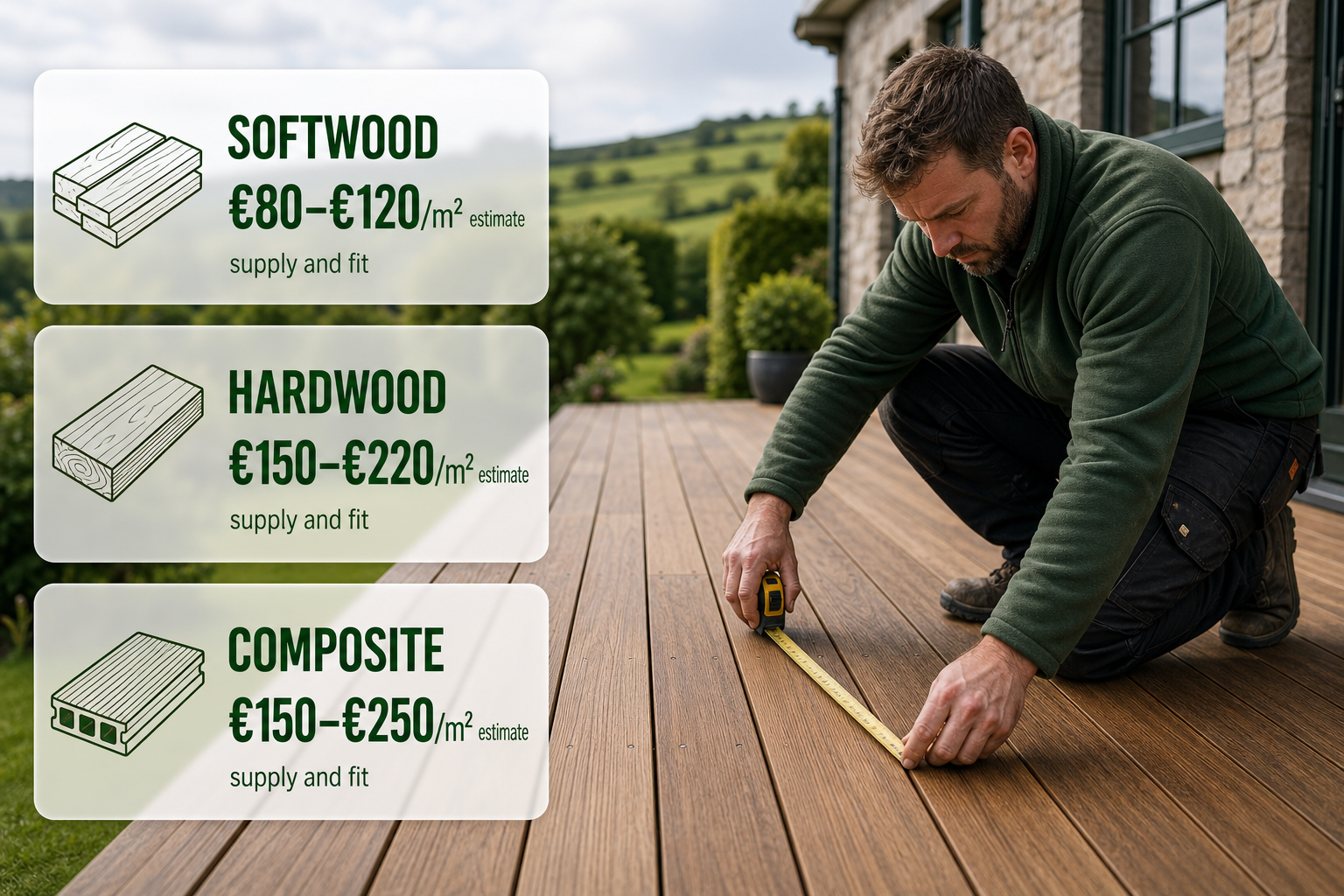
An Irish garden decking scene with frosted-glass cards summarising fitted decking price ranges from the price table section.

Decking cost per square metre: the price table

Everything below is an aggregate Irish market estimate. The fitted lines are supply and fit with VAT included; the final two lines are materials only, for a homeowner who builds the deck personally.

Line item Typical range Unit
Treated softwood deck at ground level, supply and fit €80–€120 per m²
Hardwood deck, supply and fit €150–€220 per m²
Composite deck, supply and fit €150–€250 per m²
Extra for a raised deck with a taller subframe €30–€60 per m²
Steps, supply and fit €150–€300 per step
Balustrade or handrail, supply and fit €100–€200 per linear metre
Removing and disposing of an old deck €15–€25 per m²
Softwood boards and fixings, materials only €25–€45 per m²
Composite boards and fixings, materials only €60–€110 per m²

The raised-deck line is an addition rather than an alternative rate: a softwood deck on a taller subframe comes to €110–€180 per m² once the two lines are combined.

Two worked examples at 20 m²

A 20 m² ground-level softwood deck works out at about €1,600–€2,400, because 20 m² multiplied by the €80–€120 per m² band gives exactly that spread. The same 20 m² in composite comes to about €3,000–€5,000, reflecting the €150–€250 per m² composite band.

Extras stack on top of those figures. A 20 m² softwood deck on a raised subframe, with three steps and 6 linear metres of balustrade, adds €600–€1,200 for the taller subframe, €450–€900 for the steps and €600–€1,200 for the rail, bringing the job to roughly €3,250–€5,700. That spread is wide because steps, rails and heights are exactly where quotes diverge.

What moves the price

Material. The board type sets the floor and ceiling of every quote. Softwood is the cheapest board, hardwood commands a clear step up, and composite covers the middle and top of the table depending on board thickness and capping.

Deck height and subframe. A deck sitting more than a few centimetres above the lawn needs longer joists, more posts, bracing and often concrete pads or screw piles. That is the €30–€60 per m² extra in the table, and on a sloping garden it lands at the top of the band.

Ground preparation and site levels. Stripping turf, excavating soft ground, correcting a fall away from the house and dealing with drainage all take time before a single board is laid. A flat, firm site keeps the job near the bottom of the range; a wet or uneven one pushes it upward.

Access to the back garden. Boards and joists are long and awkward. A side gate wide enough to carry timber through keeps labour down; a route through the house, over a wall or around a tight corner adds handling time to the labour element of the quote.

Shape and cuts. A plain rectangle wastes almost nothing. Angled corners, curves, cut-outs around drains, downpipes and manholes, and borders that must meet an existing patio all increase board wastage and fitting time.

Extras. Steps at €150–€300 each, balustrade or handrail at €100–€200 per linear metre, fascia boards to hide the subframe, built-in seating and garden lighting each add a separate line to the quote.

Whether a raised structure needs permission is a matter for the local planning authority rather than the installer, so confirm it with them before the subframe height is fixed; the height thresholds are explained in planning permission for decking.
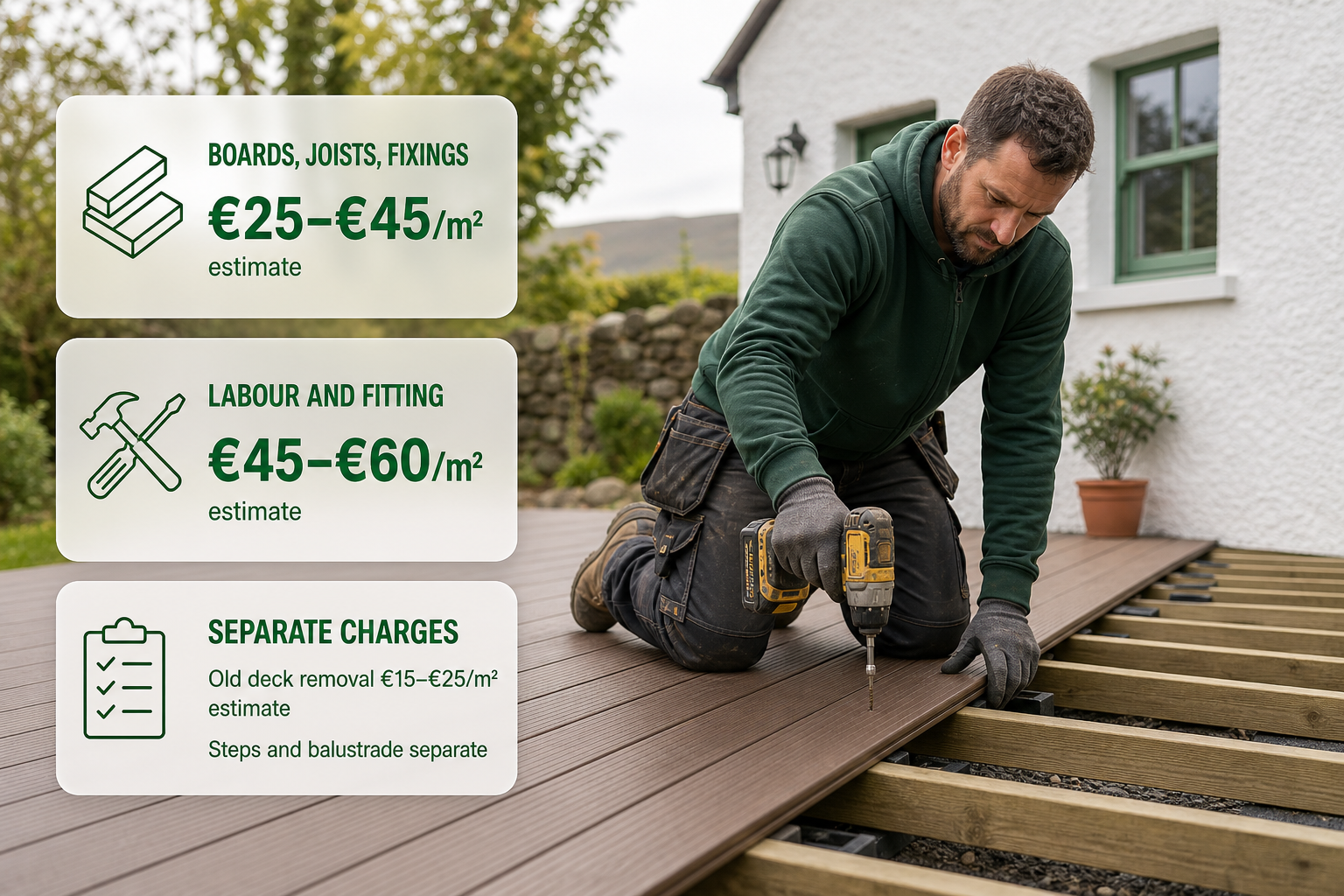
A deck-building scene at an Irish home with frosted-glass cards explaining what a per-square-metre decking quote includes and separate charges.

What a per-square-metre quote includes and what is charged separately

Taken apart, the softwood fitted rate breaks down like this as an aggregate Irish market estimate:

  • Boards, joists and fixings: €25–€45 per m²
  • Labour and fitting: €45–€60 per m²
  • Ground preparation, levelling and waste of offcuts: €10–€15 per m²

Those three lines add up to the €80–€120 per m² fitted rate at both ends of the scale.

A homeowner who fits the deck personally pays for materials only, at €25–€45 per m² for softwood boards and fixings and €60–€110 per m² for composite. Lifting an old deck and taking it away is a separate charge of €15–€25 per m² of deck removed, whatever goes back down in its place.

A standard per-square-metre price normally covers boards, joists, standard fixings, labour, basic levelling on an accessible flat site and removal of offcuts. It usually does not cover excavation and spoil removal, concrete pads or piles on poor ground, steps, balustrades, lighting, fascia boards, staining or oiling after installation, or skip hire. Ask for each of those as a separate line so quotes can be compared like for like. Decks are often built on the same visit as fencing, paving or garden clearance, which is where the wider home services category comes in.

Softwood, hardwood and composite: upkeep and lifespan

Treated softwood is the budget choice and the one that asks most of the owner. Left bare it greys and can split, so it needs re-staining or oiling regularly, and boards that stay damp can rot where they meet the joists. Individual boards are easy to replace, which keeps long-term costs predictable, and the fitted rate makes it the entry point for most gardens.

Hardwood is denser, more stable and holds its colour better, and it needs oiling far less often, though an occasional treatment still helps. It costs €150–€220 per m² up front and is heavier to handle, but it suits a homeowner who wants to avoid annual maintenance.

Composite needs the least attention: a wash with water and a stiff brush is normally enough, with no staining and no splinters. The trade-off is the €150–€250 per m² price, and board quality matters, because cheaper boards can fade or expand in strong sun.

Decking or a paved patio: how the costs compare

Both are quoted per square metre, but they buy different things. Treated softwood at €80–€120 per m² is often the cheaper route where the garden falls away from the house, because a deck is carried on a timber subframe and posts rather than a deep excavated sub-base; a raised deck adds €30–€60 per m² to that figure. Composite at €150–€250 per m² sits well above softwood on day one and has to earn the difference back through lower upkeep.

Paving needs a compacted, level base with hardcore and a fall for water, so excavation and spoil removal weigh more heavily in a paving quote. A homeowner comparing the two should ask each contractor for a per-square-metre figure that includes the base, the edging, the waste and VAT, then compare the totals rather than the headline rate. On finish, paving is cooler and quieter underfoot and needs no oiling, but a cracked unit is harder to lift; a deck is warmer and lighter underfoot, and single boards can be swapped. Paving suits a flat, well-drained site, while decking copes better with uneven ground and changes in level.

Checklist for comparing quotes from decking installers

  • Ask for the rate per square metre in writing, with the raised subframe, steps and balustrade priced as separate lines.
  • Confirm whether VAT is included in the figure quoted.
  • Ask what ground preparation is covered and whether excavated soil and spoil are taken away.
  • Check board type, board thickness and joist spacing, since these drive both the price and how solid the finished deck feels.
  • Confirm how cut-outs around drains, manholes and downpipes are priced.
  • Ask whether an old deck is being lifted and at what rate per square metre.
  • Agree the access route and whether a skip or protective sheeting is needed.
  • Ask what happens if the ground turns out softer or more sloping than expected, and get that in writing before work starts.
  • Agree a payment schedule tied to stages of the work rather than a large upfront sum.
  • Request insurance details and any registration the installer holds, and check them before work begins.

FAQ

Does the per-square-metre rate change for a very small deck?

Small jobs land at the upper end of the ranges, because delivery, set-up and waste are spread over fewer square metres. The low end of each band assumes a straightforward job of reasonable size with room to work. A tiny deck reached through a narrow side passage can therefore price near the top of the softwood band even though nothing unusual is being built.

Are steps and balustrades ever inside the square-metre price?

Almost never. They are quoted separately, one price per step and one price per linear metre of rail, because the labour behind them has nothing to do with floor area. A raised deck with open sides also needs guarding for safety, so budget for it at the quoting stage rather than after the main figure looks settled.

Should the homeowner supply the boards to save money?

Buying materials only looks attractive against a fitted rate, but installers often prefer to supply their own boards so they can stand over the finished deck. Where the homeowner supplies, expect the quote to cover labour and fixing only, and expect responsibility for board quality, quantity and warranty to sit with the buyer.

Is it worth taking out an old deck before getting quotes?

Getting prices with and without clearance shows what removal actually costs, and lifting and disposing of an old deck is rated at €15–€25 per m² of deck removed. There is a practical reason too: rotten joists and hidden ground conditions only show themselves once the old structure is up, and that can move the subframe figure.

Getting quotes for a deck

Posting a job on ShamFix is free and there is no commission, and a subscription is planned for the future. ShamFix does not check or certify tradespeople, and profiles are filled in by tradespeople themselves, so homeowners should check registrations themselves and read reviews before agreeing a price. Start from the ShamFix home page to post a decking job with the size, the deck height and any steps or balustrades set out clearly.

Keep reading