Unblocking a drain in Ireland usually costs €100 to €250 for a straightforward job done during working hours, as an aggregate Irish market estimate including VAT. A blocked sink, shower or toilet is often at the lower end, while an outside drain cleared with a high-pressure jetter typically costs €150 to €350. Emergency call-outs at night or at weekends can cost €200 to €450, and a camera survey to find the cause of a blockage that keeps coming back adds €150 to €350. Before paying anyone, it is worth knowing who owns the blocked pipe, because a blockage in the public sewer is cleared by Uisce Éireann at no cost to the household. Homeowners who need a private drain cleared can post the job under drain cleaning and unblocking and compare quotes.
Drain unblocking prices at a glance
The figures below are an aggregate Irish market estimate, VAT included, for a typical house.
| Job | Typical price |
|---|---|
| Call-out and first hour, working hours | €80–€150 |
| Unblocking a sink, shower, bath or toilet | €80–€180 |
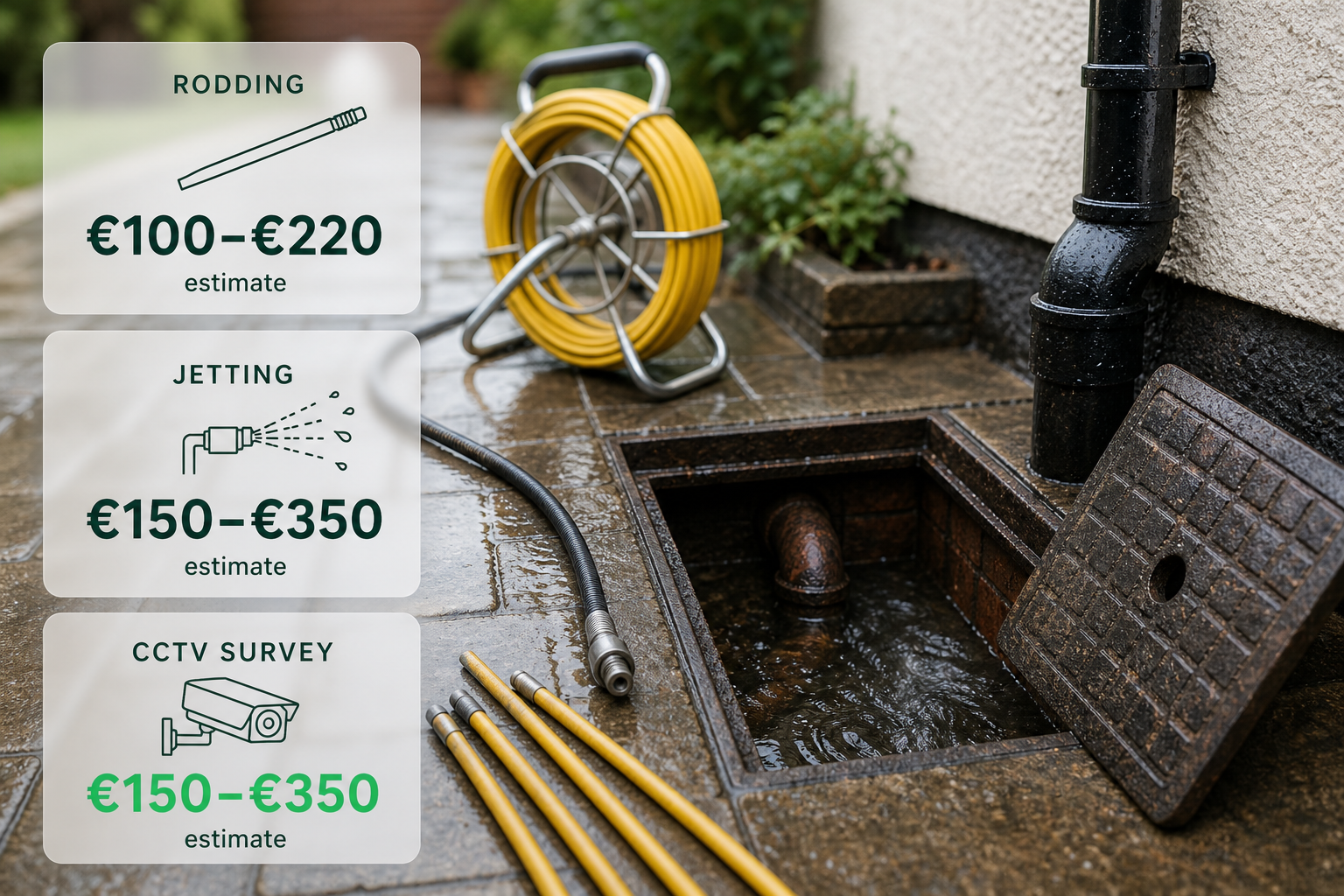
| Rodding an outside drain or gully | €100–€220 |
| High-pressure water jetting of an outside drain | €150–€350 |
| Emergency or out-of-hours call-out | €200–€450 |
| CCTV drain survey with written report | €150–€350 |
| Root cutting or descaling a drain | €250–€600 |
| Patch relining of a cracked section, no digging | €400–€900 per section |
| Excavating and replacing a collapsed section | €900–€3,000+ |
A worked example: a kitchen drain that backs up into the outside gully every few months. A first visit with rods costs about €100–€220 and clears it, but the blockage returns. A jetting visit with a camera survey then costs roughly €300–€700 together and shows a build-up of fat and a dip in the pipe. If a short cracked section needs patch relining, the total for the year comes to about €800–€1,800. Paying for the survey early is usually cheaper than paying for repeated call-outs.
Who pays: your drain or the public sewer?
Responsibility depends on where the blockage is. According to Uisce Éireann, it has sole responsibility for cleaning and maintaining the public sewer network, while householders and property owners are responsible for their internal plumbing and the private pipework leading up to the sewer main. Where a blockage is on the public side, Uisce Éireann says it is generally cleared within 24 hours.
A practical way to tell the difference:
- Only one fixture is slow, such as a single sink or shower: the blockage is almost certainly inside the house and is the owner's to clear.
- Several fixtures back up, or the inspection chamber nearest the house is full but the next one downstream is empty: the blockage is in the private drain between the two.
- The chamber at the boundary is full and neighbours have the same problem: the blockage may be in a shared drain or the public sewer. Uisce Éireann asks people who are unsure to report it so it can be checked, and if wastewater is flooding the property it can be reported by phone at any hour.
In private housing estates and apartment blocks, the EPA notes that the property owner or management company is responsible for clearing drains and sewers on private property. Homes on a septic tank are always responsible for their own system, including blockages.
What each method involves
Plungers and drain snakes clear most blockages in a single sink, bath or toilet, where hair, soap or food is caught close to the outlet.
Drain rods are pushed through an outside drain from an inspection chamber to break up a blockage in a straight run. Uisce Éireann's own advice lists rods as the usual first step for a homeowner, and they can be bought or hired.
High-pressure jetting uses a powerful water jet to scour the inside of the pipe. It clears fat, scale and silt that rods only push through, and it is the usual choice for kitchen drains and recurring blockages.
CCTV surveys send a small camera along the pipe to show cracks, root intrusion, collapsed sections or a sagging run where waste collects. Uisce Éireann may ask for a survey of the private side when the cause of a problem is unclear, and that cost falls on the homeowner.
Relining and excavation are repairs rather than unblocking. A liner can seal a cracked section from the inside without digging. A collapsed pipe usually has to be dug up and replaced.
What pushes the price up
- Out-of-hours call-outs, especially at night, weekends and bank holidays.
- Access, such as a buried or missing inspection chamber, or a drain under a driveway or extension.
- Fat and scale build-up, which needs jetting rather than rods.
- Tree roots and cracked clay pipes, common in older Irish houses.
- Repeat blockages, which usually mean a fault in the pipe that only a camera survey will find.
- Waste disposal, if the contractor has to tanker away a large volume of wastewater.