
Professional window cleaning in Galway City generally starts at €60 for a standard residential job, with expanded work that includes gutter clearing commonly priced from €80. For many households, that's often the starting point, but the final quote usually turns on access, window type, and how much Atlantic grime has built up since the last clean.
That pricing matters because Galway windows get dirty in a very Galway way. A house near the bay or out toward Salthill doesn't just collect rain marks. It picks up salt haze, grit and traffic film that can leave glass looking dull even when the rest of the house is tidy. Many homeowners only start comparing providers when the sun catches the streaks, the front room loses light, or guests are due.
The local market is mature enough that homeowners have options, a mix of sole traders and established firms serve Galway City and county. This isn't a niche service in Galway City; it's part of regular property upkeep.
What often frustrates householders isn't whether to hire someone. It's why two quotes can look very different, why one cleaner wants to use a water-fed pole while another reaches for ladders, and why “a few awkward windows” can suddenly make a simple job feel less simple. The answers are practical once the local trade is broken down properly.
Your Guide to Crystal Clear Windows in Galway
A typical Galway homeowner sees the pattern quickly. The glass looks clean after a visit, then a few windy days off the bay leave a light film behind, especially on exposed fronts and upper-storey panes. On older streets near the centre, damp air and traffic residue can dull the view again before the frames look dirty.
That local pattern matters because Galway is harder on windows than many inland towns. Salt in the air, frequent moisture, and changing winds mean the dirt is often a residue problem rather than simple dust. The result is that cleaning frequency, method, and price depend more on location and house type than many first-time customers expect.
It also explains why window cleaning is a steady local trade instead of an occasional one. Homeowners looking through window cleaners serving homes across County Galway will notice a mix of sole traders and established firms, which usually signals repeat domestic demand rather than one-off seasonal work.
One useful conclusion follows from that. A neighbour's schedule is only a rough reference point. A terraced house close to busy streets, a semi-detached home in an exposed estate, and a period property with awkward sash windows can all need different intervals and different approaches, even within the same part of the city.
For Galway homeowners, the practical question is narrower and more useful: how quickly does this property collect residue, what access issues does it present, and what cleaning method suits the glass and frames? Once those points are clear, the rest of the market makes more sense.
Understanding Window Cleaning Costs in Galway
A Galway homeowner in Salthill and another in Renmore can both ask for “window cleaning” and still get meaningfully different quotes. The reason is simple. Local pricing is shaped less by a headline rate and more by access, exposure, and how much time the cleaner expects to spend restoring the glass to a maintainable standard.
The starting price is only the first filter
Blue Window Cleaning's published Galway area pricing
The clearest public reference point is still a base domestic rate. Current Irish market rates indicate that professional window cleaning in Galway City and county generally starts around €60 for a standard residential property, with expanded services that include gutter clearing typically from about €80. That gives homeowners a useful benchmark, but only for straightforward houses with ordinary access and no unusual buildup.
If you are comparing window cleaners serving homes across County Galway, treat that figure as an entry point rather than a promise. In practice, the market separates into two jobs. Routine exterior cleans on modern houses, and more time-heavy work on properties with awkward windows, older layouts, or neglected buildup.
What actually moves a quote upward
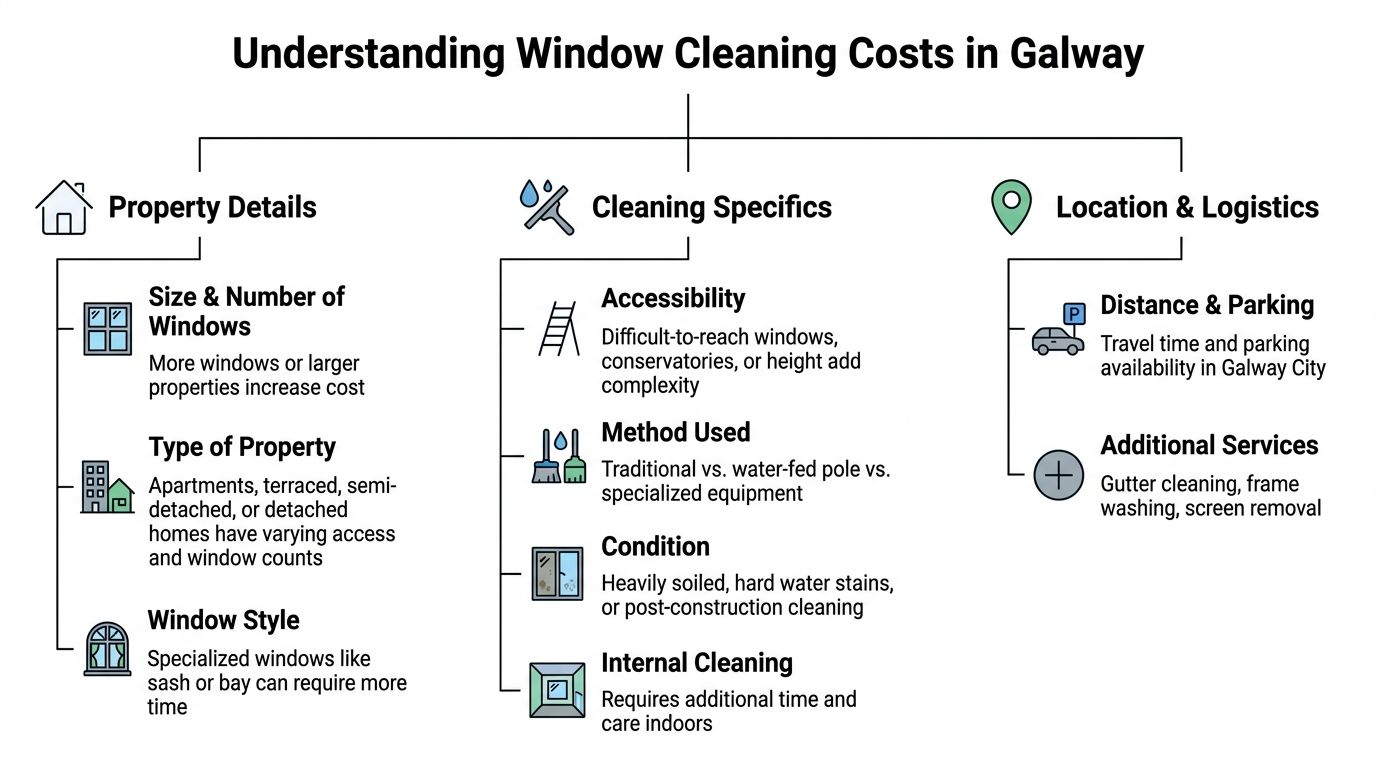
Cleaners are usually pricing labour time first, then access difficulty, then any extra scope around the windows themselves. That is why two houses with a similar number of panes can still land in different price bands.
| Cost driver | Why it changes the price in Galway |
|---|---|
| Number and size of windows | More glass means more working time. Large panes, bays, and patio doors also need slower detailing to avoid spotting at the edges. |
| Storeys and access | Rear extensions, narrow side entrances, conservatories, and upper-floor windows above roofs or sloped ground all reduce speed and can limit equipment options. |
| Inside or outside | Exterior-only work is usually faster. Interior cleaning adds setup time and requires care around floors, curtains, furniture, and paintwork. |
| Condition of the glass | A routine clean is quicker than a first visit where residue, traffic film, bird marks, or old detergent smears need to be removed. |
| Extra services | Frames, sills, doors, gutters, fascias, and conservatory roofs can turn a simple booking into a broader exterior maintenance visit. |
One cost driver deserves more attention in Galway than it gets in generic advice. Difficult windows are not only high windows. They include sash windows that need detailed hand work, panes above glass roofs, windows blocked by shrubs or side gates, and older homes where access around the rear is tight. Period properties near the city centre often fall into this category, which helps explain why homeowners in older streets can receive inspection-based quotes instead of fixed prices over the phone.
Frequency changes price because it changes the job
Regular customers often pay less per visit than one-off customers for a practical reason. The cleaner is maintaining a known property, not correcting months of buildup while also working out access, hose routes, and problem areas. The first clean tends to carry the most uncertainty.
That matters in Galway because coastal residue and damp conditions can turn a long-gap clean into restoration work rather than maintenance. A low quote on a neglected property is not always good value if the scope fails to include frames, sills, or heavier residue on exposed sides of the house.
A fair quote is usually the one that matches the property you have. For Galway homeowners, that means checking whether the price reflects access, window type, condition, and exactly what is included, not just choosing the lowest starting number.
Modern Cleaning Methods for Galway Homes
A bucket, applicator and squeegee still have their place, especially for interior panes or detailed work on traditional windows. But exterior window cleaning in Galway City has shifted toward methods that suit damp weather, upper storeys and stubborn coastal residue better.
Why pure water works on Galway glass
Cleaning Doctor's Galway window cleaning page
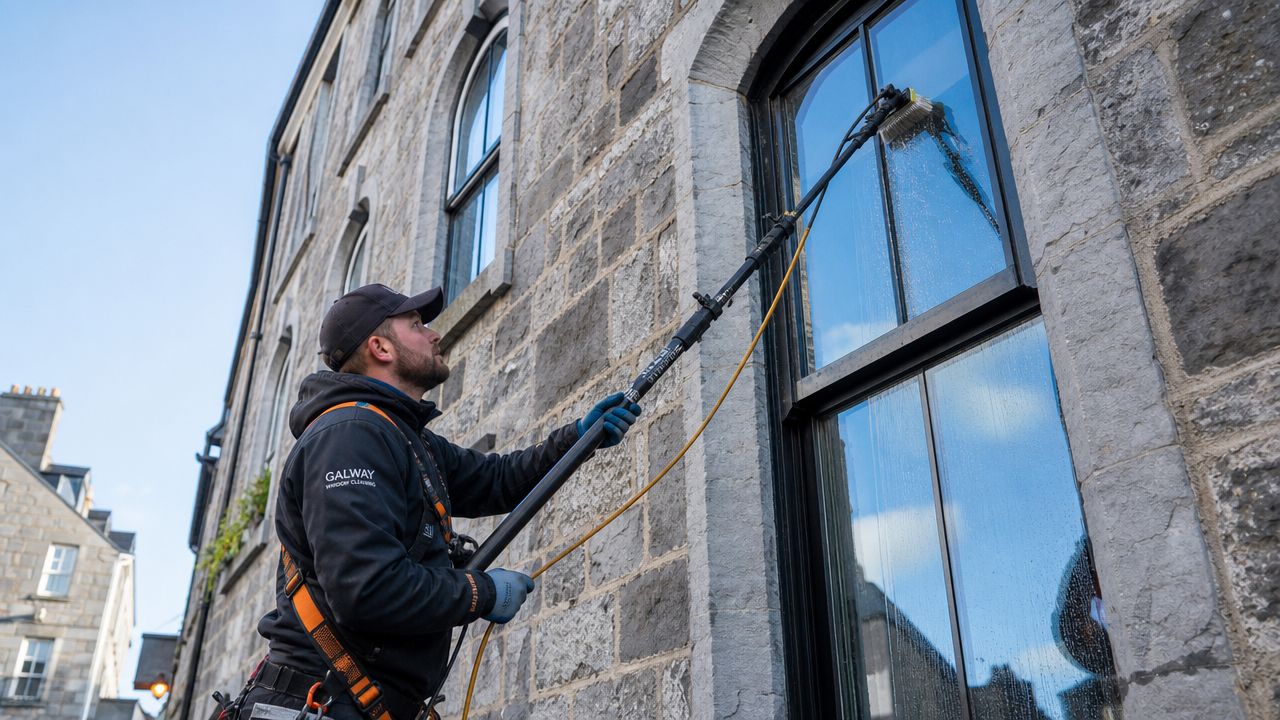
Many professional cleaners in Galway use pure-water reach-and-wash technology, with the water filtered to below about 5 parts per million (ppm) conductivity. That detail matters because the method is doing more than extending reach from the ground.
Pure water works by removing dissolved minerals that would otherwise stay behind when the water evaporates. If those minerals aren't there, they can't dry into spots on the glass, frames or sills. That's why the finish can be left to dry naturally without detergent and without the same streak risk homeowners often get from ordinary tap water.
For Galway homes, that has a second advantage. Sea air leaves a fine salt residue that needs a proper rinse, not just a wipe. Smearing salt around with a cloth can make windows look clean for an hour and hazy again once they dry. A water-fed pole system lets the cleaner flush contamination off the surface.
Practical rule: Near the bay or in exposed parts of the city, the better method is usually the one that rinses thoroughly rather than the one that simply polishes fast.
That's also why some homeowners are puzzled when a cleaner doesn't towel-dry the windows. With purified water, the absence of drying isn't a shortcut. It's part of the method.
Homeowners comparing providers can browse window cleaning services on ShamFix with that in mind, especially if the property has upper-floor glass or awkward rear access where reach-and-wash is often the practical choice.
Matching the method to the frame
Glass is only half the job. Galway housing stock mixes modern materials with older period details, and each frame type needs a different level of care.
- uPVC frames are common in modern Irish homes. They usually respond well to mild soapy water and a soft cloth. Abrasive pads and solvent cleaners can dull the finish or leave scratches.
- Aluminium frames benefit from a mild detergent and careful drying. If water is left to sit, spotting can show more clearly.
- Timber and sash windows are the caution category in older Galway properties. Excess water can affect paint, putty and wood finishes, so gentle cleaning matters more than speed.
- Powder-coated frames should be treated as a non-abrasive surface. Aggressive scrubbing can mark the coating.
A good cleaner doesn't use one routine on every house. A period townhouse near the city centre with painted timber sash windows needs a different approach from a detached estate house with uPVC casements and a conservatory.
That's one reason generic advice often fails in Galway. The city's weather pushes cleaners toward modern methods, but the buildings still demand old-fashioned care.
Safety Regulations and Insurance Requirements
Homeowners often focus on finish first. The bigger issue is sometimes what happens before the first pane is touched. Once work moves above easy ground-floor reach, window cleaning becomes a safety job as much as a cleaning job.
CleanLink's coverage of window washing safety standards
Height changes the risk calculation
Tall Galway townhouses, apartment blocks and properties with awkward rear extensions create the kind of access decisions that separate professional practice from casual side work. Work at height in Ireland is governed by Part 4 of the Safety, Health and Welfare at Work (General Application) Regulations 2007, which require work at height to be properly planned, risk-assessed, and carried out by competent people with suitable equipment wherever there's a risk of a fall. Most domestic window cleaning stays well below the point where rope access is needed, but the same discipline, sound equipment, safe footing, and not improvising at height, applies to any upper-storey work.
Even on lower domestic jobs, the same logic applies. Equipment condition, footing, reach limits and setup discipline are not optional extras.
A cleaner willing to improvise at height may also be willing to improvise elsewhere. That's rarely the bargain it first appears to be.
Why insurance matters to the homeowner
Public liability insurance isn't just a business detail. It protects the homeowner if something goes wrong on site, whether that means property damage or an accident during the job. A professional provider should be able to confirm they hold current cover.
That question is especially important when the house has glass roofs, narrow access, fragile landscaping or upper windows above a conservatory. Those features increase the chance of accidental damage if the job is rushed or poorly equipped.
A sensible hiring rule is simple:
- Ask for insurance confirmation before booking, not after.
- Ask how upper windows will be reached if the property has awkward access.
- Be cautious with unusually low quotes where the method isn't explained.
- Treat safety language as a quality signal. Clear answers usually indicate an organised operator.
In Galway, where weather can turn quickly and surfaces are often damp, the cleaner's process matters as much as the price.
How to Choose a Reliable Local Window Cleaner
A common Galway scenario is this. The front windows look dull again only a week or two after cleaning, the upstairs panes are awkward to reach, and two quotes arrive with a wide gap between them. At that point, choosing well matters more than choosing fast.
Galway gives window cleaners a harder brief than many inland towns. Salt carried in from the bay sticks to glass and frames. Frequent moisture leaves residue on sills and ledges. Older terraces and period houses often add sash windows, tight rear access, or panes above extensions. A cleaner who prices without asking about those details may be underestimating the job, and that usually shows up later in the finish, the method, or the final bill.
Reputation matters more than the cheapest quote
An established trading history is useful because window cleaning is repeat work. Businesses that stay busy over time usually do so because homeowners book them again, not because one low quote won a single job. That matters in Galway, where the key test is not whether the glass looks good on the day, but how well the result holds up after the next spell of damp weather and road grime.
A better screening test is to listen for specifics. Reliable cleaners tend to ask practical questions early, because the answer changes the time required and the method used.
- Clear scope. Ask whether the price covers glass only, or also frames, sills, doors, and any French doors or rooflight panes.
- Method matched to the house. A modern estate home with easy perimeter access may suit water-fed pole cleaning. A period property with delicate timber, divided panes, or awkward interior access may need a more selective approach.
- Knowledge of Galway conditions. Sea air, exposed estates, and shaded streets create different dirt patterns. A local operator should be able to explain how that affects frequency and results.
- Review pattern, not one-off praise. Balanced feedback about punctuality, communication, and consistency is more useful than a single glowing line with no detail.
Short answers are a warning sign. If someone cannot explain what they are cleaning, how they will reach it, and what is included, the risk is not only poor communication. It is poor job control.
DIY myths that still waste time
Galway homeowners still hear the old advice about washing-up liquid and newspaper. The problem is residue. Detergent often leaves a film, and in a coastal city that film gives salt and dirt something to cling to. The glass can look acceptable for a day, then lose clarity quickly.
Sun is another factor people misread. On a bright day, glass seems easier to inspect, but rapid drying can leave marks before the window is properly finished.
Access is the bigger break point. Many DIY attempts work at ground-floor level, then stall at the bedroom window above a porch, the pane over a conservatory, or the back elevation with limited footing. That is usually where professional value starts. The issue is not only labour. It is choosing a method that suits the house layout and the glass type.
A reliable local cleaner earns the booking by reducing uncertainty. The result should be a well-scoped job, carried out with a method that fits the property and the conditions, rather than a quick pass priced on guesswork.
A Practical Checklist for Getting Accurate Quotes
A Galway homeowner sends a two-line message asking for a window cleaning price. The house turns out to have a rear extension, salt-marked upper panes facing the coast, and one awkward window above a porch. The first quote was never wrong. It was incomplete.
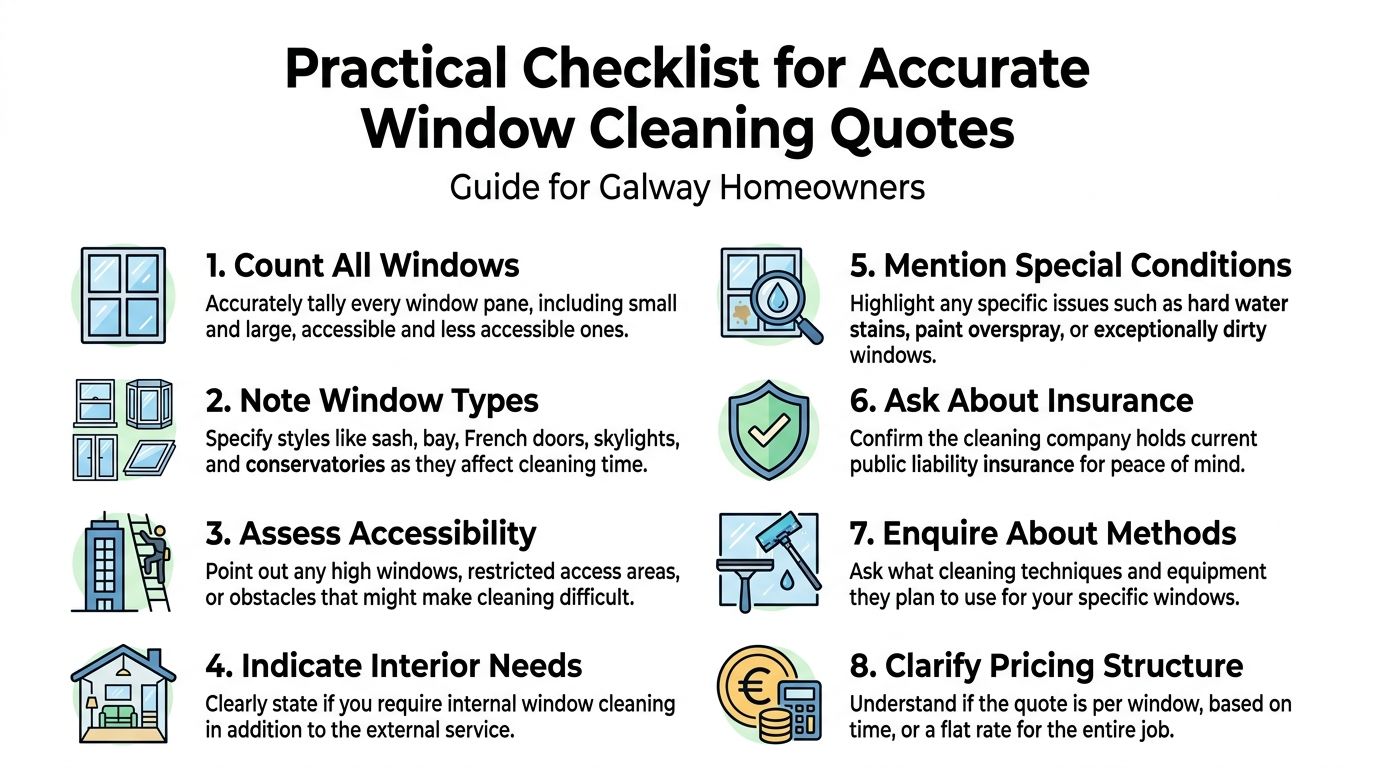
Quote accuracy in Galway depends less on postcode and more on access, exposure, and window type. Two houses with the same number of bedrooms can price very differently if one has modern easy-reach panes and the other has sash windows, rooflights, or glass that picks up coastal residue quickly. Period homes and properties near the bay often sit at the expensive end for a simple reason. They take longer to clean properly, and the cleaner has less margin for rushed work.
What to send before asking for a price
The aim is to remove guesswork before the cleaner does.
- Property type and layout. Say whether it is a terrace, semi-detached house, detached house, apartment, or older townhouse. Mention extensions if they change access at the back.
- Actual window count. Count windows, not rooms. Flag wide panes, French doors, bay windows, rooflights, and any glass over a conservatory or porch.
- Access limits. Note narrow side passages, locked rear access, uneven ground, or anything that affects poles, ladders, or setup time.
- Scope of cleaning. State whether you want exterior only, inside and out, or selected windows only.
- Condition of the glass. Say if there is salt film, traffic grime, bird mess, paint specks, or a long gap since the last clean.
- Extras. Name frames, sills, doors, gutters, and conservatory roofs separately so they do not get assumed in or left out.
Photos matter because they show what text usually misses. One clear front photo and one rear photo often tell a cleaner more than a long message. If you want a simple way to standardise that request, you can post your window cleaning job with photos and access details.
What to check before you accept
A quote is only useful if it defines the job clearly enough to compare one provider with another.
| Ask this | Why it matters |
|---|---|
| Are frames and sills included? | Some cleaners price glass only, which makes a low quote look better than it is. |
| How will you reach the awkward windows? | The answer shows whether the price reflects real access time or a quick assumption. |
| Is this a one-off clean or a maintenance price? | Regular rounds are often priced differently from first visits with built-up dirt or salt residue. |
| Are inside windows included, and if so, which rooms? | Interior cleaning adds time and access issues, especially in occupied family homes. |
| Are problem windows included in the stated price? | This reduces the chance of extras being raised on the day for rooflights, porch windows, or rear upper panes. |
| Do you hold current public liability insurance? | It confirms the operator is quoting as a business, not just offering an informal cash job. |
The useful test is simple. If someone else read the quote a week later, could they tell exactly what would be cleaned, how access problems were allowed for, and what would trigger extra cost? If the answer is no, the cheapest figure on the page may not be the lowest final bill.
Connecting with Tradespeople on ShamFix
The strongest trade platforms in Ireland don't create trust by claiming to inspect everything themselves. They create a structure where reputation is visible and credentials remain the responsibility of the provider.

ShamFix is an Ireland-only marketplace founded in 2025, with its main platform at ShamFix. Listing on ShamFix is free and there's no commission; a subscription is planned for the future. That matters because it separates the platform from pay-per-lead models without making inflated promises about lead volume or speed.
The trust model is equally important. Reputation on ShamFix comes from two-sided reviews and ratings, where customers and providers rate each other after completed work. That creates a more balanced signal than one-way review systems, especially in trades where reliability, communication and access arrangements affect both sides.
A useful analogy comes from regulated trades. ShamFix's guidance for tradespeople and homeowners in Ireland notes that where a trade requires registration, the responsibility for confirmation lies with the customer. Gas installers, for example, must be registered with the RGI scheme, and customers can confirm that directly on the official register rather than relying on a platform badge. The same principle applies broadly. Providers state their own credentials. Customers confirm regulated registrations with the relevant authority.
That approach is especially sensible for home services such as window cleaning, where the key trust signals are often local reputation, clear communication, proof of insurance, and the quality of previous customer feedback. Homeowners who want to post a job can place a task on ShamFix and compare responses as the marketplace grows. For providers in Galway, the early stage creates a different opportunity. They can list now, pay no commission, and be among the first businesses found as demand develops.
Galway homeowners who want a cleaner, fairer way to find local trades can explore ShamFix. The platform serves the Republic of Ireland only, is built around earned trust through real two-sided reviews rather than badges or platform claims.