Typical Irish office cleaning contract rates sit around €13–€25 per hour or €1.50–€3.00 per m² per month, with Dublin city centre at the higher end, around €14–€18 per hour. The monthly bill depends on office size, visit frequency, access, travel, parking, consumables and any specialist work added to the standard clean.
A headline hourly rate can look attractive until a provider adds a minimum call-out, parking charge, travel cost or separate charge for washrooms and consumables. For office managers and small-business owners, the useful figure is the delivered monthly cost, based on exactly what gets cleaned, how often staff attend and what the quote includes.
How Much Office Cleaning Costs in Ireland Right Now
Irish commercial cleaning guides publish several overlapping ways to budget. Contract office cleaning is commonly quoted at €13–€25 per hour, while another useful benchmark is €1.50–€3.00 per m² per month. A regular office arrangement may also be priced per visit, particularly when the cleaning company agrees a fixed schedule and defined scope. These figures are drawn from Irish office cleaning price guidance.
Dublin city centre generally sits at the top of the Irish range, at approximately €14–€18 per hour, while Dublin suburbs, business parks and regional cities such as Cork, Galway and Limerick are commonly around €12–€17 per hour, depending on the specification. The difference isn't the cleaner's labour. Parking restrictions, loading access, security procedures, travel between jobs and after-hours entry can all increase the fully loaded cost in central Dublin. Regional Irish pricing guidance explains why location should be assessed as part of the service delivered.
Practical rule: A lower hourly rate isn't automatically the cheaper contract. Compare the completed visit, the monthly frequency and every added charge.
VAT also needs checking before a quote is approved. Revenue treats routine cleaning of immovable goods, including office cleaning, as a contract service, and the applicable Irish VAT rate is the reduced 13.5% when the supplier is registered for VAT. The buyer should ask whether the quoted price is inclusive or exclusive of VAT, rather than adding an assumption at the end. Revenue's cleaning-services VAT guidance sets out the relevant treatment.
The most reliable next step is a written brief stating the floor area, rooms, access arrangements, cleaning frequency, consumables and requested extras. Businesses can post an office cleaning job to receive quotes from local commercial cleaners, then compare the proposals against the same specification. The ShamFix office cleaning directory is another route for finding providers serving Irish businesses.
How Office Cleaning Is Priced Per Hour Per Square Metre and Per Visit
Office cleaning is usually priced through one of three models. Each answers a different question, so the right comparison depends on whether the buyer wants to purchase cleaning time, building coverage or a scheduled service.
Hourly pricing
An hourly quote is easiest to understand for a small office, a short-term requirement or a site where the workload is still being assessed. The buyer pays for the time assigned to the visit, with the final invoice affected by the number of visits and the hours used each time.
Irish commercial rates are commonly around €13–€25 per hour, with Dublin city centre often around €14–€18 per hour and Dublin suburbs and regional cities generally around €12–€17 per hour, depending on the work and specification. These are headline labour-related rates, not necessarily the full cost of parking, travel, consumables or specialist work.
Per-square-metre pricing
Per-square-metre pricing works well when an office has a predictable layout and a regular cleaning programme. A provider can calculate the cleanable area and apply a monthly rate, commonly around €1.50–€3.00 per m² per month in Irish commercial cleaning guidance.
This method makes larger offices easier to budget, but the number only means something when the specification is clear. A square metre of open-plan carpet isn't equivalent operationally to a square metre containing several washrooms, a busy kitchen or hard flooring that needs additional care.
Per-visit contract pricing
A per-visit price gives the buyer a fixed amount for each scheduled attendance. It can be useful when the same tasks are carried out at the same frequency, because the monthly cost can be calculated from the agreed visit price and the number of planned visits.
The distinction is similar to buying time versus buying coverage. An hourly quote buys attendance time. A per-square-metre quote prices the building footprint. A per-visit contract prices an agreed result at an agreed frequency. Understanding how scope and workload affect each model helps facilities teams choose the right basis for comparison.
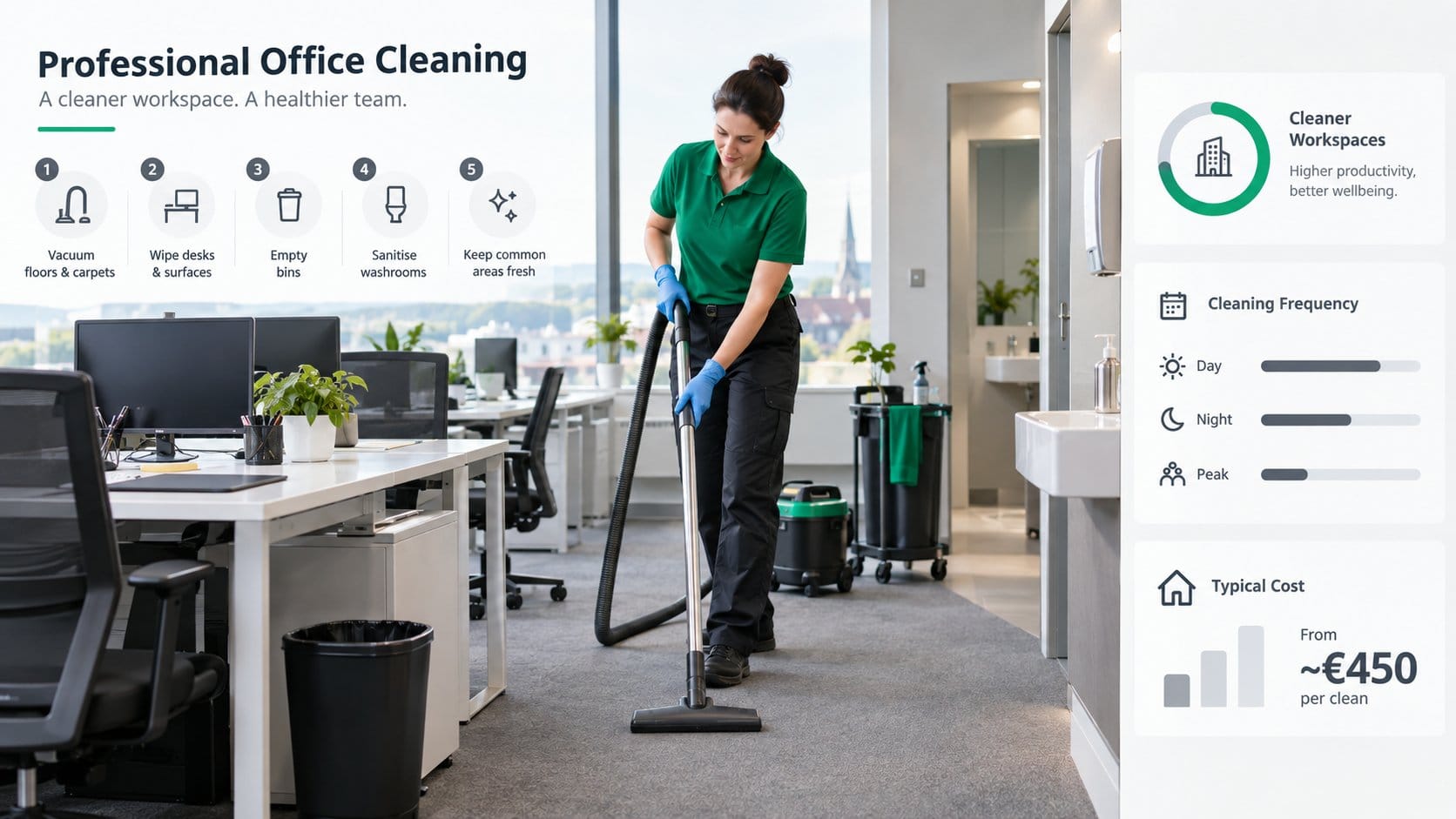
The buyer should request a delivered-service comparison. Each quote should show the visit length, frequency, included rooms, consumables, travel, parking and any minimum-callout rule. That approach prevents a nominally cheaper rate from producing a higher monthly bill.
What a Standard Office Clean Includes
A standard office clean should be treated as a written scope, not a vague promise to “clean the office”. Most routine specifications cover the areas employees use every day, but the precise tasks and frequency need to appear in the quote.
Desks and surfaces
The usual baseline includes wiping desks, tables, counters, reception surfaces and other accessible areas. The buyer should clarify whether staff must clear papers and personal items before attendance, and whether equipment such as monitors, keyboards or telephones is excluded from direct cleaning.
Floors normally include vacuuming carpets and mopping hard floors. Spot cleaning, skirting boards, stairwells and entrance mats may sit outside the routine scope unless they're listed specifically.
Kitchen and breakroom areas
A standard kitchen or breakroom clean commonly covers counters, sinks, splashbacks and appliance exteriors. The quote should state whether internal oven cleaning, fridge cleaning, dishwasher loading and removal of food waste are included, because these tasks take the service beyond ordinary surface cleaning.
Washrooms, bins and supplies
Washroom work generally includes toilets, sinks, mirrors and touch surfaces. Bins are emptied and liners replaced, but consumables restocking needs closer attention. Toilet tissue, hand towels, soap and sanitiser may be supplied by the client, supplied by the cleaner at an additional charge or included through a separate hygiene arrangement.
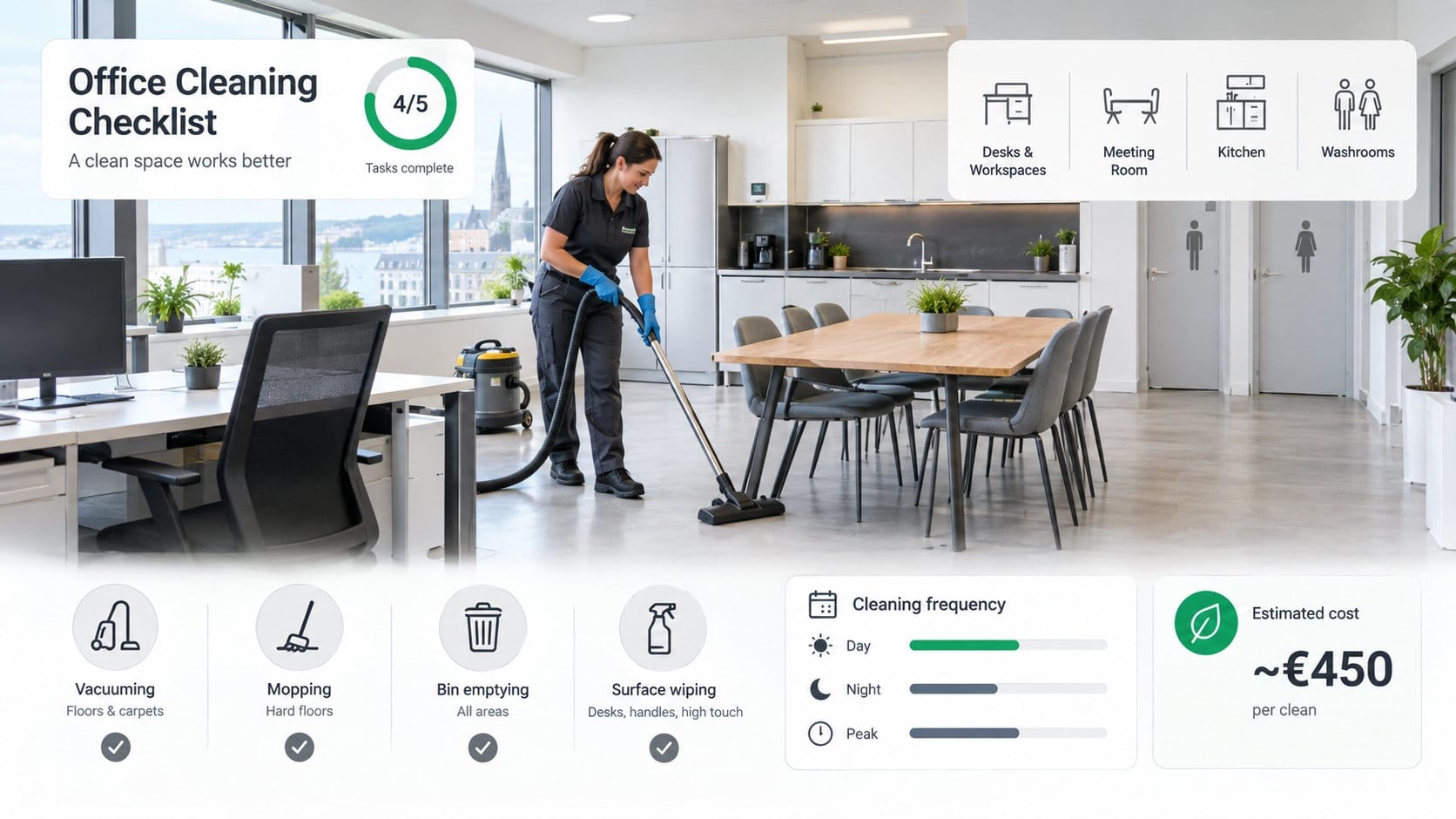
A few desks don't determine the workload on their own. A small office with several desks, one washroom and a compact kitchen may need much less time than a larger open-plan workplace with multiple washrooms, meeting rooms and hard floors. Cleaning frequency and the number of areas covered often matter more than desk count.
A clear specification should list each room, each task, the expected frequency and exclusions.
How Frequency and Office Size Change Your Monthly Price
Frequency drives the monthly invoice because every additional attendance adds labour, travel and site-access time. Daily cleaning gives the most regular coverage, while several visits per week may suit an office with moderate use. Weekly cleaning can work for a smaller or quieter workplace, but the longer gap may mean that kitchens, washrooms and bins need more attention during each visit.
Irish commercial cleaning pricing guidance gives useful budgeting bands by office size and frequency. A small office up to 200 m², cleaned three times per week, is estimated at around €400–€700 per month. A medium office between 200 m² and 500 m², cleaned five times per week, is estimated at around €800–€1,500 per month. The figures come from Irish commercial cleaning cost guidance.
Typical monthly cost by office size and frequency
| Office size | Frequency | Typical monthly range |
|---|---|---|
| Up to 200 m² | Three visits per week | €400–€700 |
| 200–500 m² | Five visits per week | €800–€1,500 |
These ranges are useful starting points, not substitutes for a site-specific specification. A contract with short, predictable visits may cost less per attendance than a one-off clean because the provider can plan staff, equipment and routes in advance. A one-off or short-notice booking often carries a premium because the cleaner has less opportunity to combine the work with other nearby jobs and may need to arrange extra staff or equipment.
Why the same office can receive different quotes
Two offices with similar floor areas may have very different monthly costs. One might have open-plan carpet, a single kitchen and limited washroom use. Another might have meeting rooms, a reception area, several washrooms, hard flooring and frequent staff movement.
Access also changes the calculation. A city-centre office may require paid parking, timed loading access, security sign-in and a longer journey between the vehicle and the building. A regional contract may have lower urban friction, while a rural site can attract a travel surcharge. The buyer should ask for these items separately rather than assuming the hourly rate covers everything.
A useful monthly calculation starts with the cost of one complete visit, then applies the agreed frequency and adds any fixed monthly or periodic services.
Bundling routine cleaning with planned periodic work can make budgeting easier, but it doesn't make specialist tasks free. Carpet shampooing, window cleaning and floor restoration should remain visible as separate lines so the office manager can see the routine cost and the occasional cost independently.
Common Add Ons and How They Are Charged
The standard clean keeps an office presentable through routine attendance. Add-ons deal with condition, hygiene or specialist surfaces, and they're often priced separately because they require different equipment, chemicals, training or preparation.
Carpet shampooing
Carpet shampooing or extraction cleaning is commonly charged as a specialist service rather than included in the regular hourly visit. A provider may price it by the area, by the task or by the time and equipment required. The quote should state whether furniture movement, drying time and stain treatment are included.
Interior window cleaning
Interior windows are often priced as a separate visit or as a periodic service. The number and type of windows, access to internal panes, frames, sills and meeting-room glass can all affect the scope. A buyer should ask whether the price includes glass only or also frames, ledges and removal of visible marks.
Hard-floor stripping and polishing
Hard-floor stripping and polishing goes beyond ordinary mopping. It may involve removing old finish, mechanical cleaning and applying a new protective finish. Providers may charge by area, by visit or by the labour and equipment required, so the specification should identify the floor type and whether furniture must be moved.
Periodic deep cleaning
A deep clean may include detailed work that isn't practical during a short evening maintenance visit, such as high-level dusting, neglected corners, internal kitchen areas or intensive washroom cleaning. One-off and ad-hoc office cleaning is commonly priced around €20–€30 per hour, compared with €13–€18 per hour for standard contract cleaning. Specialist cleaning is commonly around €18–€25 per hour, according to Irish corporate cleaning pricing guidance.
Dublin services described as fully insured and compliant may quote around €22–€30+ per hour, with deep cleaning and specialist tasks higher again. The premium reflects flexibility, compliance expectations and short-notice planning, not the minutes spent holding a vacuum.
Washroom hygiene and consumables
Washroom hygiene can include replenishment of soap, toilet tissue, hand towels, sanitiser and other supplies. It may be charged as a product-and-service line, a scheduled replenishment service or an agreed additional monthly amount. The buyer should ask who buys the products, who monitors stock and whether emergency replenishment is included.
The cleanest comparison separates routine contract work, periodic services and consumable supply. That structure makes it easier to approve the regular monthly budget without losing sight of occasional costs.
What to Check Before Hiring and How to Compare Quotes
Price is only one part of a commercial cleaning decision. The buyer is giving a provider access to a workplace, equipment, documents and potentially alarmed premises, so the appointment needs a clear operational arrangement as well as a reasonable cost.
Confirm responsibility and insurance
Ask for evidence of public liability insurance and confirm that the policy remains current. Cleaning is not a regulated trade in Ireland, so the buyer should also check whether staff are properly covered and employed for the work, and whether Garda vetting applies to the particular setting. Vetting may be especially relevant where cleaners work around sensitive records, vulnerable people or restricted areas.
The provider should identify who supervises the service and who handles complaints or missed tasks. References and genuine customer reviews can help the buyer assess reliability, but they don't replace insurance or a written agreement.
Put the specification in writing
A useful specification names the rooms, surfaces and tasks, then assigns a frequency to each. It should also record:
- Visit timing: State whether cleaning takes place before opening, after closing or during agreed working hours.
- Access control: Confirm who holds keys, who manages access cards and how alarm codes are handled.
- Staff absence: Ask how sickness, annual leave and emergency cover are managed.
- Consumables: List which products are supplied, stored, monitored and replenished.
- Periodic work: Price carpet, windows, floor treatment and deep cleaning separately.
The VAT position must be clear. Revenue guidance applies the reduced 13.5% VAT rate to routine cleaning of immovable goods, including offices, when the supplier is VAT-registered, so the quote should state whether VAT is included or will be added. Parking, travel, minimum call-outs and after-hours access should also appear in writing where they apply.
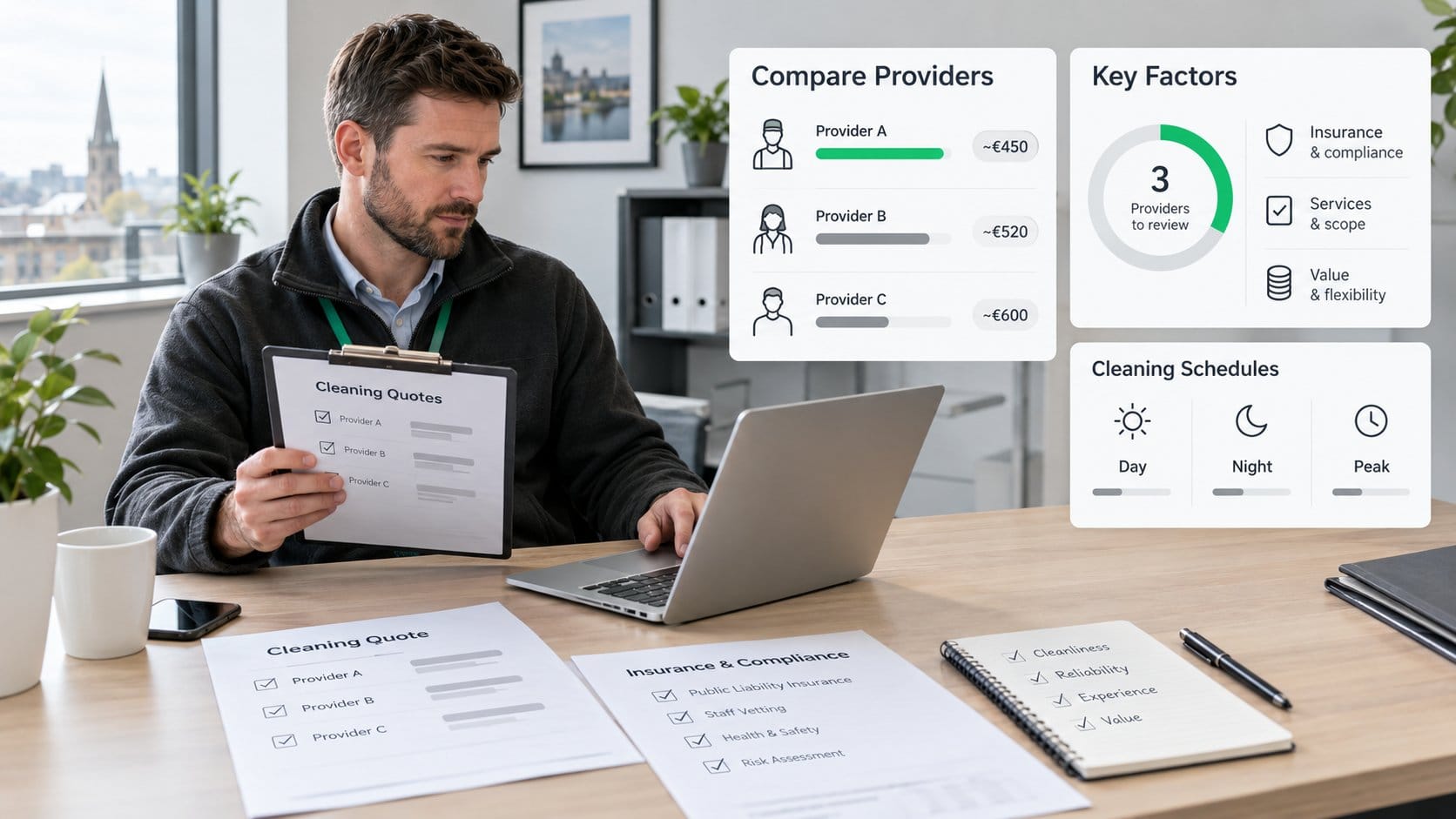
Scheduling or workforce software doesn't replace a site visit or a detailed written scope when comparing providers.
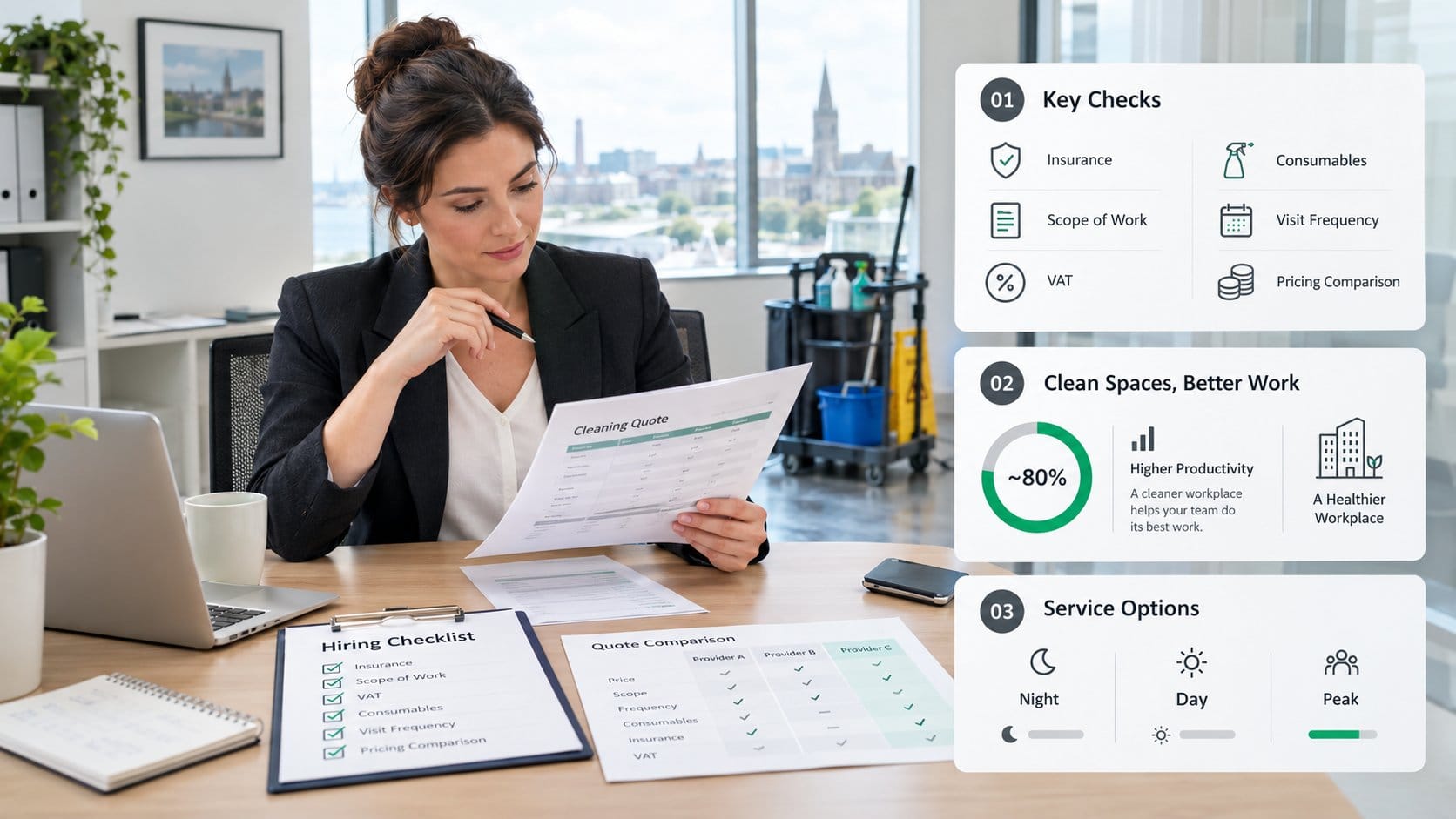
Compare like with like: Put each proposal into the same checklist, then compare visit length, tasks, frequency, consumables, VAT, travel and cover arrangements.
A low total may exclude periodic work, supply costs or absence cover. A higher total may include those items and provide a more dependable delivered service. The buyer should select based on the complete scope and operational fit, not the first hourly figure on the page.
Are You a Commercial Cleaner in Ireland
Commercial cleaners serving Irish offices can list their business so local organisations can find the service category and make an enquiry. A listing should be supported by accurate business information, a clear service area and straightforward details about insurance, staffing and the work covered.
ShamFix does not vet or verify providers. Buyers check insurance, references and reviews themselves, and any enquiry routed through a marketplace is not a quality guarantee. Commercial cleaning businesses can apply to become providers and describe their own services to potential customers.
Listing on ShamFix is free and there's no commission; a subscription is planned for the future.