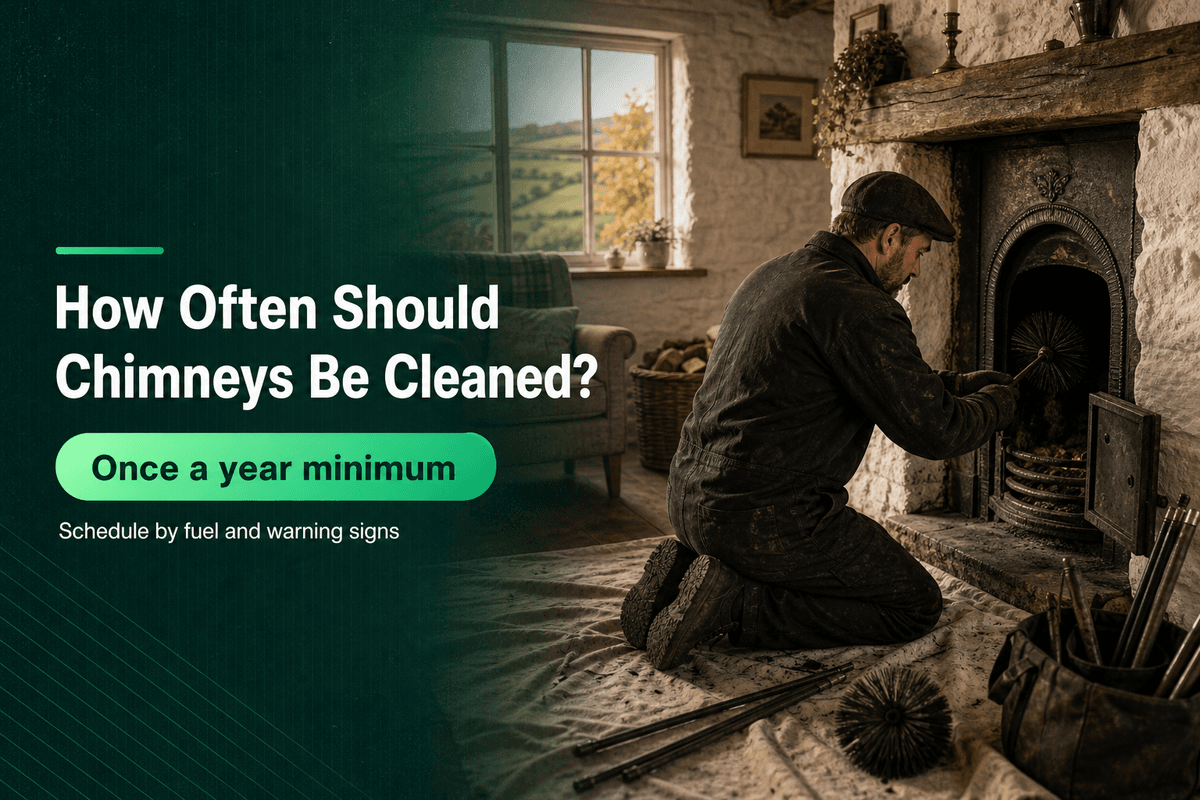
Chimney cleaning cost in Ireland normally comes down to a first-flue price plus whatever extras the flue itself needs, and as an aggregate Irish market estimate the first chimney or stove flue swept on a visit runs roughly €60 to €120 — an open fire sits at the lower end, while a stove whose baffle is taken out and cleaned sits at the upper end. Each additional chimney or flue swept on the same visit adds roughly €30 to €50, removing a bird nest or heavy blockage adds roughly €100 to €200, a camera (CCTV) inspection of the flue runs roughly €100 to €200, and a bird guard or cowl supplied and fitted costs roughly €60 to €150. Local chimney cleaning and inspection covers all of this on one visit, and the table below sets out what each figure buys.
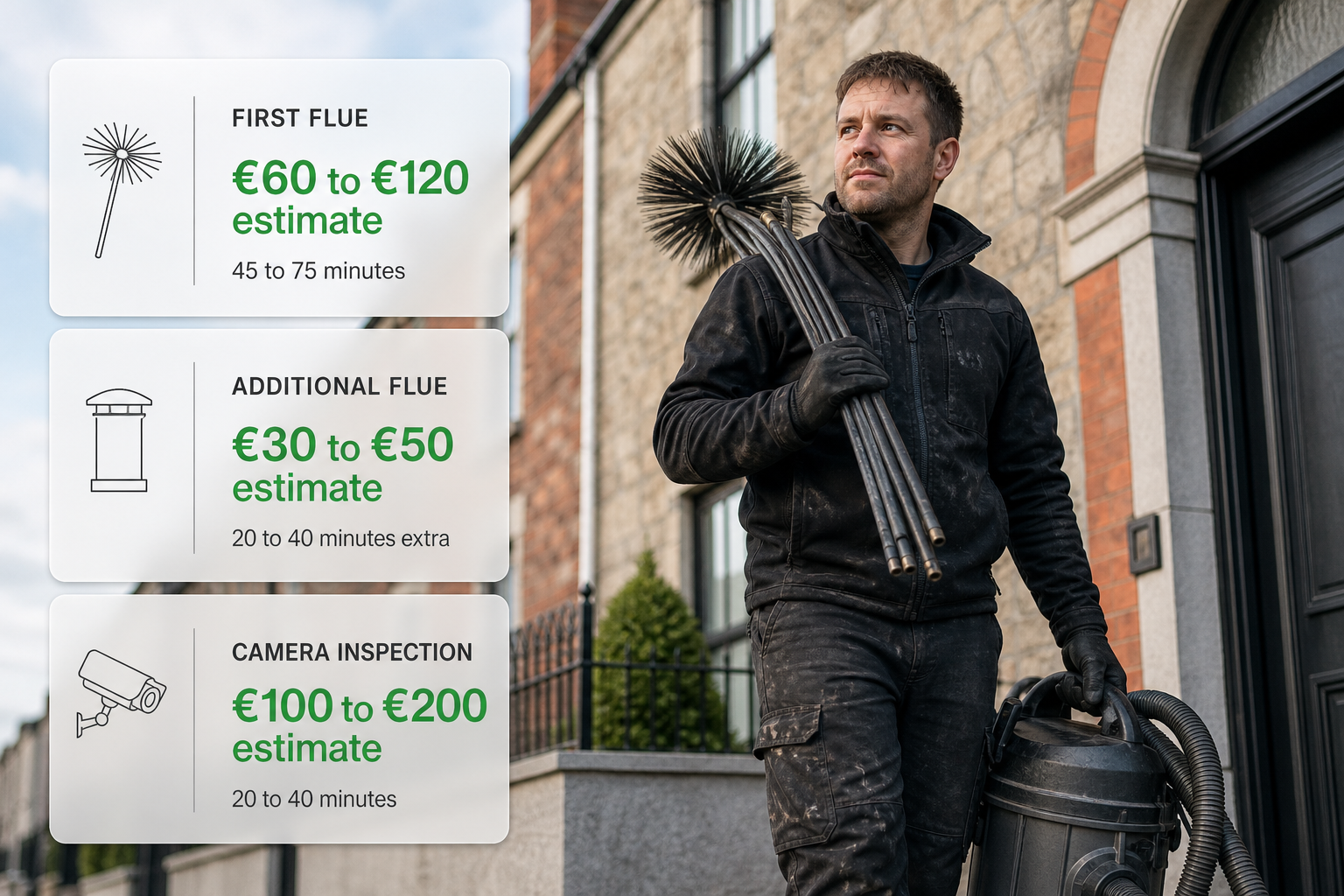
What chimney sweeping costs in Ireland
The figures below are an aggregate Irish market estimate for a single visit by a sweep working in Ireland, covering the flue, the appliance opening and the clean-up afterwards. Times refer to the work itself and exclude travel.
| Job | Typical price | Typical time on site | When it is needed |
|---|---|---|---|
| First chimney or stove flue swept | €60 to €120 | 45 to 75 minutes | Where the flue serves an open fire, a stove or a solid-fuel appliance |
| Each additional chimney or flue on the same visit | €30 to €50 | 20 to 40 minutes extra | A second chimney breast or a second appliance flue in the same house |
| Bird nest or heavy blockage removed | €100 to €200 extra | 30 to 90 minutes extra | Where a nest, a fall of soot, loose masonry or other debris is blocking the flue |
| Camera (CCTV) inspection of the flue | €100 to €200 | 20 to 40 minutes | After a chimney fire, where tar or cracking is suspected, or where the flue cannot be seen from either end |
| Bird guard or cowl supplied and fitted | €60 to €150 | 20 to 40 minutes | To keep birds, rain and debris out of an open pot |
As an aggregate Irish market estimate, a house with an open fire and a stove swept on one visit is the first flue at €60 to €120 plus one additional flue at €30 to €50, so roughly €90 to €170 in total. Any of the extras in the table are added on top of that figure, which is why a house that also needs a nest cleared and a new cowl fitted ends up well above the cost of a straightforward sweep.
What makes a chimney sweeping job take longer
Time on site, not the size of the house, is what moves a quote up or down, and a few things reliably stretch a visit.
- More chimneys and flues. A sitting room fire, a kitchen stove and a back boiler can mean three separate flues, each swept with its own brush or rod set and each taking its own run at the roof or the appliance opening.
- Heavy soot or tar. A flue that has burned damp timber, unseasoned logs or smoky fuel at low temperatures builds a hard glazed layer that an ordinary brush will not shift. It needs rotary rods or a chemical treatment, and occasionally a second visit once the deposit has softened.
- Nests and blockages. A bird nest, a collapsed crown, a heavy fall of soot or a flue packed with debris has to be pulled out before sweeping can begin. This is the single most common reason an appointment runs over, because the sweep cannot know what is up there until the rods go in.
- Difficult roof access. A straight run of roof with the chimney at the ridge is quick. Dormers, valleys, glazed conservatory roofs, steep pitches, or a mid-terrace stack with nowhere to foot a ladder all add time, and a roof ladder or working platform may be needed.
- Rural travel. A sweep covering a wide area builds travel into the day, and a call-out to a remote townland takes longer to reach than a job on the same street as the previous one.
- Busy autumn weeks. From September until the first cold snap, sweeps are booked out, so appointments are squeezed around other jobs and the time window offered is wider.
- Access inside the room. A stove set into a tight alcove, heavy furniture in front of a fireplace, a stove that has to cool before it can be touched, or a carpet needing extra sheeting all slow the work down.
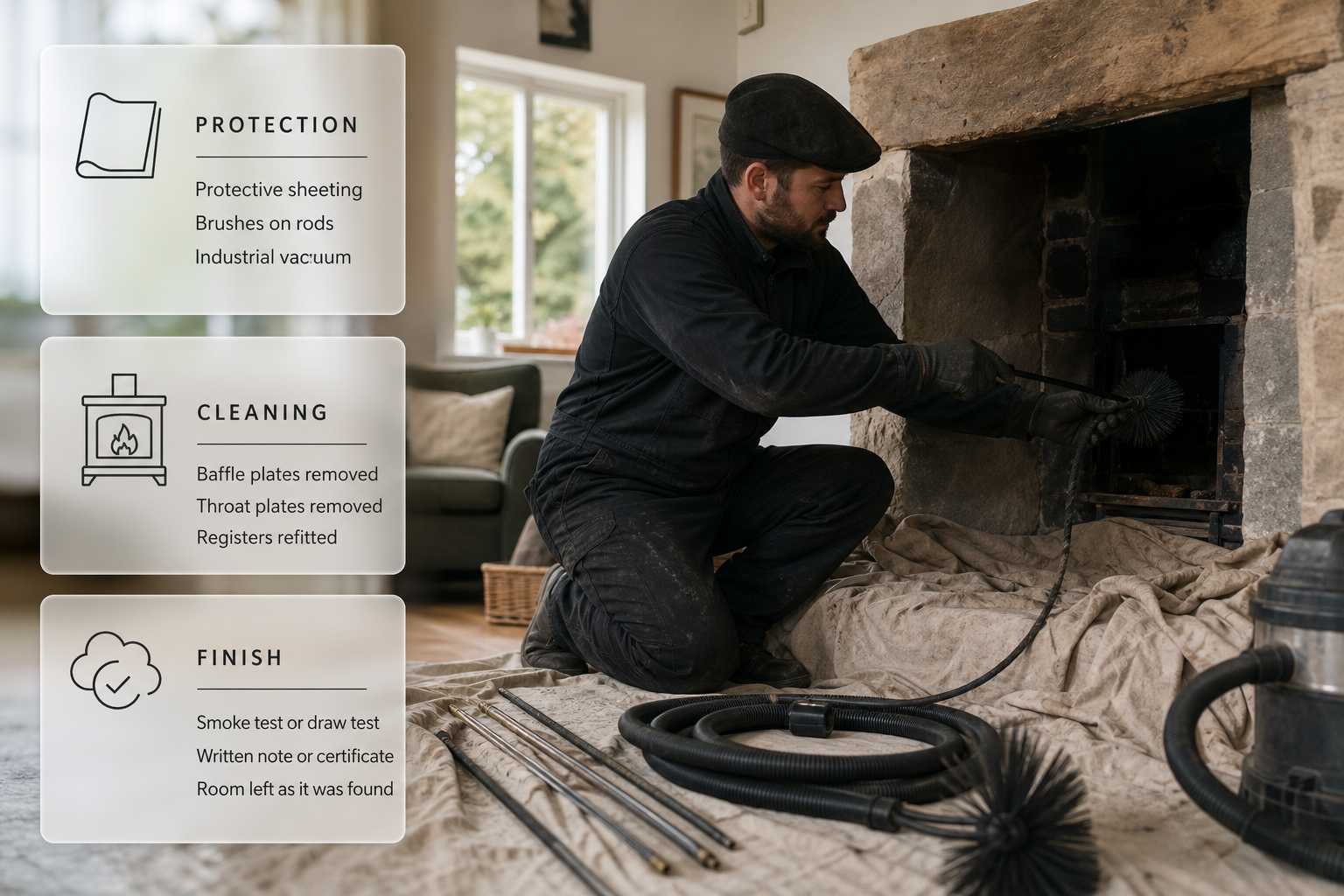
What a standard sweep includes
A normal visit follows a set pattern, and a homeowner should expect all of the following as part of the job rather than as an add-on.
- Protective sheeting over the hearth, floor and nearby furniture, often taped around the opening.
- Brushes on rods, or rotary rods driven by a drill where deposits are hard, matched to the size of the flue.
- An industrial vacuum running throughout, with soot bagged and taken away rather than left behind in a household bin.
- Baffle plates, throat plates and registers removed and refitted, so the top of the appliance and the flue collar are cleaned as well as the flue.
- A smoke test or draw test afterwards, to confirm the flue is pulling air up and out rather than spilling into the room.
- A short written note or certificate recording the flues swept, the date and anything the sweep noticed while working.
- The room left as it was found, with the hearth swept and covers folded away.
A sweep will also say a word about the appliance itself. A room sealed too tightly can starve a fire of air, a flue showing tar, cracking or a failed seal is worth watching, and many householders keep a carbon monoxide alarm in the room as a backstop. Householders often use the same visit to sort other small jobs around the house, and home services listed locally cover the wider work. Cleaning a flue by hand with a domestic brush kit is possible on a short, straight, ground-floor flue, but the inside of a flue cannot be seen from the room, soot is fine and spreads through a house very easily, and the roof work that a full sweep involves needs ladders and fall protection most householders do not have.