A realistic fireplace installation cost in Ireland usually lands in the €2,200 to €5,500 range for a stove-based supply-and-fit job, and plenty of living-room installs end up around €2,500 to €4,000 once the appliance and the flue or chimney work are both included. Those two items move the quote more than anything else, and they're exactly why a cheap headline price so often turns into a much bigger final bill.
If the house has an older chimney, a blocked opening, or no proper flue route, the budget climbs fast. That's the point where many homeowners realise they weren't comparing like with like at all.
What a Fireplace Installation Actually Costs in Ireland in 2026
You get one quote for €2,400 and another for €4,800 for what looks like the same living-room fireplace job. The gap usually comes down to the building decisions buried inside the price. One quote may cover only the stove and fitting. The other may include the flue liner, hearth, chamber finish, ventilation, and the paperwork needed to sign the job off properly.
That is the cost question in Ireland in 2026. You are paying for five things at once: the appliance, the flue route, the hearth, the fuel type, and the compliance work needed for the house you have.
Current Irish pricing still points to a broad €2,200 to €5,500 band for stove-based supply-and-fit work, with lower figures usually tied to a simpler inset job into a usable chimney and higher figures tied to boiler models or installs with more flue work. These are aggregate Irish market estimates rather than a published tariff. A package that bundles an insert stove with a marble fireplace surround typically lands higher again, around €3,000 to €6,000, because that price includes the visible fireplace finish as well as the hidden installation items.
Right after that first price check, the practical next step is to find fireplace and stove installers and post your job.
Why one home lands near €2,500 and another pushes past €5,000
A straightforward install stays cheaper. That usually means an existing chimney in decent condition, a standard stove, a modest hearth job, and no major opening-up or repair work.
The price rises when the house forces a different build decision. No usable chimney means a new flue solution. A damaged opening means remedial work before fitting starts. Choosing gas or a boiler stove changes both the appliance cost and the installation standard required. A decorative fireplace with a stone or marble surround also shifts the quote, even if the heating appliance itself stays mid-range.
Cheap headline prices cause problems because they hide those choices.
What actually changes the budget
These are the items that separate a lean quote from a full one:
- Appliance type. Inset, freestanding, gas, electric, or boiler stove
- Flue setup. Existing chimney, new liner, or a full new route
- Hearth and surround. Basic slate costs less than a larger decorative finish
- Fuel requirements. Solid fuel, gas, and electric all involve different fitting work
- Compliance items. Ventilation, certification, and safety checks
If a quote does not break those out clearly, you cannot compare it properly.
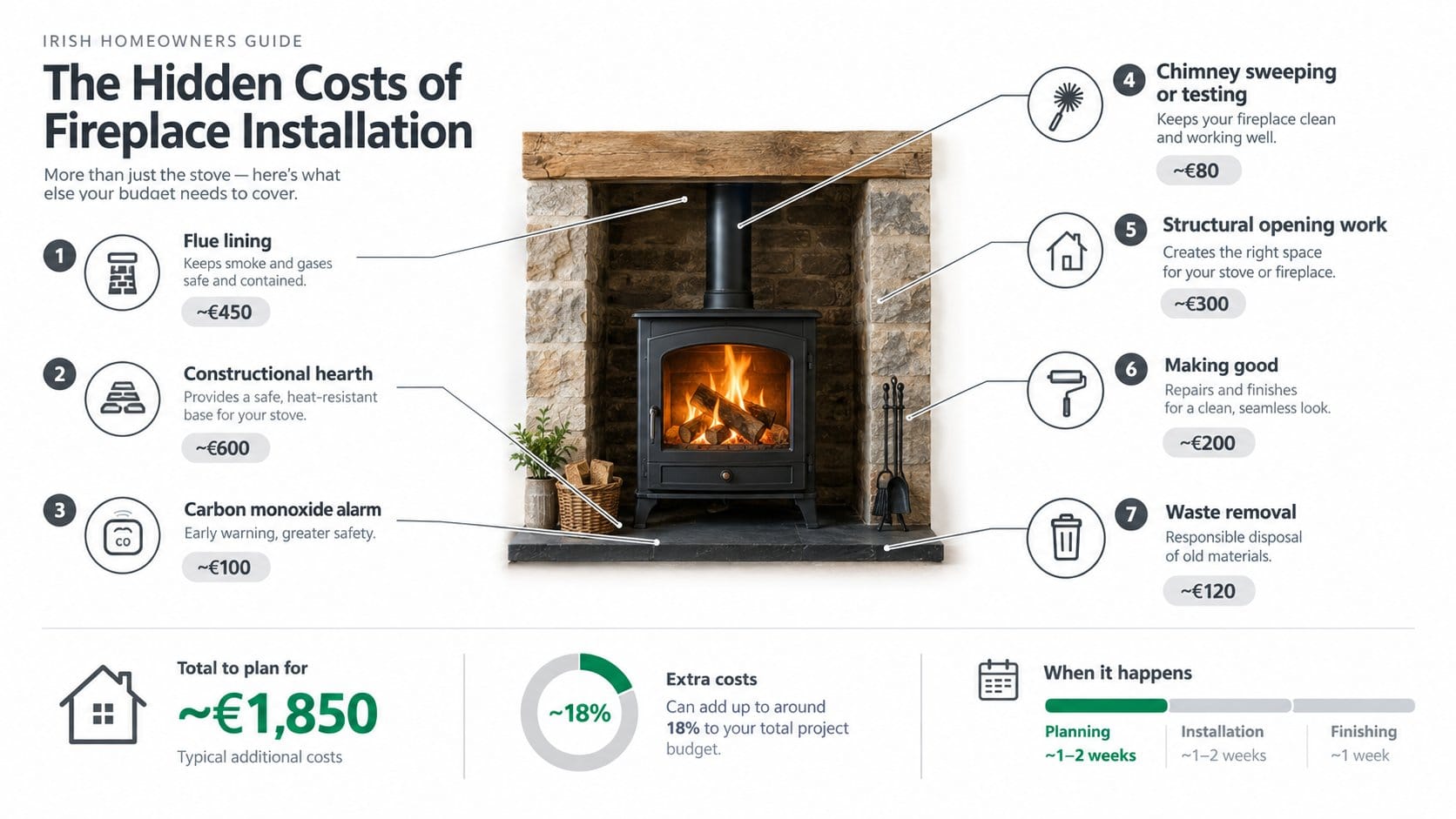
Smaller add-on works such as ventilation changes, plastering, or decorating commonly add €200 to €500 on top of the appliance and the fitting itself. Those extras are exactly why two homeowners can choose a similar stove and still end up with very different final bills.
Anatomy of an Irish Fireplace Quote
You get two quotes for what sounds like the same job. One is €2,400. The other is €4,300. The difference usually is not the stove. It is the build decision behind it: whether you are reusing a sound chimney, adding a liner, building a new flue route, changing the hearth, or paying for the compliance work to sign the job off properly.
That is why a proper fireplace quote should read like a small building quote. If you only get one total figure, you cannot see what is included, what has been assumed, and what will come back later as an extra.
What should appear on the quote
A decent quote should spell out the appliance, the flue plan, the hearth, any chamber or surround work, labour, waste removal, and final certification. Gas jobs also need the gas connection scope and RGI sign-off clearly stated. If those items are missing, the price is incomplete.
Typical 2026 line items in an Irish fireplace install quote
| Line item | What it covers | Typical 2026 range |
|---|---|---|
| Appliance | Stove or fire unit itself | €1,200 to €2,500 for the stove element in mid-range insert packages, as noted earlier |
| Surround and hearth | Marble, stone, slate, or similar finishing materials | €1,000 to €2,000 where a decorative package is included, as noted earlier |
| Installation, liner, certification | Fitting labour, flue liner, testing, and sign-off | €800 to €1,500 in packaged insert jobs, as noted earlier |
| Inset stove supplied and fitted | Combined package price | €2,200 to €3,500 for a standard inset installation, as noted earlier |
| Freestanding stove supplied and fitted | Combined package price | €2,500 to €4,000 for a typical supply-and-fit job, as noted earlier |
| Boiler stove supplied and fitted | Combined package price | €3,500 to €5,500 where the stove ties into the heating system, as noted earlier |
| Chimney liner | Flexible liner if the existing flue is unsuitable | €1,000 to €2,500 depending on height, access, and chimney condition, as noted earlier |
| Twin-wall flue | New insulated flue system where there is no usable chimney | €1,800 to €3,200 depending on route and external work, as noted earlier |
| Ancillary making good | Ventilation changes, plastering, patching, decorating | €200 to €500 for smaller finishing extras, as noted earlier |
Use the table to judge what kind of job you are being priced for.
If Quote A includes only the appliance and labour, while Quote B includes a liner, new vent, hearth alterations, and making good, Quote B is not overpriced. It is more complete.
What appliance-only quotes leave out
Appliance-led quotes are where budgets go wrong. The cheap number often excludes the flue work, the liner, any rebuild inside the opening, the hearth upgrade, ventilation, and certification.
That is the expensive part.
A stove can sit in the middle of the quote and still be a minority of the final bill if the chimney needs work or the room needs to be altered to meet current standards. Homeowners miss this because the showroom price is easy to compare, but the building work is not.
VAT and quote reading
Ask for the VAT treatment in writing before you accept anything. In Ireland, residential repair and installation labour is often charged at 13.5% VAT, while some professional services can fall under 23%. Supply-and-fit can also be treated differently depending on how the quote is structured.
Do not accept “plus VAT if applicable.”
Ask for one final figure that states exactly what is included, exactly what rate is being used, and whether certification, waste removal, and making good are part of that price. That is how you compare quotes properly.
Cost by Fireplace and Stove Type
You can get two fireplace quotes that are €1,500 apart for what looks like the same room. The difference is usually not the brand badge on the stove. It is the building job behind it. Appliance choice, flue route, hearth work, fuel type, and compliance drive the cost.
2026 supply-and-fit price ranges by fireplace and stove type
| Install type | Typical 2026 supply-and-fit range | Why the price lands there |
|---|---|---|
| Inset stove into existing opening | €2,200 to €3,500 | Cheapest when the chimney opening is sound and the flue setup is straightforward. Costs rise fast if the chamber needs rebuilding or the flue needs lining |
| Freestanding stove on hearth | €2,500 to €4,000 | Usually costs more because the job often includes a new hearth, visible flue connection details, and more finishing work in the room |
| Boiler stove | €3,500 to €5,500 | Higher because you are paying for more than room heat. Pipework, heating connections, and commissioning add labour and risk |
| Gas fire | Get a written quote | Price depends on whether gas is already available, what flue system the appliance needs, and the level of wall or chimney alteration required |
Source note: ranges in this table are based on the Irish installer pricing references cited earlier in the article, including Stove Fitters Dublin and ShamFix's Laois guide.
Inset stove
Inset stoves suit homeowners who already have a chimney breast and want a built-in look without rebuilding the whole room. If the opening is usable and the flue is serviceable, this is often the best-value upgrade from an old open fire.
The budget changes once the old fireplace is only partly usable. A narrowed opening, damaged inner chamber, poor draw, or an unsuitable flue turns a simple stove swap into a masonry and flue job. That is why one inset quote can sit near €2,200 while another pushes toward €3,500 before any decorative upgrade is added.
Freestanding stove
A freestanding stove gives you more freedom on the final look. It works well if you want strong room heat, a simpler chamber finish, or a more contemporary setup.
It also shifts the spend into different parts of the job. You may need a new hearth, a clearer flue route, and more visible finishing around the stove and pipework. If you are comparing an inset quote with a freestanding one, do not assume the dearer option is overpriced. It often includes more actual building work.
Efficiency is one reason many Irish homeowners move away from an open fire. The Local Government building guidance note, citing SEAI comparison data, says an open fire is typically 20 to 30% efficient, while a closed stove is 50 to 80% efficient and a stove with back boiler is 65 to 85% efficient in the Local Government building guidance note.
Boiler stove and gas fire
Boiler stoves belong in a different budget category. You are not just fitting an appliance. You are tying it into hot water or radiators, which means more labour, more coordination, and more to commission properly. If your goal is simple room heat, a standard stove is usually the better value choice.
Gas fires need a stricter reading of the quote. The appliance can look tidy and compact, but the final cost depends on gas supply, flue type, terminal position, wall construction, and certified installation. The right advice here is simple. Get a written quote from an RGI-registered installer, and make sure it states exactly what flue and finishing work is included.
What Moves the Price Most
Two houses can buy the same stove and get quotes that are thousands apart. The difference is usually not the appliance. It is the building work around it.
What Moves an Irish Fireplace Quote Most
| Cost Driver | Building decision behind the cost | Typical Euro Impact |
|---|---|---|
| Chimney liner needed | The existing flue has to suit the new appliance. If it is damaged, oversized, or unsuitable, relining becomes part of the job. | €1,000 to €2,500 |
| No chimney, twin-wall flue needed | If there is no usable chimney, the installer has to create a full new flue route through the house or externally. Materials and labour jump fast here. | €1,800 to €3,200 |
| Appliance type | A basic room-heating stove is one budget. An inset unit, cassette fire, or boiler model usually brings more fitting time, more parts, or more coordination. | €2,200 to €5,500 |
| Surround and hearth specification | A simple hearth costs far less than a full chamber, surround, stone finish, or raised constructional hearth. | €1,000 to €2,000 |
| Ancillary making good | Opening-up, vent work, plaster repairs, and redecorating often sit outside the headline install figure. | €200 to €500 |
The flue usually decides the budget
If you want the single biggest reason quotes vary, start with the flue.
A house with a sound, usable chimney stays closer to the lower end of the range. A house with a cracked flue, a blocked route, poor draw, or no chimney at all moves into a different budget. That is why one quote for a stove comes back at a manageable figure and another jumps sharply. The appliance may be identical. The smoke route is not.
The appliance changes the building work
Freestanding stoves are often straightforward, but only if the fireplace opening, hearth, and flue already suit them. Inset fires and cassette units can look neater, yet they often need more work to the chamber, more finishing, and less room for error on clearances and connection points.
Boiler stoves push the price higher for a simple reason. You are no longer fitting heat for one room. You are tying the appliance into water or heating systems, which adds labour, components, and commissioning.
Fuel type and compliance also move the number
Solid fuel tends to cost more in building terms. You may need a proper hearth, an air vent, a carbon monoxide alarm, chimney work, and heat-safe finishes around the opening.
Gas changes the cost in a different way. The visible fire can look simpler, but the quote still depends on gas supply, flue type, terminal position, and certified installation. A cheap-looking gas quote is often just an incomplete one.
Use this budgeting rule
Ask what your house needs, not what a stove costs.
That question gets you to the price drivers faster. Appliance choice, flue route, hearth spec, fuel type, and compliance decide the final number. County labour rates matter, but they are rarely the main reason one Irish fireplace quote is far above another.