Rubbish Removal Prices in Ireland: A Homeowner's Guide
Expect roughly €50 to €450 for household rubbish removal in Ireland, with the price set by how much of a van the load fills.
/8 min read
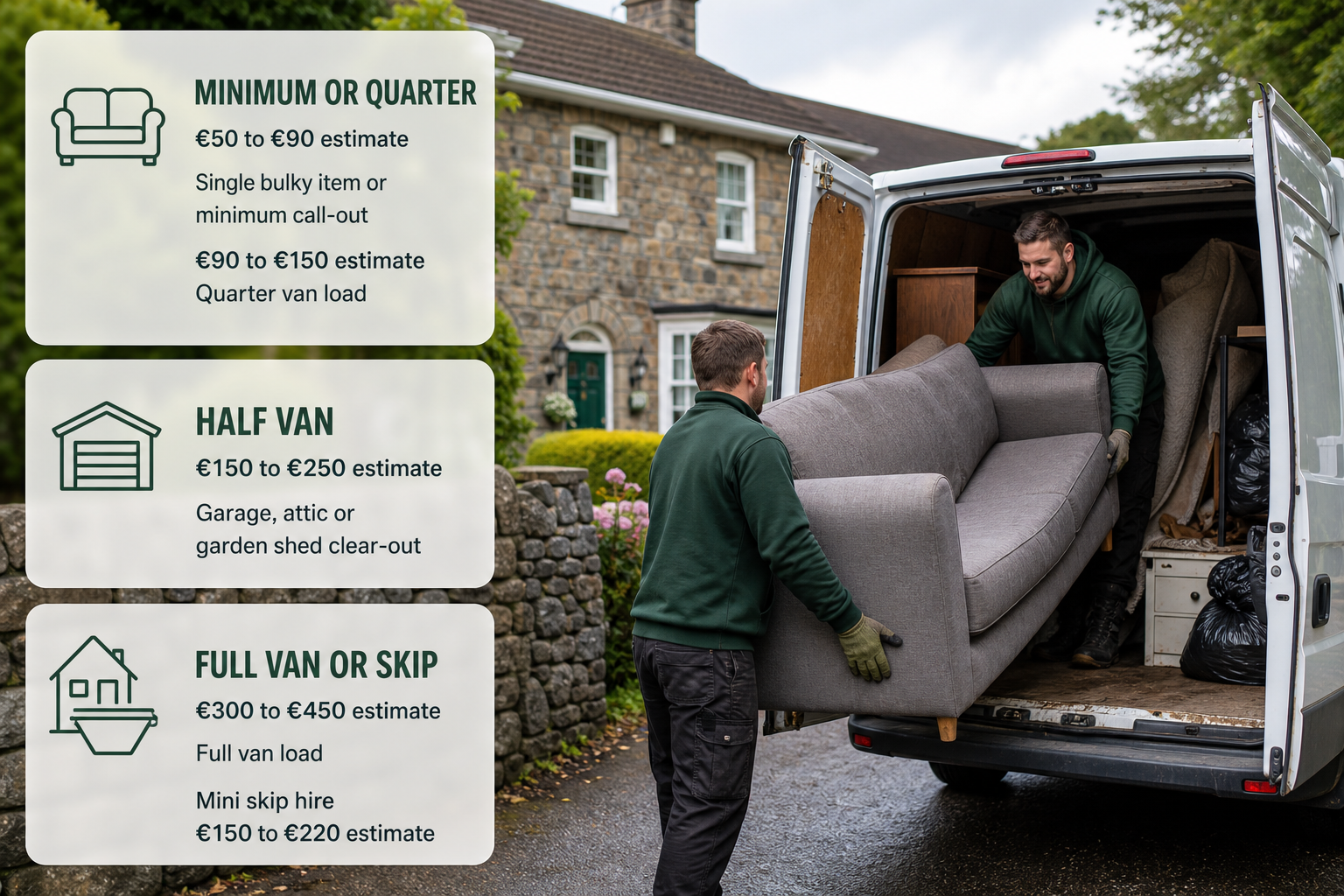
Household rubbish removal in Ireland is priced mainly by the space a load takes up in the van rather than by its weight, so two similar-looking piles can attract very different quotes. As an aggregate Irish market estimate, a single bulky item or minimum call-out costs roughly €50 to €90, a quarter van load roughly €90 to €150, a half van load roughly €150 to €250 and a full van load roughly €300 to €450. Householders comparing offers in their own area can start with local rubbish removal services and match each quote to the size of the pile in front of them.
Household rubbish removal prices at a glance
The same aggregate Irish market estimate, set out in table form:
What the price covers
Typical range
When it fits
Single bulky item or minimum call-out
€50 to €90
One three-seater sofa, a wardrobe or a handful of bags
Quarter van load
€90 to €150
A box room, a few bags and one large item
Half van load
€150 to €250
A garage, attic or garden shed clear-out
Full van load
€300 to €450
A whole house clearance or a large shed
Mini skip hire, for comparison
€150 to €220
A bathroom strip-out or a garden tidy-up
Builder's skip hire, for comparison
€300 to €450
Rubble, soil and timber from a bigger job; an on-street skip may also need a council permit
A van load here means the usable space in a standard small panel van, filled level with the top of the sides. The two skip rows sit alongside the collection bands for comparison rather than inside them: a mini skip suits a small strip-out or a garden tidy-up, while a builder's skip takes the heavier rubble and timber from a larger job.
Using the same estimate, a garage clear-out of about half a van — old shelving, two bicycles, a broken lawnmower, flattened cardboard and a worn armchair — lands in the half van band at roughly €150 to €250. If the shelving turns out to fill closer to a full van once it is loaded, the figure moves into the €300 to €450 band, which is why an accurate volume estimate before the job matters more than almost anything else.
What moves the price up or down
For general household waste the deciding factor is volume, not weight: bags of soft rubbish, cardboard and light furniture are cheap to carry because they are bulky but light. Heavy materials are the exception. Rubble, soil, plasterboard, tiles and concrete are dense enough to reach a vehicle's weight limit long before the van looks full, so collectors price them higher and sometimes refuse mixed loads that contain them.
Access is the second big factor. A first-floor flat with no lift, a long carry down a side passage, a narrow gateway or a street with nowhere to park all add labour time, and the quote reflects it. A van parked two streets away can turn a ten-minute job into a thirty-minute one, and that difference shows up in the price rather than in the volume.
Timing changes the price as well. Same-day, evening and weekend collections usually attract a surcharge, while a job booked a week or more ahead is typically the cheapest way to have a load taken away. A collection squeezed in around a house sale or a clear-out deadline will always cost more than one that can wait.
Items that cost extra, and what cannot be taken
Some items cannot travel in a general waste load, so collectors treat them as extras on top of the load price. Mattresses, tyres, paint tins and gas bottles are the usual ones. A mattress is awkward to compact, a tyre needs separate processing, paint needs to be dried out or handled as a liquid, and a gas bottle is pressurised and dangerous in a compactor. Saying what is in the pile when asking for a quote avoids a higher price on the day or an item left behind at the kerb.
Hazardous waste is a different job again. Asbestos sheeting, insulation board and contaminated material need a specialist contractor and are not part of normal household rubbish removal. Asbestos is a serious health hazard when disturbed, so it should never be broken up, bagged with general waste or handed to a collector who is not set up for it.
Electrical items are the easy part of a clear-out. Waste appliances and small electrical goods can usually be left free of charge at a civic amenity site, or handed back to the shop when a replacement is bought, so they rarely need to go into a paid rubbish load at all.
Private collector, skip hire or doing it yourself
A private collector suits a mixed household load — furniture, bags, garden cuttings and odd items — because the crew does the lifting, loads the van and takes everything away in one visit. A skip suits a bigger, heavier, one-off job that can be filled over several days, such as a shed demolition or a bathroom strip-out.
Doing it yourself is the cheapest option on paper and the most work in practice. A household with a car and trailer can take a small load to a civic amenity site, where a modest charge per car or van load applies and the site decides what it accepts. That works for a few bags or a single item, but stops making sense once the load needs two or three trips or takes a full day to move. Some councils also run bulky waste collections, and what they accept and charge varies from county to county.
For households already organising a move or a clearance, the same crews that handle moving and transport work will often quote for taking away what is left behind, which avoids paying twice for two separate visits; typical van rates are set out in man with a van prices.
Checking the collector before the job
The practical safeguard is short and worth the two minutes it takes: use only a collector who holds a waste collection permit, take the permit number and check it against the National Waste Collection Permit Office register before the job goes ahead, and ask where the load will be taken and what happens to anything that cannot be recycled. The householder can be held responsible if the waste ends up dumped, so an operator who will not produce a permit number is a false saving rather than a bargain, and a note of the permit number and the destination leaves the householder with a record of where the rubbish was supposed to go.
What to tell a collector for an accurate quote
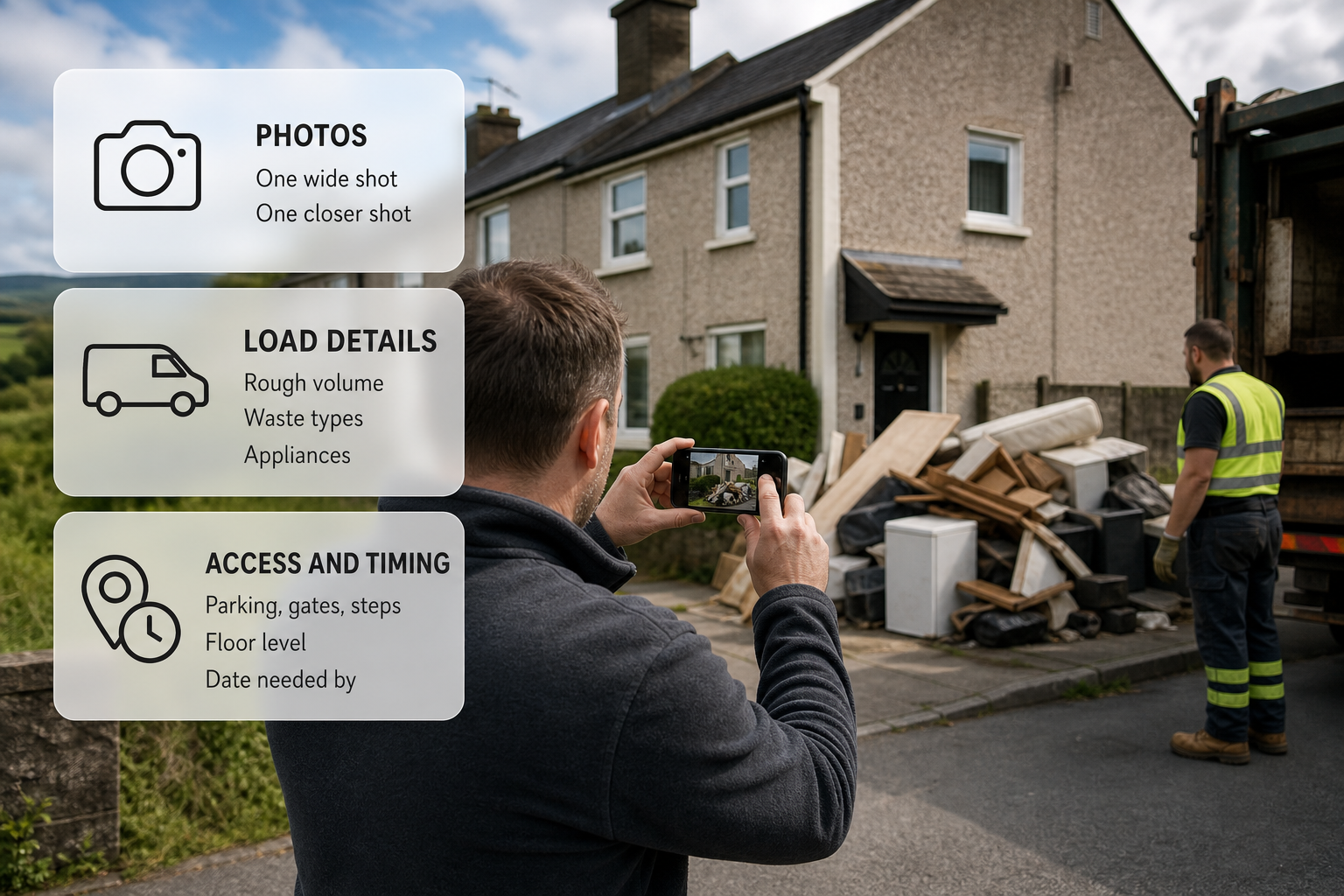
Photos are the fastest way to a realistic figure: one wide shot showing the whole pile and one closer shot showing what it is, plus the details that affect handling:
Rough volume: how much of a van the load would fill, or a simple list of the large items.
Waste types: general household waste, garden waste, timber, metal, rubble or soil, plus anything charged as an extra such as a mattress, tyre, paint tin or gas bottle.
Appliances: any electrical item included in the load.
Access: parking, gates, steps, kerbs, a lift, or a long carry from the back of the property.
Floor level: whether the waste is on the ground floor, upstairs, or in an attic or basement.
Timing: the date the waste needs to be gone by, and whether a weekend or same-day visit is needed.
Ask whether the quoted price includes disposal and whether a receipt or docket will be provided. A fixed price for the load described is easier to compare than a price per hour, and a written note of the collection is useful evidence if the waste ever turns up somewhere it should not.
FAQ
Is a skip cheaper than a collector for a full van load?
For the same volume the two sit in the same €300 to €450 band, so the decision usually comes down to labour and convenience rather than headline cost. A collector lifts and loads everything, while a skip has to be filled by hand and cannot take items barred from mixed waste such as mattresses and gas bottles. A skip may also stand outside the property for a week or more, which suits a slow strip-out and frustrates anyone with a tight driveway.
Do collectors charge by weight or by volume?
Most household quotes are built on how much of the van the load fills rather than on a weighbridge ticket, which is why a light pile of cardboard can cost the same as a much heavier one of the same size. Weight only takes over with dense material such as rubble, soil or plasterboard, where the vehicle reaches its legal limit with space still free. If a quote looks high, ask what the same pile would cost at half the volume — the answer shows whether volume or material is driving the figure.
Are there cheaper options for a small amount of rubbish?
Yes, for a few bags or one appliance the cheapest route is usually a trip to a civic amenity site, where the charge is per car or van load. A collector's minimum call-out at €50 to €90 starts to make sense once there is lifting involved, such as a sofa or a wardrobe that will not fit in a car. Below that threshold, paying a firm to drive out is convenience rather than necessity.
Can two households share one collection?
Sharing works well where neighbours are clearing out at the same time, because one van making one trip costs less per household than two separate minimum call-outs at €50 to €90 each. Both piles need to be ready, accessible and in one place when the crew arrives, and it is worth agreeing in advance who books and who pays. Anything charged as an extra, such as a mattress or a tyre, should be named at quoting stage so the split is clear.
Getting a rubbish removal quote
Posting a job and listing it on ShamFix is free and there is no commission, and a subscription is planned for the future. ShamFix does not check or certify tradespeople — profiles are filled in by tradespeople themselves — so homeowners should check registrations themselves and read reviews before booking anyone. Comparing two or three quotes against the same volume, access notes and list of extras is the simplest way to judge which one is fair.