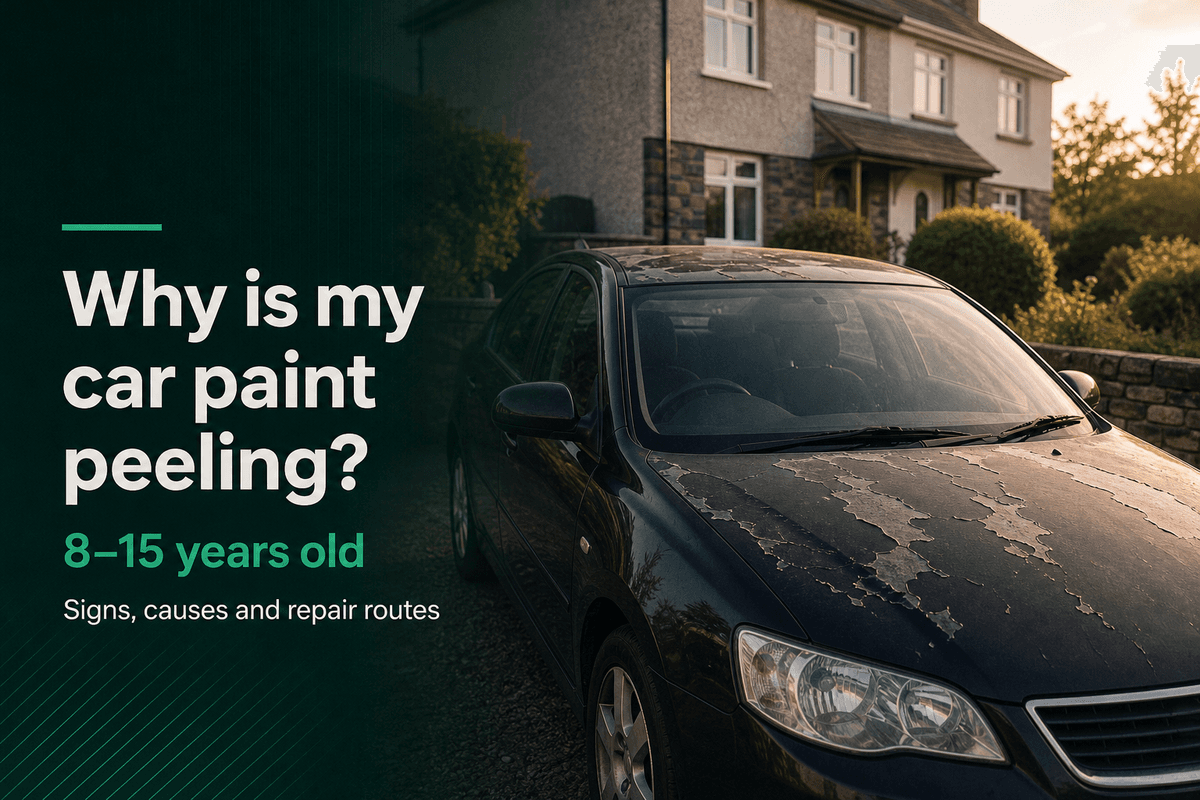
Car paint peeling almost always means the clear coat — the transparent lacquer sprayed over the colour — has broken down after years of sun, road salt and harsh washing. Once that layer fails, the colour underneath goes dull and chalky and the lacquer lifts off in flakes. Rust pushing up from below, stone chips that let water in, and a previous repair whose paint never bonded are the other common causes; owners who decide the damage is past a home fix can arrange car bodywork and painting locally.
What is actually failing when paint peels
Car paint is a stack of layers: a corrosion-protecting primer on the metal, a primer surfacer, the colour base coat, and the clear lacquer on top that carries the gloss and the ultraviolet protection. Peeling is rarely a fault in the colour itself. The clear coat takes the punishment — UV light, heat cycling, salt, bird droppings and wash chemicals — and once its UV absorbers are used up it oxidises, turns cloudy, loses its grip and lifts away. The colour layer has no UV protection of its own, so it fades and chalks the moment it is exposed.
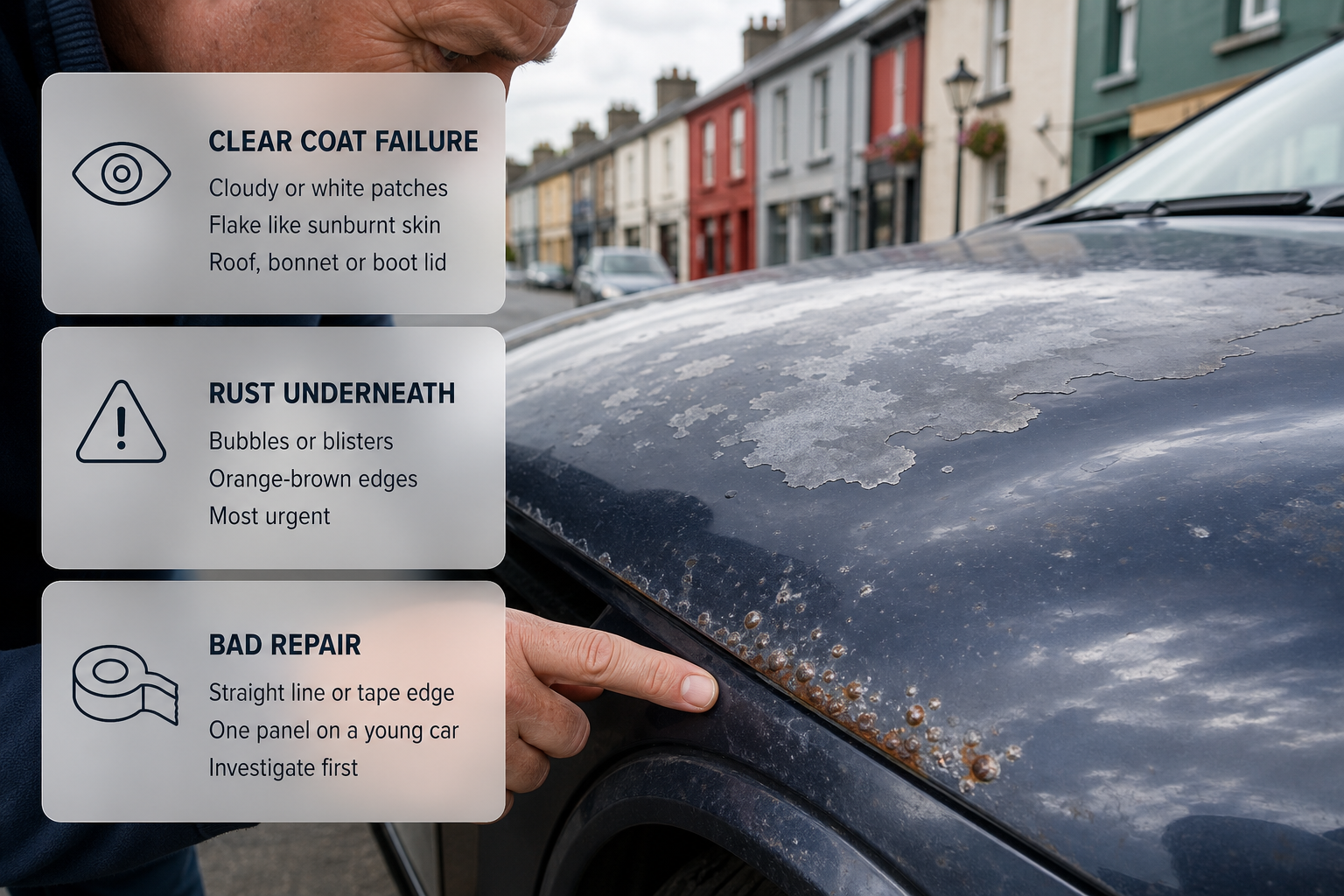
Rust works from the opposite direction. A chip, a scratch through to metal or a stone thrown up on the motorway breaks the film at a single point, moisture sits in the opening, and corrosion creeps sideways underneath. The paint above looks intact for a while and then blisters and lifts around an orange-brown edge, which is why bubbling is a more serious sign than a dull roof.
A previous repair is the third route. If a panel was not sanded properly, if the wrong primer was used on plastic, or if new paint was applied over a contaminated or still-failing surface, the new film never bonds and lets go in sheets — often along a masking tape line or a panel edge.
Age is the simplest clue. Clear coat failure usually shows on the roof, bonnet and boot lid first, and on cars roughly eight to fifteen years old. Peeling on one panel of a much younger car, particularly along a straight line or on a single door, more often points to an earlier repair or respray than to ordinary ageing.
Diagnosis: what you see and what it means
The pattern the owner sees is usually enough to point at the cause. The table below sets out the common signs, how quickly each needs attention and the repair that normally follows.
| What you see | Likely cause | How urgent | Usual fix |
|---|---|---|---|
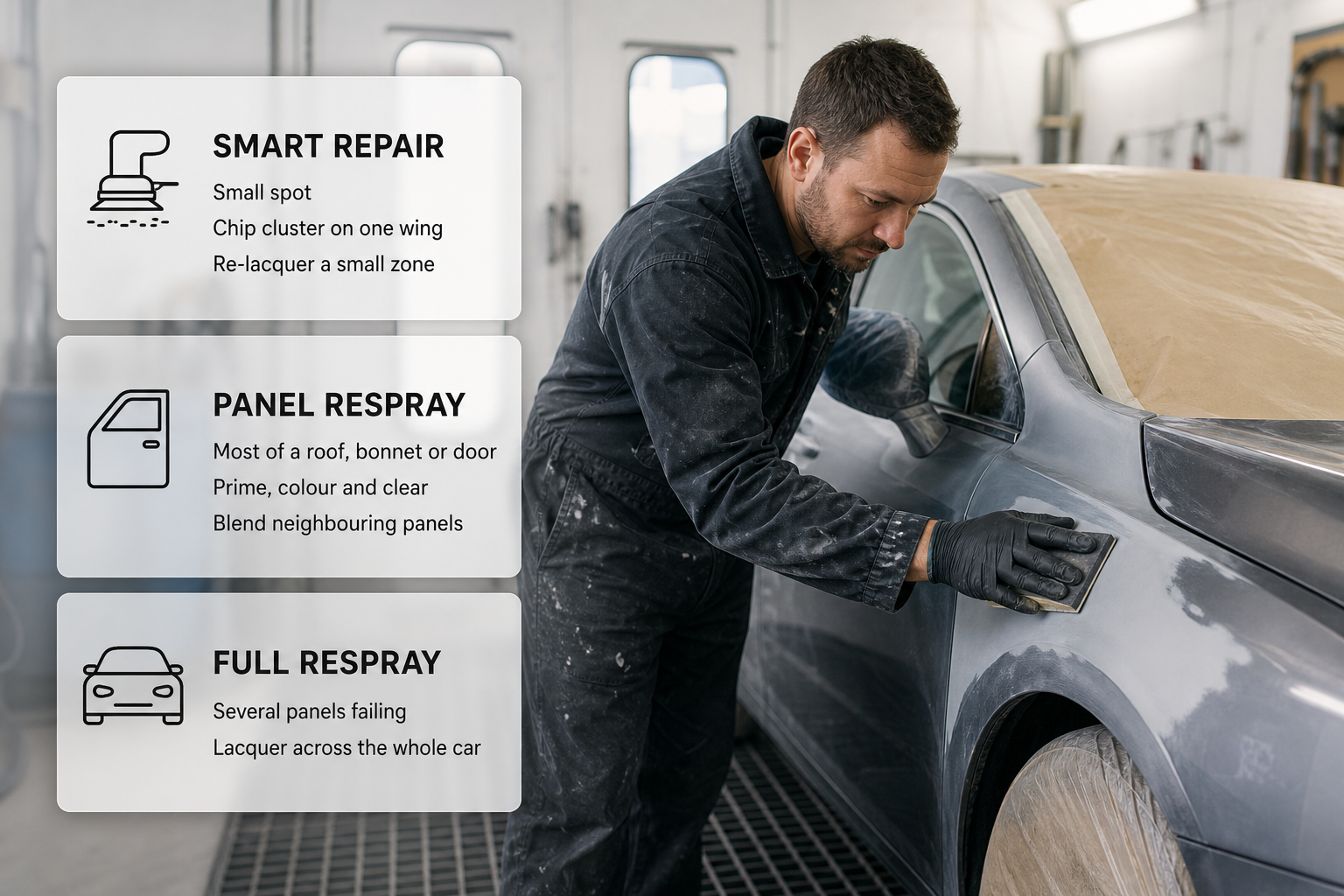
| Cloudy or white patches that flake like sunburnt skin, typically on the roof, bonnet or boot lid | Clear coat (lacquer) failure | Cosmetic at first, but it spreads across the panel | Sand or strip the failed lacquer on that panel, prime, then recoat colour and clear |
| Flaking paint with grey primer or bare metal showing underneath | Lacquer and colour both gone, usually after chips, scratches or a scrape | Fairly urgent — bare metal starts to rust quickly | Sand back to sound paint or metal, use an anti-corrosion primer and repaint the panel |
| Bubbles or blisters with orange-brown edges, often at seams, arch lips or old chips | Rust lifting the paint from below | Most urgent — corrosion keeps travelling sideways | Cut back to bare metal, treat the rust, prime and repaint |
| Peeling along a straight line, a tape edge or on one panel of an otherwise young car | An earlier repair or respray that never bonded | Investigate before spending elsewhere | Have it repainted properly; if the repair was recent, go back to whoever did it |
| Peeling from the edges of a bumper or plastic trim, around sensors or tow eye covers | Poor adhesion to plastic, often a repair that skipped the adhesion promoter, made worse by flexing | Cosmetic at first, but it spreads inwards from the edges | Strip the panel, use a plastic primer or adhesion promoter, then colour and clear |
Why roofs, bonnets and boot lids go first
Horizontal panels take the full sun load and hold more heat than the sides of the car, and they are usually the last areas to be washed and waxed. That combination burns through the clear coat ahead of everything else, which is why a dull, chalky patch on a roof is often the first sign an owner notices. A car that lives outside rather than under cover will show it sooner, and tree sap left on a boot lid etches into the lacquer and gives moisture a way in.
Irish conditions that speed up paint failure
Winter salt on the main routes and on coastal roads dries on panels, sits in panel gaps and creeps into every chip in the film, so a car that spends a lot of time on salted roads ages faster than one that does not. Sea air on coastal routes does the same job all year round: salt-laden wind settles on the paint and attacks exposed edges.
Bird droppings and tree sap are acidic and will etch through lacquer if they are left on the surface for days. They should be lifted with warm soapy water and a soft cloth rather than scraped or rubbed at dry. Pressure washers cause a surprising amount of damage when the nozzle is held too close to a panel edge or a chipped area, because the jet drives water under lifting lacquer and can strip a failing edge in one pass. Automatic brush washes with stiff bristles and recycled water also abrade the lacquer, especially in the weeks after a chip or a repair.
Why bumpers and plastic trim let go differently
Plastic panels flex, and paint is relatively rigid, so paint on a bumper or a mirror housing is working harder than paint on a steel wing. Bare plastic also has low surface energy, which means paint struggles to grip it, so manufacturers rely on an adhesion promoter or a dedicated plastic primer before colour. When a previous repair skips that step, or the panel was not properly cleaned of mould release agents, the film lets go in sheets from the edges.
Stone strikes and light knocks crack the film on a flexible panel without denting it, and the crack opens and closes every time the bumper flexes, pulling water in. That is why peeling around parking sensors, tow eye covers and trim edges is so common, and why it is a different problem from clear coat failure on metal.
What a careful owner can do now
A few simple habits slow the damage and buy time before a repair.
- Wash with a pH-neutral car shampoo and a soft mitt, working from the roof down, then rinse and dry with a clean microfibre cloth or drying towel. Drying matters as much as washing, because standing water works into chips.
- In winter, rinse the car — including under the arches and along the sills — after gritting runs, ideally once a week.
- Lift bird droppings and tree sap as soon as they are spotted, using warm soapy water and a soft cloth.
- Protect paint that is still sound with a wax or a polymer sealant, applied thin and buffed off. This slows oxidation where the lacquer is intact but does not re-bond a lifting edge.
- On small, firm, rust-free chips, clean the area with isopropyl alcohol on a cotton bud, let it dry, then build up clear lacquer or a matching touch-up in thin layers, allowing the product's stated drying time between coats.
- Check the peeling edge regularly. If the colour underneath looks chalky and pale, the lacquer has gone and no amount of polishing will bring it back.