ShamFix
Back to insights

Car Respray Cost in Ireland: What to Expect

One panel costs about €250–€450 and a full respray €2,000–€3,500, so see what drives the quote before you book.

10 min read
Car Respray Cost in Ireland: What to Expect

A respray in Ireland rarely comes with a single price, so here are the bands to work from, given as an aggregate Irish market estimate: one panel such as a door, wing or bumper costs roughly €250 to €450, two to four panels roughly €600 to €1,500, and a full respray in the same colour roughly €2,000 to €3,500 on a small car or €3,000 to €5,000 on a large car, SUV or van. A full colour change, which also means painting the door shuts, the boot opening and often the engine bay, runs to roughly €4,000 to €7,000 or more, while a scratch or scuff handled by smart repair costs about €80 to €200. Owners who want a figure for their own car can post the work as a bodywork and painting job for local tradespeople to quote, but the bands below are the yardstick for judging what comes back.
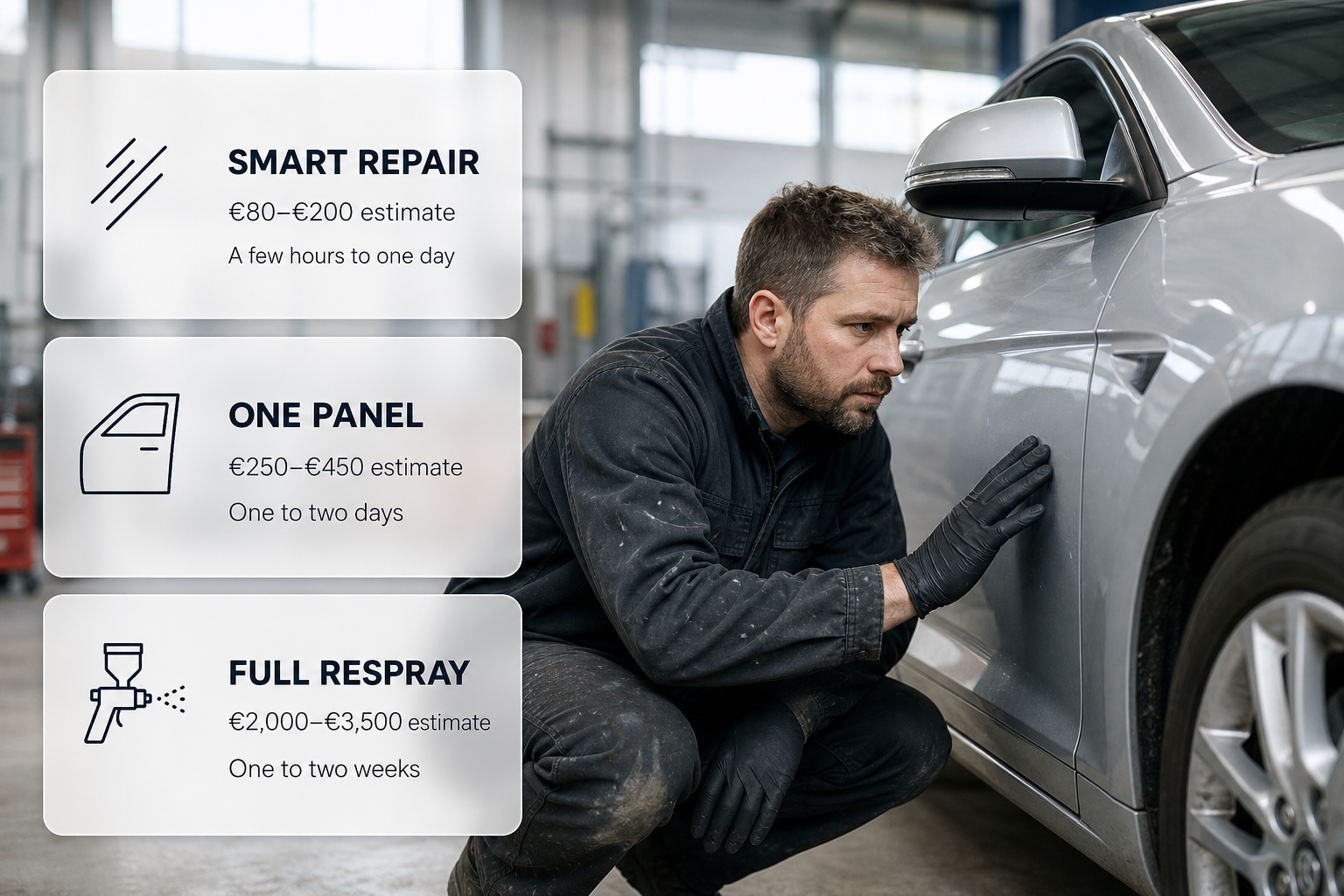
An Irish bodyshop scene with frosted-glass cards summarising typical respray costs and workshop times by job.

Typical respray costs by job

Everything in this section, both the table and the worked example below it, is an aggregate Irish market estimate. These are bands rather than fixed prices, because two cars of the same size can need very different amounts of preparation before paint goes anywhere near them.

Job Typical price band Typical time in the workshop Best for
Smart repair of a scratch or scuff €80–€200 A few hours to one day Small damage on a single panel where the paint around it is sound
One panel (door, wing, bumper or bonnet) €250–€450 One to two days A single dented, scraped or faded panel
Partial respray of two to four panels €600–€1,500 Two to four days A faded bonnet and roof, or blending a repair into the panels either side
Full respray in the same colour, small car €2,000–€3,500 One to two weeks Paint that has faded or broken down across the whole car
Full respray in the same colour, large car, SUV or van €3,000–€5,000 One to two weeks More metal, more paint and more preparation time
Full colour change, including door shuts, boot opening and often the engine bay €4,000–€7,000 or more Two to four weeks Changing the colour of the car completely

Workshop time follows preparation and reassembly more than painting itself. Masking, sanding, filling, priming, drying between coats and refitting lights, handles and trims all take hours, and a car carrying rust or old filler under the paint can sit in the workshop well beyond the times above.

A 10-year-old family hatchback with a faded bonnet and roof shows how the bands work in practice. Repainting the bonnet and roof, and blending into the tops of the front wings, covers three panels, which falls inside the €600 to €1,500 partial respray band, with a realistic quote landing around €900 to €1,300. A full respray in the same colour on the same car falls in the €2,000 to €3,500 band, and is worth considering only if the doors, boot and rear quarters are in the same condition as the bonnet.

What pushes a respray quote up or down

Car size. A full respray on a small car sits in the lower of the two full-respray bands in the table above, while a large car, SUV or van sits in the higher one, because there is more surface to prepare, more paint to mix and more trim to remove and refit.

The type of paint. Solid colours are the most straightforward to match and finish. Metallic finishes need a correctly matched base coat with a clear coat over it, and pearl or multi-stage finishes take longer again. That extra work shows up in the paint materials line of the quote breakdown further down.

A colour change. Painting the door shuts, the boot opening and often the engine bay, plus the extra masking and reassembly, is what pushes a colour change into the top band in the table rather than the same-colour band.

Rust and dent repair. Light surface rust that sands back adds little. Rust that has to be cut out and new metal welded in is quoted separately once the panels are stripped, and it is the most common reason a quote rises after work has started. Dent pulling, panel beating and filler work sit in the same category.

Stripping and refitting. Trims, lights, handles, bumpers, mirrors and seals have to come off and go back on, which is the strip-and-refit line in the breakdown below, and older plastic clips and rubbers often break on removal.

The finish expected. A tidy daily-driver finish with two clear coats, flatted and polished, costs less than a deep, glassy show finish that takes extra coats and extra polishing time. That work sits in the booth, clear coat and finishing line in the breakdown below.

Where the colour of a car changes, the owner should tell the insurer so that the policy matches the vehicle. The colour also needs to be updated on the vehicle registration details, with the current steps confirmed with the motor tax service.
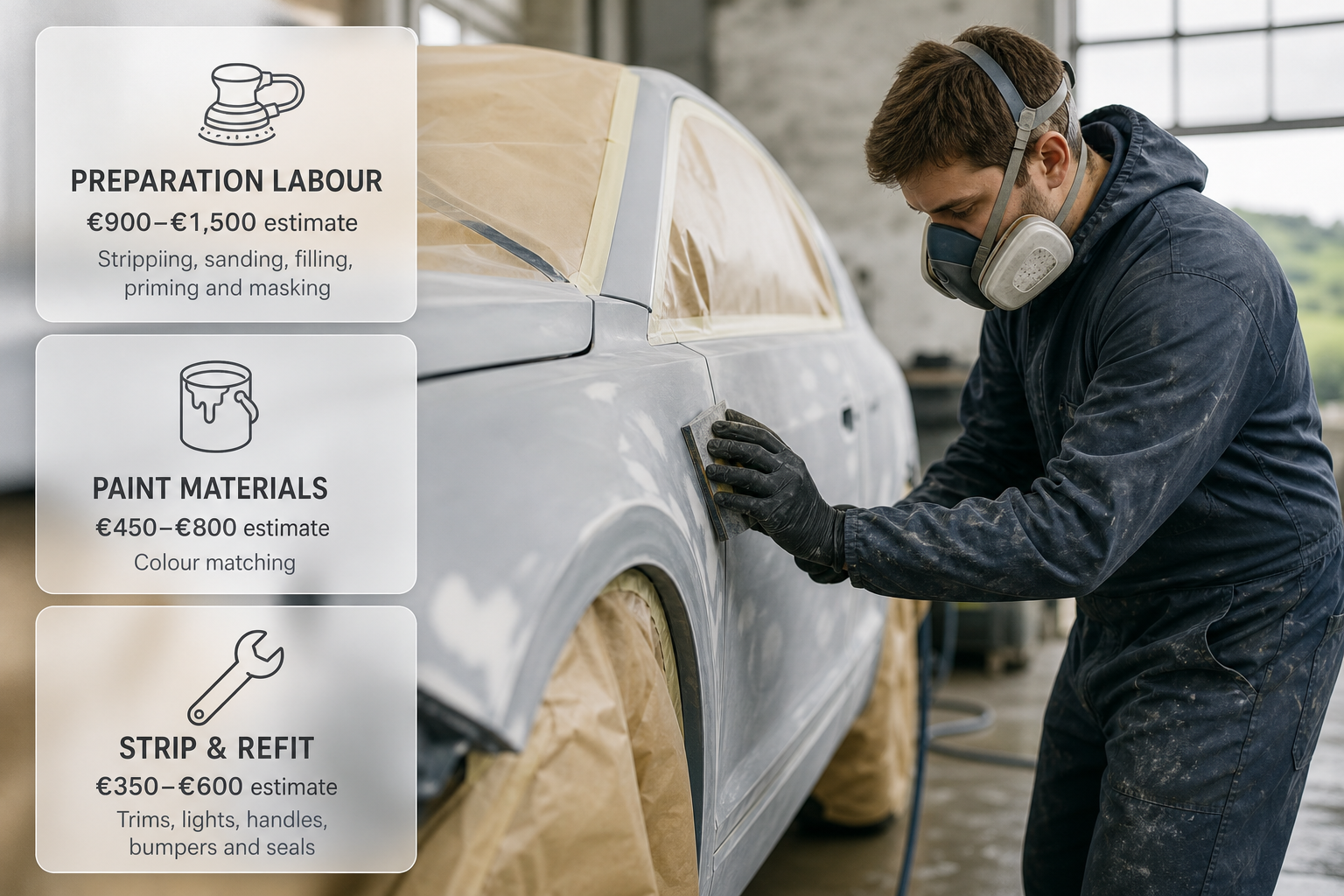
A car being prepped for paint in an Irish workshop with frosted-glass cards showing what a full respray quote includes.

What a quote includes, and what is usually extra

A written quote for a full respray in the same colour on a small car normally breaks into four lines that add up to the €2,000 to €3,500 band in the table above. The four lines below are an aggregate Irish market estimate:

  • Preparation labour, including stripping, sanding, filling, priming and masking: €900–€1,500
  • Paint materials and colour matching: €450–€800
  • Stripping and refitting trims, lights, handles, bumpers and seals: €350–€600
  • Booth time, clear coats, flatting and final polishing: €300–€600

On a larger car, SUV or van the same four lines grow and the total moves into the €3,000 to €5,000 band, which is also an aggregate Irish market estimate. A respray is one of the bigger items among the automotive services a car needs over its life, so it pays to read the breakdown rather than the headline figure.

Most quotes include removal and refitting of lights, handles, trims, bumpers and badges, masking of glass and the engine bay, sanding, filling and priming of the panels being painted, the paint materials, booth time, flatting and polishing, and a basic colour match to the existing finish. Work that is commonly charged as an extra includes rust repair beyond light surface rust, dent pulling and panel beating, filler or old repairs discovered under the paint, clips and seals that break on removal, blending into adjacent panels, extra time for metallic and pearl colour matching, and a courtesy car. Ask for those extras to be listed separately with their own prices, and ask what happens if more rust is found once the panels are stripped.

Why preparation decides how long the finish lasts

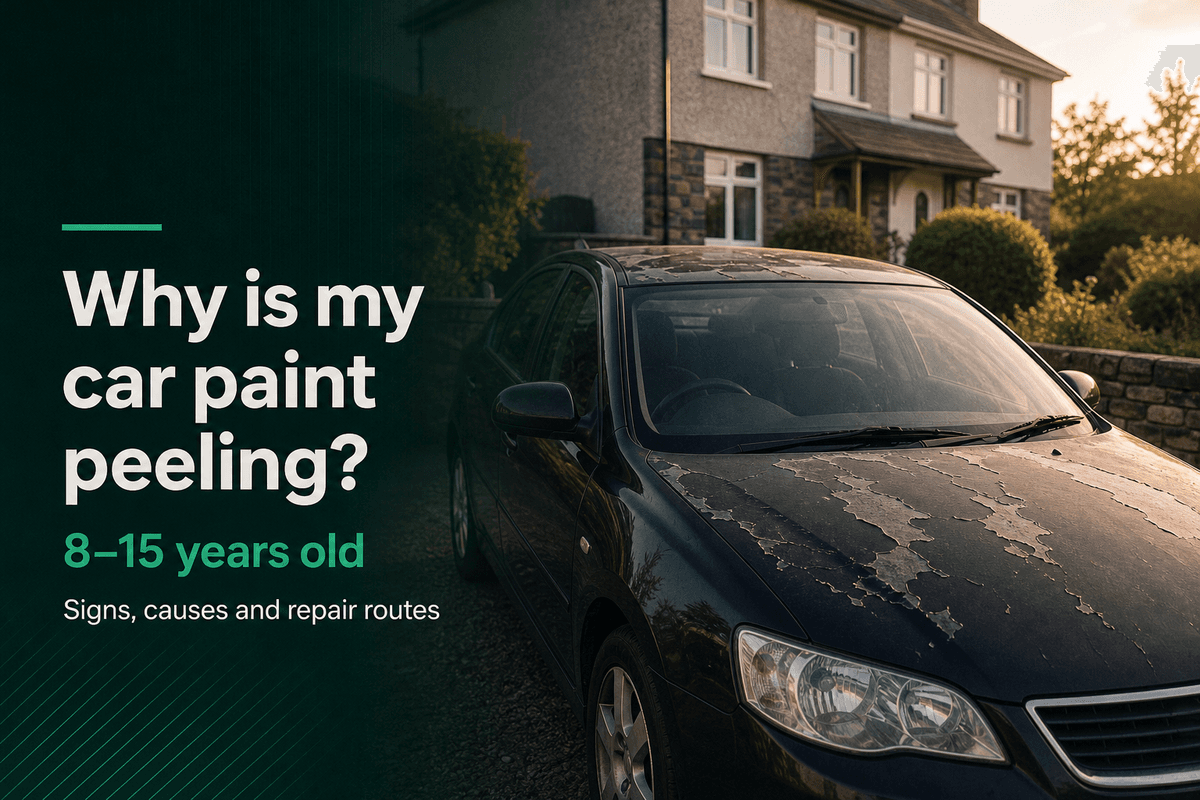
Paint sticks to preparation, not to the old finish. A panel that is degreased, sanded to the right grit, filled, primed and sealed gives the colour coat something to bond to, while a panel that is simply wiped over and sprayed can blister, lift at the edges or fade unevenly. The booth matters too: paint that cures at a controlled temperature with proper extraction and flash-off time between coats hardens more evenly than paint applied in a cold, dusty workshop.

For an owner, that means the useful questions are about preparation rather than about price alone. Will the lights, handles and trims come off, or will they be masked around? Will the panels be primed and sealed before colour? How many clear coats are included? Will the finish be flatted and polished before handover? A quote sitting in the middle of the bands above, from someone who answers those questions clearly, is often better value than the cheapest quote that skips them.

Once the car is home, fresh paint is still hardening, so it is worth washing it by hand with plain water and a soft sponge, keeping pressure washers away from panel edges, and leaving wax or polish off the new paint for the first month or so.

Is a full respray worth it on an older car?

Faded paint on an older car comes down to one comparison: the respray quote against what the car would actually sell for. Where the two figures are close, the respray is money that is unlikely to come back at resale and makes sense only if the owner plans to keep the car for several more years. Where the quote is a modest part of the car's value and the car is mechanically sound, repainting can be a reasonable way to keep a good car on the road.

The rule of thumb is to judge the job against the car's market value rather than its original price, and to treat any quote that would buy a large share of the car as a decision about keeping it rather than about repairing it. A partial respray is usually the better compromise: repainting the two or three panels that have actually faded sits in the partial respray band in the table above and keeps the car looking consistent without the cost of a full job, while leaving the original paint on the panels that are still in good order. Where rust has reached the structure of the car, that is a separate repair from painting and is priced on top of the bands in the table. Owners not yet sure what is behind flaking or bubbling paint can start with why car paint peels.

Alternatives: smart repair and a vinyl wrap

Two alternatives come up in most conversations about car respray cost, and the figures in this section are an aggregate Irish market estimate. Smart repair is the cheapest route for small damage: a scratch, scuff or small dent on a single panel that still has sound paint around it falls in the €80 to €200 band, and because the work is done on the car rather than in a booth, it usually takes a few hours to a day. It is not suitable for a large faded area, for a panel with rust coming through, or for damage that has cracked the paint across a wide area, all of which need the panel resprayed.

A vinyl wrap is the alternative to a colour change. A wrap costs roughly €1,500 to €3,500, well below the colour-change band in the table above, and it can be removed later to return the car to its original colour. The catch is that a wrap fixes nothing: dents, rust and peeling lacquer still show through, and the paint underneath has to be sound before the film goes on, so any bodywork is charged on top of the wrap price.

Touch-up pens and aerosol cans have their place on small stone chips and hidden panel edges, but they will not disguise a large faded area, and a bodyshop may charge to remove a poor match before repainting the panel properly. Where the damage came from an accident, the repair normally goes through the insurer rather than being paid for directly.

Before the car goes into the workshop

It is worth taking dated photographs of the car before handover, agreeing in writing which panels are being painted and how the finish will be prepared, and confirming what happens if extra rust or old filler turns up. Listing a job on ShamFix is free and there is no commission, and a subscription is planned for the future. ShamFix does not check or certify tradespeople, profiles are filled in by tradespeople themselves, so car owners should check registrations themselves and read reviews before booking.

FAQ

The figures in the answers below are an aggregate Irish market estimate.

How much does it cost to respray a bonnet or a roof on its own?

A bonnet or a roof is a large panel with more surface area than a door, so it sits at the upper end of the €250 to €450 one-panel band. Once two or three panels are involved the job moves into the €600 to €1,500 partial respray band, which is usually where a faded bonnet plus roof lands, and blending into the tops of the wings can be added to that.

Is it cheaper to wrap a car than to respray it in a new colour?

For a colour change, yes: a wrap costs roughly €1,500 to €3,500 against €4,000 to €7,000 or more for a full respray in a new colour, and the film can be taken off again. A wrap will not repair dents, rust or peeling lacquer, though, so bodywork is priced separately and has to be done before the film goes on.

Does a respray add value to a car at resale?

Rarely in full. A respray is a presentation cost rather than an investment, and a buyer will not normally hand back the cost of the paint on top of the car's value, although a tidy, consistent finish can make a car easier to sell and easier to price. The owner who keeps the car for several more years gets the most out of the money.

What happens if rust or old filler is found once the panels are stripped?

It is quoted as extra work, because the bodyshop only sees how far the rust runs once the paint and trim are off. The sensible approach is to ask for a written price for that repair before work continues, and to decide then whether to cut the rust out properly, treat it and repaint, or stop at the panels that are still sound.

Keep reading