
A man with a van in Ireland is priced either by the hour or by a fixed quote agreed before the job starts, and the two figures are not comparable until the details behind them match. Aggregate Irish market estimate: a van, a driver and one helper costs about €50 to €80 per hour, while a typical one-bedroom apartment move comes in at roughly €270 to €500 as a fixed price. Homeowners who need a small move, a furniture delivery or one bulky item collected can book man with a van services without paying for the overheads of a full removal firm.
Hourly Rates and Fixed Quotes: How the Pricing Works
An hourly rate suits a job whose length is genuinely unknown. A sofa collected from a shop and dropped at a house, a run to a civic amenity site with a load of cardboard, or an hour of loading while the homeowner decides what else is going are all hourly jobs. The clock usually starts when the van reaches the pickup address rather than when it leaves the depot, and most operators apply a minimum booking of one to two hours (aggregate Irish market estimate). Waiting time, a return journey and a second stop are normally charged at the same hourly rate, so a job that looks like one hour of driving can bill as three.
A fixed quote suits a job that can be described in advance: a known address, a known volume of furniture, a known set of stairs. The operator either walks the load or asks for a short video, then prices the whole job. That protects the homeowner from a slow lift, a late start or heavy traffic on the day, and it makes two quotes easy to compare because both figures cover the same work.
As a rule of thumb, hourly pricing is cheaper for very small jobs and dearer for jobs that drag on. Fixed pricing is cheaper for a full apartment or a long carry, and dearer when the load turns out to be lighter than the quote assumed.
What Goes Into a Man with a Van Quote
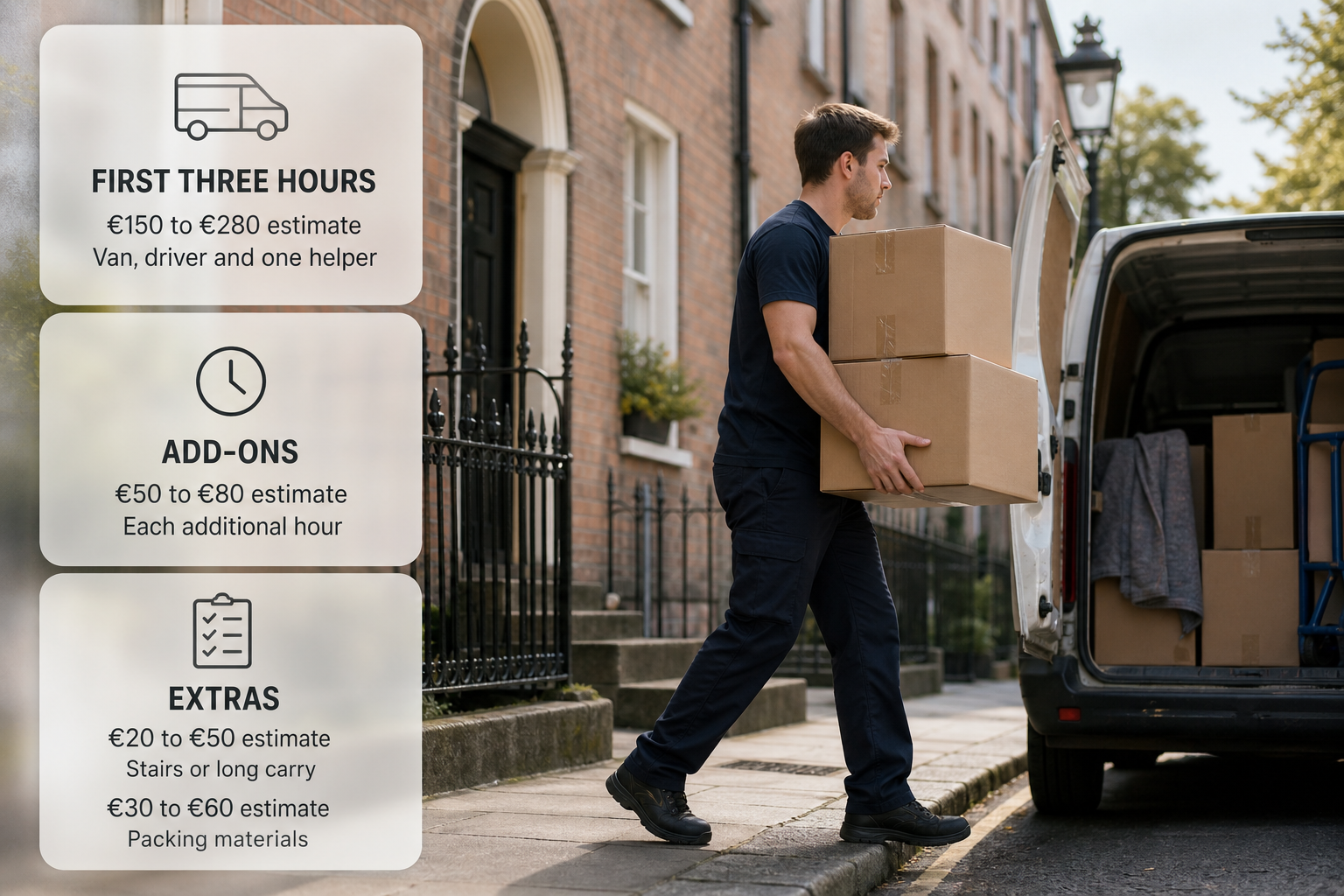
The line items below are an aggregate Irish market estimate for a one-bedroom apartment move with a short ground-floor carry, one helper and no packing service. They also show how a fixed quote is built up from its parts.
| Line item | Typical range |
|---|---|
| Van, driver and one helper, first three hours | €150 to €240 |
| Each additional hour after the first three | €50 to €80 |
| Stairs, lift restrictions or a long carry (per flight, or per 20 metres beyond the first 20 metres) | €20 to €50 |
| Packing materials and light packing labour | €30 to €60 |
| Taking away one bulky item or unwanted piece of furniture for disposal | €20 to €70 |
Using one additional hour, one flight of stairs and one bulky item, those five lines add up to €270 at the low end and €500 at the high end — the same €270 to €500 range quoted for a typical apartment move above.
Where a job needs two people carrying rather than one, a second helper usually adds €20 to €30 per hour (aggregate Irish market estimate), which is why a two-person crew is normally quoted at €70 to €110 per hour rather than the single-helper rate.
What Pushes the Price Up
The gap between the cheapest and dearest quote for the same job almost always comes down to a handful of variables. The following add-ons are an aggregate Irish market estimate of how each one moves the figure.
- Distance and travel time. A job 60 km from the operator's base costs more than a job 6 km away, because the van, the fuel and the driver's time are all tied up for longer. Tolls and city-centre parking are commonly charged at cost on top of the rate.
- Van size. A small car-derived van is the cheapest option. Stepping up to a long-wheelbase or high-roof van adds roughly €10 to €25 per hour, because the vehicle costs more to buy, run and insure.
- Number of helpers. One helper is standard on man with a van work. A second helper adds €20 to €30 per hour and is usually worth it for anything bigger than a one-bedroom load or for anything heavy.
- Stairs and lift restrictions. Upper-floor flats, narrow stairwells, tight turns and lifts that will not take a sofa all slow the job down, and they are charged per flight or per 20 metres of long carry at €20 to €50.
- Packing. Boxes, bubble wrap, tape and mattress bags, plus the labour to use them, sit inside the €30 to €60 line above. Full packing for a three-bedroom house is a separate job and is quoted on its own.
- Bulky or awkward items. Pianos, safes, large American-style fridges and glass table tops need extra hands, straps and time, and some operators simply decline them. Ask before booking rather than on the morning.
- Same-day, evening and weekend bookings. Short-notice work and out-of-hours slots usually add roughly 15% to 30% to the quoted rate.
- Waiting time on site. A homeowner who is not packed when the van arrives pays for the wait at the same hourly rate.
- Waste loading and disposal. Loading is labour and sits inside the hourly rate. Taking the load away for disposal is often charged separately, because the operator has to spend time at a facility after the job.
Typical Jobs and What They Cost
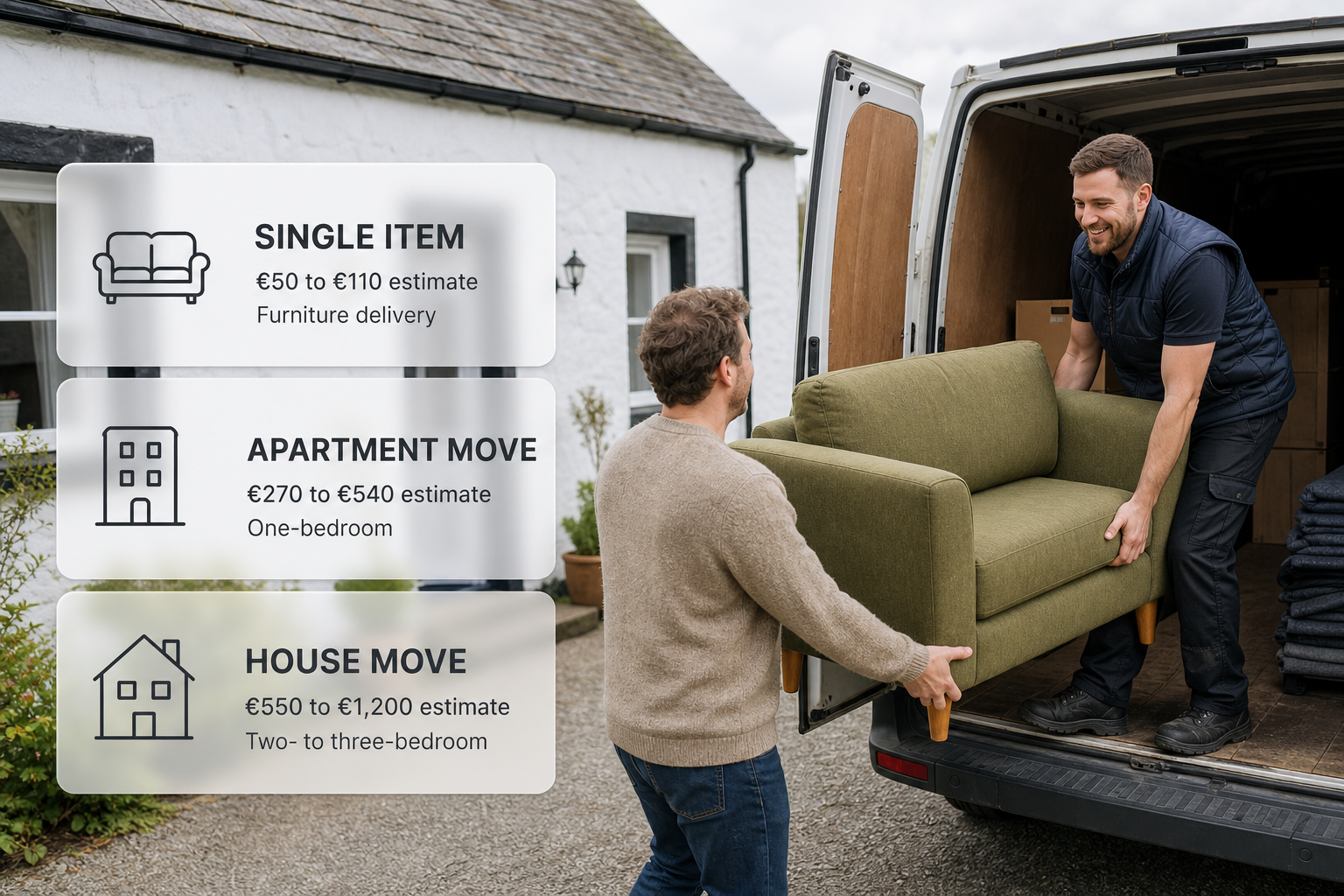
The following figures are an aggregate Irish market estimate for the jobs homeowners ask about most, and they assume a weekday booking made a few days ahead.
- Single-item furniture delivery across a city or county: €50 to €110, covering collection, one drop-off and a short carry.
- Small studio or one-bedroom apartment move: €270 to €500, the same fixed-quote range used above.
- Two- to three-bedroom house move where the homeowner does the packing and the van carries the load: €550 to €1,200, depending on distance and how many runs are needed.
- Clearance-style job where a full van load of furniture and bags is loaded and taken away: €350 to €900, before any disposal charge at the facility.
Dublin quotes generally sit at the upper end of these ranges, mainly because of traffic, difficult parking and congestion in the city centre. Outside Dublin, travel distance matters more than congestion, so a job in the same town is usually the cheapest kind of booking there is, while a cross-country run pushes the figure towards the top of the range.
Waste is the one part of a clearance job that a homeowner cannot assume is covered. Anyone in Ireland who collects household waste for payment needs a waste collection permit, and the National Waste Collection Permit Office keeps a public register where a homeowner can check the operator; who is responsible for disposal should also be agreed in writing before the van is loaded.