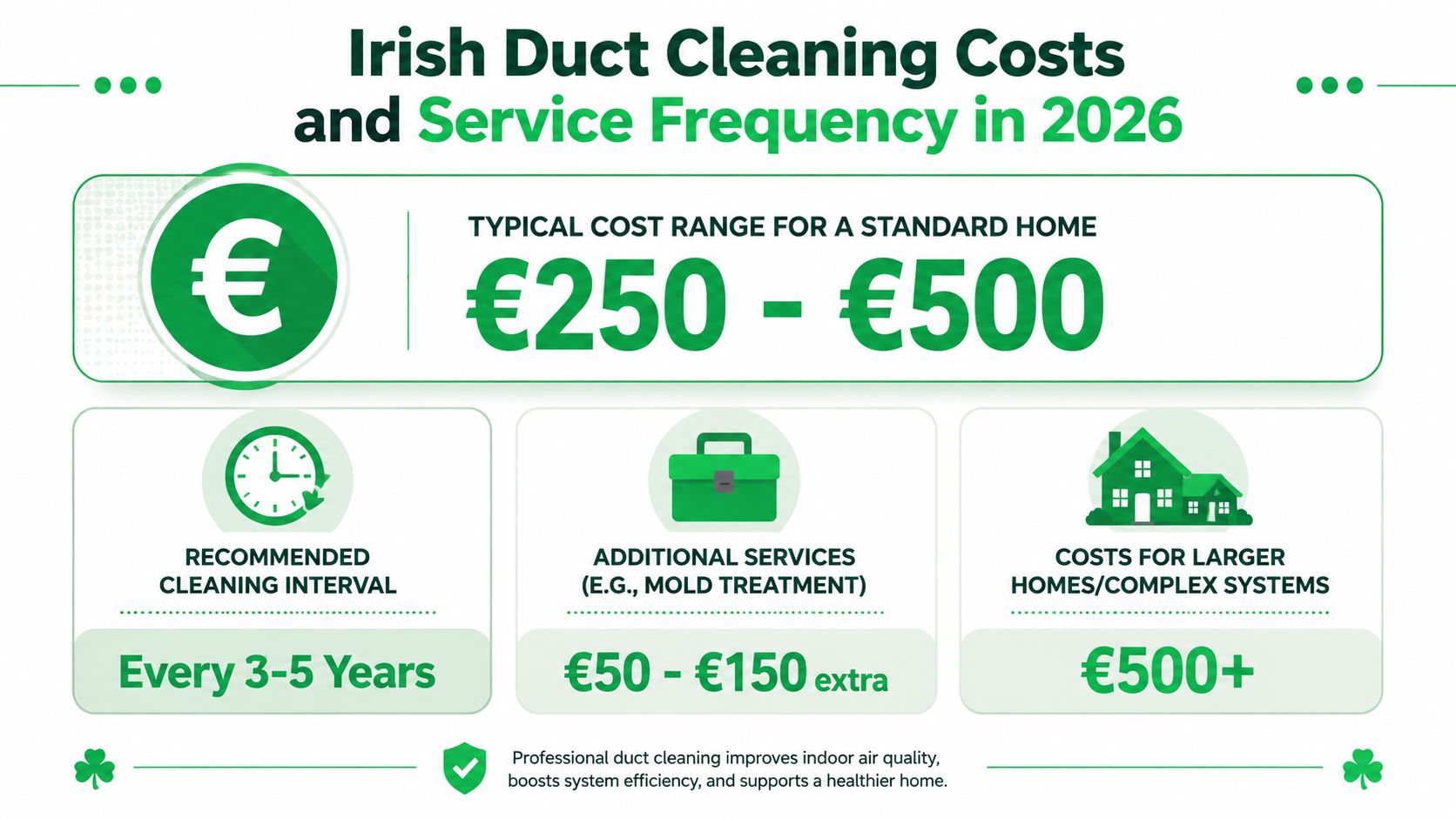
Typical duct and vent cleaning services in Ireland cost from €100 for a basic job to €300 for a more thorough clean, with a median price of about €150 for a standard service, according to Perfect Clean's Irish air vent cleaning cost guide. That's a manageable maintenance cost in the right circumstances, but plenty of homeowners searching for Duct and Vent Cleaning Near Me do not yet require a full clean.
That usually becomes clear when the search starts from a real problem rather than a generic reminder. Dust around an extract grille, stale air in a bathroom, mould near a vent terminal, weak airflow from an MVHR system after renovation work, or a dryer taking too long to dry clothes are all sensible reasons to investigate. Booking a clean merely because someone says “it should be done every year” is different. In Irish homes, that advice is often too blunt to be useful.
A good hiring decision starts with three questions. Does the system need cleaning. Is the contractor cleaning the full system rather than just the visible covers. And can they show, in writing, exactly what's included before any work starts. Those points matter more than glossy marketing, especially because residential duct cleaning isn't a tightly regulated domestic trade in the way gas or electrical work is.
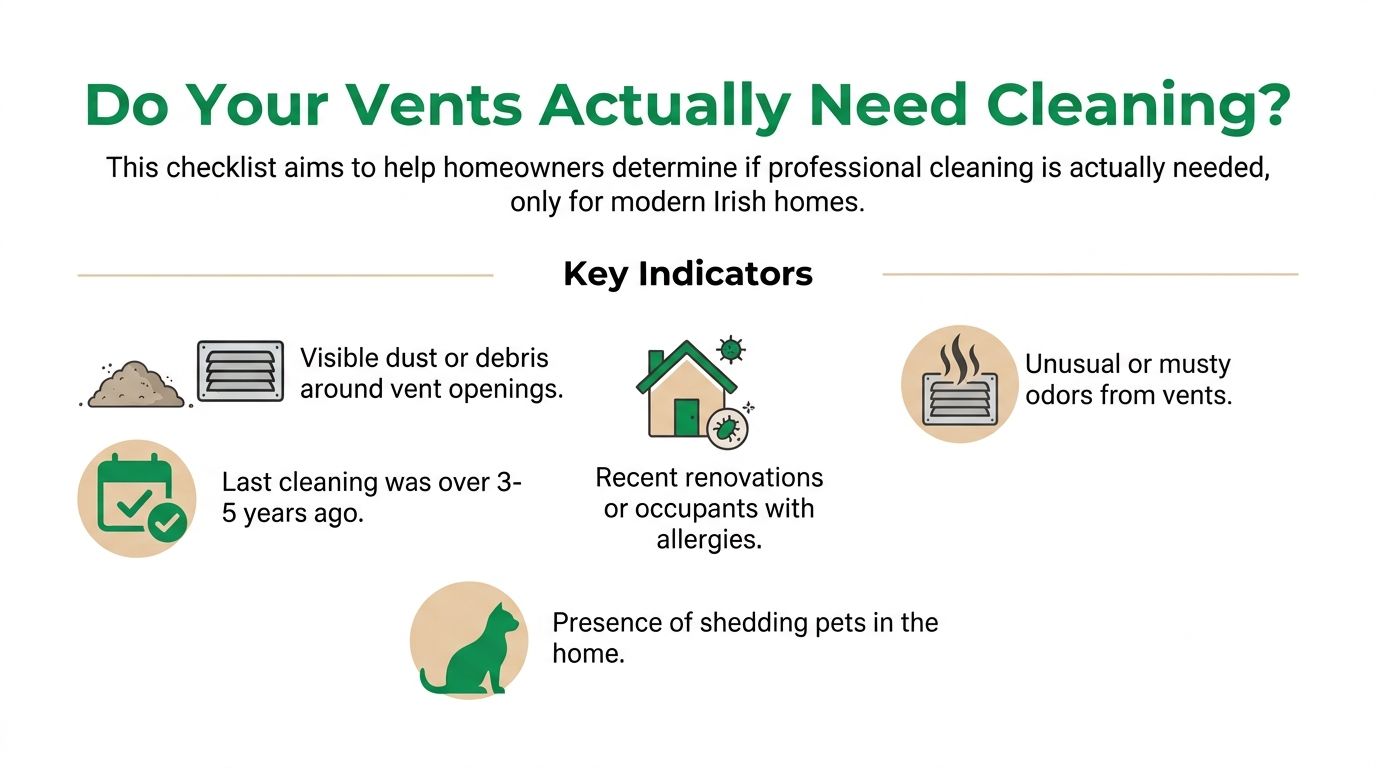
Do Your Vents Actually Need Cleaning
The annual cleaning assumption doesn't always hold
The strongest reason to pause before booking is simple. Many Irish homes may not need frequent duct cleaning at all. Homes built or deep-retrofitted since the 2019 Part F and Part L amendments usually have a mechanical ventilation system with filters, and where those filters are changed on schedule the ductwork tends to stay reasonably clean. Older properties with neglected extract runs, blocked wall terminals or years without maintenance are a different case.
That matters because the usual sales pitch treats every property the same. One home needs inspection and filter discipline; the other may need proper cleaning.
Practical rule: Don't hire on schedule alone. Hire because the system shows a real symptom, or because a legitimate inspection has found a problem.
Signs that justify a proper inspection
There are sensible reasons to go looking for duct and vent cleaning near me. Renovation work is a big one because dust loading rises sharply after plastering, cutting, sanding, or attic work. Visible mould, dust discharging from supply points, stale smells, or a noticeable drop in airflow are also strong reasons to inspect further.
A competent contractor should also take seriously any sign of persistent moisture or growth around terminals and grilles. At that point, cleaning may only be part of the remedy. If mould is part of the problem, the underlying damp issue often needs attention as well, and that's where related services such as damp proofing and mould treatment may be more relevant than duct cleaning on its own.
A useful distinction is this:
Visible at the cover only: Dust on the grille, light surface dirt, or fluff near the opening may be a housekeeping issue.
Coming from deeper in the system: Dust discharge, poor airflow, internal contamination, or signs of moisture suggest the problem sits beyond the cover.
Linked to recent works: Renovation debris and disturbed insulation dust often justify a more thorough professional check.
Homeowners also need to separate air quality concerns from marketing claims. Independent research has not established a direct link between duct cleanliness and improved indoor air quality, although contaminants resuspended from dirty ducts can raise indoor exposure. In plain terms, filthy ducts can be part of the problem, but duct cleaning should not be sold as a cure-all for every comfort or allergy complaint.
Finding and Vetting Local Duct Cleaners in Ireland

Residential duct cleaning in Ireland is not a formally regulated household trade in the same way as gas or electrical work. That doesn't make it risky by default, but it does mean the homeowner has to do more checking. Public liability insurance, a written scope, real before-and-after evidence, and clear method statements are what provide practical protection.
The first useful test is whether the contractor asks sensible technical questions. They should want to know the system type, whether it's MVHR, centralised or decentralised MEV, individual extract fans, or passive vents only, and whether the issue is dust, airflow, mould, post-renovation debris, or a dryer vent blockage. If the only question is “how many vents,” the quote is probably being built too loosely.
What to ask before accepting a quote
A good quote should answer more than price. It should define the job.
System scope: Ask exactly what's being cleaned. That might include MVHR or MEV ducting, extract fans, wall vents, trickle vents, a dryer vent, or only selected accessible sections.
Filters: Ask whether filters are being inspected only or replaced, and who pays for replacements.
Rebalancing: If the system is mechanical, ask whether airflow will be checked afterwards and whether the unit will be re-balanced or recommissioned if needed.
Evidence: Ask for before-and-after photos from inside the system, not just a photo of a dusty grille.
Insurance: Confirm public liability insurance directly rather than taking a vague assurance at face value.
A contractor's own website should also tell the homeowner how the work is done. If there's no mention of containment, extraction, inspection, or proof of results, the service may amount to little more than vent cover cleaning.
What a competent contractor should do on arrival
On site, a competent contractor should identify the system type first, locate the main unit, usually in an attic or utility space, check and photograph filter condition, inspect accessible ductwork and external wall terminals, and confirm power isolation before opening any unit. They should also agree what is accessible and what is not before settling the final scope.
Homeowners should expect the contractor to discuss limitations before work starts, not after the invoice appears.
There's also a safety and competence angle that gets overlooked. Operatives working on Irish sites are generally expected to hold a valid Safe Pass card, issued through SOLAS, along with manual handling training. Where access equipment such as a boom lift is used, the operator needs the relevant certification for that machine.
That requirement matters most on larger or awkward-access jobs, but the principle is useful even for domestic work. A careful homeowner asks who is attending, what access equipment is involved, and whether the quote includes safe access and reinstatement. The cheapest quote often excludes the awkward part of the job.
What a Professional Duct Cleaning Service Involves
What the homeowner should expect to see
A proper duct clean is a controlled extraction job, not a quick wipe-down. The contractor should inspect the accessible system, isolate power where required, remove covers carefully, and work through the duct runs in a way that captures debris instead of blowing it around the house.
For Irish residential systems, standard practice is to dry clean first: brushing and vacuuming to remove loose dust, lint and debris, with damp cleaning used only where the manufacturer permits it and where it can be done safely around electrical components.
What usually separates a real service from a cosmetic one is whether the hidden sections get attention. Surface cleaning of vent covers may make things look better, but it doesn't address contamination in the ducting, fan housing, or internal terminals.
The equipment that actually matters
The critical part of the method is negative air. Professional HVAC cleaning in Ireland should place the system under negative pressure using a high-efficiency duct cleaning machine so debris is suctioned out while the duct interior is agitated. Without that containment, dirt can be displaced and then settle elsewhere in the system or home, as explained in TR19, the UK best-practice standard widely referenced in Ireland for commercial extract systems.
That's why homeowners may see tools such as:
Rotary brush systems on flexible rods for rigid ducting
HEPA-filtered extraction equipment so loosened dust is captured rather than redistributed
A borescope or duct camera for before-and-after evidence
An anemometer or flow hood to check airflow at each terminal after cleaning
The airflow check is the meaningful proof. If airflow hasn't been measured after cleaning, there's no clear demonstration that system performance improved.
A thorough contractor should also explain whether the job includes only ventilation ducting or adjacent items such as fan housings, internal unit surfaces, external grilles, and the dryer vent. For some households, especially where lint and combustion by-products are a concern elsewhere in the property, related checks such as chimney cleaning and inspection can be just as important for overall air movement and safety as the vent cleaning itself.
For higher-standard work tied to TR19 practice, the post-clean report should include photographic evidence from the same positions before and after. That's the sort of paperwork worth paying for because it shows what was removed, rather than asking the customer to trust a general reassurance.