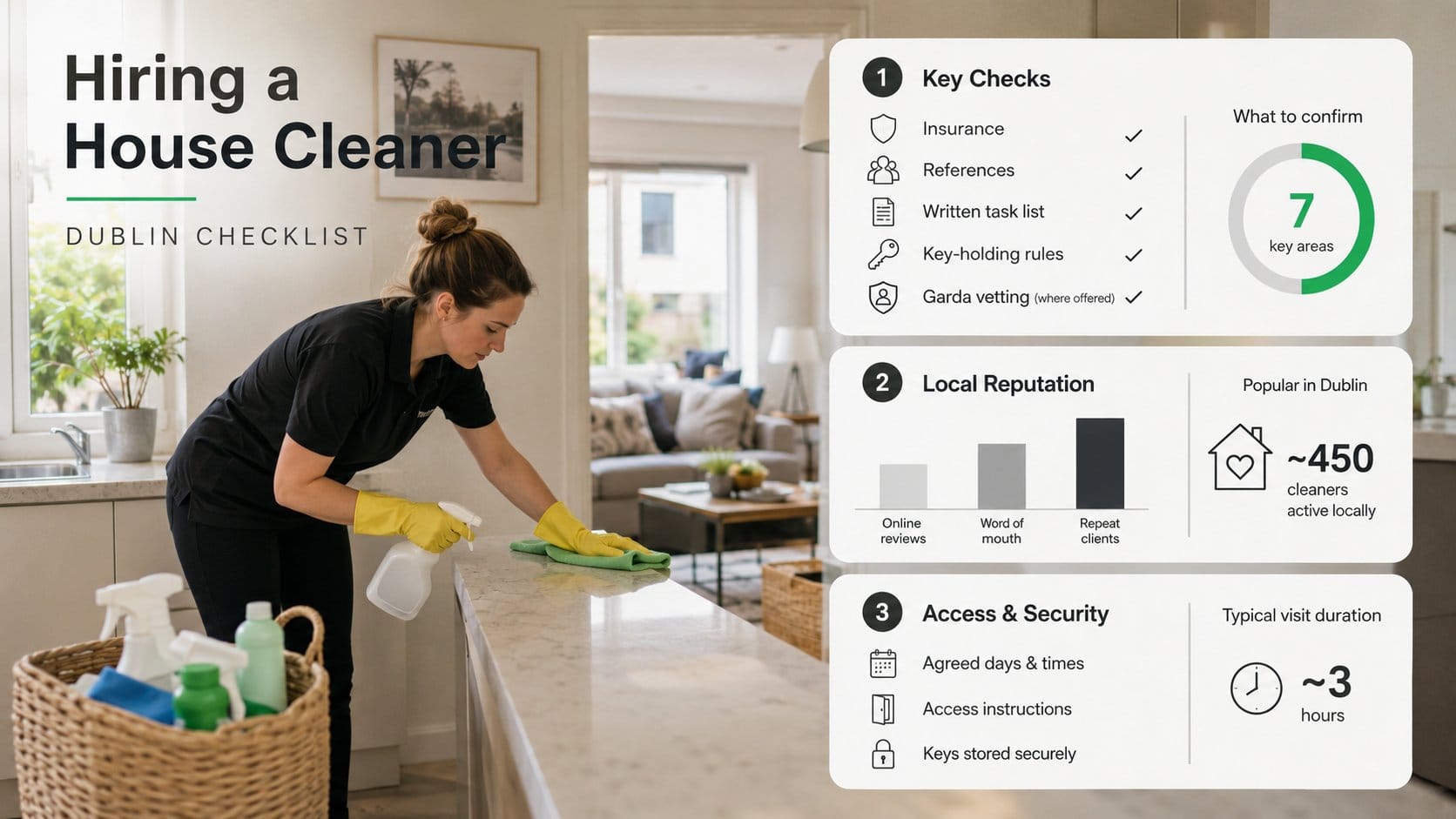
Current Irish market rates put standard domestic cleaning at roughly €16–€28 per hour, with Dublin typically at the upper end of that range. The trade isn't state-registered, so insurance, a written task list, Garda vetting where offered and detailed local reviews matter more than choosing the cheapest headline quote.
That matters when a cleaner is due at a terraced house before work, an apartment near the city centre needs a reset, or a landlord has to prepare a property between tenancies. A good arrangement starts with a clear scope, a realistic price and written rules for access. Dublin's traffic, parking restrictions and key-holding arrangements can affect the practical cost just as much as the number of bedrooms.
What House Cleaning in Dublin Really Means
Domestic cleaning in Ireland is a largely unregulated trade. A homeowner generally won't find a State register that confirms a cleaner's training, insurance or service quality, and there isn't a single national minimum cleaning qualification that every domestic cleaner must hold. That puts the responsibility for sensible checks on the customer.
The Irish cleaning market is large and fragmented, and a long list of providers still doesn't tell a homeowner who will turn up, what will be cleaned or what happens if something is damaged.
Three decisions protect the homeowner
The first decision is scope. “A full clean” can mean vacuuming and bathrooms to one cleaner, but include oven interiors, skirting boards and internal windows to another. Every visit should have a room-by-room task list.
The second is price. The amount depends on time, property size, condition, frequency and extras. A low quote that excludes the oven, fridge interior or difficult access isn't necessarily good value.
The third is vetting. Public-liability insurance, references, Garda vetting where offered and detailed local reviews provide more useful evidence than a polished website alone. Cleaning isn't a regulated trade in the same way as gas or electrical work, so customers shouldn't assume that a business name implies formal approval.
Practical rule: If the cleaner won't put the agreed work and access arrangement in writing, the price is not the only uncertainty.
Dublin-specific details deserve attention. A cleaner may need to allow for parking near a terraced street, apartment access, a lift, a concierge desk or a managed development's booking rules. A commuter handing over keys before travelling to the IFSC, Sandyford or Dublin Airport also needs a clear process for collection, storage and return. ShamFix Insights can be one place to compare local service information, but the homeowner still needs to confirm each provider's own insurance and terms.
Regular Clean Versus Deep Clean
A regular clean maintains a home that's already broadly under control. A deep clean tackles built-up dirt, neglected surfaces and areas that routine visits usually skip. Booking the wrong service leads to frustration, particularly when a customer expects an ordinary visit to include restoration work.
| Area / Task | Regular Clean | Deep Clean |
|---|---|---|
| Kitchen | Worktops, splashback, sink, hob surface, cupboard fronts and appliance exteriors | Limescale treatment, detailed grout work, inside the oven where agreed, and cleaning behind or around freestanding appliances |
| Bathrooms | Toilet, basin, bath or shower surfaces, mirrors and floors | Descaling tiles, grout and shower screens, detailed extractor-fan cleaning where accessible, and heavier soap or mineral build-up |
| Living areas | Dusting reachable surfaces, vacuuming and mopping floors | Skirting boards, door frames, light fittings, high corners and areas beneath furniture where access is possible |
| Bedrooms | Dusting, vacuuming and floor care | More detailed edges, furniture bases, internal windows where agreed and neglected surfaces |
| General finish | Visible maintenance clean | One-off reset against a wider written checklist |
What a standard visit should look like
Professional cleaners typically work top to bottom. Dusting and surface cleaning come before floors, because loose dust and debris fall during the earlier work. Kitchen and bathroom cleaning usually takes more attention than a lightly used bedroom because those rooms collect grease, limescale, moisture and frequent-touch residue.
A homeowner should expect a regular visit to follow the agreed sequence rather than an improvised sweep from room to room:
Surfaces first: Dust and wipe reachable furniture, shelves, switches and other agreed touchpoints.
Kitchen next: Clean the routine surfaces and appliance exteriors, with internal appliances treated as separate tasks unless included.
Bathrooms carefully: Clean sanitaryware, mirrors, shower or bath surfaces and floors, while treating heavy limescale as a possible extra.
Floors last: Vacuum carpets and hard floors, then mop suitable surfaces.
Final check: Walk through the property against the task list before the cleaner leaves.
A weekly or fortnightly schedule often suits a one- or two-bedroom apartment or a smaller terraced home, provided the household maintains a basic level of order between visits. Monthly cleaning may work for a quieter home, but longer gaps usually mean more time is needed when the cleaner returns.
When deep cleaning makes sense
A deep clean is the better starting point after building work, before or after a move, during a spring reset, before viewings or when a property hasn't had professional attention for several months. End-of-tenancy cleaning is a separate service with its own handover expectations, so it shouldn't automatically be treated as an ordinary deep clean.
For most Dublin households, the sensible pattern is a one-off deep clean followed by recurring maintenance. That gives the first visit enough time to address neglected areas, while later visits focus on keeping the home stable. Guidance on related property-clearance decisions is available in ShamFix's Kildare rubbish guide, although rubbish removal and cleaning should be priced as separate services.
How Dublin Cleaners Price the Work
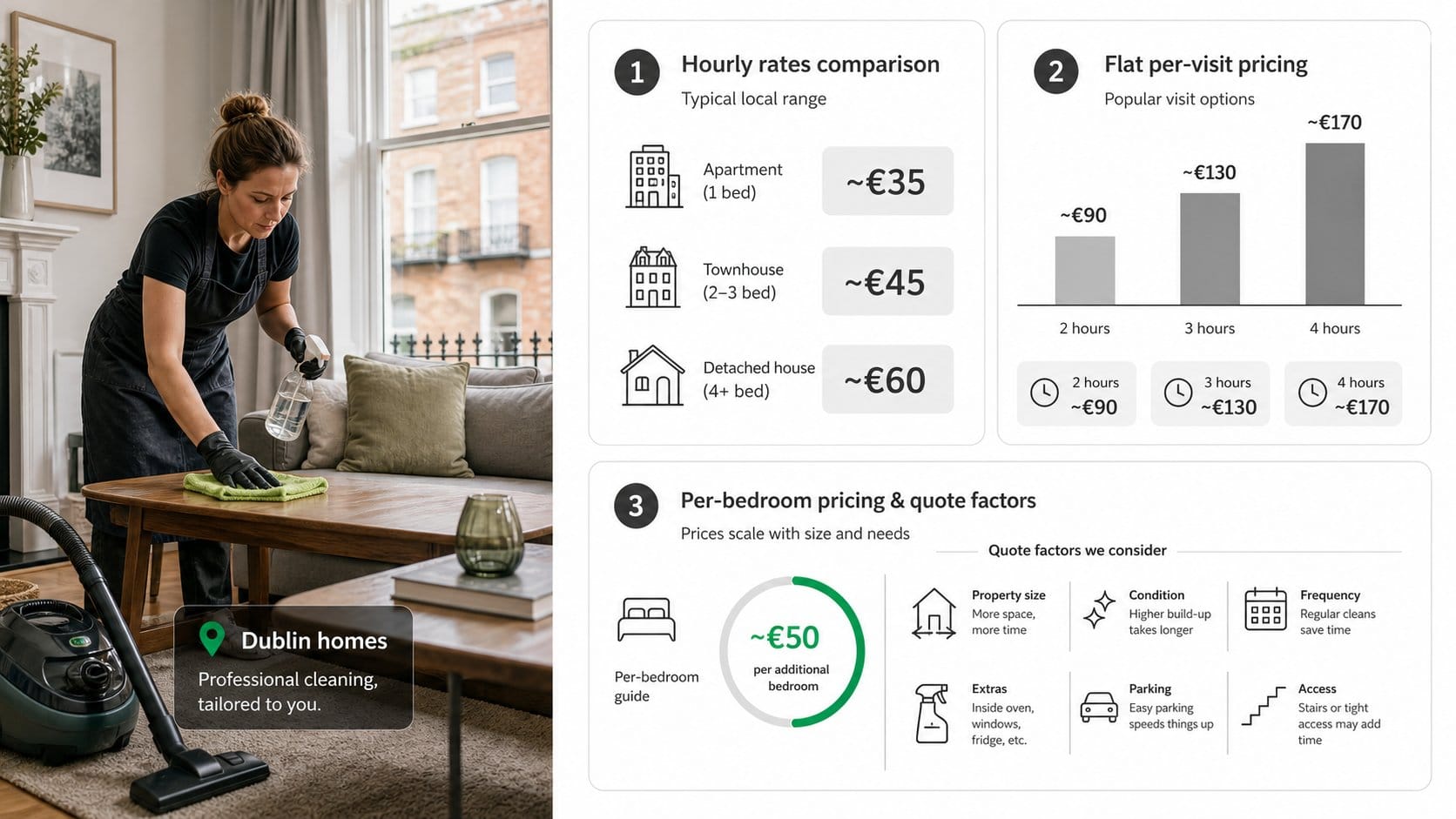
A cleaner can quote by the hour, by the visit or by the bedroom. That choice affects your risk as much as the headline price. The Irish residential market is commonly quoted at €16–€28 per hour, with Dublin at the upper end. For a real Dublin home, the written scope and pricing model matter more than that benchmark alone.
Three common pricing models
Hourly pricing works well for a solo cleaner handling a flexible list. You can set priorities during the visit, but the final bill remains uncertain if the home is cluttered, unusually dirty or slower to access than described.
A flat per-visit price suits a cleaner or small team that knows the property, agreed tasks and expected duration. It makes household budgeting easier. Before accepting it, get written confirmation of what happens with heavy grease, pet hair, limescale, post-renovation dust and other work outside the routine list.
Per-bedroom pricing appears more often in move-in and move-out cleaning. It helps compare basic offers, but bedrooms do not show the full workload. Bathroom numbers, kitchen condition, stairs, storage spaces, hard flooring and access can change the job significantly. Two homes with the same bedroom count may need very different amounts of labour.
What moves the quote
Ask the cleaner to price these factors openly:
Property size and layout: A compact apartment usually takes less time than a house with stairs, several reception rooms and extra bathrooms.
Condition on arrival: Ground-in dirt, grease, limescale, pet hair and clutter add labour.
Frequency: Weekly or fortnightly maintenance generally needs less restorative work than a one-off or widely spaced visit.
Requested extras: Oven interiors, fridge interiors, internal windows, laundry, inside cupboards and carpet or upholstery work should be listed and priced separately unless included in writing. Exterior jobs such as gutter cleaning in Dublin prices should also be treated as their own service and priced separately.
Access and parking: Apartment entry, lifts, long walks from parking and restricted street access can affect the time required.
Product requirements can change the preparation as well. Ask whether cleaning products and equipment are included, whether you need to supply anything, and whether VAT is included in a company quote.
Price should be the final comparison, not the first. Put two written task lists beside each other and check whether each quote covers the same work. In an unregulated trade, also confirm insurance, key-handling arrangements and reviews from both cleaners and homeowners. How the ShamFix marketplace works explains its marketplace model, but you still need to check the provider's own terms before handing over access to your home.