
A full post-construction clean in the Republic of Ireland typically costs about €250–€600 in 2026, with the price scaling by floor area and Dublin listings often sitting higher. Commercial work is commonly benchmarked at roughly €2–€5 per m², while a fixed residential quote depends heavily on the property's condition, access and required finish.
That range covers a wide gap between a light final clean and a demanding handover job involving plaster residue, paint splashes, fine dust, internal glass and waste handling. A small apartment with restricted parking and heavy residue can cost more than a larger, clear-access house. The sensible way to assess a quote is to identify the cleaning stage, confirm the exact scope and check whether VAT and disposal are already included.
What Post Construction Cleaning Costs in Ireland in 2026
Irish post-construction cleaning prices split into clear phases, and the phase chosen can change the quote more than the property size. A 3-bed semi-detached house is listed at €200–€400 for a rough clean, €350–€700 for a builders clean and €300–€550 for a sparkle clean. A 4–5 bed detached home can reach €350–€650 overall, or €700–€1,100 for a full three-phase clean, according to Optus Glean's after-builders-cleaning cost guide.
Use those figures to identify the cleaning stage, not to accept a vague fixed price. Rough cleaning removes bulk debris and protective coverings. A builders clean tackles construction dust, plaster residue, paint marks and the detailed cleaning of finished surfaces. Sparkle cleaning prepares the property for inspection, occupation or handover.
The property's access can add a real premium. Dublin listings show about €200–€500 per unit for a rough clean, €350–€700 for a builders clean and €400–€1,000 for sparkle cleaning. Parking restrictions, stair access, congestion, lift limits and waste collection help explain the difference. Ask the cleaner to list these costs rather than accepting an unexplained Dublin surcharge.
A return visit also changes the total. Trades coming back after the first clean can leave fine dust on sills, floors, sanitaryware and internal glass, so a final sparkle visit may be needed. Put the expected number of visits and the treatment of new dust in writing.
The Optus Glean's cleaning prices guide is useful for an Ireland-specific budgeting check, but the written scope matters more than an online range. Confirm the phase, floor area, glazing, waste removal, access, VAT and any return visit before comparing quotes.
Homeowners can post the cleaning job to get quotes from local providers with photographs, property type, floor area and access details. That information gives cleaners enough detail to price the work rather than guess from the bedroom count.
How Post Construction Cleaning Is Priced in Ireland
Irish cleaners usually price a post-construction job in one of two ways: a per-square-metre calculation or a fixed project price. Either model can work. The risk comes from comparing a low headline rate with a quote that excludes the difficult parts of the clean.
Per-square-metre pricing
Per-m² pricing suits a property with a clear layout, consistent finishes and a known amount of construction residue. The Irish commercial benchmark is €2–€5 per m². Applied to a 150m² property, that gives an initial range of approximately €300–€750.
Use that figure as a sense check, not as a complete house quotation. Extensive internal glazing, multiple bathrooms, cement residue, fine dust from returning trades and restricted access all increase labour. A residential property can therefore cost more than an empty commercial floor of the same size.
Fixed project pricing
A fixed quote is usually the better option for a one-off house, apartment or extension. The cleaner reviews the floor plan, surfaces, windows, residue, waste and access, then gives one project price or separates the work into stages. That approach prevents an open-ended hourly bill, but only if the written scope is precise.
Require the quote to state whether it includes:
- Rough cleaning: bulk debris, protective coverings and heavy construction mess.
- Builders cleaning: detailed residue removal, floors, fixtures, glass and finished surfaces.
- Sparkle cleaning: final dusting, polishing and snagging before occupation.
- Waste handling: rubble, plasterboard, packaging or skip contents.
- Access work: high-level glass, roof lights, stairs and restricted areas.
| Pricing model | Typical 2026 range |
|---|---|
| Per-m² benchmark for Irish commercial work | €2–€5 per m² |
| 150m² property using the per-m² benchmark | About €300–€750 |
| Typical full residential post-construction range | €250–€600 |
| 150m² house estimate in an Irish pricing guide | Roughly €400–€600 |
Per-m² pricing is easier to compare. Fixed pricing is generally safer for a complicated residential job because it forces the cleaner to account for access, residue and return visits. Compare quotes only when they cover the same cleaning phase, areas and waste arrangements. Confirm whether VAT is included before accepting the lowest figure, because it can change the final amount.
The Three Phases of a Builders Clean and Their Price Ranges
A builders clean usually takes more than one visit. Cleaning during construction removes bulk mess, the handover clean tackles residue and fine dust, and the final sparkle visit deals with marks left by trades and snagging. Put each phase on the quotation, with a clear price and scope.
Rough clean during works
The rough clean removes plaster offcuts, packaging, larger debris and protective coverings while fit-out continues. It does not create a move-in-ready finish, because later trades can add dust, residue and waste.
For a 3-bed semi-detached house, the published rough-clean range is €200–€400. A 4–5 bed detached home can fall within a broader overall range of €350–€650, according to Optus Glean's 2026 after-builders-cleaning guide.
Full builders clean
The full builders clean prepares the property for handover. It covers plaster and cement residue, paint splatter, silicone marks, fine dust, floors, doors, fixtures, bathrooms, kitchens and internal glass. Book it after the main finishing work. If joinery, second-fix work or snagging continues, expect dust to return and allow for another visit.
The published Irish range for a 3-bed semi is €350–€700. A large detached property requiring a full three-stage service can reach €700–€1,100, depending on the agreed scope and site condition.
Sparkle clean after handover
The sparkle clean is the final presentation visit. It removes settled dust, fingerprints and small marks left after trades leave, doors remain open and snagging work takes place. You can book it separately or include it in a wider handover package.
Published Dublin figures put sparkle cleaning at around €400–€1,000 per unit, while the general 3-bed semi range is €300–€550. Dublin pricing reflects local access and operating costs, not the name of the service.
| Cleaning phase | 3-bed semi | 4–5 bed detached |
|---|---|---|
| Rough clean | €200–€400 | €350–€650 overall |
| Full builders clean | €350–€700 | €700–€1,100 for a full three-phase clean |
| Sparkle clean | €300–€550 | €700–€1,100 where included in a full three-phase service |
Do not add these bands automatically. One all-in visit can cost less than three separate bookings because every return visit adds setup, travel and coordination. Ask whether the quote is fixed for all phases, whether return visits caused by ongoing trades are included, and whether VAT is included.
A low quote may cover only the rough stage. Ask directly, “Which phase does this price cover?” A written phase breakdown protects the budget and exposes missing work before construction dust becomes a handover dispute.
What Drives the Price Up on an Irish Builders Clean
The biggest cost increases come from residue, restricted access and work that returns after the first clean. Fine dust is easy to miss, while hardened material can take careful hand work without damaging newly finished surfaces.
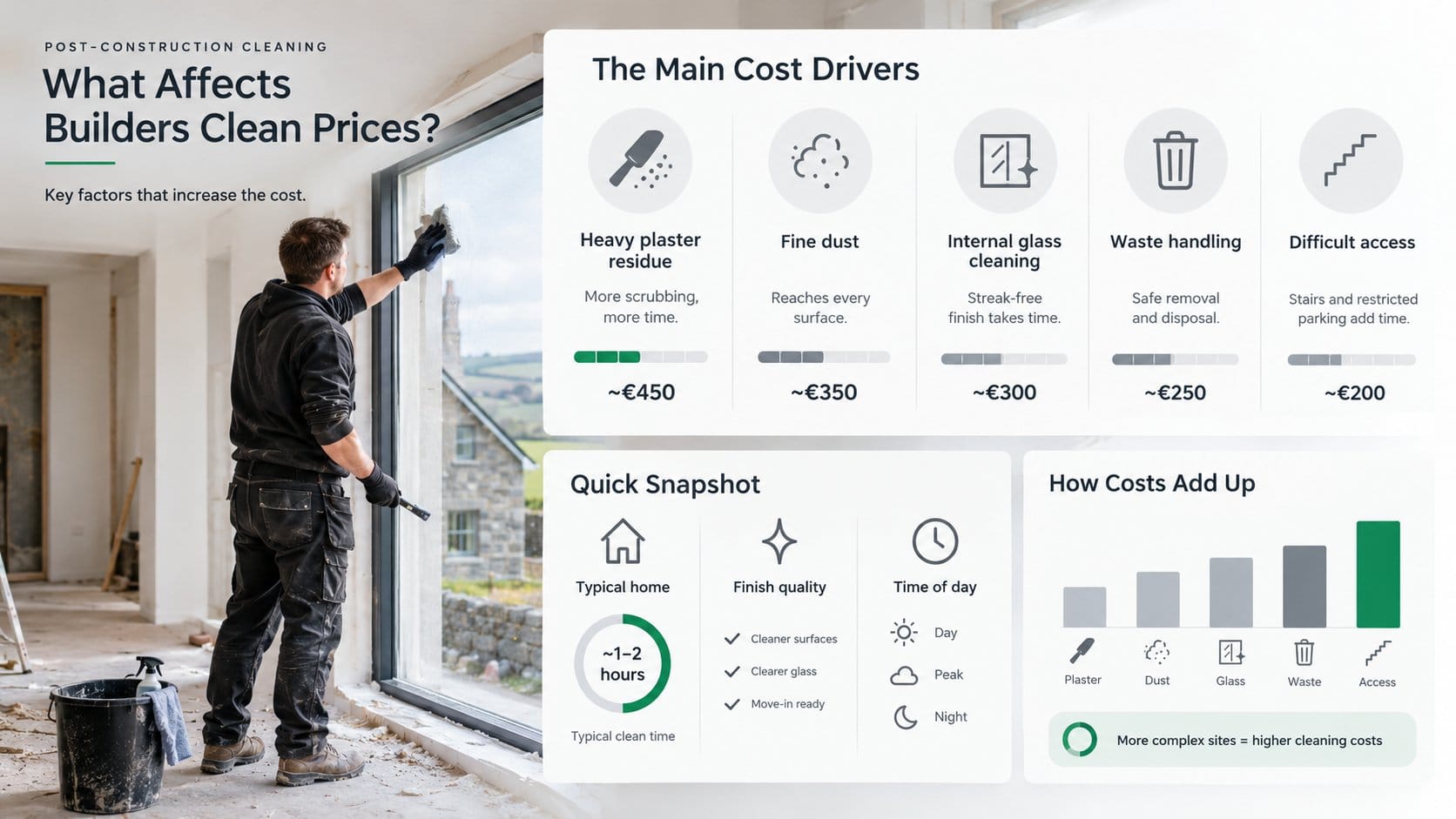
Residue and fine dust
Plaster and cement residue usually needs controlled scraping and a treatment suited to the surface. Dried deposits on glass, stainless steel or tiles can scratch or etch if removed too aggressively. A careful cleaner may test a small area before treating the rest.
Paint splatter needs the same level of care. Hardwood, grout, uPVC frames and finished joinery cannot all be cleaned with one method. If a quote includes “paint removal”, ask whether that means light spots, hardened drips or both, and whether the allowance covers several rooms.
Fine sanding dust creates another hidden charge. It settles inside skirting gaps, vents, door tracks, radiators and built-in units. Joinery or second-fix work carried out after the initial visit can spread fresh dust through rooms that were already cleaned, making a return pass necessary.
Film, glass and disposal
Protective film and stickers come off more easily when removed promptly. Heat and sunlight can harden the adhesive, turning a quick task into slower, more delicate work. Tape marks and silicone residue around sanitaryware, splashbacks and window frames create similar delays.
Internal glass may be excluded or charged separately where windows are high, roof lights are involved or specialist access equipment is needed. Waste removal also requires a written answer. Rubble, broken plasterboard, packaging and offcuts may need separate handling, while the cleaning price may cover surfaces only.
The cheapest quote is often the one with the most exclusions. Compare the task list, not only the final total.
Access can decide the price. A small Dublin apartment with lift restrictions, limited parking and awkward waste movement may take longer than a larger house with a driveway. The Irish market discussion of post-construction cleaning costs shows why floor area alone cannot price the job accurately.
Ask for a fixed phase-based quote, confirmation of return-visit charges, and a clear statement on VAT and disposal. That exposes the bottom line before handover.
New Build Versus Renovation or Extension Cleans
Project type matters less than containment, occupancy and dust movement. A new build is usually the simplest job to price because the property is empty, the room sequence is predictable and the builder can arrange cleaning before occupation. Bulk waste may already be gone, so cleaners can work without shifting furniture or protecting residents' belongings.
Renovations create more uncertainty. Chasing walls, removing kitchens and cutting materials send plaster and fine dust beyond the rooms under construction. In an occupied home, cleaners must protect furniture, work around residents and complete rooms in stages. Return visits become more likely when joinery, second-fix work or snagging follows the first clean, because fresh dust can settle in areas that were already finished.
Extensions vary sharply. A sealed extension with a clear route from the entrance can be treated almost like a contained new-build clean. An open connection to an existing kitchen or living room is different. Dust can migrate through the original house, widening the cleaning boundary and adding work to floors, door tracks, vents, radiators and built-in units.
Use the phase ranges in The Three Phases of a Builders Clean and Their Price Ranges as the pricing reference. Do not compare a renovation against a new build by floor area alone. A heavily dust-producing renovation can cost more than a larger, well-contained new build, while an isolated extension may stay close to a small standalone job.
Ask these questions before accepting a fixed price:
- Is the property occupied? Protection, furniture movement and staged access add labour.
- Has bulk waste been removed? Surface debris may be included, while rubble, plasterboard, packaging and offcuts can require separate disposal.
- Can cleaners reach every area safely? Restricted routes, shared entrances, lift limits and poor parking can add time, particularly on compact urban jobs.
- Will other trades return after cleaning? A later installation or snagging visit can spread dust and trigger a chargeable return pass.
- Does the quote include VAT? The displayed figure is not the final cost unless the VAT treatment is stated clearly.
The practical comparison is contained work against active, occupied and interconnected work. Choose a fixed phase-based quote, define disposal and return visits in writing, and require the cleaner to state whether VAT is included. That exposes the handover cost before work begins.
What to Check Before Hiring a Post Construction Cleaner
A written scope matters more than a polished company description. Cleaning is not a regulated trade in Ireland, so the homeowner needs to establish the provider's insurance, reviews, disposal arrangements and actual responsibilities before access is granted.
Insurance and waste responsibility
Ask for a current public liability insurance certificate and check what activities it covers. If the cleaner is removing rubble, plasterboard or other construction waste, ask who holds the required waste collection permission and how the material will be handled. The homeowner shouldn't assume that a cleaning company's presence on site means it can legally transport every type of waste.
The provider should also explain whether high-level access is included. Internal glass above normal reach, roof lights, atriums and stairwells may require extra equipment or a separate arrangement. The scope should state what happens if safe access isn't available.
The written quote
A proper quotation should identify:
- Cleaning stages: rough, full builders clean and sparkle or snagging visit.
- Surface work: plaster, cement, paint, silicone, adhesive and fine dust removal.
- Glass and fixtures: internal windows, frames, sanitaryware, extractor covers and appliances.
- Waste: collection, loading, transport and disposal, or a clear exclusion.
- Return visits: whether a second pass is included and what triggers an extra charge.
- VAT: whether the displayed price includes VAT.
A homeowner can also reuse the standard questions for hiring any cleaner when comparing replies, adapting the answers to post-construction work.
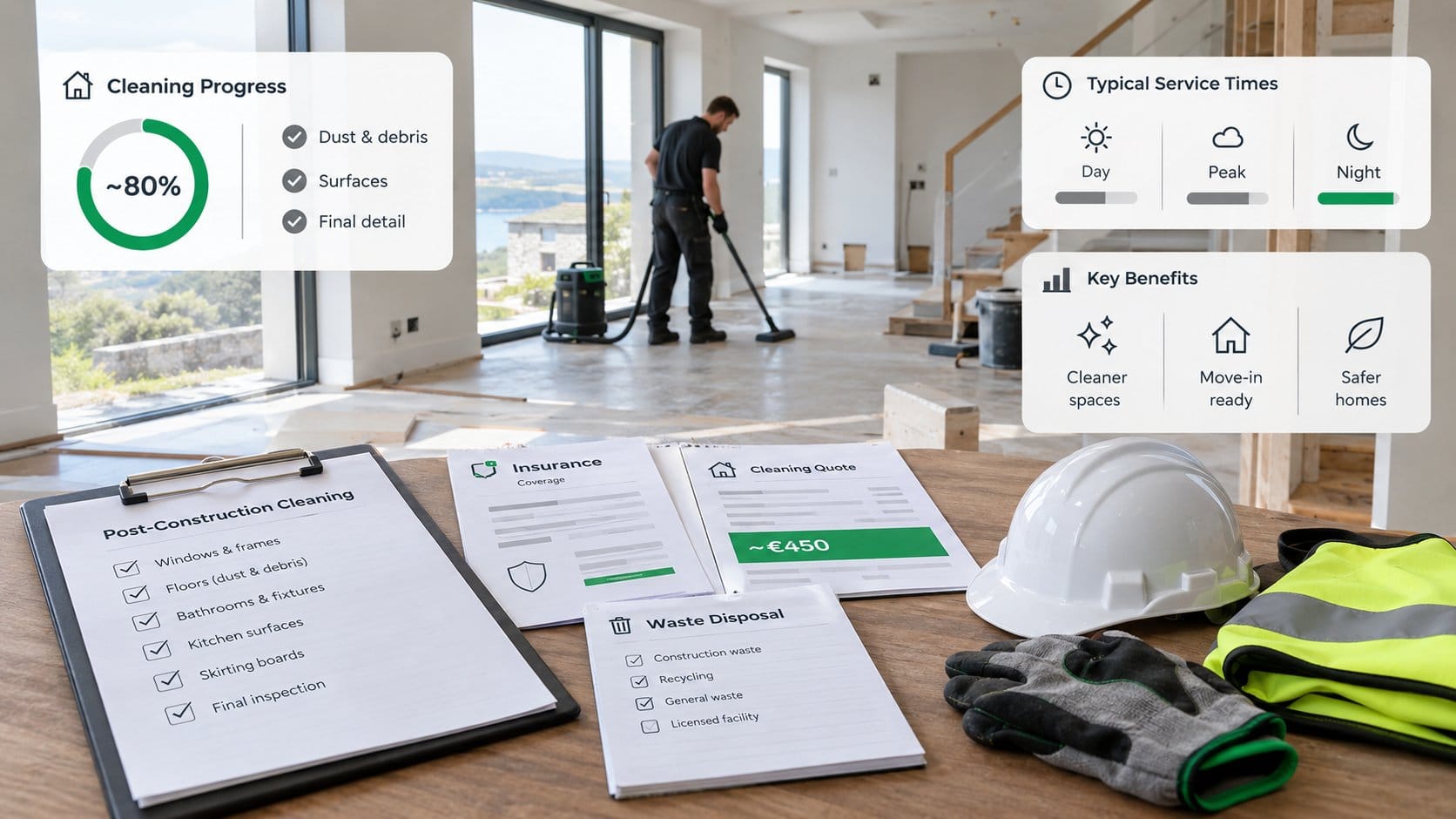
A short written list prevents the most common dispute: the homeowner expects a handover clean, while the cleaner priced a rough clean. Reviews from similar-sized projects can help, but they don't replace a site-specific scope. The provider should state who supplies water, electricity, access keys and clearance of personal belongings.
Before booking, ask one direct question: “If the site is dirtier than the photographs suggest, which exact items can change the price?”
Local Access, Dublin Premiums and VAT on Cleaning
Dublin cleaning quotes often carry a premium because access consumes labour time. A terraced property with restricted parking, narrow stairs, congestion and difficult skip access takes longer to service than a similar house with a driveway and open loading area.
Apartments create a different set of delays. Lift bookings, loading bays, management-company permissions and long routes from the van to the property reduce productivity. A smaller apartment clean can therefore cost more than a larger, easier-access home.
| Logistic factor | Typical Dublin impact | Typical regional impact |
|---|---|---|
| Parking and loading | More restricted access and longer unloading | Often simpler where a driveway or open frontage is available |
| Apartment access | Lift bookings, stairs and management rules may add coordination | Usually depends more on the individual property |
| Waste movement | Longer carrying routes and tighter collection access | More room for skips or direct loading in some locations |
| Travel and congestion | More time between arrival, loading and disposal | Travel still matters, but access may be less constrained |
Published local guides place some Dublin examples around €150–€350 and Kildare examples around €130–€320 for particular cleaning work, as discussed in Perfect Clean's Ireland after-builders-cleaning guide. These figures are not a universal tariff. They show why the quote must account for access, loading and disposal, rather than relying on floor area alone.
Return visits can add another hidden cost. Dust released by later trades, repeated access to the property and extra carrying from upper floors can turn a fixed-looking job into several separate attendances. Ask the cleaner to price each phase clearly and state whether access delays or a return visit change the agreed amount.
VAT needs to be written into the price
Revenue states that routine cleaning of immovable goods is taxable at the reduced 13.5% VAT rate. Where the cost of goods used exceeds two-thirds of the total price, the VAT rate applying to those goods can apply to the whole transaction. Check the relevant Revenue guidance on cleaning contracts for non-residential immovable goods for the arrangement being quoted.
The practical rule is straightforward. The cleaner must state whether the price is VAT-inclusive or VAT-exclusive, and identify the VAT treatment used. Do not set the project budget from a headline figure that leaves tax unclear. Ask for the final payable amount in writing before booking.
Getting an Accurate Quote and Getting the Job Done
The strongest quote starts with accurate information. The homeowner should send the floor area, floor plans if available, room count, number of windows, high-level glazing, photographs of residue and clear notes about parking, stairs, lifts and waste.
The finish standard should also be explicit. “Clean after builders” can mean removal of bulk debris, a detailed handover clean or a final presentation pass. The written offer should separate those stages and list optional work such as appliance interiors, difficult adhesive, high windows and waste removal.
A reliable quoting sequence
- Send the dimensions. Include square metres, storeys, rooms and the number of bathrooms.
- Describe the condition. Identify plaster residue, paint splashes, sanding dust, protective film and packaging.
- Show access. Include photographs of entrances, stairs, lifts, parking and any roof lights or atrium areas.
- Separate the phases. Ask for rough, builders and sparkle cleaning as separate lines, even if an all-in price is also offered.
- Confirm the handover date. The final clean should follow the last dusty trade, silicone work, paint touch-ups and snagging.
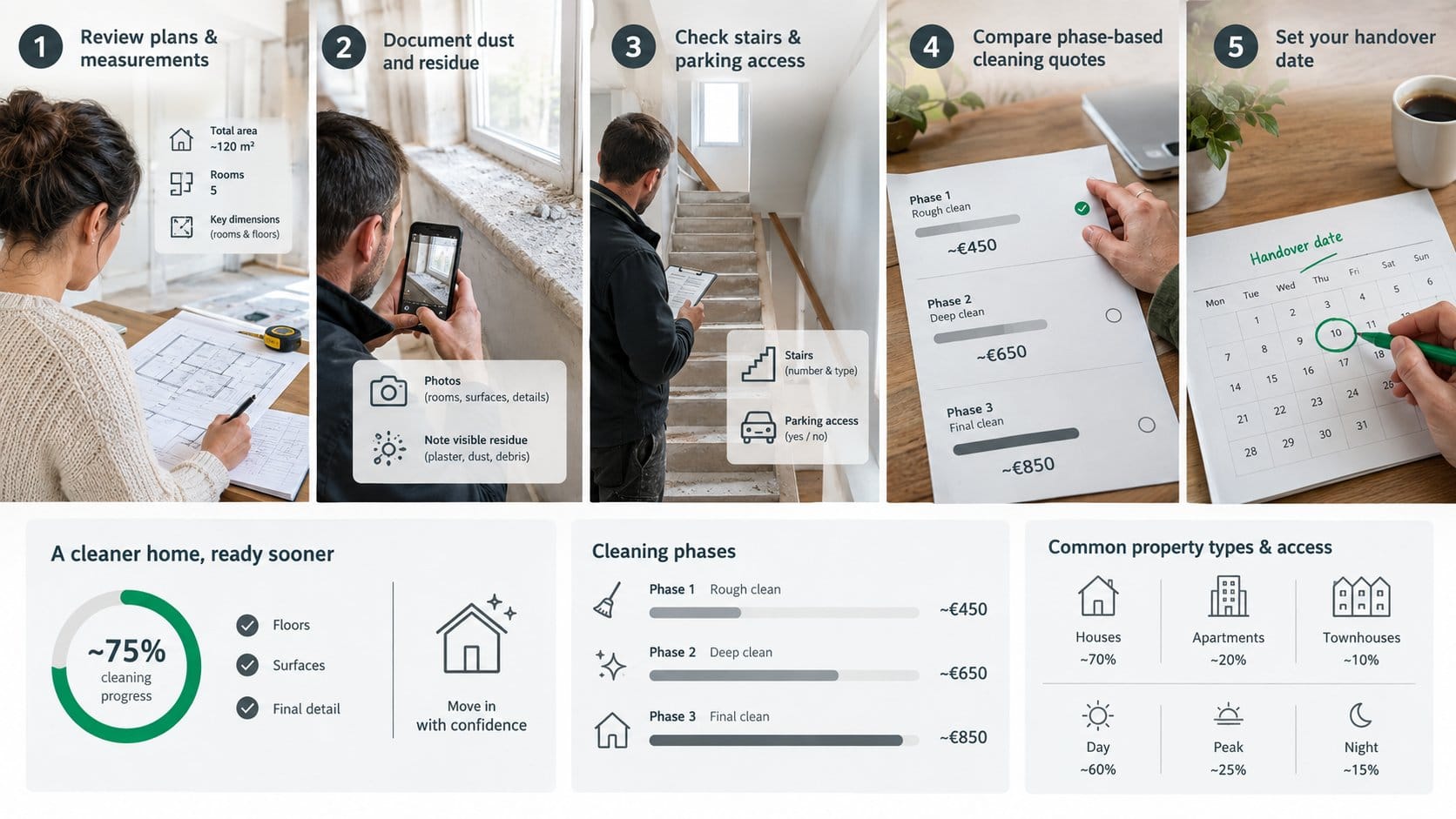
Two or three written quotes give a useful comparison, but only when each provider receives the same information. A site visit is sensible for a large build, occupied renovation, awkward access or extensive residue. The homeowner should also confirm whether power, water, heating and clear rooms will be available on the cleaning day.
For disposal questions, treat cleaning and waste collection as separate line items rather than assuming one price covers both. The final budget should show the cleaning price, optional extras, waste arrangements and VAT position rather than bundling everything into an unexplained total.
For most Irish homeowners, a realistic starting budget is €250–€600 for a full residential post-construction clean, with the final figure driven by floor area, stage, residue, access and disposal. A 3-bed semi-detached home can range from €200–€400 for a rough clean, €350–€700 for a builders clean and €300–€550 for a sparkle clean, while a full three-phase clean on a larger detached home can reach €700–€1,100. Homeowners can browse post-construction cleaning providers or post the full job brief with photographs and measurements before choosing a cleaner.
ShamFix routes each enquiry to local providers, but it does not vet or verify them, so homeowners should check insurance, written scope and reviews themselves.
Are you a post-construction cleaning business in Ireland?
Cleaning businesses can apply to list on ShamFix and describe the services and areas they cover. ShamFix does not vet or verify providers, so homeowners check insurance and reviews themselves. Listing on ShamFix is free and there is no commission; a subscription is planned for the future.