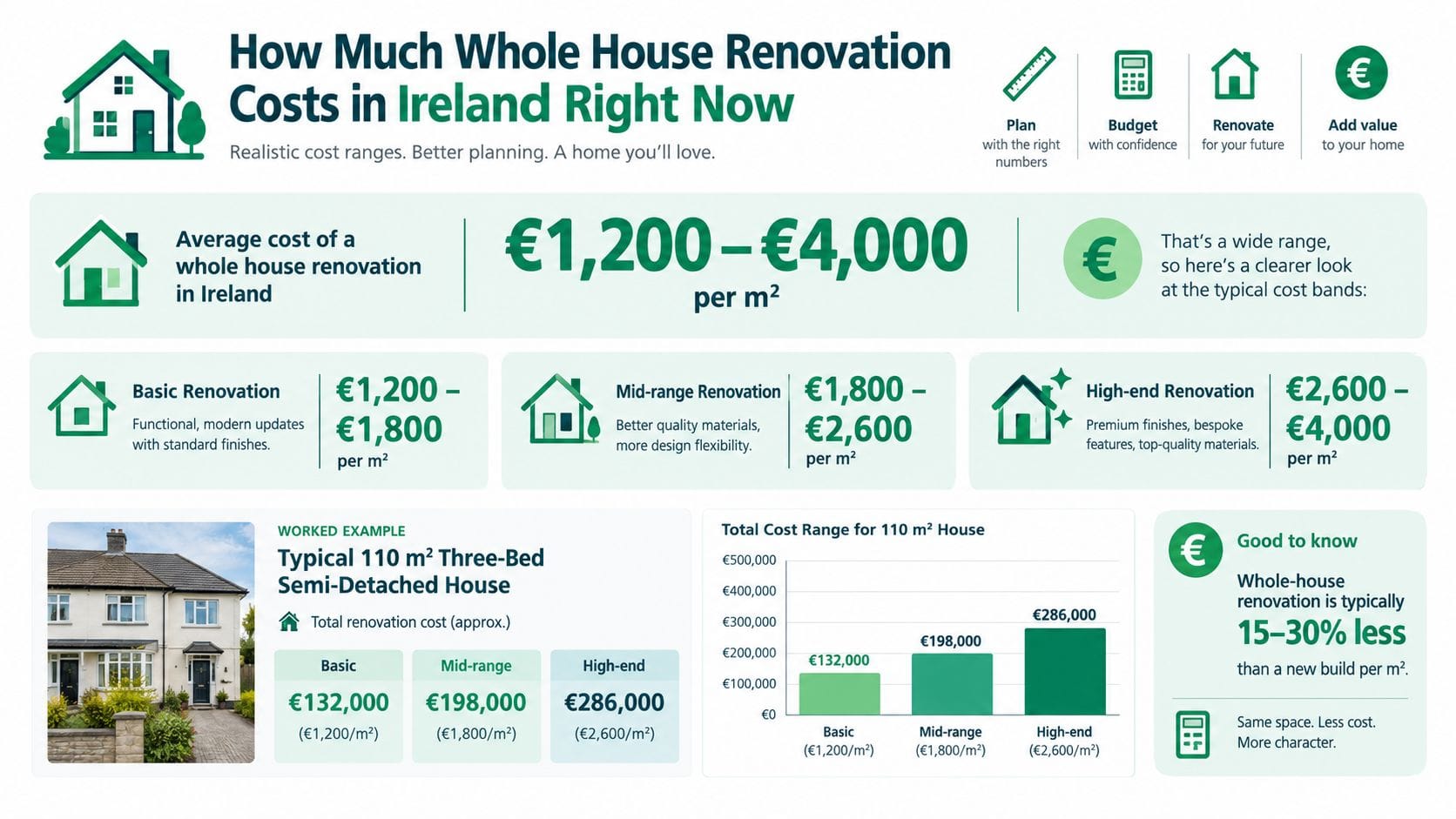
A whole-house renovation in Ireland commonly falls into three broad bands: €800–€1,200 per m² for a cosmetic refresh, €1,200–€2,000 per m² for a standard renovation, and €2,700–€3,300 per m² for full structural work. For a 110 m² three-bed semi-detached house, the standard band gives a base construction budget of roughly €132,000–€220,000 before VAT, professional fees, surveys and contingency.
That is why the phrase house renovation cost Ireland needs more than one headline average. A house needing paint, flooring and minor joinery isn't financially comparable with an older property requiring a strip-out, rewiring, replumbing, insulation, heating replacement and structural alterations. The reliable starting point is the floor area multiplied by a scope-based Irish rate, followed by a written schedule of what the quote includes.
Find renovation contractors and post your job once the scope and budget are sufficiently clear. The figures below are planning ranges, not a substitute for a survey and itemised quotation.
How Much Whole House Renovation Costs in Ireland Right Now
A useful Irish starting point is the floor area multiplied by a scope-based rate. The Society of Chartered Surveyors Ireland Real Cost of Renovation study uses case studies of 20 vacant and derelict properties across the country, showing why condition and scope matter more than one national average (SCSI renovation benchmark). A light refurbishment may retain most services. A deep refurbishment can require floors, walls and ceilings to be opened throughout.
For a 110 m² three-bed semi, the standard band works out as:
- 110 m² × €1,200 per m² = €132,000
- 110 m² × €2,000 per m² = €220,000
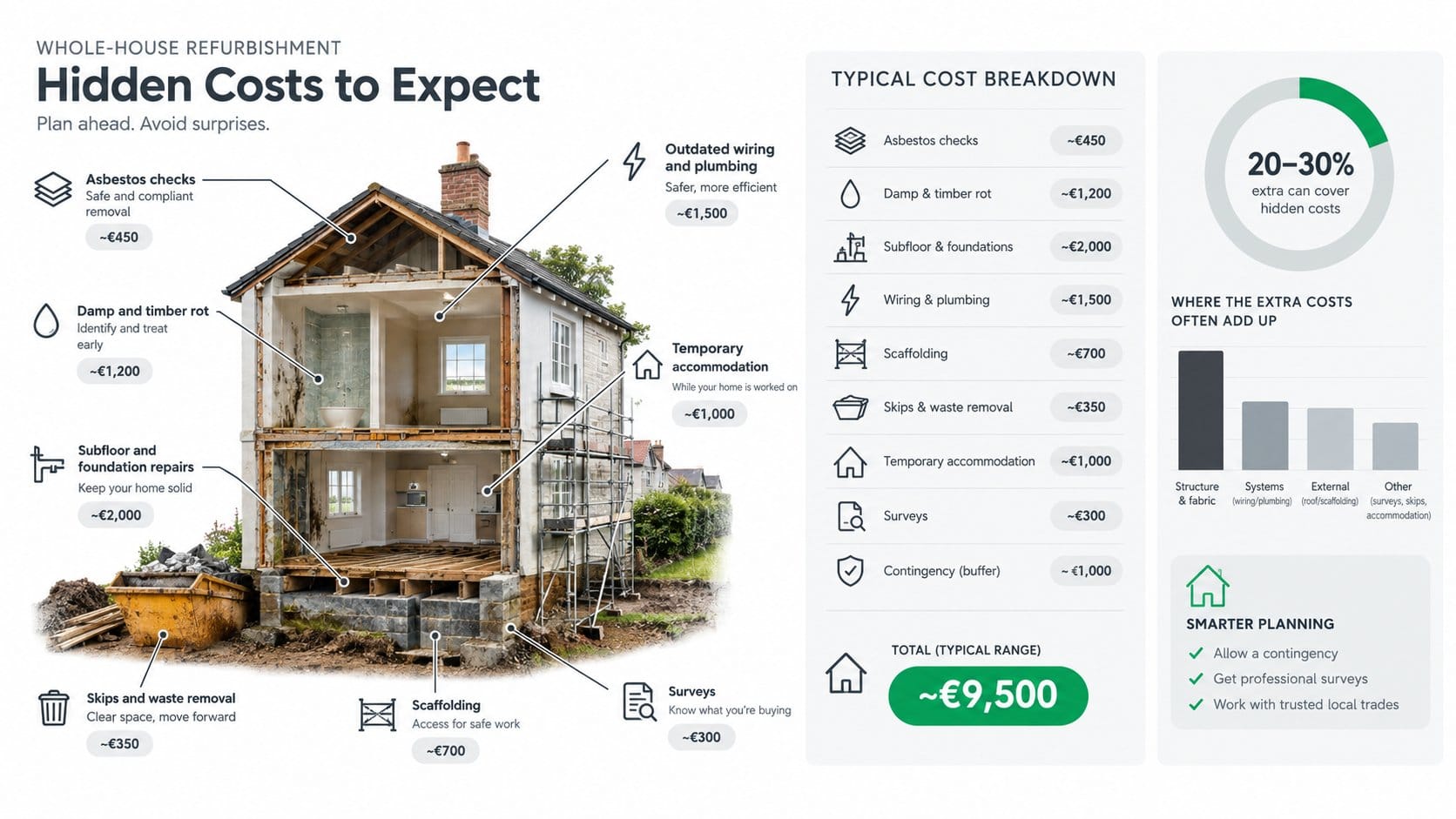
These figures are a mid-range base construction budget before VAT, professional fees, surveys and contingency, on aggregate Irish market estimates. They are not a turnkey total. Scaffolding, restricted access, waste removal, design, engineering, certification, temporary accommodation and making good may all sit outside the headline rate.
What a whole-house renovation usually includes
An end-to-end refurbishment can cover:
- Preliminaries and strip-out, including old fixtures, finishes and redundant services.
- Structural work, such as altered openings, floor repairs, steelwork or layout changes.
- Mechanical and electrical services, including rewiring, replumbing, heating, ventilation and controls.
- Thermal improvements, including insulation, airtightness measures, window replacement and energy-system upgrades.
- Interior completion, covering the kitchen, bathrooms, plastering, flooring, internal doors, joinery, painting and decorating.
- Making good, testing, certification and final connections.
A kitchen or bathroom replacement is narrower and should be priced as a separate package. Rebuilding a house is a different comparison. Irish construction-sector rebuilding data places the minimum base rebuilding cost of a 98 m² three-bed semi in Dublin at €331,340, or €3,381 per m², after a 7% national rise in rebuilding costs. That context shows why extensive structural, mechanical and electrical work can move renovation economics towards rebuilding costs.
Roof replacement can change the budget substantially, so keep that specialist package separate from the whole-house allowance and price it on its own.
Renovation Tiers by Scope and Price Per Square Metre
The main budget question is how much of the existing house will be disturbed. Retaining sound wiring, plumbing and heating keeps a project in a different category from stripping rooms back to masonry and renewing every service route. Finishes matter, but hidden mechanical and electrical work usually creates the larger jump.
The table uses Irish per-square-metre planning bands. The example totals apply the rates to 110 m², before VAT, professional fees and contingency.
Whole House Renovation Cost by Tier in Ireland
| Renovation Tier | Typical Scope Included | Cost Per m² ex VAT | Indicative Total for 110 m² |
|---|---|---|---|
| Cosmetic refresh | Painting, decorating, flooring, minor carpentry, lighting changes and local repairs, with most wiring, plumbing and heating retained | €800–€1,200 per m² | €88,000–€132,000 |
| Standard renovation | Kitchen and bathroom renewal, selected layout changes, rewire or significant electrical work, plumbing alterations, insulation improvements, plastering, flooring and finishes | €1,200–€2,000 per m² | €132,000–€220,000 |
| Full gut or deep refurbishment | Extensive strip-out, structural changes, full replumb and rewire, heating replacement, major insulation and window work, plastering, joinery and complete internal finishes | €2,700–€3,300 per m² | €297,000–€363,000 |
These bands are planning tools, not fixed industry classifications. An Irish pricing guide gives lower overlapping ranges for light refurbishment, mid-range work, full renovation and major deep-retrofit or period-property projects, from €450–€800 per m² through to €2,100–€3,000+ per m² (Solarinfo Irish renovation guidance). The overlap reflects scope: two projects with the same floor area may require very different levels of strip-out, service replacement and energy work.
Why the middle tier can become a full refurbishment
A house can look suitable for a standard renovation until walls and floors are opened. Replacing the electrical installation, plumbing routes, insulation and heating system adds first-fix labour, access work, coordination and reinstatement. Energy upgrades can also include windows and ventilation, so the cost increase is often driven by the building's infrastructure rather than paint, flooring or kitchen style.
The distinction is similar to servicing a car versus rebuilding its systems. A cosmetic project changes what is visible. A deep refurbishment changes what makes the house operate.
Regional pricing also affects the starting band. Dublin commonly costs more than rural areas, while Irish guidance indicates a regional spread of roughly ±35% for some renovation work. Use the table to set an initial allowance, then obtain local quotes that reflect the address, access, existing condition and required M&E upgrades.
What Drives the Final Renovation Budget Up or Down
Two houses with the same floor area can have very different renovation bills. Floor area measures scale, but it does not describe condition. A sound house with serviceable wiring may stay within a lower per m² band. An older property with damp, failed services or structural movement may require a much deeper intervention.
Seven decisions that move the figure
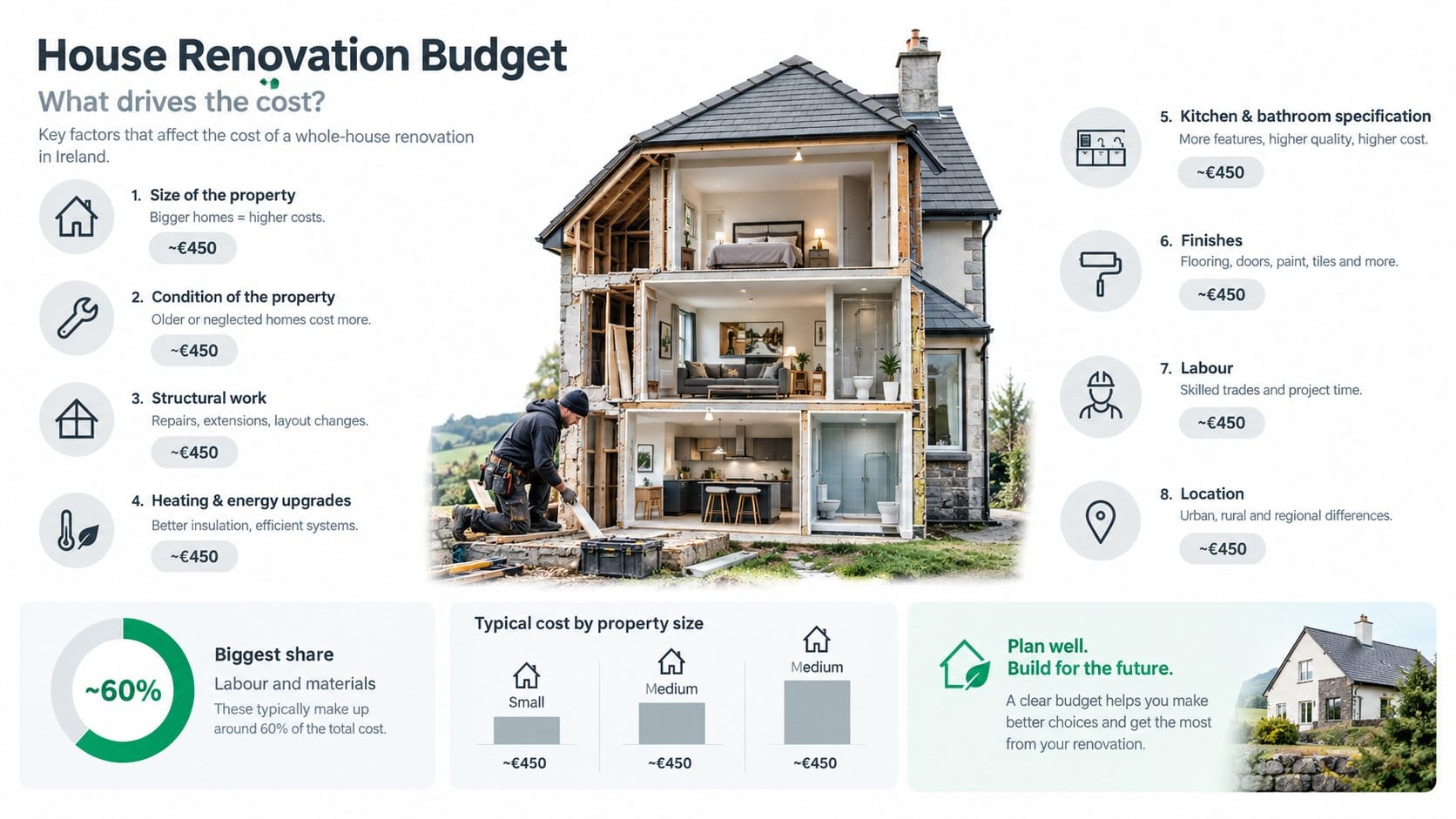
Extent of renovation. A cosmetic refresh limits demolition and first-fix work. A full gut adds strip-out, waste disposal, replacement services and extensive reinstatement. The large cost jump usually comes from hidden mechanical and electrical work, not from choosing a better paint or floor finish.
House size. A quoted rate per m² produces a higher total as the treated floor area grows. The rate still needs checking. A small house with complex structural work can cost more per m² than a larger, straightforward property.
Age and condition. Older housing stock may contain damp, timber decay, uneven floors, outdated wiring and plumbing that was not designed for the proposed layout. A survey helps identify these risks before the contract sum is fixed.
Structural changes. Removing walls, changing openings, altering stairs or repairing foundations brings design, engineering, temporary works and compliance requirements. For wider construction work, find tradespeople and post a task when the project includes an extension, major structural alteration or a comparison with building new.
Heating and energy upgrades. Insulation, airtightness, ventilation, heat-pump installation and controls must work as one system. A deep retrofit therefore depends on the home's starting condition and can add substantial first-fix and coordination work, rather than improving individual rooms.
Kitchen and bathroom specification. Cabinet construction, worktops, appliances, sanitaryware, ventilation, tiling and plumbing positions all affect the allowance. Two rooms with a similar appearance can require very different installation work.
Finishes and joinery. Internal doors, skirting, wardrobes, stairs, flooring and decorative finishes can move a project within its tier. Changes after ordering create rework, storage and replacement costs.
Labour is generally the largest budget component, followed by materials. Professional fees and permits usually form a smaller share, but their allowances still need to be included. Dublin labour rates are generally higher than rural rates, so written local quotations matter more than a national average.
Price a separate plastering allowance for that trade rather than treating plastering as the whole renovation budget.