A snagging survey costs €300–€650 in Ireland, with a re-inspection €120–€180. See what is checked and how to compare quotes.
/8 min read
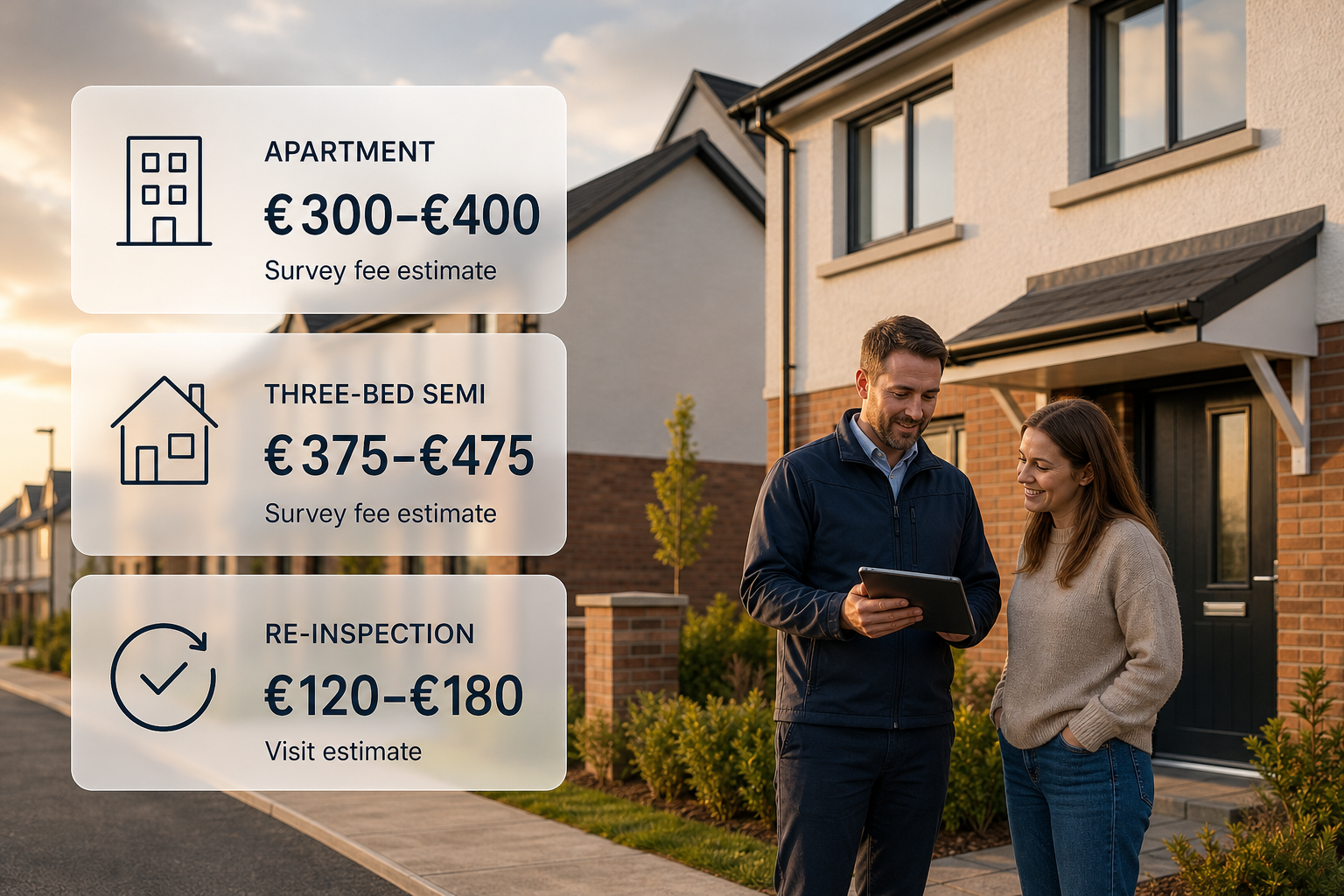
As an aggregate Irish market estimate, a snagging survey for a new-build home in Ireland costs €300–€650 including VAT, with apartments at €300–€400, three-bed semi-detached houses at €375–€475 and four-bed or detached houses at €450–€650. A re-inspection after the builder's repairs is €120–€180, so a three-bed semi with one re-inspection comes to about €495–€655. For a snagging survey, the fee buys a room-by-room visual inspection and a photo report that the buyer can send to the builder through their solicitor before closing.
What a snagging survey costs by property type
The following table is an aggregate Irish market estimate, with VAT included. It sets out the survey fee by property type and the common extra for a return visit.
Quote item
Range
Survey fee for an apartment
€300–€400
Survey fee for a three-bed semi-detached house
€375–€475
Survey fee for a four-bed or detached house
€450–€650
Re-inspection visit after the builder's repairs
€120–€180
A three-bed semi-detached house with one re-inspection comes to €495–€655 in total, using the lower and upper ends of the two relevant ranges. The fee normally covers the inspector's time, travel within the surveyor's area and a written report with photographs. A re-inspection is not automatic; it is ordered when the buyer wants the surveyor to check that agreed snag items have been completed.
What moves a snagging survey quote
Several things move a quote. Floor area matters because a larger house takes longer to inspect and produces a longer report. The number of storeys adds time for stairs, upper floors and roof access. Travel distance to the site can move a quote toward the upper end of the range for that property type, especially for a remote or island property. The report format matters too: a short checklist is not the same as a full photo report with room-by-room notes, and a re-inspection is an extra visit with its own range in the table.
A buyer should compare the scope, not just the bottom line. A quote at the low end of the apartment range may cover a shorter inspection and a basic report, while a quote at the high end of the detached range may include more photographs, a more detailed summary. If a quote sits outside the range for the property type, the surveyor should explain what is different.
What a new-build snagging survey checks
A snagging survey is a visual, non-invasive inspection of the finished home. It looks at ceilings, walls and floors for cracks, uneven finishes, damp marks and poor painting or plastering. It checks windows and doors for opening, closing, seals and alignment; kitchen units, worktops and appliances for damage or poor fitting; bathrooms for sealant, tiling, drainage and water pressure; and sockets, switches, heating controls and radiators for visible defects. Outside, it records paths, paving, boundaries, external walls, roof covering from ground level or an accessible attic, gutters and downpipes. The surveyor also notes ventilation, condensation risks and any obvious service issues that can be seen without opening walls or testing hidden pipework.
Because Building Control Regulations apply generally to new buildings Government of Ireland, a snagging survey often records visible issues that may relate to compliance, such as missing ventilation, poorly fitted fire doors or incomplete drainage connections. It is not a compliance certificate and does not replace the builder's own certification. Where a buyer needs help with formal building-control paperwork or regulatory issues, regulatory and compliance services may be relevant, but the snagging report itself is a practical list of defects for the builder to fix.
When to book a snagging survey
The best time is once the builder says the home is finished and before closing. At that stage the buyer can inspect with the surveyor, prepare a snag list and send it to the builder through the buyer's solicitor before closing. Booking earlier, while trades are still on site, can mean items are disturbed or completed after the inspection. Booking after closing is possible, but the buyer then has less leverage because the snag list has not been formally passed to the builder before completion.
The buyer should ask the builder for access for the surveyor and should not sign off on a final walk-through until the report has been reviewed. If the builder agrees to repairs, the buyer should keep a dated copy of the snag list and photographs. A re-inspection can then be booked to confirm the work. If items remain unresolved after completion, the buyer's solicitor can advise on the next step. Once the closing date is fixed, the move itself can be planned with a moving day checklist.
What the report looks like
A useful report is more than a list of complaints. It usually opens with a short summary of the main issues, then works room by room and elevation by elevation. Each item has a location, a description, a photograph and a recommended action. The surveyor may grade items as minor, moderate or significant, and may separate workmanship defects from items that need further specialist inspection. A good report also states what was not inspected, such as concealed pipework, electrical testing or areas blocked by stored materials.
The report should be dated and identify the property. Photographs should be clear enough for the builder to find the item without a second visit. A re-inspection report should refer back to the original snag list and note which items are complete, which are partly complete and which remain outstanding. Buyers should keep the report in digital form so it can be emailed to the builder and solicitor.
Is a snagging survey worth paying for?
A do-it-yourself snag list is free and can catch obvious problems: a scratched worktop, a sticking door, a missing seal or a mark on a wall. It is less reliable for drainage, ventilation, roof coverings, external levels, window alignment, service connections and the interaction between different trades. A professional surveyor sees many new homes, knows where defects commonly appear and can produce a consistent, photographed list that is harder for a builder to dispute.
The fee sits within the ranges in the table, and the value lies in the timing and the evidence. A survey that catches a drainage or ventilation problem before closing gives the buyer evidence to seek a repair before completion. A survey that produces a clear list can also make the builder's repairs easier to manage. The buyer should still walk the home with the surveyor, take their own notes and keep copies of every communication.
Snagging survey versus a building condition survey
A snagging survey is for a new-build home that is nearly finished. It focuses on finish, workmanship and visible defects that the builder can fix before handover. A building condition survey is for an existing or second-hand home. The Government of Ireland recommends getting a building condition survey before signing contracts, to find out whether there are defects or related issues with the property Government of Ireland.
The two reports answer different questions. A building condition survey looks at the overall condition of an older property, including structure, damp, services and likely repair costs. A snagging survey assumes a new home should be finished to a proper standard and lists the gaps. A buyer of a second-hand home may need a building condition survey and a separate structural or damp inspection; a buyer of a new home normally needs a snagging survey and a re-inspection after repairs.
How to compare snagging survey quotes
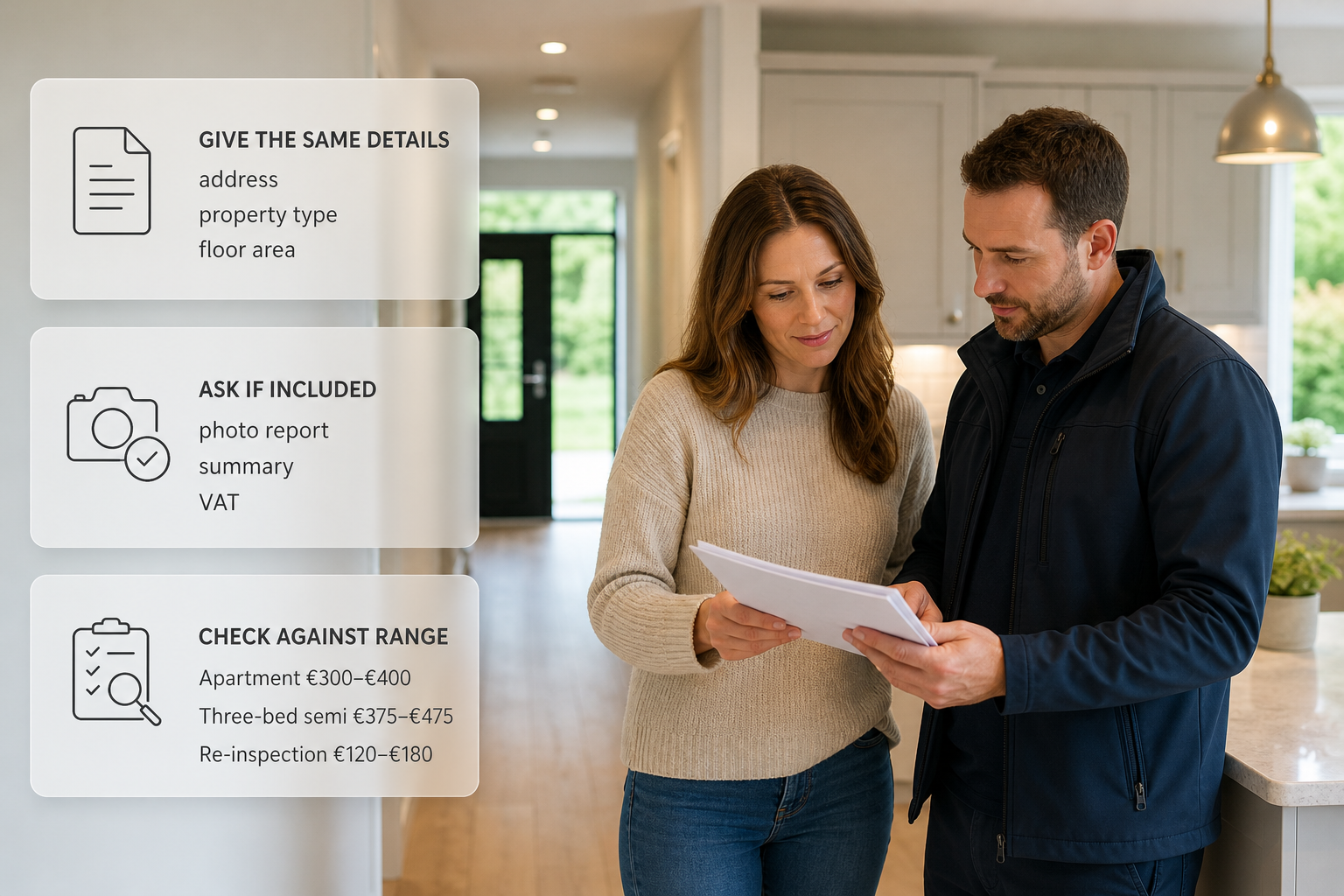
The first step is to compare like with like. The buyer should give every surveyor the same address, property type, floor area and expected access, then ask whether the quote includes a photo report, a summary, a re-inspection and VAT. A quote for an apartment should be checked against the €300–€400 range, a three-bed semi against €375–€475, and a four-bed or detached house against €450–€650. A re-inspection should be quoted separately against €120–€180.
The buyer should ask what qualifications and professional indemnity insurance the surveyor holds, who will carry out the inspection, and whether the report will be issued by that person. Ask for a sample report and check that it has room-by-room notes and photographs, not just a checklist. Ask what the surveyor will not inspect, how long the report will take and whether the surveyor will speak to the builder or solicitor if a defect is disputed. A quote below the relevant range in the table that excludes the report, access equipment or a return visit is not comparable with a quote that includes those items.
Posting a job or listing on ShamFix is free and there is no commission; a subscription is planned for the future. ShamFix does not check or certify tradespeople, and profiles are filled in by tradespeople themselves, so homeowners should check registrations themselves and read reviews.
FAQ
Does a snagging survey include the attic?
It usually includes an accessible attic, roof space and visible roof structure, but not areas blocked by stored goods or sealed hatches. The surveyor will note if access was limited. A full roof inspection from height may need a separate specialist.
Should the buyer attend the inspection?
Attendance is useful because the buyer can point out concerns and see how the surveyor records them. It is not essential, but the buyer should arrange clear access and make sure the surveyor can reach every room, the attic and the external areas.
Is a re-inspection always needed?
No. A re-inspection is most useful when the snag list is long or when the builder has carried out work that is hard to check without a return visit. It costs €120–€180 and should be booked only after the builder says the repairs are complete.
What if the builder disputes a snag item?
The buyer should ask the surveyor for the photograph, location and description, then pass the evidence to the solicitor handling the purchase. The builder may agree to repair, explain why the item is not a defect, or propose a different solution. Keeping the original report and a dated repair list makes the discussion clearer.
House renovation cost Ireland guide with per m² rates by tier, cost drivers, hidden costs, SEAI grants and quoting tips to budget your whole-house refurb.
Garden wall cost Ireland explained with per-metre prices for block, brick and stone, cost drivers, planning rules and how to compare quotes to avoid extras.
16 min read
Next step
Find local help
Browse people offering this work in your county and post a job.