A standard block garden wall in Ireland is about €50 to €80 per m², brick or stone is about €100 to €150 per m², and retaining walls are about €150 to €250 per m². Those figures are a practical starting point only, because VAT at 13.5% should be checked on the quote, and length, height, and ground conditions can shift the final bill quickly.
A homeowner measuring a boundary line in Dublin, Cork, or anywhere else in the Republic often discovers the same thing, the wall itself is only part of the job. Foundations, access, finish, and whether the wall is really a boundary wall or a retaining wall matter just as much as the visible face. For a first-time homeowner, that's usually where the quote stops feeling straightforward.
How Much a Garden Wall Costs in Ireland Right Now
A homeowner might start with a tape measure and a rough boundary line, then discover that “just a wall” can mean three different jobs. A plain boundary wall, a finished feature wall, and a structural retaining wall all carry different pricing, because each one asks for a different amount of work under the surface. In Ireland, a standard block garden wall typically sits around €50 to €80 per m², brick or stone around €100 to €150 per m², and a retaining wall around €150 to €250 per m². Those bands are a useful first check, but they only make sense once the wall type is clear.
ShamFix's fencing and gates service page can help a homeowner find wall and boundary builders and post a job: find wall and boundary builders and post your job
Why the unit matters more than the headline
Garden walls are usually priced per linear metre or per square metre of wall face, not just by the length on a sketch. That matters because height changes the job as much as length does. A 10 metre wall at 1 metre high is one thing. The same 10 metres at 2 metres high needs more blockwork, more labour, and often more support.
The cheapest-looking quote is often the one that leaves out the footing, capping, waste, or finish.
Local pricing also shifts by county. Dublin and commuter counties tend to be dearer than rural areas, mainly because labour rates are often higher and access can be tighter. A written itemised quote is the figure that counts, because it should show what is included and what is not.
VAT and the “final number”
A quote should make clear whether VAT at 13.5% is included for residential building work. A headline price can look reasonable until VAT is added back in. Ask for the full installed price, not just the wall face price.
The wall face is the visible shell. The footing and support work are the part that hold it up, like the hidden base under a shed. That is why two walls that look similar from the street can sit in very different price bands once the ground work and structural load are taken into account.
Garden Wall Prices by Material and Finish Compared
A garden wall can look simple from the road and still sit in a very different price band once you decide what job it is doing. A plain boundary wall, a finished feature wall, and a structural retaining wall are three different builds, much like a coat, a lined coat, and a coat with a stiff inner frame. The wall type usually changes the cost more than the material alone.
A rendered block wall is usually the lowest-cost route. Brick sits in the middle, natural stone is the dearest, and block with stone cladding falls between plain block and full stone. On aggregate Irish market estimates, a standard block garden wall runs about €50 to €80 per m², brick or stone walls about €100 to €150 per m², and retaining walls about €150 to €250 per m². That spread is the clearest sign that the structure matters as much as the finish.
| Wall Type |
Typical Cost per m² |
What Drives the Price |
| Rendered concrete block |
€50 to €80 |
Cheapest common option, fast to build, labour stays relatively manageable, render or plaster adds finish cost |
| Brick |
€100 to €150 |
More labour-intensive laying, cleaner face finish, often chosen where appearance matters more |
| Natural stone |
€100 to €150 and often higher in practice when detailing is heavier |
Highest labour intensity, more time spent selecting and laying units, more skill needed |
| Block with stone cladding |
Between block and full stone |
Core wall is still block, but cladding adds material and labour, gives a more premium look without full stone construction |
The live Irish material market also helps explain why the face price does not tell the whole story. At Irish builders' merchants, a 4-inch solid 7.5N concrete block is about €1.40 each and a 9-inch cavity block about €2.50 each. That is only one part of the wall, but it shows how block choice alone can shift the bill before labour is counted.
How the finishes compare in plain terms
Rendered block suits a homeowner who wants a clean boundary wall without paying for a decorative face. Brick suits someone who wants a neater finish and is willing to pay for slower, more careful laying. Natural stone takes the most time and skill, so it usually lands at the top end.
Block with stone cladding is the middle ground. The wall still needs a proper structural core, and the cladding is only the outer face, like a good jacket over a solid frame. That means the price can sit well above plain block even if the finished look is only a small step away from full stone.
A render or plaster finish also adds cost, because the wall still needs that outer coat applied properly. The rendered finish adds the cost of that outer coat and the labour that goes into applying it.
Simple comparison: block is the work jacket, brick is the smarter jacket, and natural stone is the tailored overcoat.
What Your Quote Actually Pays For
A proper wall quote reads from the ground up. The first money goes into excavation and the concrete strip foundation, because the wall needs something solid to sit on. Aggregate Irish market estimates show why this part matters, with ready-mix concrete at about €115 to €128 per m³, concrete pumping at about €14 per m³, a skilled mason at about €43.18 per hour, and general labour at about €31.19 per hour. Once the footing and blocklaying are included, labour can become the biggest part of the bill on shorter runs.
The wall is built in layers
A wall is a small building, not a painted line in the garden. The footing carries the load into the ground, then the wall rises course by course, then the top is protected with capping or coping so rainwater does not soak straight into the structure. If the quote includes a damp-proof course, weep holes, or drainage detail, that is not padding, it is basic weather protection.
Taller walls may need reinforcement or piers at intervals. That adds cost because every extra course means more masonry labour, more mortar, and more handling time. A wall that must hold itself steady in wind or support more load needs more structure than a low decorative boundary.
A wall without the right footing is like a house on sand, it may look finished on day one and still fail later.
Removal of an old wall, skips, waste disposal, and making good around paths or lawns are often priced separately. The same goes for render if the wall is to be plastered or finished on both sides. A homeowner should ask the builder to state those items in writing, because an apparently low quote can turn into a much larger final bill once the “small extras” appear.
The reason the numbers shift so sharply is simple. Surface finish is visible, but the hidden work below ground and at the top of the wall protects the structure. On a garden wall, the hidden work is often the part that decides whether the quote is honest.
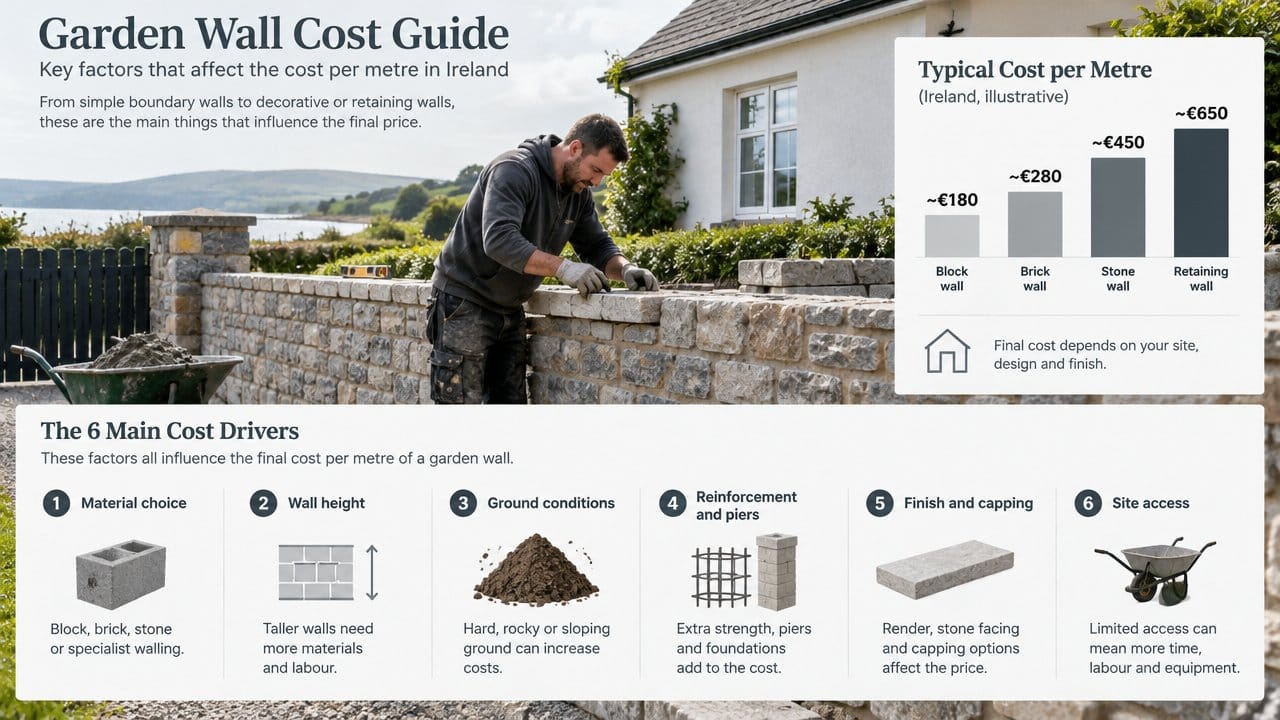
The Main Cost Drivers That Change the Final Price
Two walls can be the same length and still cost very differently. The biggest reason is often the wall job itself. A plain boundary wall, a finished feature wall, and a structural retaining wall all ask for different work, so the material alone does not decide the bill. Irish material pricing also shifts over time, so builders watch inputs such as mortar, concrete, and finishes closely. Irish materials price index tracking
Material choice, height, and ground
Material choice is the first fork in price. Concrete block is usually cheapest, brick sits above it, and natural stone costs more because it takes longer and needs more skill to lay. Height and length then shape the total. Every extra course adds mortar and labour, while a longer wall increases the overall material bill even if the price per metre stays steady.
Ground conditions can change the job completely. Soft or sloped ground often needs deeper or wider footings, which means more excavation, more concrete, and more labour. A wall on poor ground is not just a little harder to build, it needs a different base to carry the load properly.
Reinforcement, finish, and access
Reinforcement and piers become more important as the wall gets taller or needs extra strength. They are part of the structure, like stronger legs under a heavier table. Without that support, the wall is more likely to move in wind or over time.
Finish and capping also change the price. A wall that is rendered, stone-capped, or made to look neat on both sides needs more labour and more time on site.
Access can add hours too. If the builder has tight space for blocks, sand, concrete, or skips, everything takes longer to move and place. That slower pace shows up in the quote. The same applies where an old wall has to come down first. Demolition, waste, and clearance all cost money before the new build starts, and removal work can change the final figure significantly.
Irish industry cost datasets also show a simple pattern. As wall systems need more stiffness or structural performance, the price rises for real build reasons, not guesswork. That is the same logic a homeowner sees in a garden wall. The job type, the ground, the access, and the finish shape the quote just as much as the material choice.
Planning Rules and When a Wall Becomes a Retaining Wall
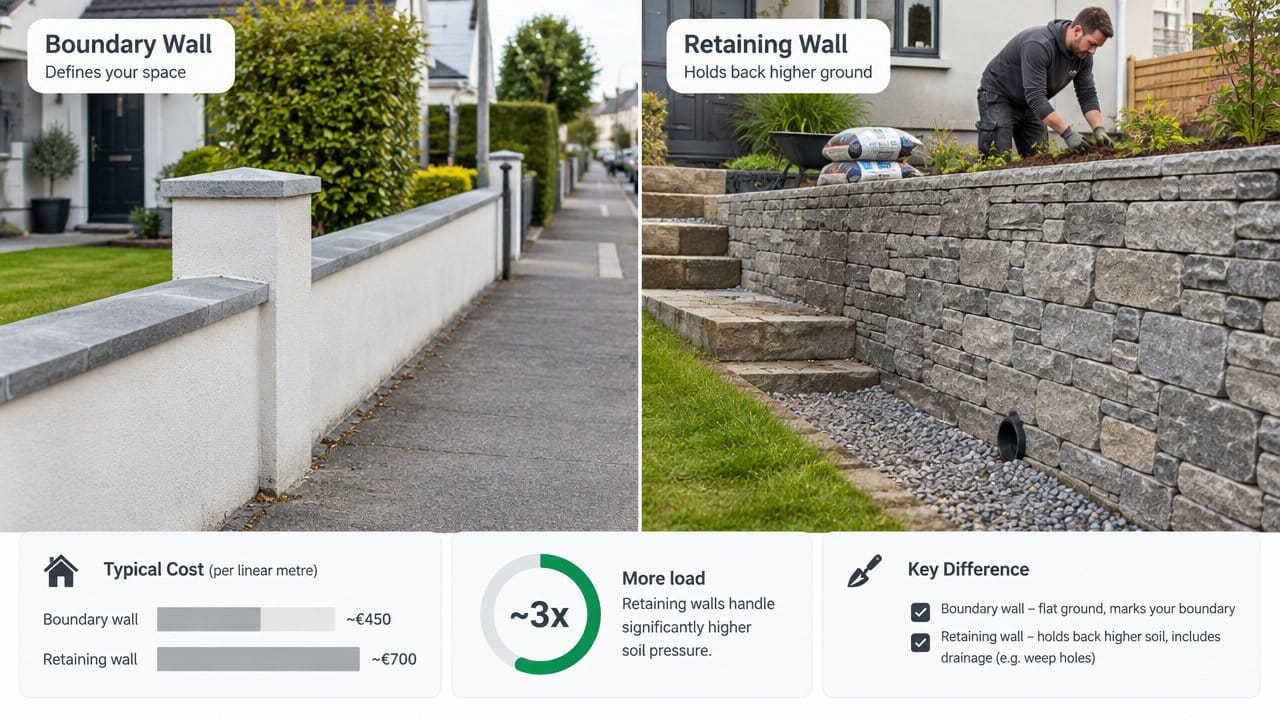
A homeowner can stand in the garden and see one wall, but the rules may treat it as two different jobs. A boundary wall marks where the garden ends. A retaining wall holds back soil, like a low barrier holding a stack of earth in place.
That difference changes both planning and price. In the Republic of Ireland, a front wall or fence facing a public road is exempt up to 1.2 metres high, while a wall or fence at the side or rear can be exempt up to 2 metres high. The homeowner should still confirm exempted-development limits with the local authority, especially near a road or where the site has special constraints.
Height matters because a taller wall changes what it has to resist. A wall close to the road can affect sightlines, and a wall that sits above the exemption limit may need planning review before work begins. A quick check is far easier than correcting the job after the build has started.
Boundary wall or retaining wall
A boundary wall defines a line. A retaining wall holds back earth. Once soil pressure enters the picture, the wall is no longer just a simple screen. It needs thicker footings, drainage, and often reinforcement or design input so it can carry the load behind it.
The site usually gives the clue. If one side of the garden is higher than the other, or the wall must keep soil from slipping, the wall is doing structural work. In the same way a shelf needs proper brackets before you load it up, a retaining wall needs support behind and below it. The wall may also need weep holes and back drainage so water does not build up behind it.
What the homeowner should watch for
If the wall only encloses a garden, the usual boundary-wall rules generally apply. If it is supporting ground, the design has to change with it. That is why a retaining wall often lands in a different price band, even when it looks much like a normal wall from the street.
A simple test helps. Stand at the proposed line and ask whether the wall is holding back earth or just marking a boundary. If it is holding back earth, the quote should reflect the extra structure. If it is not, the homeowner should not be paying retaining-wall money for a plain boundary wall.
How to Compare Quotes and Avoid Common Extra Costs
A proper quote comparison starts with the same brief. Each builder should price the same length in metres, height, and wall type, because a plain boundary wall, a finished feature wall, and a structural retaining wall are different jobs. The wall type often changes the price more than the material alone, the way a simple shelf, a fitted shelf, and a load-bearing shelf all need different support.
Each quote should also state footing dimensions, pier spacing, the material, the finish, whether capping is included, and whether VAT at 13.5% is included for residential work.
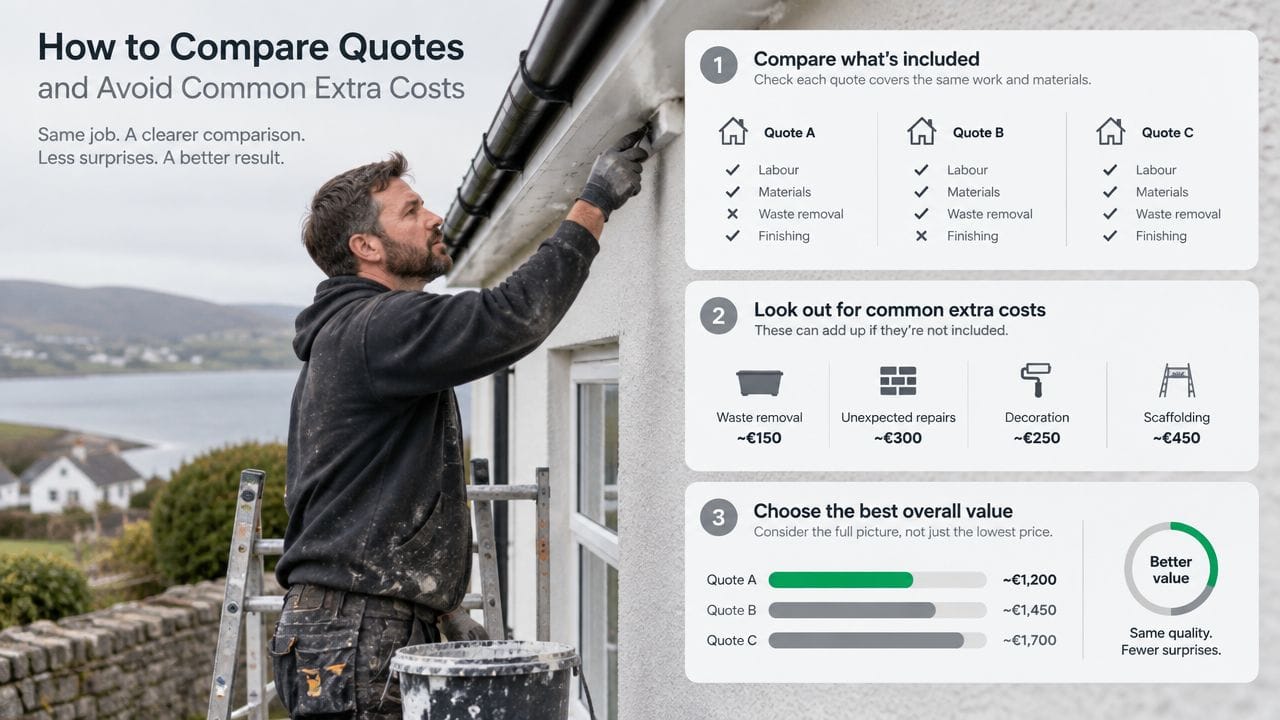
A useful quote checklist
- Footings and depth: The quote should say how deep the foundation will be and whether the ground needs extra excavation.
- Structure: Check if piers, reinforcement, or extra courses are part of the job.
- Finish details: Render, coping, capping, and any decorative finish should be priced clearly.
- Drainage and damp protection: DPC, weep holes, and back drainage should not be left vague.
- Site extras: Waste removal, demolition of the old wall, access issues, and making good should be named.
- Tax treatment: VAT should be shown plainly so the final total is not a surprise.
The cheapest quote is often missing something rather than more efficient. A builder can look cheaper by leaving out waste removal, reducing footing size on paper, or excluding the finish that keeps the wall weather-tight. Once those items are added back in, the total often moves closer to the other quotes.
Where wider outdoor works fit
If the wall is part of a larger job involving foundations, driveway edges, or retaining structures, it may be better priced as one outdoor project instead of separate pieces. For wider outdoor and landscaping construction work, find tradespeople and post a task here: for wider outdoor and landscaping construction work, find tradespeople and post a task
Three itemised written quotes give a clearer comparison than three vague totals. That is the safer way to see which price includes labour, concrete, drainage, and finish, and which one leaves out a cost that will show up later.
Getting an Accurate Local Quote and Next Steps
The right wall type, height, and structure matter more than chasing the lowest per-metre figure. A simple boundary wall can be economical, but once the site is soft, sloped, tight for access, or retaining soil, the quote belongs in a different category. Confirm VAT, ask for everything in writing, and check planning if the wall is near the 1.2 metre or 2 metre thresholds.
How ShamFix connects Irish homeowners with local providers: how ShamFix connects Irish homeowners with local providers
A homeowner comparing wall quotes usually gets the best result by describing the site clearly, including height, access, and whether anything old has to come down first. That gives local providers a better brief and reduces the chance of missing costs later. For a garden wall in Ireland, the cheapest quote is rarely the clearest one.
Are you a tradesperson building walls, fences, or other outdoor structures in Ireland? Listing on ShamFix is free and there's no commission; a subscription is planned for the future. Local homeowners can find your business through the platform's two-sided review system, where reputation is earned on both sides of each completed job.
ShamFix helps Irish homeowners compare local providers for garden walls, boundary work, and related outdoor projects in one place. Posting the job on ShamFix lets you reach local providers with the details that matter, like wall height, access, and whether the wall is boundary or retaining.