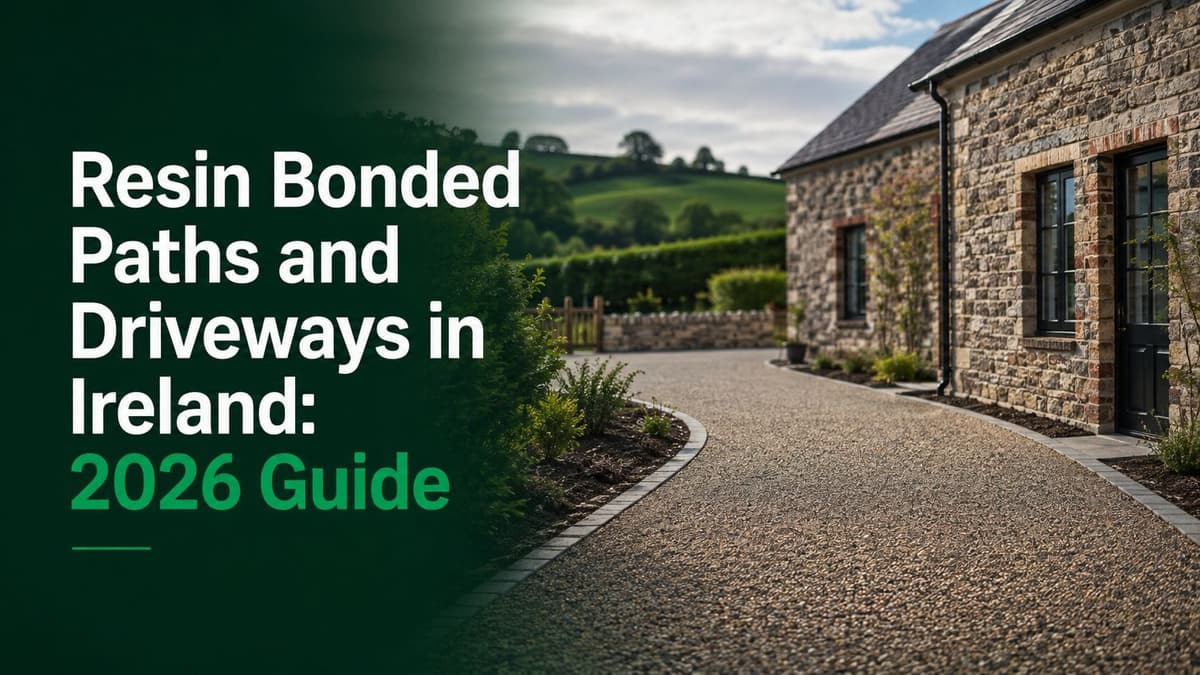
A tired driveway in a Dublin, Cork or Galway suburb can look worse after one wet winter than it did when it was laid. Cracks open, weeds find the edges, and rainwater sits in shallow depressions beside the garage. Resin often appears to offer a cleaner finish without the disruption of rebuilding the whole entrance, but the important question isn't just whether resin looks attractive. It's whether the correct resin system suits the existing base, the traffic, and the way surface water must be managed in the Republic of Ireland.
The phrase resin bonded paths and driveways creates much of the confusion. Resin bonded and resin bound are different construction methods. One is a thin decorative coating over a sound, sealed surface. The other can form a permeable driveway wearing course when it's installed over the right open-graded foundation. That difference affects planning, drainage, durability and the price of the work.
Why Resin Surfacing Comes Up on Most Irish Driveways
An old concrete or tarmac entrance may look ready for a new finish after a wet Irish winter. Before choosing resin, check what lies beneath it. The base must cope with Atlantic rain, temperature changes, vehicle weight and water moving towards the public footpath. A decorative layer can improve appearance, but it cannot correct movement, weak construction or trapped water.
Resin bound surfacing is relevant because its open structure can let rain pass through the finished surface and into a suitable permeable foundation. In many situations, that can help meet the drainage condition without a separate drainage design.
The word sound matters more than the word resin. A resin finish over a cracked, moving or poorly drained base can reproduce the same failure at greater cost. Resin bound is a wearing course, not a replacement for proper ground preparation.
Practical rule: A good-looking top layer cannot rescue a base that moves, holds water or has not been properly assessed.
For a new driveway, the base also needs time to cure. Resin bonded surfacing has a narrower role. The installer spreads resin across an existing monolithic surface, then broadcasts aggregate into the wet film. The stone remains visible and textured, while the resin seals the surface beneath it. It therefore does not provide permeability in the same way as resin bound surfacing. As general resin-industry practice, resin bonded surfacing is typically applied at about 3 mm, and a new base is generally allowed about 28 days to cure before application.
That makes resin bonded suitable for some patios, footpaths and low-load access areas where the existing surface is stable and drainage is already resolved. It is unsuitable as the structural base for a new driveway, particularly where surface water must be managed through a permeable build-up or where the existing slab has not been proven sound.
Resin Bound vs Resin Bonded Systems Compared
A driveway can look sound in a photograph and still be unsuitable for a resin finish. The base, levels and runoff should be checked first, then the choice between resin bound and resin bonded can be made. The materials share a word, but they do different jobs underfoot and in rain.
Resin bound aggregate is mixed with resin before being spread and trowelled into a relatively smooth layer. Resin bonded aggregate is scattered onto wet resin already applied to the base, leaving the stone partly exposed and giving a more textured finish.
The drainage difference often decides the specification. Resin bound can form a permeable system when paired with a suitable open-graded base. Resin bonded depends on the sealed surface beneath it and is not itself a SuDS-permeable build-up.
Resin Bound vs Resin Bonded at a Glance
| Criterion | Resin Bound | Resin Bonded |
|---|---|---|
| How it's made | Aggregate and resin are mixed together, then trowelled onto the prepared base | Resin is spread onto the base, then dry aggregate is broadcast over the wet film |
| Permeability | Can be fully permeable when paired with a suitable open-graded base | Not permeable in the same way, because the resin film seals the base |
| Typical depth | Technical specifications commonly use about 15 to 18 mm, with some driveway specifications recommending 18 to 20 mm and greater depths for higher traffic | Typically a thin surface application of about 3 mm |
| Base requirement | Needs a structurally sound base and a permeable or suitably designed foundation where infiltration is required | Needs a dry, sound, monolithic concrete or tarmac surface |
| Traffic suitability | Appropriate for many residential driveways when correctly designed and installed | Better suited to paths, patios and decorative overlays with light or moderate use |
| Appearance | Smooth, even and compact, with aggregate distributed through the layer | Textured, higher-grip finish with aggregate sitting at the surface |
| Typical Irish use | Residential driveways, paths and areas where surface-water management is central | Retrofit decoration over intact concrete or tarmac, especially on paths and patios |
The table is a practical first filter. Choose resin bound where water must pass through the surface and its foundation, provided the ground conditions support that design. Choose resin bonded for an intact sealed path or patio where the aim is a textured overlay rather than a new permeable driveway build-up.
Resin bonded is not a structural driveway base. A new driveway still needs a properly designed foundation, and the base must be allowed to cure before surfacing. Neither system should be specified from a photograph alone. Ground levels, existing cracks, downpipes, thresholds and the direction of runoff require an on-site check.
How a Resin Driveway or Path Is Built
At a typical Irish house, the finished resin surface is only the visible part of the job. The installer must first establish whether the ground can carry it, where rainwater will go, and whether the weather will allow the resin to cure properly.
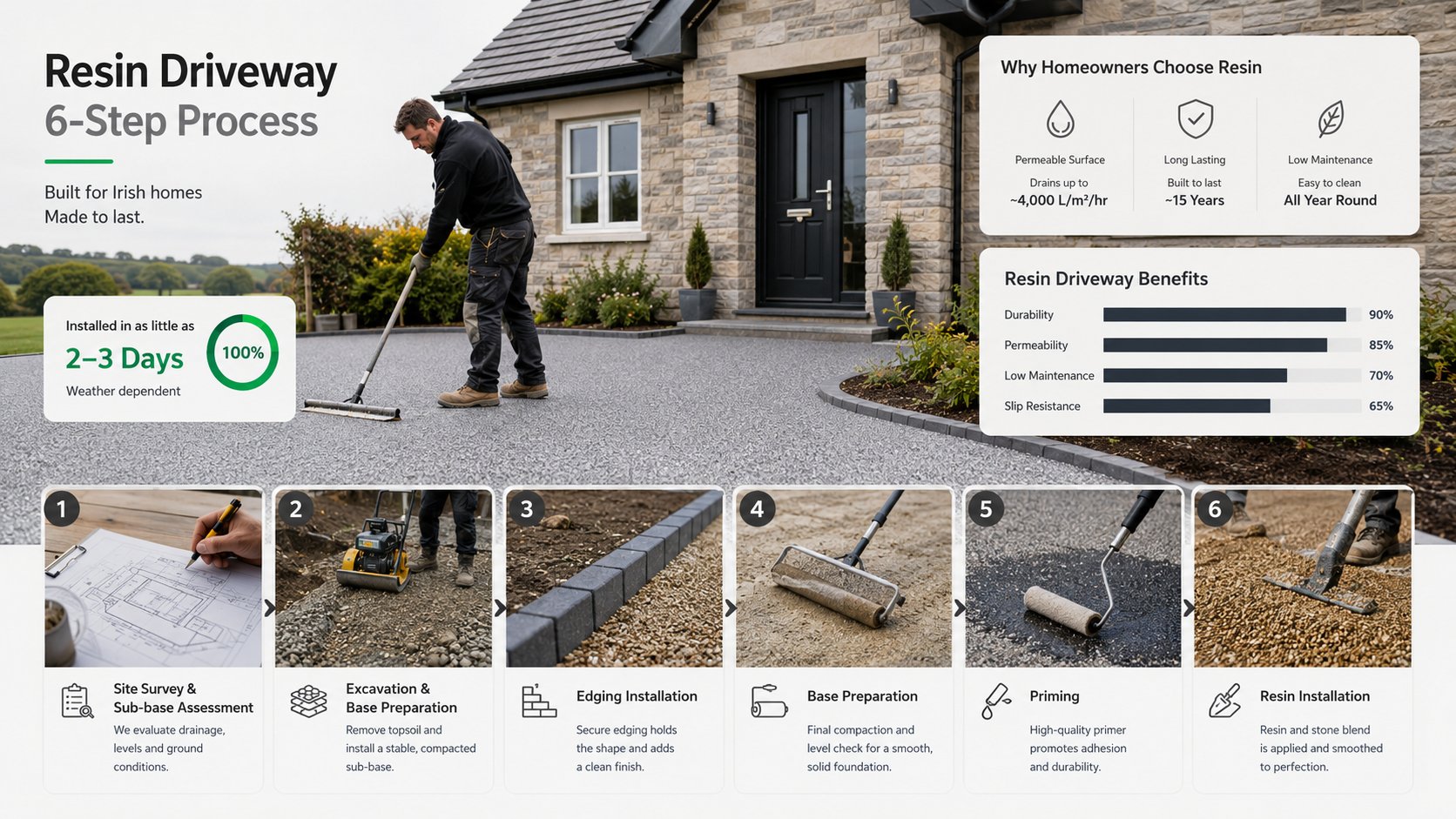
The construction sequence
Site survey and measurement. The installer records dimensions, access for materials, levels, thresholds, drainage points and the condition of the existing surface. A driveway that looks level may still send water towards a garage or public footpath.
Sub-base assessment. Concrete or tarmac is checked for movement, cracks, hollows and moisture. Where the foundation is failing, excavation and rebuilding may be more suitable than applying an overlay.
Edging installation. Concrete, brick or metal edging contains the finished material and sets its boundary. It also reduces damage from vehicle tyres and mowing equipment.
Base preparation. For a permeable driveway, the resin bound layer is commonly about 15 to 18 mm, over a minimum 125 mm compacted Type 3 or equivalent open-graded sub-base. Compaction must retain the voids that let water pass through. Resin bonded surfacing does not replace this structural driveway foundation.
Priming. Where the chosen system requires it, a compatible primer or tack coat is applied. The surface must be clean and dry, since dust, oil and moisture can reduce adhesion.
Mixing and finishing. With resin bound work, aggregate and resin are mixed before the material is spread and trowelled into an even layer. With resin bonded work, the resin film is applied first, then dry aggregate is scattered into it. Both finishes need protection while curing.
A new concrete or tarmac base must not be coated straight away. It needs about 28 days to cure before resin bonded application. That waiting period is especially relevant on Irish projects, where damp conditions can extend the programme. It should be written into the quotation rather than treated as an afterthought.
Rain, persistent dampness and cool temperatures can delay installation or alter the cure. The quotation should state the proposed surface, base treatment, curing period and weather conditions required. Resin is a constructed pavement finish, not a quick coat of paint.
Drainage Rules and Planning Exemptions in Ireland
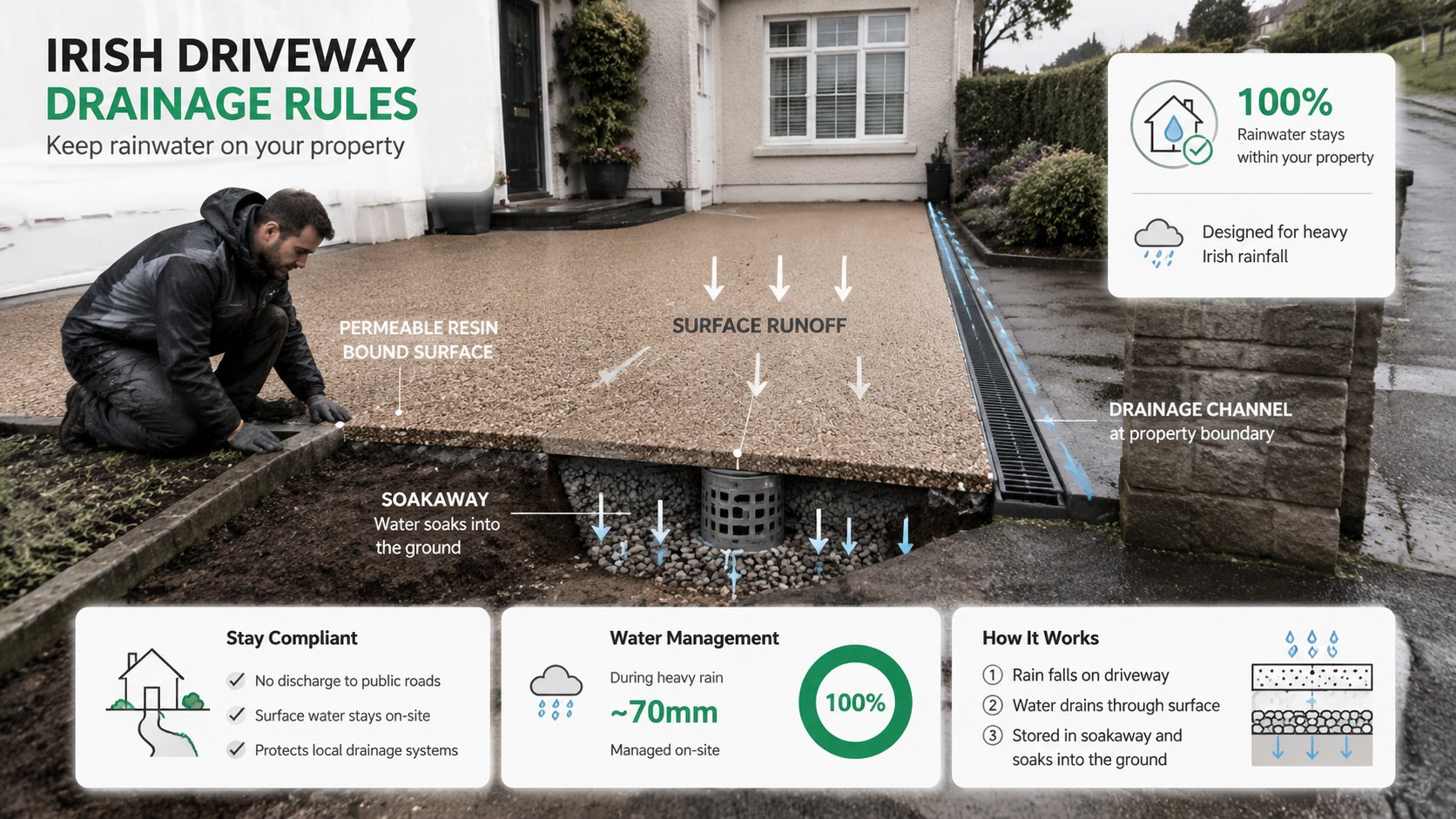
A widened front entrance can send rainwater towards the public road unless its levels and surface are planned carefully. Since 1 October 2008, Irish domestic front-driveway exemptions have included a condition that water from a new or widened driveway must remain on the property rather than discharge onto the road, as set out in Citizens Information's summary of exempted development rules for houses.
During a site visit, the practical question is simple: where will the water go after heavy Irish rain? Options can include permeable surfacing, grading towards a lawn or soakaway, or connecting to an existing surface-water drain within the property. The exemption concerns how runoff is managed. It does not make every driveway material acceptable automatically.
Resin bound may support a permeable design because the resin and aggregate form a surface that can allow water through, provided the foundation beneath it also contains suitable voids. A concrete slab underneath can block infiltration, much like placing a breathable fabric over plastic. In that situation, channels, a soakaway or another controlled drainage arrangement may be needed.
Resin bonded follows a different drainage pattern. Its resin film holds aggregate at the surface, so rain generally runs across the finish instead of passing through the complete pavement. It may suit an existing hardstanding where runoff is already controlled. It is not a structural permeable driveway base, and should not be specified as one.
Before accepting a quote: Ask the local authority how the proposed surface will manage runoff at the property boundary, particularly where the entrance is being widened or levels are changing.
The small domestic exemption may not cover a protected structure, apartment development, conservation area or larger commercial site. Property status and local conditions can alter the planning position. The local authority confirms the applicable requirement.
When Resin Is the Wrong Surface for Your Site
A resin finish can look sound while the ground beneath it continues to move. Before choosing colours or requesting a final quote, check whether the existing base can support the proposed system. Cracked tarmac that is still moving, shifting concrete or unmade ground can transfer movement into the new surface. Resin bound and resin bonded finishes are surface treatments, not repairs for settlement or structural failure.
Water is the other early warning. Persistent ponding, saturated ground or a downpipe discharging without a planned outlet can leave the site unsuitable until drainage is addressed. Trapped moisture may affect adhesion and leave the finish uneven or cloudy. In Ireland, the question is not whether resin looks attractive. It is whether the whole build-up and its drainage route suit the site.
Site conditions that deserve a pause
Unknown sub-base: Dips, open cracks and an unclear construction history call for investigation before an overlay. A resin bonded surface is not a structural driveway base.
Poor infiltration: Heavy soil or a high water table can prevent a permeable build-up from shedding water safely. The design may need channels, a soakaway or another controlled route.
Steep or demanding access: Frequent turning, delivery vehicles or commercial loads require a specification designed for those forces. A decorative finish alone will not compensate for an inadequate base.
Planning sensitivity: A listed property, thatched building or conservation-area setting may involve more than a drainage check before the surface changes. The small domestic exemption may not apply in every case.
Cosmetic-only budgeting: Excavation, disposal, edging, base repair and drainage can cost more than the visible finish suggests. A low initial quote may leave these items unclear.
Paths need the same site assessment. Tree roots can lift the base, water can collect beside a wall, and weak edging can allow the surface to spread. Paving, tarmac, concrete or gravel may therefore be the better choice where they suit the ground and provide a clearer drainage route.
A useful self-check: Two or more unresolved site problems should shift the budget towards investigation and base repair, not towards choosing a more attractive resin colour.
Ask for a written survey stating what the existing surface can support, how movement will be managed and where runoff will go. If those answers are missing, postpone the finish selection.