
ShamFix
Back to insights

Moving Day Checklist: An Irish Step-by-Step Guide

A practical Irish moving day checklist: post redirection, Eircodes, utilities, deposit handover and the first night, in order.

9 min read
Moving Day Checklist: An Irish Step-by-Step Guide

Moving day itself is the shortest part of a move; the checklist that decides how it goes runs from the weeks before it to the first morning in the new house. The sequence below follows how Irish moves actually happen: date and notice first, then decluttering, packing and labelling, then post redirection, Eircode-linked records, utilities, broadband, TV licence, insurance and employer notifications, then the tenancy handover, the day itself and the first night. Where a step is handled by an organisation or a provider, the household should confirm the current process directly with that body, because forms and timeframes change.

Book the Date and the Help First

Nothing else can be scheduled until the date is fixed. Homeowners and renters should settle on a date, then work backwards: notice to a landlord or agent, notice to a broadband or energy provider, and a booking with whoever is physically moving the contents. Asking for the move on a Friday or at the end of a month usually means less choice of help, so flexibility on the day is worth something.

For the move itself, a household can post the job on ShamFix and review the responses that come back from local house moving services. Posting a job and listing on ShamFix is free and there is no commission, and a subscription is planned for the future. ShamFix does not check or certify tradespeople and profiles are filled in by tradespeople themselves, so registrations, insurance cover and reviews should be checked before anything is agreed.

Whoever is booked should confirm in writing what is included: how many people, van size, whether furniture is dismantled and reassembled, packing materials, and how goods are protected in transit. Tenants should also check the notice clause in the tenancy agreement and confirm the current requirement with the Residential Tenancies Board, which handles tenancy registration and dispute matters.

Declutter Before Anything Is Packed

Decluttering is cheaper and faster before boxes exist than after. Each room should be sorted into keep, donate, sell and dispose, and the dispose pile should be dealt with before packing starts rather than left in a hallway on moving day. Bulky items such as mattresses, old furniture and white goods can be brought to a local authority civic amenity or recycling centre, and many local authorities publish what they accept and any booking requirement, which is worth confirming locally. A skip or bag collection is arranged through a permitted waste collection provider, and the household should keep the receipt where a landlord may ask about removals.

Packing and Labelling, Room by Room

Strong double-walled boxes, packing paper, bubble wrap, tissue, a marker and wide tape cover most of a house. Heavy items go in small boxes, books go flat rather than on their edge, plates stand on edge in a box lined with paper, and glassware is wrapped individually. Screws and fittings should be taped into a labelled bag and taped to the furniture they belong to, and a photograph of the back of a television or router before it is unplugged saves an evening later.

Every box should carry the room it belongs to and a short contents note, with a separate mark for "open first". Boxes that a removal crew will move should be sealed, and nothing fragile or valuable should travel inside a box marked for general storage.
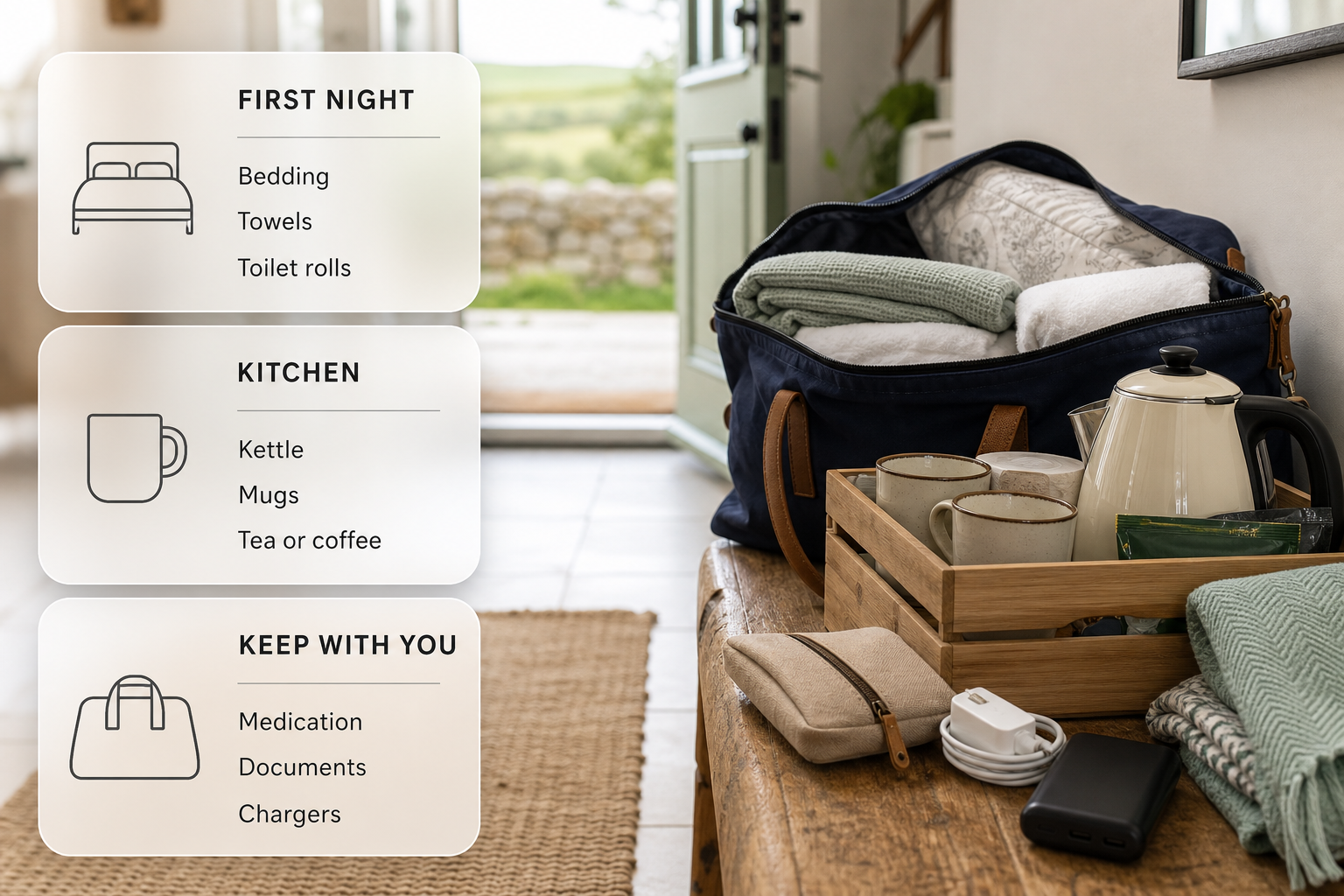
An essentials bag packed in an Irish home with checklist cards showing what should stay in the car for the first night.

The Essentials Bag

The essentials bag stays with the household, in the car, not in the van. One bag per person plus one kitchen box covers the first night: bedding for each bed, towels, toilet rolls, soap, a kettle, mugs, tea or coffee, snacks, chargers, medication, a change of clothes, pet food, bin bags, cloths, basic tools and a torch. Documents such as passports, the tenancy agreement or contract, and any keys or codes should travel the same way. Anything that would be a disaster to lose should never be packed in the back of the van.

Redirecting Post and Updating Eircode-Linked Records

An Post runs the mail redirection service, and the application is worth making before the move so it starts on the right day. Redirection forwards post, but it does not update the sender's records, so each organisation still has to be told the new address and its Eircode. Because an Eircode is tied to a property rather than to a person, a household moving into a new build may need to request the code from the Eircode operator, and old mail addressed to a previous occupant should simply be returned.

The list that matters most is Revenue for tax and any credits, the bank, the insurer, the employer's payroll or HR team, the family doctor and dentist, schools, the motor tax and driving licence records, pensions and subscriptions, and every online account with a saved delivery address. A single note listing who has been told, and when, prevents the same call being made twice.

Utilities, Broadband, Water and the TV Licence

Electricity and gas meters should be read and photographed on the day of the move, including the meter serial number, and the closing reading given to the provider along with a forwarding address for the final bill. The new home's account is usually opened with the meter point reference number, which appears on a previous bill, and the connection should be confirmed before the first night rather than after it.

Broadband needs the longest lead time, because a technician visit may be required and a contract notice period usually applies before the old service ends. The water utility should be told about the change if there is an account, and the TV licence is tied to the premises, so the TV licence operator is told about the move and asked whether the licence transfers or a new one is needed. Consumer guidance from the Commission for Regulation of Utilities covers energy and water queries, and each provider confirms its own current steps.

Some of this work needs a second pair of hands — mounting a television, moving a single bulky appliance, or lifting furniture between rooms. ShamFix groups requests like these under moving and transport, where a household describes the job and reviews the responses.


Insurance, Employer and Other Notifications

Home and contents insurance must cover the new address from the day the keys change hands, and the policy should be checked for what happens to belongings while they are in transit, since the removal firm's cover and the household's own policy are not the same thing. Motor insurance should be told about a change of address, because it affects the policy. Life and health policies, professional registrations and memberships also hold an address that is rarely updated.

An employer needs the new address for payroll and HR records, and the tax position is confirmed through Revenue rather than assumed. Anyone in rented accommodation should give the landlord or agent a forwarding address in writing at the same time as the keys are returned.

Renter-Specific Tasks: Notice, Inventory and Deposit

A tenant's checklist has items that a homeowner does not have to think about. Written notice must match the tenancy agreement and the current rules, and the end date should be confirmed in writing with the landlord or agent rather than agreed verbally. The original inventory is checked room by room, and anything beyond fair wear and tear should be repaired, replaced or agreed in writing before the final walk-through. Cleaning is done to the standard the inventory describes, meters are read and photographed, and every key, fob, remote, bin store key and alarm code is accounted for. Dated photographs or a short video of each room taken after cleaning are the simplest proof if a deduction is later questioned. Deposit disputes are handled by the Residential Tenancies Board when a landlord and tenant cannot agree.

A key handover at an Irish house with checklist cards summarising what must be completed before the keys change hands.

What Must Be Finished Before Keys Change Hands

A short list should be closed out before the handover, not after it: meters read and photographed, post redirection live, the old providers notified with closing readings, the new home's utilities and broadband confirmed, insurance active from the right date, and any agreed deduction or repair recorded in writing. Keys, fobs and codes are handed over in person where possible, and the household keeps its own record of what was handed back and when. Buyers and sellers should also confirm with their solicitor what has to be signed or returned on the day, since those items sit outside the removal itself.

Moving Day Itself

Beds are stripped and the fridge and freezer emptied and defrosted in advance, because a freezer cannot travel full. On the morning of the move, the essentials bag goes into the car first and the last boxes out are the cleaning items. When the crew arrives, someone walks the house with them, points out what is fragile and what is staying, and checks items off the list as they are loaded. Before the van leaves, a final sweep covers cupboards, the hot press, the attic, the shed, the garden and under the stairs. At the other end, boxes are directed to their rooms as they come in and beds are assembled first, so the first night is not spent looking for bedding.

The First Night in the New Home

Heat and hot water are checked early, and the stopcock and fuse board are located while the house is still quiet. Beds, towels and the kettle are unpacked first, a simple meal is planned rather than cooked from scratch, and everything else waits. A torch or phone light near each bed costs nothing and helps in an unfamiliar house.

Settling In During the First Week

In the days after the move, redirected mail should be checked to confirm it is arriving, any provider or organisation not yet updated should be contacted, and the household should register with a local doctor if it has moved area. Small jobs tend to appear quickly — shelving, a curtain rail, boxes to be cleared, a garden to be tidied — and these are the kind of jobs that homeowners post on ShamFix once the boxes are gone. Posting a job and listing is free, there is no commission, and a subscription is planned for the future. ShamFix does not check or certify tradespeople, profiles are filled in by tradespeople themselves, so it is worth checking registrations and reading reviews before agreeing any work.

FAQ

Does the TV licence move with the household or stay with the address?

The TV licence is linked to the premises, so a household that moves should tell the TV licence operator about the change and confirm whether the existing licence transfers or a new one is needed at the new address. Leaving it alone can mean post going to the wrong place and questions later. A single update before the move closes the matter.

Who should be told about a change of address first?

The order should follow consequences rather than convenience: the post redirection first, then Revenue, the bank, the insurer and the employer's payroll, because those affect money, cover or tax. Schools, doctors and subscriptions can follow in the same week. What matters more than the order is keeping one list and ticking each name off as it is confirmed.

Can a tenant get a deposit back before the keys are handed over?

Normally the deposit is returned after the final inspection and the return of the keys, and any deduction should be put in writing with a reason. Nothing prevents a tenant asking for the inspection to be scheduled before the last day so there is time to fix anything raised. If no agreement is reached, the Residential Tenancies Board handles the dispute, and dated photographs taken after cleaning carry the most weight.

What happens if the new home is not ready on moving day?

A delay is usually filled with a short storage period or a few nights elsewhere, so it is worth asking the removal firm in advance whether goods can be held and for how long, and getting any arrangement in writing. Insurance should be checked for belongings sitting in storage, since a standard policy may not cover it. The essentials bag stays with the household throughout, so the first night works wherever it is spent.

Keep reading