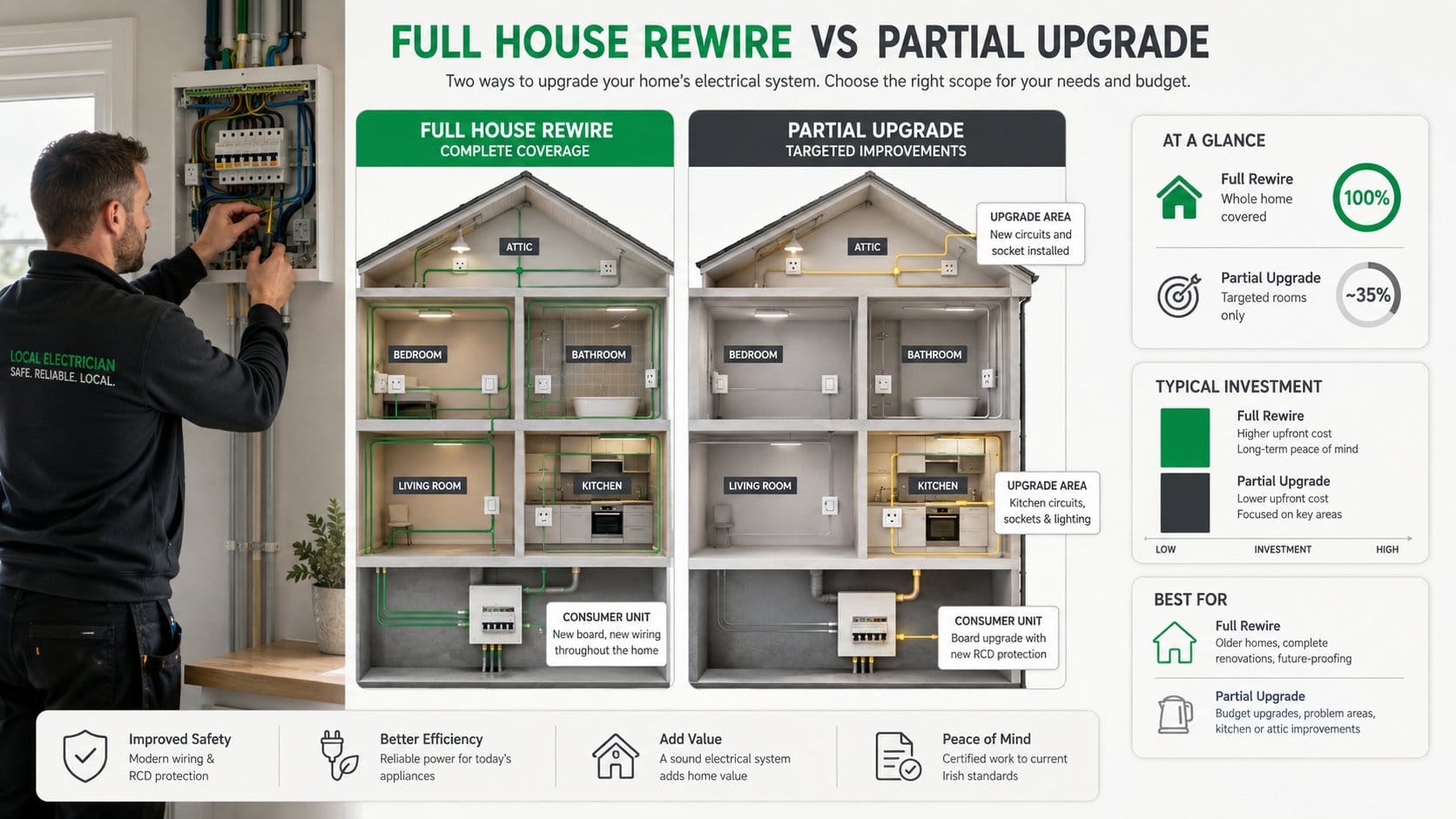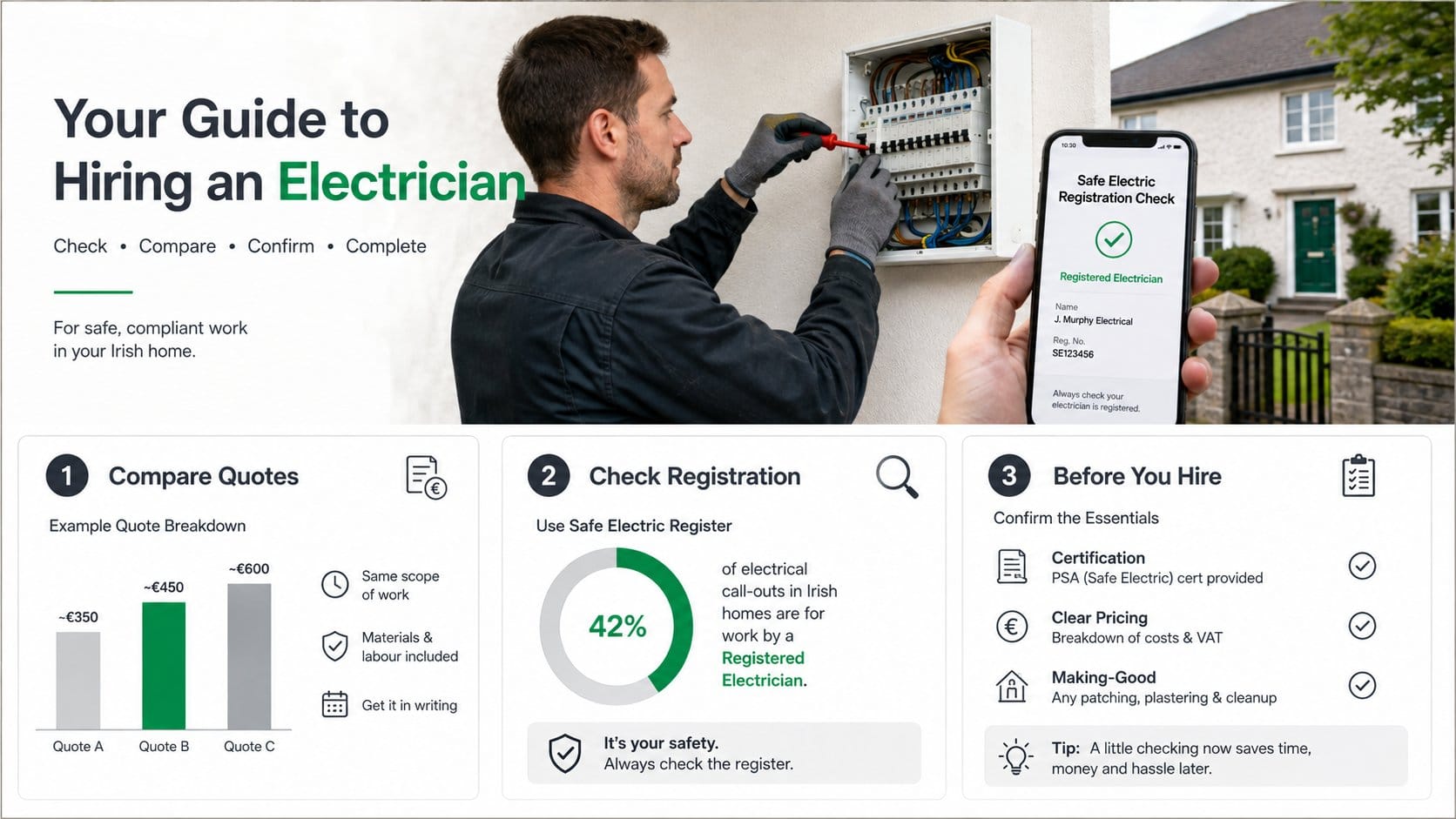
A full house rewire in Ireland for a standard 3-bed semi typically sits in the €10,000-€14,500 range in 2026, and the spread comes mostly from scope, not copper prices. In the same market, a fuller renovation package can push a similar house into the €12,000-€14,500 bracket, while a broader occupied-home project can climb into the low €20,000s once replastering and refinishing are included.
Owning an older Irish home can make that spread feel confusing. A fuse board that keeps tripping, too few sockets in the wrong places, or wiring that looks like it belongs in another decade are all signs that the core question isn't just what a rewire costs, but what scope of rewire is being bought.
If you already know you need the work done, post your job on ShamFix to get quotes from local electricians — describe the house and what is failing, and Safe Electric electricians who cover your county can respond.
What This Guide Covers and Why It Matters Now
A homeowner buying a 1970s three-bed semi, inheriting a cottage, or living with a fuse board that trips at the worst possible time usually wants one clear answer before any walls are opened. A rewire is not just new cable in the walls. It is a set of choices about access, plastering, certification, and how much of the old installation can safely stay.
That is why rewiring a house cost Ireland is better treated as a scope question than a single price. A quote may cover labour and basic materials, or it may also include the consumer unit, smoke alarms, plastering, painting, and the final certificate. The same house can land in very different price bands once you decide whether you are buying a bare electrical changeover or a wider finish package.
Older homes make the question harder. If the property is occupied, if it has period details, or if the layout is awkward, the electrician may need more labour and more making-good than in a straightforward empty house.
The practical job here is simpler, work out what a rewire includes, spot when an older home needs one, understand Safe Electric rules, and budget for the awkward middle bits that decide the final bill. That means knowing who signs off the work, who repairs the walls, and what must be clear before money changes hands.
Practical rule: if a quote does not say whether finishing, certification, and making-good are included, the budget is still incomplete.
What a House Rewire Involves
A rewire is a full replacement of the fixed electrical installation inside a house, not a simple new fuse board. The electrician takes the old cabling out of service, runs new circuits, installs new sockets and switches, and connects the house to a modern consumer unit once the building work is ready.

First fix and second fix
First fix is the hidden stage. Cables go in before the walls are closed up, with chases cut where needed and floorboards lifted where access allows. It is the rough-in phase, the part homeowners do not see once plastering and decorating start.
Second fix is the visible stage. Sockets, switches, light fittings, extractor fan connections, and the consumer unit are installed and tested. A good rewire also separates circuits more sensibly, so kitchens, immersion heating, and other heavier-load areas are not left sharing circuits in a way that suits an older layout rather than the way the house is used now.
What gets replaced
A proper rewire usually changes more than cables. It normally includes the consumer unit, earthing and bonding, the wiring routes, and the accessories people use every day.
In older houses, the original layout often has too few socket outlets. That is why extension leads become a habit, and why the quote needs to be read as a scope of work, not just a price tag. A bare electrical changeover is one thing. A rewire that also covers the parts a homeowner sees and lives with is a wider job altogether.
Modern protection is part of that scope too. A new installation usually adds residual current protection through RCDs or RCBOs, which is why the work is a safety upgrade rather than a cosmetic refresh. That matters most in older homes where the wiring was designed for a smaller electrical load and a different pattern of daily use. For more on finding or comparing an electrician, see electrical services in Ireland.
Warning Signs an Older Irish Home Needs a Rewire
A rewire usually starts with clues, not a failure. In an older Irish house, the first warning is often what you can already see in the attic, under the floors, or beside the fuse board: rubber, lead or fabric-insulated cables, a wooden-backed board, or sockets that depend on trailing leads because the rooms never had enough outlets. Those signs are about how the house is wired, not how tidy it looks.
The warning signs that matter most
Visible older cable types: Rubber, lead-sheathed or fabric-insulated wiring in accessible spaces usually means the installation has moved beyond simple patching.
An outdated fuse board: A basic old-style fuse box, rather than a modern consumer unit, calls for a proper inspection.
No residual-current protection: A board without RCD protection shows the system has not been updated to current expectations.
Too few sockets: Rooms that rely on extension blocks and adapters usually reflect an original layout that no longer suits daily use.
Frequent tripping or blown fuses: Repeated faults point to a circuit or board that is struggling with demand.
Warm or discoloured switch plates: Heat at a switch or accessory should always be checked.
A tired-looking installation does not always mean immediate danger, but it does mean the house should be inspected before more money goes into decoration or new appliances.
Age matters too, especially where the wiring is original. In older Irish homes, insulation can deteriorate even if nobody has touched the system for years. A Safe Electric registered electrician can inspect it and tell you whether you are dealing with one weak circuit, a board that has run its course, or a full replacement job. If several warning signs appear together, a full rewire quote makes more sense than another small repair.
The decision is the scope of work you are buying. A house can look similar from the outside and still need a very different electrical job inside, which is why two quotes for the same home can land in very different places. The first step is still a proper inspection and a clear scope.
Safe Electric, Registration and the Completion Certificate
A rewire quote only matters if the work can be signed off. In Ireland, Safe Electric regulates electrical contractors in the Republic, and the Commission for Regulation of Utilities says contractors must be registered through the Safe Electric scheme to work here. For a homeowner, that means the name on the quote should match the name on the register before any live work begins.
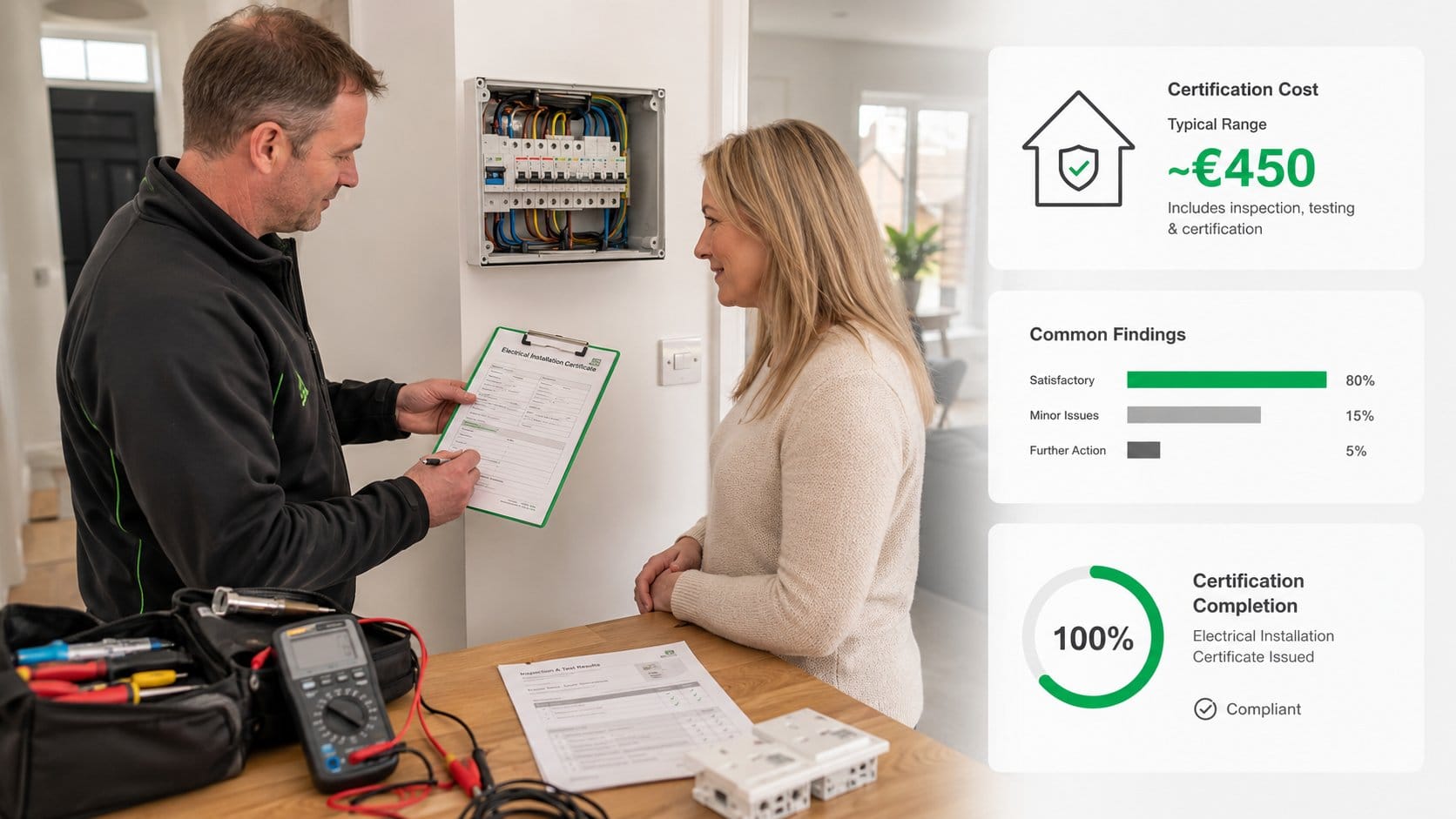
A certified electrician should test the installation during and after the job, then issue a Completion Certificate if the work qualifies. Irish government guidance says Safe Electric registration requires the application, recognised electrical qualifications, proof of the Verification and Certification of Electrical Installations course, insurance documents, and a €75 application fee. The homeowner does not file that paperwork, but it shows why the certificate belongs with the registered contractor, not with the person doing a quick cash job.
The consumer unit matters as well. A modern board with RCD or RCBO protection is a different standard from the old fuse board still found in many older homes. In a full rewire, that upgrade is often included because it brings the installation to a point where it can be checked, tested, and certified properly.
The question is not only about who is cheapest. It is whether you are buying a full, certifiable electrical job or a narrow repair that leaves the rest of the system untouched. That is why the shortlist matters. The safe starting point is still the register check and a clear answer on when the certificate will be issued.