For a homeowner facing a burning smell at a socket, a scorched faceplate or a consumer unit that will not stay on, the emergency electrician call-out in Ireland begins long before the van arrives. The first minutes are about making the installation safe, the next decision is whether the fault belongs to the home or to the electricity network, and only then does it make sense to ring a contractor. This guide covers what genuinely counts as an emergency, who to contact first, what an out-of-hours visit involves, how call-out charges work, and how to check that the person attending is registered.
What counts as a true electrical emergency
Most domestic electrical faults are inconvenient rather than dangerous, and treating every one of them as an emergency simply costs more than it needs to.
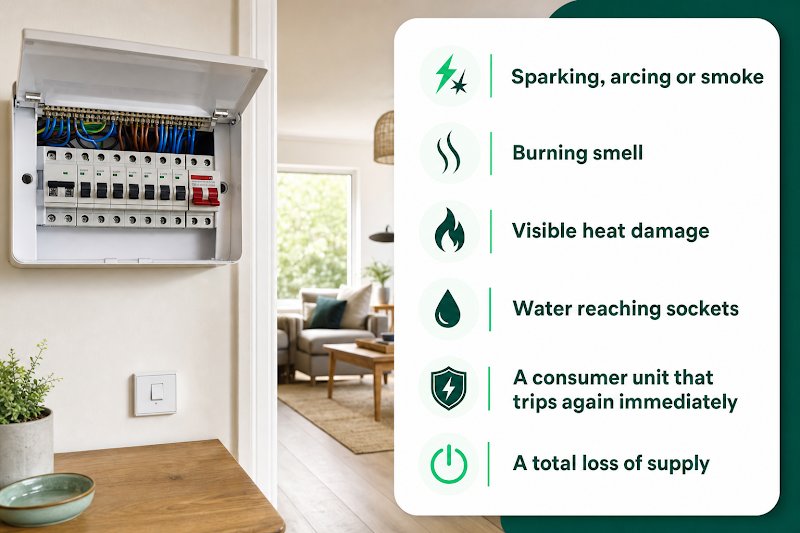
Genuine emergencies include:
- Sparking, arcing or smoke at a socket, switch, light fitting or the consumer unit.
- A burning smell with no obvious source, particularly near the board or an appliance still plugged in.
- Visible heat damage: scorch marks, brown staining around a faceplate, a plug too hot to touch, a melted cable.
- Water reaching sockets, cables or the consumer unit after a burst pipe, a leak or flooding.
- Exposed or damaged conductors after a cable strike, storm damage or a drill through a wall.
- A consumer unit that trips again immediately after one reset attempt.
- A total loss of supply in the home while the main switch is still on.
Not emergencies in the ordinary sense: a single dead socket in an otherwise working house, one light fitting that has stopped working, an appliance that no longer heats, or a circuit that holds perfectly once the faulty appliance has been unplugged. These are jobs for a normal appointment at a normal rate.
The first minutes: safety steps before anyone arrives
These steps reduce harm. They do not fix anything.
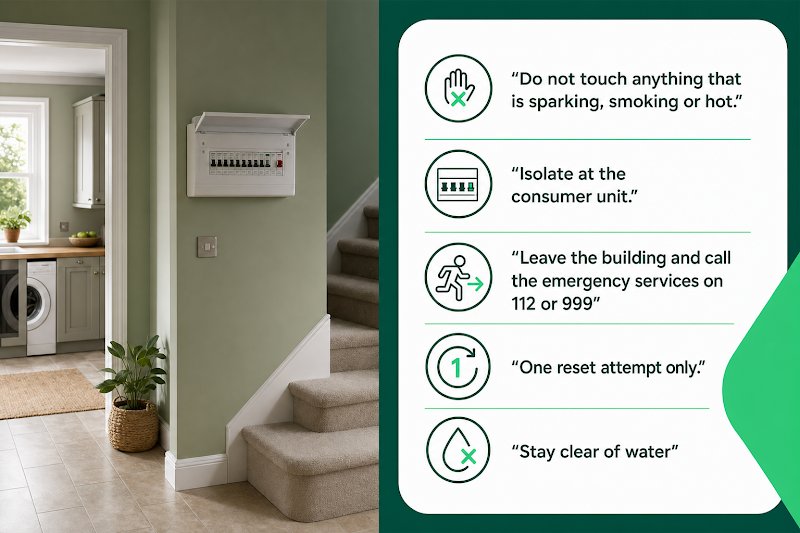
- Do not touch anything that is sparking, smoking or hot. Pulling a plug from a socket that is already arcing can make matters worse.
- Isolate at the consumer unit. Switch off the main switch, then the individual breakers. Where only one circuit is affected, switching off that breaker alone may be enough to make the rest of the home safe.
- Unplug the suspect appliance, but only after switching it off at the socket, with dry hands, and only if it can be reached safely.
- If there is smoke or flame, leave the building and call the emergency services on 112 or 999. Water should never be used on an electrical fire.
- One reset attempt only. If a breaker trips the moment it is switched back on, leave it off.
- Stay clear of water that has reached sockets or the board.
- Keep the route to the consumer unit and the meter cabinet clear so whoever attends can work.
Once the immediate danger has been dealt with and the repair can be booked in the ordinary way, homeowners can find registered electricians and post the job, describing the fault, what was switched on at the time and whether the board resets.
Fallen wires and network damage: do not approach
Any downed, sagging or damaged wire, or a damaged pole, should be treated as live. A member of the public should not approach or touch a fallen electricity wire, and should call the ESB Networks emergency service immediately on 1800 372 999, or the emergency services on 112 or 999 (Government of Ireland). Children and pets should be kept indoors and well back until the network operator has made the area safe.
Home fault or network fault: who to ring first
This single decision saves more time than anything else in the process. ESB Networks operates and maintains the electricity network, and is the body to contact about connecting to the grid for the first time or disconnecting completely (Citizens Information).
- If neighbouring homes are also dark, the problem is likely on the distribution network rather than inside the house. That is a call for ESB Networks, not an electrician.
- If the neighbours have power and the home does not, the fault is more likely at the meter position, the main fuse or inside the consumer unit.
- A homeowner should never pull or interfere with the ESB main fuse. It is sealed and belongs to the network operator.
- If the main switch is on and there is still no supply, ring ESB Networks first.
- If the board is tripping, warm, burnt or noisy, that is a job for a registered electrician.
When an electrician is the right call
An electrician is the correct route when the fault sits inside the installation: a burning smell traced to a circuit, a board that will not reset, storm damage to domestic wiring, a scorched socket, or earlier work that no longer looks safe. The same applies when the home still has power but something has changed, such as flickering across several rooms at once, lights that dim when an appliance starts, or a faint buzzing from the board. Those point to a loose connection or a failing protective device rather than a faulty lamp.
Registration: the one check that matters most
It is a legal requirement for electrical contractors undertaking electrical works in a domestic setting, excluding minor electrical works, to be registered with the Electrical Safety Supervisory Body (Government of Ireland). Urgent making-safe work and permanent repairs to a domestic installation fall squarely inside that requirement, so the registration number should be requested when booking, not on arrival.
Registration is not a formality. A robust and fit-for-purpose electrical safety regime exists to protect lives and property, and the activities relating to electrical safety are set out on the CRU website (Government of Ireland). The Commission for Regulation of Utilities is the statutory body responsible for regulation of the energy and water sector in Ireland (Citizens Information), which is where unresolved issues about supply ultimately sit.
A practical checking sequence:
- Ask for the registration number when booking the call-out.
- Check that number against the public Safe Electric register before agreeing to any work.
- Confirm in whose name the completion certification will be issued.
- Treat a logo on a van as no evidence on its own. The register entry is what counts.
- Keep the invoice and any certificate together, since they are usually needed at the same time, whether on a sale, an insurance claim or a rental inspection.
What an out-of-hours call-out actually involves
An emergency visit is not a daytime appointment, and knowing the sequence helps a homeowner judge what is being paid for.
- Triage by phone. The contractor asks what happened, what is still switched on, whether the board resets, whether anyone is at risk and where the property is.
- Attendance and testing. The van arrives with test equipment such as a multimeter and insulation resistance, RCD and loop impedance testers. The electrician isolates, tests to find the fault and identifies the circuit or accessory responsible.
- Make safe, then repair. The priority is removing the danger. A permanent repair may need a part that is not carried on the van, in which case the circuit is left isolated and a return visit is arranged. That is normal.
- Documentation. An invoice should be expected and, where the work involves the installation itself, the relevant certification from the registered contractor.
Whether a call-out fee includes the repair depends on the fault. Diagnosis and making safe are normally part of the visit; the permanent fix may not be, especially where parts or further access are needed. Timing drives cost, because evenings, weekends, public holidays and late-night calls all fall outside normal working hours.
How quickly a call-out can realistically be arranged
No single response time applies across the country, but the factors that shape it are predictable:
- Location. Urban areas with many contractors working nearby generally attract a faster response than rural areas, where travel time alone can add an hour or more.
- Time of day. A weekday morning call is easier to fill than a Sunday night or a public holiday, when fewer contractors are on rota.
- Weather events. A storm that damages a whole county stretches everyone at once, because the same crews are dealing with many properties.
- Access. A gated property, an apartment block with no parking, or a home where nobody can be present slows attendance.
- How the call is described. A caller who can say whether the board resets, whether neighbours are affected and which appliance was in use helps the contractor decide what to bring and whether to attend immediately.
Where a fault is urgent but not life-threatening, it is worth asking when booking whether the contractor covers that area after hours, what the earliest realistic attendance window is, and whether a second visit is likely if a part has to be ordered.
Emergency call-out charges in Ireland
Nothing below is published by an official body and nothing here is a quote for a particular contractor. It is an aggregate Irish market estimate, offered only as a planning range.
- Weekday, normal hours, first hour: roughly €80 to €150.
- Evenings and weekends: roughly €150 to €300.
- Late night, public holidays, or remote and island locations: €250 to €400 and above in some cases.
Parts, cable, accessories and any second visit are normally charged on top, and it is worth confirming whether a quoted figure includes travel and VAT, which on repair work in a home is normally the reduced 13.5% rate. Four questions to ask before agreeing to a call-out: what is the call-out charge, what is the hourly rate after the first hour, is travel included, and does the rate change after a certain hour?
If a faulty appliance or product is suspected
Where a fire, scorch or repeated tripping appears to follow one appliance, that product should be taken out of use. Electrical products sold in Ireland and the EU must meet health and safety standards, and products in the relevant voltage range must be compliant and carry a CE mark (Citizens Information). A product that fails those standards, or that has been recalled, can be reported, and the electrician should be told which appliance was in use when the fault first appeared.
What to have ready when the electrician arrives
The Eircode, the MPRN shown on the electricity bill, a short description of what happened and when, whether neighbouring homes lost power at the same time, whether the main switch stays up, and whether the property is rented all save time. If the fault followed a specific event, such as a storm, a leak, a new appliance or drilling into a wall, say so, because that single detail can cut the diagnosis in half.
Planning ahead, before anything goes wrong
Most of the stress in an electrical emergency comes from not knowing where the consumer unit is or who to ring. That can be removed in advance: find the consumer unit, check that every breaker is labelled, keep the bill to hand for the MPRN, and save the ESB Networks emergency details alongside the contact details of a registered contractor.
For planned work such as additional sockets, a rewire, outdoor supplies or a board upgrade, and for anything that runs into wider construction and renovation work, find tradespeople and post a task, the job is easier to price when it is described in full rather than raised as an emergency. Where a grant may be available for a planned upgrade, SEAI is the body to check with directly.
A short note on the platform itself: how ShamFix connects Irish homeowners with local providers is straightforward. A customer posts a task describing the job, the area and the timing, then receives responses from local providers, and a tradesperson or company can register as a provider, list the services they cover and respond to tasks in their area. Listing on ShamFix is free and there''s no commission; a subscription is planned for the future. ShamFix does not vet or verify providers and profiles are self-filled, so homeowners should check registrations themselves, Safe Electric for electrical work, and read reviews before booking.
FAQ
Is a power cut an emergency electrician call-out?
Usually not. Where several homes in the area are dark at the same time, the fault is most likely on the distribution network, which is a matter for ESB Networks rather than a contractor. An electrician is the right call when neighbours have power and the fault sits inside the home, or when there is sparking, smoke or a burning smell.
Can a homeowner reset the consumer unit?
Switching a breaker back on once is reasonable if it is safe to reach and nothing is sparking, smoking or hot. If it trips again immediately, leave it off and call a registered electrician. Repeated resetting into a live fault is how overheating starts.
What registration should be checked before work starts?
Electrical contractors carrying out electrical works in a domestic setting, excluding minor electrical works, must be registered with the Electrical Safety Supervisory Body (Government of Ireland). Request the registration number when booking and check it against the public Safe Electric register.
How much does an emergency call-out cost in Ireland?
As an aggregate Irish market estimate rather than an official figure, first-hour weekday call-outs commonly fall in the €80 to €150 range, evenings and weekends in the €150 to €300 range, with late-night, public holiday or remote visits higher again. Parts and any second visit are usually charged on top.
What should be done first if a socket is sparking?
Keep away from it, switch off the circuit at the consumer unit only if it can be reached safely, and leave the building if there is smoke or flame. Water should never be used on an electrical fire, and the fault should be handled by a registered electrician rather than reset repeatedly.