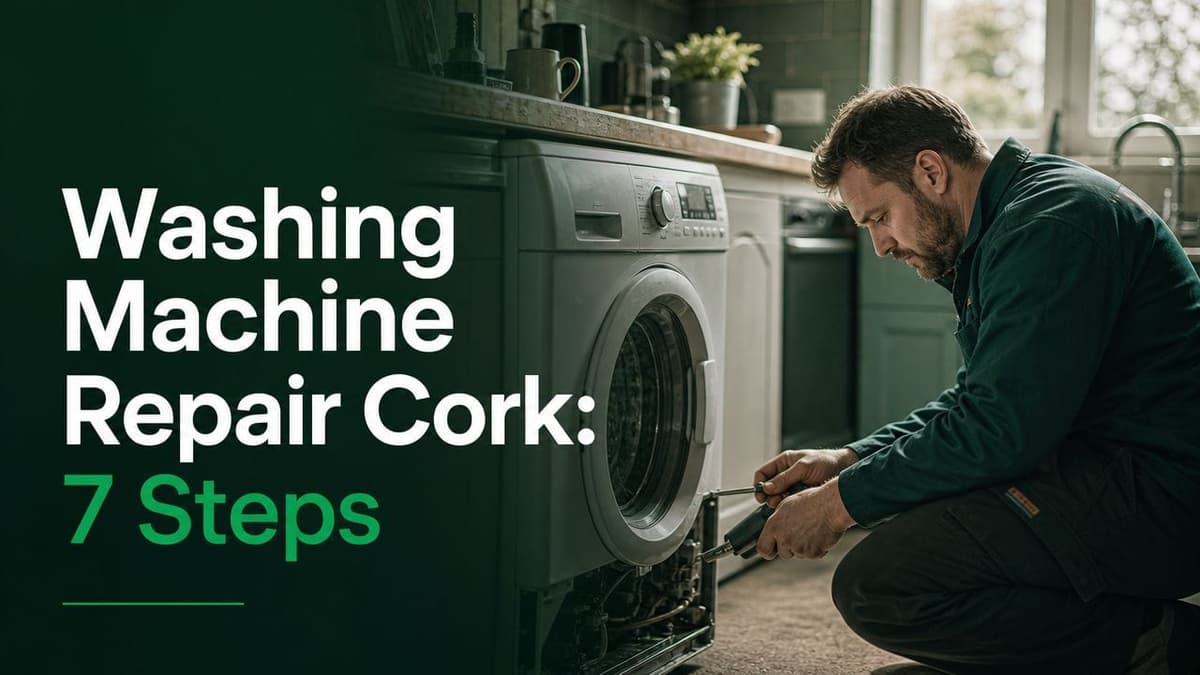
A washing machine that won't drain, leaks at the door, or gets loud on spin usually needs a diagnosis, not a guess. In Ireland, 132,767 white-goods repair requests were completed in 2020, and about 95% of requests ended in a repair rather than replacement, so the fastest route is usually to identify the symptom, isolate any safety issue, and ask for a quote that separates diagnosis, labour, parts and VAT.
For washing machine repair Cork searches, the practical question is simple. What should a homeowner check first, what faults are usually worth repairing, and what should be asked before booking anyone? This guide uses general Republic of Ireland guidance to help Cork homeowners make a clear repair decision without turning the process into a sales pitch. If the machine is leaking or dead, start with the category page for household appliance repair on ShamFix. ShamFix publishes this guide.
1. Make the Machine Safe First
If the washing machine is leaking, smoking, tripping power, or making a severe grinding noise, the first step is safety. Switch the machine off, unplug it if safe to do so, and turn off the water supply. A wet floor around a live appliance is not a fault-finding exercise for a homeowner.
If there is a visible leak, place towels or a shallow tray under the front edge and take a quick photo before drying everything. That photo can help later if the leak only appears during fill, wash, or spin. If the machine has stopped mid-cycle with water in the drum, avoid forcing the door open until the power is isolated and the issue is clearer.
Practical rule: the first job is always to make the area safe, not to restart the cycle and hope the fault disappears.
A quick reset can occasionally clear a control glitch, but repeated restarting usually gives less information, not more. Once the machine is safe, the next step is to identify the symptom properly.
2. Identify the Symptom Clearly
A good repair decision starts with a clear description. "It's broken" is not enough. A better description sounds like this: the machine fills but will not spin, it drains slowly and shows an error, it leaks from the door on wash, or it makes a banging noise only at high speed.
The most useful details to record are:
the make and model
the exact symptom
any error code on the display
whether the fault happens during fill, wash, drain, heat, or spin
whether the issue is new, intermittent, or getting worse
This matters because different symptoms point to very different causes. A machine that will not drain may have a blocked filter, pump problem, or drainage issue. A machine that is noisy on spin may have a load-balance problem, worn shock absorbers, or drum bearings. A machine that leaks at the front may point to the door seal, while a leak underneath can suggest hoses, pump housing, or internal connections.
The clearer the description, the easier it is to get a useful quote and avoid a wasted first visit.
3. Check the Most Common Simple Causes
Before booking a repair, it makes sense to rule out the most basic homeowner-level issues. That does not mean taking the machine apart. It means checking the obvious things that often cause call-outs.
Start with the filter if the machine is not draining properly, but only if the manufacturer instructions allow safe access. A blocked filter can cause slow draining, poor spin performance, or a complete stop before the cycle ends. Check the drain hose for kinks, and make sure the waste connection is not blocked.
If the machine smells bad or leaves residue, the fault may be maintenance-related rather than mechanical. A detergent drawer blocked with old soap, a dirty door seal, or repeated low-temperature washing can all cause performance complaints that feel like a breakdown.
If the machine is banging loudly, check whether it is level and whether the load inside is badly unbalanced. A single heavy item can cause violent movement that looks like a serious fault. If the machine is leaking from the front, inspect the visible part of the door seal for tears, trapped objects, or heavy buildup.
The right homeowner check is simple and external. If the next step requires removing panels or exposing electrics, it is no longer a homeowner check.
Do one controlled test cycle before booking
After the external checks in section 3, the most useful next step is often one short empty test cycle. A drain-only, rinse-and-spin, or the shortest wash available is usually enough. Stay nearby and note four points: does the machine take in water, turn the drum, drain out, and build up to spin? Stop at once if there is fresh leaking, tripping power, smoke, or a harsh grinding sound.
The aim is not to fix the machine by trial and error. The aim is to replace “the washing machine is broken” with something more exact. A note such as “fills and tumbles, but stops with water left in the drum” or “drains fully, then bangs and never reaches spin speed” gives a far better starting point for diagnosis. If the problem appears only on a full wash but not on a rinse or spin cycle, that detail is useful too.
One observed cycle is usually enough. Repeating restarts can make a leak worse and can blur the fault pattern if the problem is intermittent. A single controlled test, plus a photo of any error code or where water shows up, is often the clearest information a homeowner can give before deciding whether a repair is worthwhile.
4. Decide if the Fault is Usually Repairable
Many washing machine faults are still repair-first problems. Blocked pumps, door-lock issues, worn belts, damaged door seals, drainage faults and some heating issues are often worth diagnosing because the machine may have plenty of life left.
Other faults need a more careful cost decision. Drum bearings, control boards, motors and major electrical issues can still be repaired, but the quote needs to be weighed against the age and value of the machine. A budget machine near the end of its expected life is different from a better-built model with years of otherwise solid use behind it.
A sensible repair decision usually depends on five things:
This is where homeowners often make the wrong call. They focus only on whether the machine can be repaired, when the better question is whether it should be repaired at that price. A clear diagnosis matters more than optimism.
5. Understand Typical Repair Costs in Ireland
For a Cork homeowner, the useful pricing question is not "what does repair cost?" but "what is included in the quote?" Appliance repair prices can vary by area, urgency, fault type and parts availability.
A written quote should separate:
In Ireland, repair of movable goods is subject to 13.5% VAT, so the quote should make clear whether VAT is already included. The cheapest headline number is often the least useful if it hides call-out charges, excludes parts, or turns into a second invoice once the machine is opened.
Urgent faults, unusual parts, and older models can all push repair costs higher. That does not automatically make repair poor value, but it does mean the homeowner should compare the full repair figure against the cost of a reasonable replacement rather than against wishful thinking.
Need a starting point before ringing around? Find local pros Ireland and use the business pages to compare the repair route against replacement.
What to send with the booking request
A repair booking is easier to handle when the first message includes the right evidence, not just the right words. The most useful items are a photo of the rating plate or model label, a photo of the display if there is an error code, and a photo of the area where water appears if the machine is leaking. If the fault is a noise on drain or spin, a short video can help if it is safe to record one.
A simple format works well:
- make and model
- approximate age of the machine
- exact symptom in one sentence
- the stage where it fails: fill, wash, drain, heat or spin
- whether water is left in the drum
- whether the fault is constant or intermittent
- photos or video attached
It also helps to mention anything that could affect the visit itself, such as a built-in machine under a worktop or awkward access.
This does more than tidy up the enquiry. It helps a repairer judge whether the first visit is likely to be diagnosis-only, whether extra time may be needed, and whether the symptoms already point to a straightforward repair or a likely parts-order job. For the homeowner, it means fewer vague replies and less chance of a wasted trip caused by missing model details or an unclear fault description.
6. Ask Better Questions Before Booking
The quality of a repair booking often depends on the questions asked before anyone arrives. A good phone call or enquiry message should establish whether the first visit is a diagnosis appointment, a likely repair visit, or simply a call-out.
Useful questions include:
Is there a separate diagnosis fee?
Is the call-out charge included in the repair price?
Does the quote include VAT?
What happens if the machine is beyond economic repair?
Will there be a second visit if parts are needed?
Can the provider estimate whether the fault sounds like pump, seal, board, bearing, or heating trouble?
Is the machine likely to be worth repairing based on its age and symptom?
These questions matter because they force clarity early. They also make it easier to compare one option with another without getting distracted by vague promises of cheap repair.
For readers comparing Cork options, ShamFix Insights is the right place to cross-check the broader repair process and keep the booking decision grounded in practical terms.
7. Compare Quotes the Right Way
A washing machine repair quote is only useful if it is comparable. Homeowners often compare a low call-out number from one provider with an all-in estimate from another, which is not a real comparison.
The right way to compare quotes is to check:
what the first visit includes
whether the provider has the model details already
whether likely parts are available
whether labour is capped or open-ended
whether VAT is included
whether the quote explains the next step if repair is not economical
A clear quote protects both sides. It gives the homeowner a realistic decision point and reduces the chance of confusion once the machine is dismantled. This is especially important with faults that may branch in more than one direction, such as poor spin, intermittent power loss, or heating problems.
The best repair booking is not the fastest yes. It is the clearest explanation of what happens next.
When the time comes to compare home-service booking methods, learn how ShamFix works gives a clean view of how local enquiries are routed without turning the platform into a quality guarantee.
The smartest booking sequence is simple. Switch off the machine and water supply where appropriate, then record the make, model and exact symptom. Photograph leaks, error displays and any visible damage, because a clear picture usually saves one wasted visit and helps the technician bring the right parts.
A homeowner should ask for a written quote that separates diagnosis, labour, parts and VAT. In Ireland, repair of movable goods is subject to 13.5% VAT, so the price conversation has to make clear whether VAT is already included. The cheap quote is often the one that leaves something out, especially access issues, making good or a second visit.
The repair-versus-replace decision should be driven by the fault, not by panic. A blocked pump, door seal or simple drainage issue is usually a repair-first conversation. Worn drum bearings, a failed control board or a heating fault can still be repaired, but the quote has to be weighed against the machine's age and the cost of a comparable replacement. Irish consumer law also matters here, because for faulty goods the trader must carry out repair or replacement free of charge, within a reasonable time and without significant inconvenience, and the CCPC says consumers can often choose repair or replacement after the first 30 days if the fault is reported later than that.
Before any booking, the homeowner should also ask what happens if the machine is beyond economic repair. That question stops the conversation drifting into vague promises. It also forces the provider to say whether they can source parts, whether a replacement is available, and whether the first visit is really a diagnosis appointment or just a call-out.
For Cork homeowners, the best outcome is a clean decision, not a rushed one. Use the provider pages above to narrow the field, then insist on a clear scope before anyone turns up.
Are you an appliance repair provider in Cork or elsewhere in Ireland?
Appliance repair providers across Ireland can list on ShamFix with 0% commission and no per-lead credit fees. It's a subscription-based marketplace built to help local services get found as demand grows, without taking a cut of each job. Current listing terms are at ShamFix for tradesmen.