A DIY inkjet refill kit costs roughly €10 to €25 for several refills, while a new branded inkjet cartridge typically costs about €15 to €40. A professional refill is usually cheaper than buying a new branded cartridge, although Irish refill-service prices aren't widely published and depend on the cartridge and work required.
The familiar problem is simple. A printer runs out of ink just before an important form, school project or invoice is needed, and the replacement cartridge costs almost as much as the printer seemed to cost. Refilling can reduce the spend, but the cheapest sticker price doesn't always produce the lowest usable cost.
This guide compares DIY refill kits, compatible cartridges, remanufactured cartridges and new OEM replacements for home and small-office printers in the Republic of Ireland. It also covers print quality, cartridge chips, cleaning, warranty risks, disposal and the questions to ask before handing a cartridge to a local service.
For Irish printer-consumables context, current Irish price listings show entry-level items from €2.90, while Canon cartridges listed in Ireland include prices of €10.49, €15.49, €19.49, €20.99, €26.99 and €33.99. That spread explains why refilling or choosing a compatible cartridge can be attractive.
If a local service is the practical choice, post your job to get quotes from local refill providers, and ask each provider whether cleaning, testing and chip handling are included.
Printer Cartridge Options and Costs in Ireland at a Glance
The table below gives an indicative Irish comparison, not a fixed national tariff. Retail prices move by printer model, cartridge capacity and whether the product is standard or high yield. Professional refill pricing is less consistently published, so it should be confirmed directly before the work starts.
| Cartridge option | Typical inkjet cost | Typical laser toner cost |
|---|---|---|
| DIY refill kit | €10 to €25 for several refills | Usually not a simple home refill |
| Compatible cartridge | €5 to €15 | €25 to €50 |
| Remanufactured cartridge | Often similar to compatible pricing, depending on model | €25 to €50 |
| New OEM cartridge | €15 to €40 | €60 to €120 |
| Professional refill service | Indicative, generally below a new OEM inkjet cartridge | Usually higher than a basic inkjet refill because toner cartridges may need remanufacturing |
The OEM, or original equipment manufacturer, cartridge is made for the printer brand. It usually offers the most predictable recognition and colour profile, but it can carry the highest purchase price. A compatible cartridge is newly manufactured by another supplier for the printer model. A remanufactured cartridge starts with a used cartridge that has been cleaned, refilled and, where necessary, fitted with replacement components.
Irish listings show how widely prices can vary. Irish refill listings include compatible ink cartridges from €15.00 to €29.95, while remanufactured toner can reach €165.99. Those figures don't replace the indicative comparison above, but they show why cartridge type and capacity must be checked before assuming a refill will be cheap.
Retail goods such as cartridges and ink include VAT at the standard 23% rate. Buyers should still check whether any quoted service price includes VAT, especially when a business separates labour from parts.
Key Factors That Determine Your Refill Cost
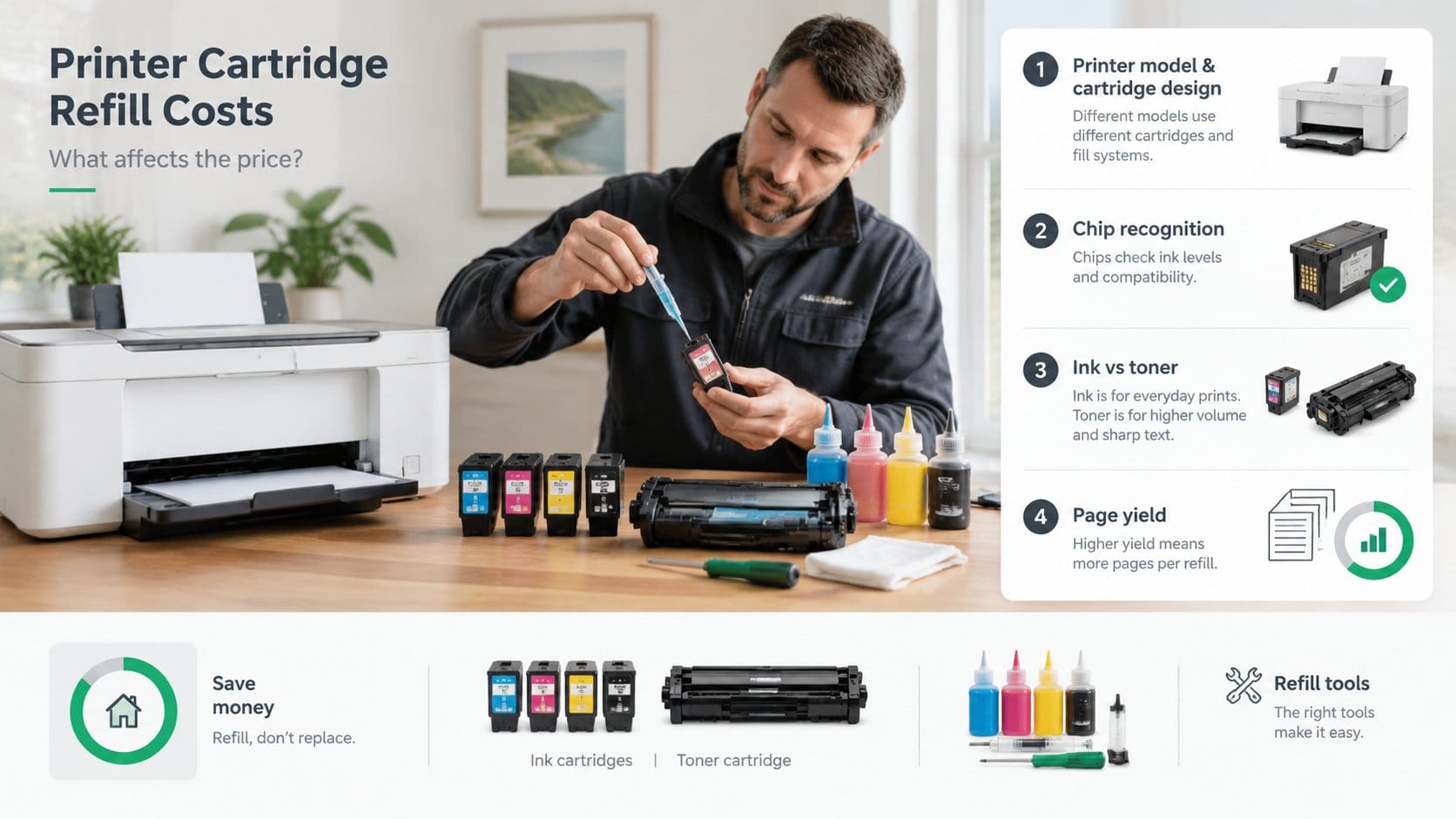
The printer's cartridge architecture matters more than the word “refill”. Two cartridges that look similar can require very different handling, ink formulations and testing.
Printer model and cartridge design
Many cartridge-style HP and Canon inkjet cartridges combine the ink reservoir with an integrated print-head. That makes a refill more sensitive to dried ink, blocked nozzles and poor sealing. A tank printer, such as an Epson EcoTank design, uses separate refill bottles and is built around a different ink-delivery system.
Irish retail listings illustrate the effect. Epson EcoTank black refill bottles appear at about €18.99 to €20.66, while a cartridge-style HP 305XL black item is listed at €32.99 on Elara's Irish Epson store pages. The comparison isn't a promise that every tank printer is cheaper, but it shows how printer design drives ongoing consumable cost.
Chips and recognition
Many cartridges contain a microchip that records usage or reports an empty status to the printer. Refilling the physical reservoir may not reset that status. A provider may therefore need to reset or replace the chip before the printer recognises the cartridge again.
That extra work increases the chance that a professional refill will cost more than adding ink alone. It also explains why a cartridge that appears full can still display an empty or incompatible warning.
Ink versus toner
Inkjet refilling normally means adding liquid ink and checking the cartridge. Laser toner is a powder, and a proper remanufacture may also involve cleaning internal parts, replacing a drum or dealing with a chip. Toner should therefore be treated as a remanufacturing job, not as a straightforward top-up.
Volume and yield
A standard cartridge, XL cartridge, bottled-ink system and high-yield toner can all produce different page volumes. The right comparison is cost per usable page, not the price of the bottle or cartridge.
Practical rule: compare the expected yield of the exact model, then add the cost of failed prints, cleaning cycles and any replacement cartridge needed if the refill isn't recognised.
DIY Refill Kits versus Professional Refill Services
DIY refilling has the lowest upfront barrier for many inkjet owners. Irish listings show refill kits around €12.95 to €13.95 on Inkshop's Irish refill-kit pages, and the broader indicative range is approximately €10 to €25 for kits intended to provide several refills.
The financial appeal is obvious, especially when the kit costs less than one new OEM cartridge. The process can still involve gloves, syringes, careful filling, sealing and printer cleaning. A spill inside the printer can turn a small consumable saving into a repair problem.
DIY kits suit some printers
DIY is more reasonable where the cartridge is easy to access, the correct ink type is clearly identified and the printer is older or outside its warranty period. It also suits an owner who prints frequently enough to use the kit before the ink degrades or the cartridge seals fail.
The main risks are overfilling, leaks, incorrect ink chemistry, blocked nozzles and poor colour balance. A cartridge can look full while producing streaks or missing colours because the print-head is damaged or clogged.
Professional handling reduces practical hassle
A good refill or remanufacture should include:
- Cleaning: removing residue and checking the cartridge before filling.
- Correct formulation: using ink or toner suitable for the exact printer model.
- Testing: producing a test print to confirm that the cartridge feeds and prints properly.
- Chip work: resetting or replacing the chip where the model requires it.
A professional service normally costs more than a DIY kit because it includes handling, equipment, testing and the risk of dealing with a failed cartridge. The exact refill tariff should be requested in advance, as Irish providers don't publish one consistent national price.
The cheapest option isn't automatically the best option. For a rarely used printer, the time spent troubleshooting a failed refill may outweigh the saving. For a small office printing regularly, a successful refill or compatible cartridge can make the cost per page much more attractive.
The Hidden Costs Quality Warranty and Printer Health
A refill becomes a false economy when it creates a second problem. Poor-quality ink can cause blocked print-heads, leaking cartridges, streaked pages or inaccurate colours. The owner may then spend more on cleaning cycles, replacement cartridges or a printer repair than the original saving.
Integrated print-head cartridges deserve particular care. If the head fails, replacing the cartridge may be the only practical fix. A leaking cartridge can also contaminate the carriage and paper path, making the printer unreliable even after the cartridge is removed.
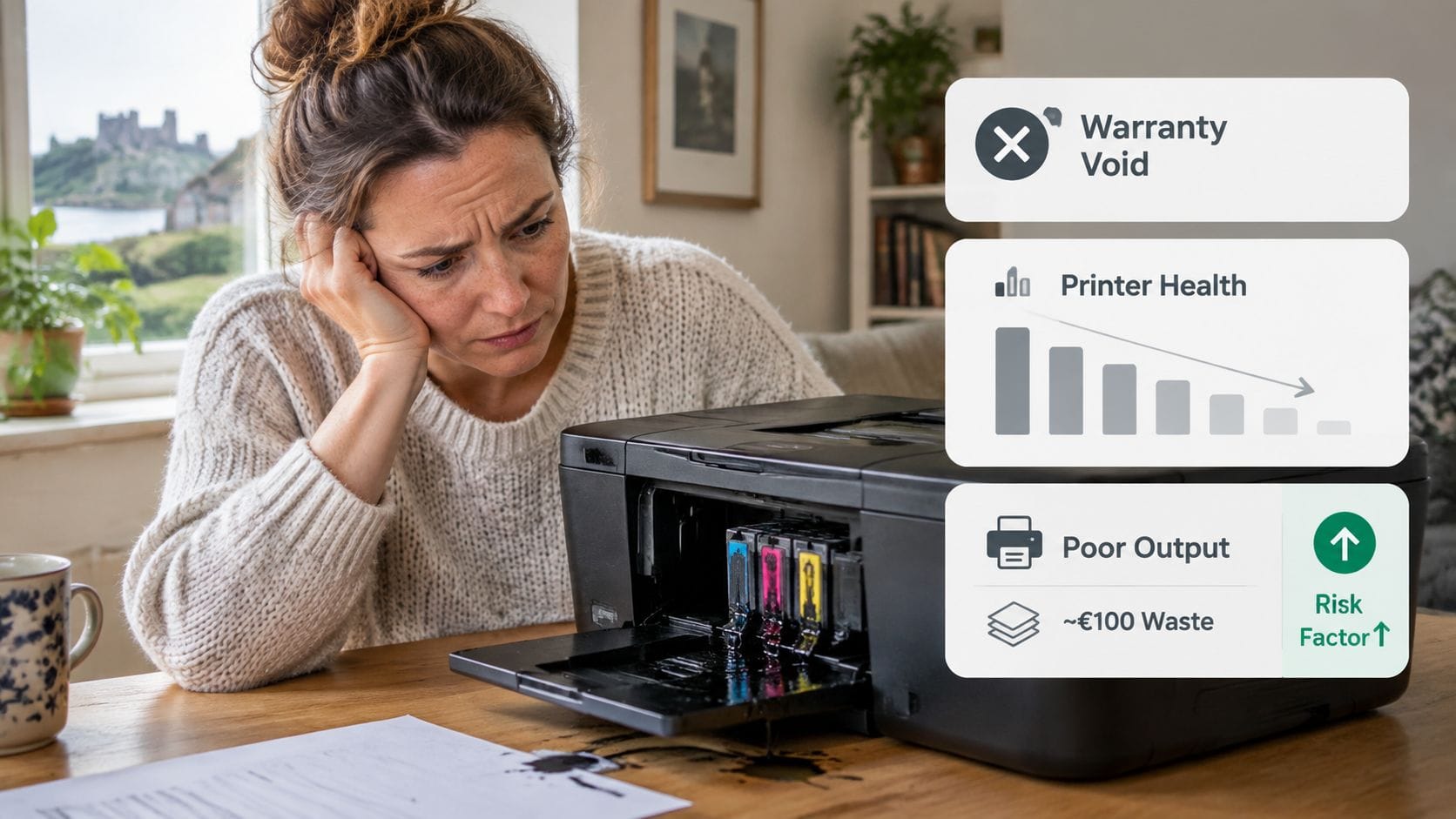
Warranty position matters too. Buyers should check the printer manufacturer's warranty terms before using a refilled or third-party cartridge. A manufacturer may not automatically treat the use of a compatible cartridge as proof that every fault is excluded, but a leak or damage linked to the cartridge can create a dispute.
Questions that expose the real price
Before approving a refill, ask:
- Is the cartridge tested before it leaves the service?
- Does the price include cleaning and a test print?
- Will the chip be reset or replaced if the printer needs it?
- What happens if the printer doesn't recognise the cartridge?
- Is the price inclusive of VAT?
- Does the service accept responsibility for leaks or defective work?
These questions are more useful than asking only for the cheapest refill. A low quote that excludes testing or chip work may not be the lowest finished cost.
Environmental Impact and Disposal Options in Ireland
Refilling keeps a usable cartridge in circulation instead of sending it directly into the waste stream. That benefit depends on the cartridge being suitable for another cycle and the refill being done without creating leaks or defective prints.
Disposal can also have a cost. Kavanagh Recycling & Recovery's Irish charges list a minimum collection fee of €30 when ink or toner cartridges aren't accompanied by IT equipment. The same published charges include €0.50 per small inkjet cartridge and €1 per laser cartridge.
That distinction matters because home refilling and commercial cartridge recovery aren't the same service. A household may be looking for a retail refill, while a business recycler may be collecting and processing waste cartridges under a separate fee structure.
A sensible disposal process is straightforward:
- Keep empty cartridges separate, with caps or packaging where available.
- Ask the refill provider whether the cartridge can be recovered, rather than discarding it immediately.
- Use a permitted waste service for commercial quantities, and confirm the collection terms.
- Avoid placing leaking cartridges loose in household waste, because ink and toner can spread through other materials.
How to Find a Reliable Cartridge Refill Service in Ireland
A local provider should ask for the printer brand, exact model and cartridge number before quoting. A photograph of the cartridge label can prevent a mismatch, particularly where a printer uses separate black and colour cartridges or has standard and XL versions.
The service should explain what the price covers. Cleaning, the correct ink or toner, a test print and chip resetting are the practical details that separate a usable refill from a simple injection of ink.
Check the service before handing over the cartridge
Look for clear answers rather than broad assurances:
- Model compatibility: the provider confirms the exact cartridge reference.
- Quality checks: testing is included or clearly priced.
- Recognition problems: the provider explains its approach to chips and printer warnings.
- Fault handling: the customer knows what happens if the cartridge leaks or fails.
- Reviews: feedback appears genuine and relevant to cartridge work, not merely general computer support.
ShamFix doesn't vet or verify providers, and provider profiles are self-filled. Customers should read reviews, ask direct questions and confirm the full price before accepting the work. The cartridge-refilling service directory can help a homeowner identify local options.
For a high-volume printer, compare the refill price with a compatible cartridge and the printer's cost per page. For occasional printing, reliability and avoiding a blocked print-head may matter more than saving a few euro on the initial cartridge.
Are You a Cartridge Refill Provider in Ireland?
Cartridge-refilling businesses can use ShamFix to present their service to homeowners looking for local help. Profiles should state the printer models handled, whether cleaning and testing are included, and how chip resets or failed cartridges are managed.
Listing on ShamFix is free and there's no commission; a subscription is planned for the future. Providers can create a ShamFix listing and describe their own service clearly, while customers decide which questions to ask before booking.