What Does a Copywriter Do? A Guide for Irish Businesses
A copywriter writes the words that get readers to act: web pages, ads, emails and product copy. See how they work, what to brief and what to check.
/7 min read
A copywriter writes the words that persuade a reader to take a next step: call, book, buy, sign up or simply keep reading. That covers website pages, adverts, emails, product descriptions, brochures, social posts and scripts. The work starts with a brief about the product, the audience and the goal, and ends with copy that fits the space it will appear in, whether that is a two-line Google ad or a full service page. For an Irish small business without the time or confidence to write its own marketing, a freelance copywriter is often the quickest way to turn what the business knows about its customers into words that sell.
What a copywriter does day to day
Most of a copywriter's time goes into three things: understanding the business, understanding the reader, and writing and rewriting until the two meet.
Reading the brief. A good copywriter starts by asking what the copy has to achieve, who will read it and where it will appear. The answers decide the length, tone and structure before a word is written.
Research. That means learning the product or service, looking at what competitors say, reading customer reviews and questions, and picking out the phrases customers use themselves.
Finding the angle. Out of that research comes the one idea the copy is built around: a problem the reader recognises, a benefit that matters, or a reason to choose this business over the next one.
Drafting. First drafts often include several headline options and a couple of different openings, so the client can react to real wording rather than to a description of it.
Revising. Copy is rewritten after feedback, sometimes several times. Cutting words is a large part of the job: most copy gets shorter and sharper with each round.
Working with others. On bigger projects a copywriter works alongside a designer or web developer, because the words have to fit the layout, the buttons and the space on the page.
The main types of copy
Type of copy
Typical examples
What it has to do
Website copy
Home page, service pages, about page
Explain what the business does, for whom, and lead the visitor to get in touch
Advertising copy
Google and social ads, radio scripts, print ads, posters
Catch attention in seconds and earn a click or a call
Email copy
Newsletters, offers, welcome sequences
Get opened, get read and get one clear action
Product and service descriptions
Online shop listings, menus, price lists
Answer buyers' questions and remove doubts
Sales and print material
Brochures, flyers, proposals, case studies
Support a decision that takes longer than one visit
Social media copy
Captions, short posts, profile text
Stay consistent with the brand in a small space
Many freelance copywriters cover most of these. Some specialise, for example in websites for trades and professional services, in email, or in a sector such as hospitality, technology or finance, where knowing the vocabulary saves the client time.
Copywriter, content writer, SEO writer and editor: the differences
The titles overlap, and many writers do more than one of these jobs, but the focus is different.
Copywriter. Writes to persuade and to get an action. The measure of success is enquiries, bookings or sales.
Content writer. Writes to inform and to build trust over time, through blog posts, guides and articles. The measure is usually readership and how well the business is found and remembered.
SEO writer. Writes or adapts pages so they match what people type into search engines, with attention to page titles, headings and the questions a page answers. Much SEO writing is a blend of copy and content.
Editor or proofreader. Improves text someone else has written: structure, clarity, grammar and consistency, rather than writing from scratch.
For a small business, the practical point is to describe the job rather than the title. "Five service pages that bring in more quote requests" tells a writer far more than "need a copywriter".
What to put in a copywriting brief
A clear brief is the single biggest factor in getting usable copy at the first or second draft. It does not need to be long. One page that answers these questions is usually enough:
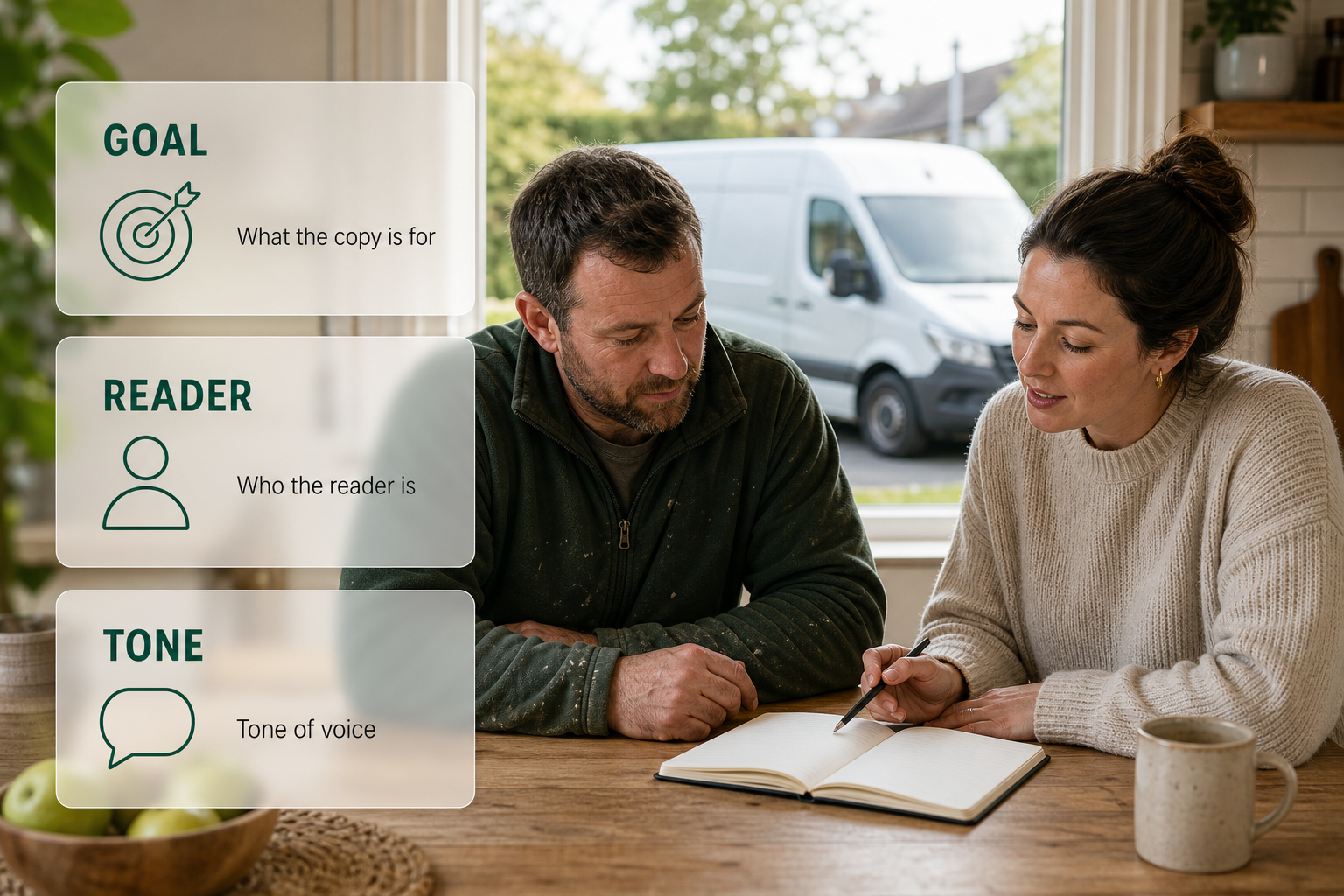
What the copy is for. Which pages, ads or emails, and the one action the reader should take.
Who the reader is. The typical customer, the problem they have when they arrive, and what makes them hesitate.
What the business offers. Services, areas covered, what makes it different, and any proof such as years trading, reviews or examples of past work.
Tone of voice. Two or three words that describe how the business wants to sound, with an example of writing the owner likes and one they do not.
Practical details. Word counts or page layouts, deadlines, who signs off, and any words or claims to avoid.
Existing material. The current website, old brochures, customer emails and frequently asked questions. These are often the richest source of real customer language.
Every claim in the brief should be one the business can stand over. Advertising has to be legal, honest, decent and truthful, and Irish consumer protection law bars false, misleading or deceptive claims about goods or services in any medium, as the Competition and Consumer Protection Commission sets out. A copywriter can make a true claim sound compelling, but cannot make an unsupported one safe.
When it makes sense to hire a copywriter
Writing in-house works well when the owner writes comfortably, knows the customer closely and has the time. Hiring tends to pay off in a few situations:
A new or rebuilt website, where the words decide whether visitors get in touch, and the copy has to be ready before the designer can finish.
Paid advertising, where every click costs money and weak copy wastes the budget.
A launch or a change of direction, such as a new service, a new area or a new type of customer.
When the business is too close to the subject. Owners often describe what they do in their own trade language; an outside writer asks the questions a customer would ask.
Smaller tasks, such as tidying up a single page, writing a few product descriptions or proofreading a brochure, are often handled by a general virtual assistant or writer, and that kind of support sits alongside other virtual assistant services.
Fees vary with the type of copy, the amount of research and the number of revision rounds, so it is worth asking for a written quote per page or per project rather than comparing hourly rates alone.
What to check before hiring a copywriter
Samples in a similar sector or format. Website copy, ad copy and long-form articles are different skills; ask to see work that matches the job.
Their questions. A writer who asks about the customer, the goal and the competition before quoting is usually a writer who will deliver copy that works.
Revision rounds. Confirm how many rounds of changes are included and what happens after that.
Deadlines and process. Agree when the brief, the first draft and the final copy are due, and who gives feedback on the business side.
Ownership and use of the copy. Agree in writing that the business can use, edit and republish the final copy wherever it needs to, and whether the writer may show it in a portfolio.
Original work. Ask for copy written for the business rather than adapted from templates, and check it reads like the business rather than like everyone else in the sector.
FAQ
Does a copywriter also design the page?
Usually not. A copywriter writes the words and may suggest how a page should be structured, but the layout, images and build are the job of a designer or web developer. On website projects the two work best when they are briefed together.
Can a copywriter improve existing text rather than start again?
Yes. Rewriting and editing existing pages is a common job, especially when the business is happy with its website design but the pages are not bringing in enquiries. The brief should say which pages matter most and what is not working.
How long does a copywriting project take?
It depends on the scope and how quickly feedback comes back. A single ad or email can be turned around quickly, while a full website usually runs over a few weeks once research, drafts and revision rounds are allowed for. Agreeing the dates for each stage at the start keeps the project moving.
Does a copywriter need to be based in Ireland?
Not necessarily, but a writer who knows Irish spelling, place names and how Irish customers speak will need fewer corrections. For local service businesses, that familiarity often shows in the finished copy.
Finding a copywriter
Posting a short description of the job, with the brief points above, is the quickest way to get comparable replies from several writers. On ShamFix posting a job and listing is free and there is no commission, and a subscription is planned for the future. ShamFix does not check or certify the people listed and profiles are filled in by them, so look at samples and read reviews before hiring anyone.
Work through safe checks — filter, vent, condenser, settings, power and reset — then book appliance repair or, for fixed wiring faults, an electrician.
11 min read
Next step
Find local help
Browse people offering this work in your county and post a job.