Real banner design prices in Ireland for static, pull-up and animated banners, plus what a quote includes and what pushes the cost up.
/8 min read
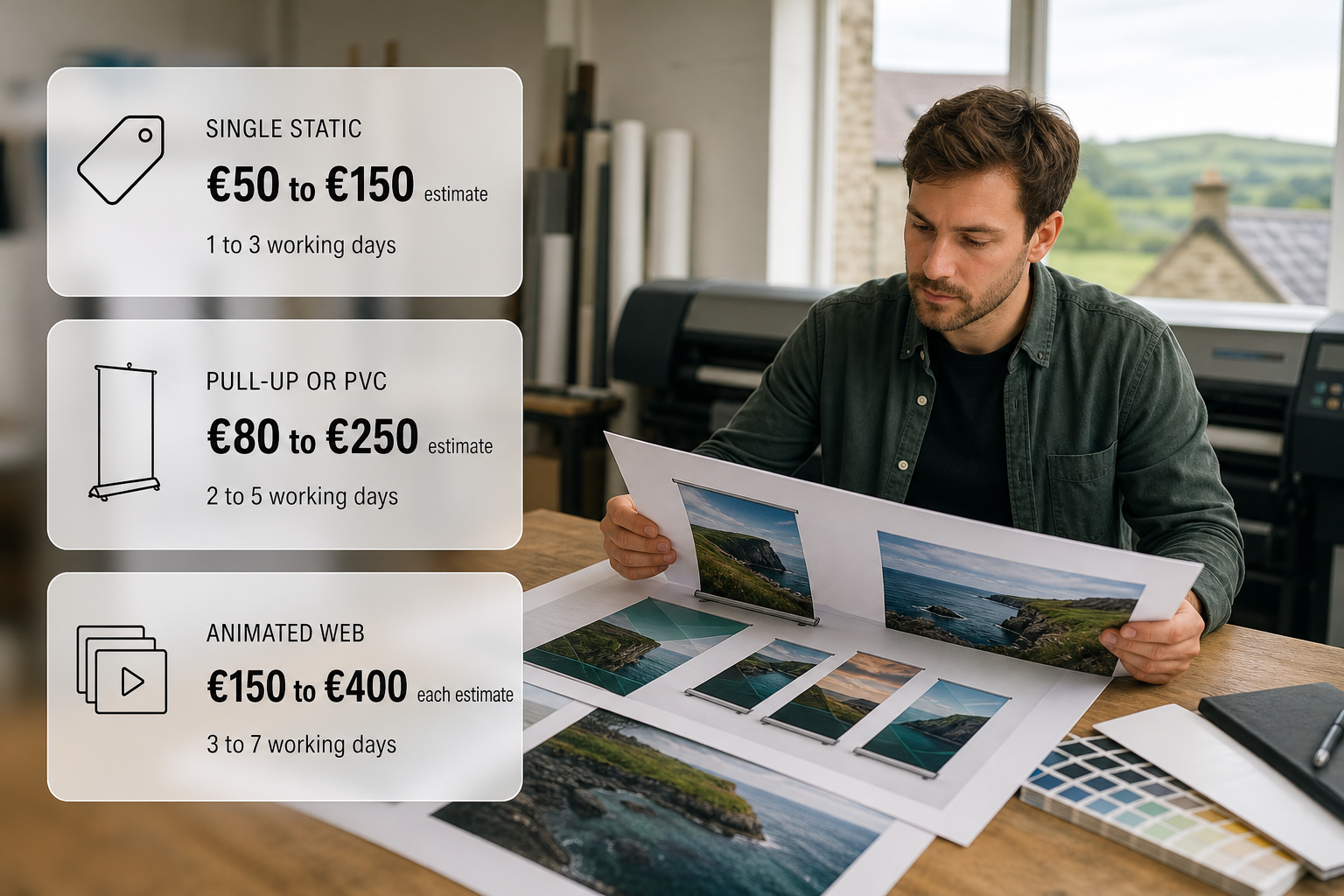
For small businesses, sole traders, clubs, schools and event organisers in Ireland, an aggregate Irish market estimate for banner design is €50 to €150 for a single static web or social media banner, €80 to €250 for pull-up (roller) banner or outdoor PVC banner artwork supplied print-ready, €150 to €400 for each animated web banner, and €300 to €900 for a campaign set of five to ten sizes built from one design, with freelance designers typically charging €35 to €70 an hour for extra work. How many sizes and how many rounds of changes are needed moves the figure far more than the artwork itself, which is why two quotes for the same banner can sit at opposite ends of those bands. A club or shop posting a job for banner design is buying files sized correctly for both the printer and the screen.
What banner design costs in Ireland
The table below is an aggregate Irish market estimate.
Banner type
Typical design price
Typical turnaround
Best for
Single static web or social media banner
€50 to €150
1 to 3 working days
A one-off website, Facebook or Instagram banner
Pull-up (roller) or outdoor PVC banner artwork, print-ready
€80 to €250
2 to 5 working days
Shopfronts, market stalls, match days, school gates
Animated web banner
€150 to €400 each
3 to 7 working days
Website sliders and paid social campaigns
Campaign set of 5 to 10 sizes from one design
€300 to €900
1 to 2 weeks
A launch, a registration drive or a seasonal promotion
Extra work billed hourly (resizing, extra revisions, new copy)
€35 to €70 an hour
By arrangement
Top-ups after the original files have been handed over
The width of each band reflects how much thinking and file preparation sits behind the artwork. A designer who also supplies finished copy sits near the upper end; an organiser who arrives with text, a vector logo and photographs sits near the lower end. If there's no vector logo yet, compare logo design quotes on ShamFix.
What moves a banner design quote
Size and format. A small social media graphic is one file in one shape. A pull-up banner is tall and narrow, and the logo, headline and contact details have to be arranged for someone standing a couple of metres away. Large-format work also means checking how the artwork behaves close to hems and eyelets.
Static or animated. A static banner is a single image. An animated banner is a short sequence: several frames, timing, a loop that ends cleanly, and a version that still reads when animation is not served.
Number of first concepts. One concept is one direction. Two or three concepts mean the designer explores alternatives and presents them for a decision, which takes longer than refining a single idea.
Revision rounds. Most quotes bundle a fixed number of rounds and charge hourly beyond that. A client who changes the headline, the date or the offer after the first draft can use up those rounds quickly.
What the client supplies. Finished text, a vector logo and good photographs remove work from the job, so the quote tends towards the lower end of the band.
Brand guidelines. A business with an existing palette, typefaces and logo rules gives the designer a clear path, but those rules must be followed carefully.
Rush jobs. A deadline inside a couple of days usually means the designer rearranges other work, and that sits at the upper end of the band.
What a normal banner design quote includes
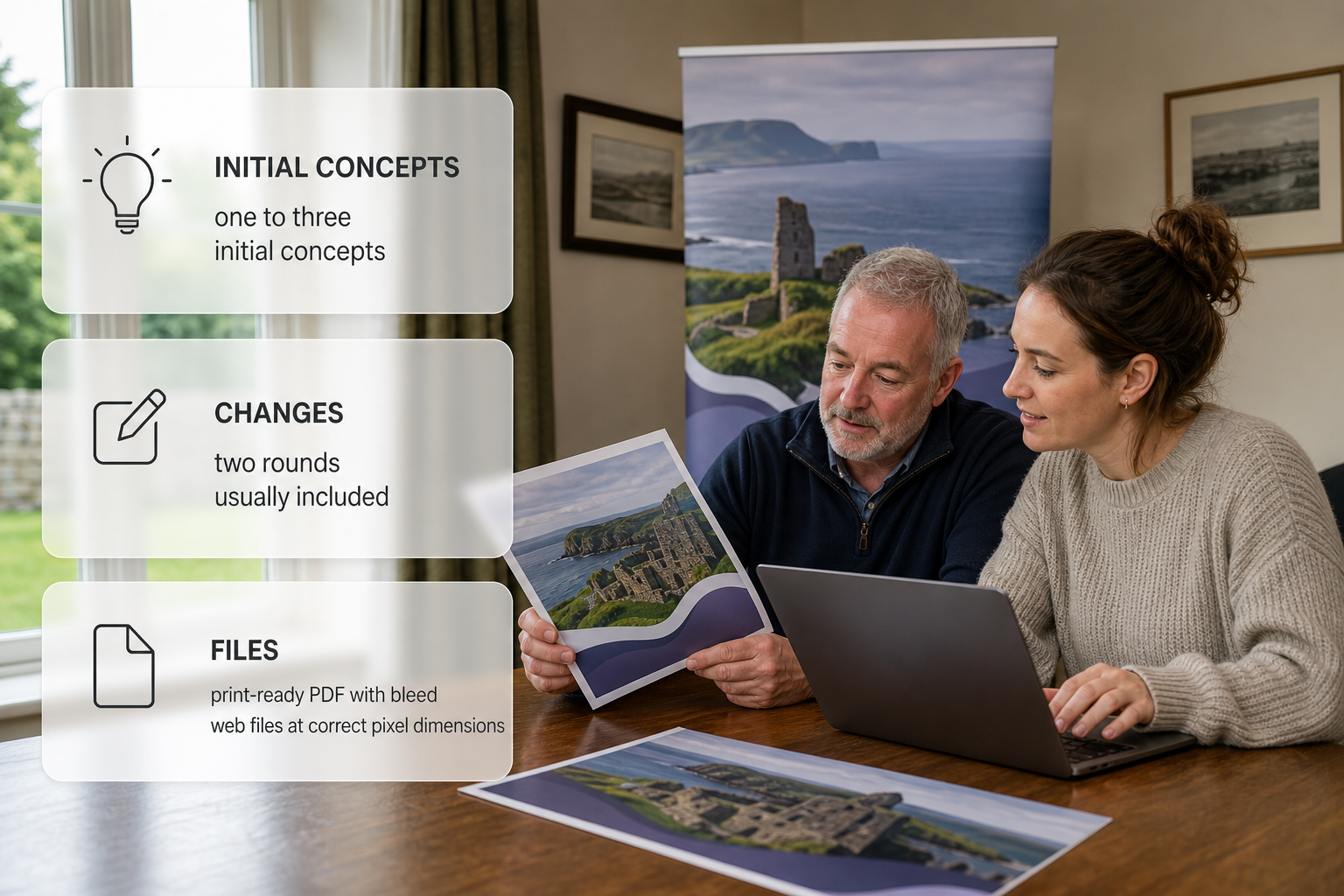
A standard quote for a single banner usually covers one to three initial concepts, two rounds of changes, a print-ready PDF with bleed for the printer, and web files exported at the correct pixel dimensions for each placement. Source files — the layered working documents — are frequently not included and are quoted as a separate line.
Common extras that appear alongside the headline figure:
Extra revision rounds beyond the two usually included
Stock photography or illustration licences
Copywriting, headline writing or proofreading
New logo or brand work
Source and working files
Additional sizes or formats added later in the job
Printing and the physical stand are priced separately by the printer, so a design quote usually does not include either.
Why adapting an existing design costs less
When a business already has a logo file, a colour palette and a banner from a previous year, resizing or reshaping that artwork takes a fraction of the time a new design takes, because the layout decisions are already made. A designer handling design and creative work across print and screen can re-lay an existing layout into a portrait pull-up shape, export the same design at three social media sizes, change a date or a sponsor's logo, or close a gap that was left open last time.
Adaptation is not always possible. Artwork that exists only as a low-resolution JPEG, text that has been flattened into an image, or a file in a format nobody can open often means starting again. A photo of the old banner and whatever files still exist help a designer judge that quickly.
Worked example: one pull-up and three social media sizes
The figures below are an aggregate Irish market estimate.
A local sports club wants one pull-up banner for the gate on match days and three social media sizes from the same campaign: a square post, a portrait story and a wide cover image. The club has its crest as a vector file, the sponsor's logo and its own photographs, so no searching or drawing is needed.
Every figure sits inside the bands in the table above: the pull-up artwork inside €80 to €250, and each social size inside €50 to €150. If the club returns after handover for a fourth size or a rewritten headline, that work is billed at the hourly rate shown in the table. Turnaround for a job of this size is usually about a week, with an extra day or two if the printer's specification arrives late.
Print-ready checklist before files go to the printer
A banner is rarely rejected because of the design. It is rejected because the file is the wrong shape, the wrong colour or too soft to print.
Exact size. Ask the printer for the finished size and its file setup requirements before design work starts. A pull-up has a visible area and a hidden base area, and only the printer can confirm which part is visible.
Bleed and safe margin. Follow the printer's instruction on extra margin, and keep text and logos away from any edge where a hem, eyelet or frame will sit.
Colour mode. CMYK for anything printed, RGB for anything on a screen. If one design is used for both, supply two files.
Resolution. Detail must suit the viewing distance. A file that looks sharp on a laptop can still print soft, so check the image sizes at the final dimensions.
Fonts. Outline or embed typefaces so the printer's software does not substitute a different font.
Proof. Read a printed proof or a scaled PDF page by page before signing off, checking phone numbers, dates and sponsor names.
File format and naming. Supply the format the printer asks for, named clearly with the size, version and date so nobody prints last year's file.
FAQ
Can a business design its own banner and pay only for resizing?
Yes, and many designers quote for a file check or a resize alone rather than a full design. That kind of work is usually billed at the lower end of the hourly band in the table above, and it suits a club that already has artwork it trusts. The risk is a do-it-yourself file built in the wrong colour mode or at screen resolution, which may take longer to repair than to rebuild.
What changes if a banner has to carry both Irish and English text?
Bilingual banners take more space per line, because the Irish wording is often longer than the English version. Both versions are best supplied as final copy before design begins, so the designer can set the layout once. Bringing a translation in at proof stage normally counts as an extra revision round.
How should two banner design quotes be compared?
Compare what sits inside each quote rather than the headline number: how many concepts, how many rounds of changes, how many sizes, which file formats, and whether the source files come with it. A cheaper quote with one concept, one revision and screen-only files can end up dearer once extra rounds and conversions are added. Deadlines and turnaround commitments matter just as much as the figure.
Can one design be reused for a poster, a flyer and a social post?
Often yes, with reformatting. A design built for a tall pull-up will not drop straight into a wide cover image or an A4 poster, because the proportions change and text has to be re-flowed. Reshaping an approved design for several extra sizes is usually quicker than starting fresh, and a job that grows to five or more sizes moves towards the campaign set band in the table above.
Getting quotes for banner design
A brief that saves money names the exact sizes, the deadline, the audience, and what the client will supply: logo files, photographs, finished text and any brand colours. It is worth asking the printer for its specification sheet before briefing a designer, and asking each designer what the quote includes, what counts as an extra, and when the files will arrive. Redoing a job because the size or colour mode was wrong costs more than getting the brief right at the start. For wider print and social artwork, compare graphic design quotes on ShamFix.
Posting a job and listing on ShamFix is free and there is no commission, and a subscription is planned for the future. ShamFix does not check or certify tradespeople and profiles are filled in by tradespeople themselves, so clients should check registrations themselves and read reviews before hiring.
Work through safe checks — filter, vent, condenser, settings, power and reset — then book appliance repair or, for fixed wiring faults, an electrician.
11 min read
Next step
Find local help
Browse people offering this work in your county and post a job.