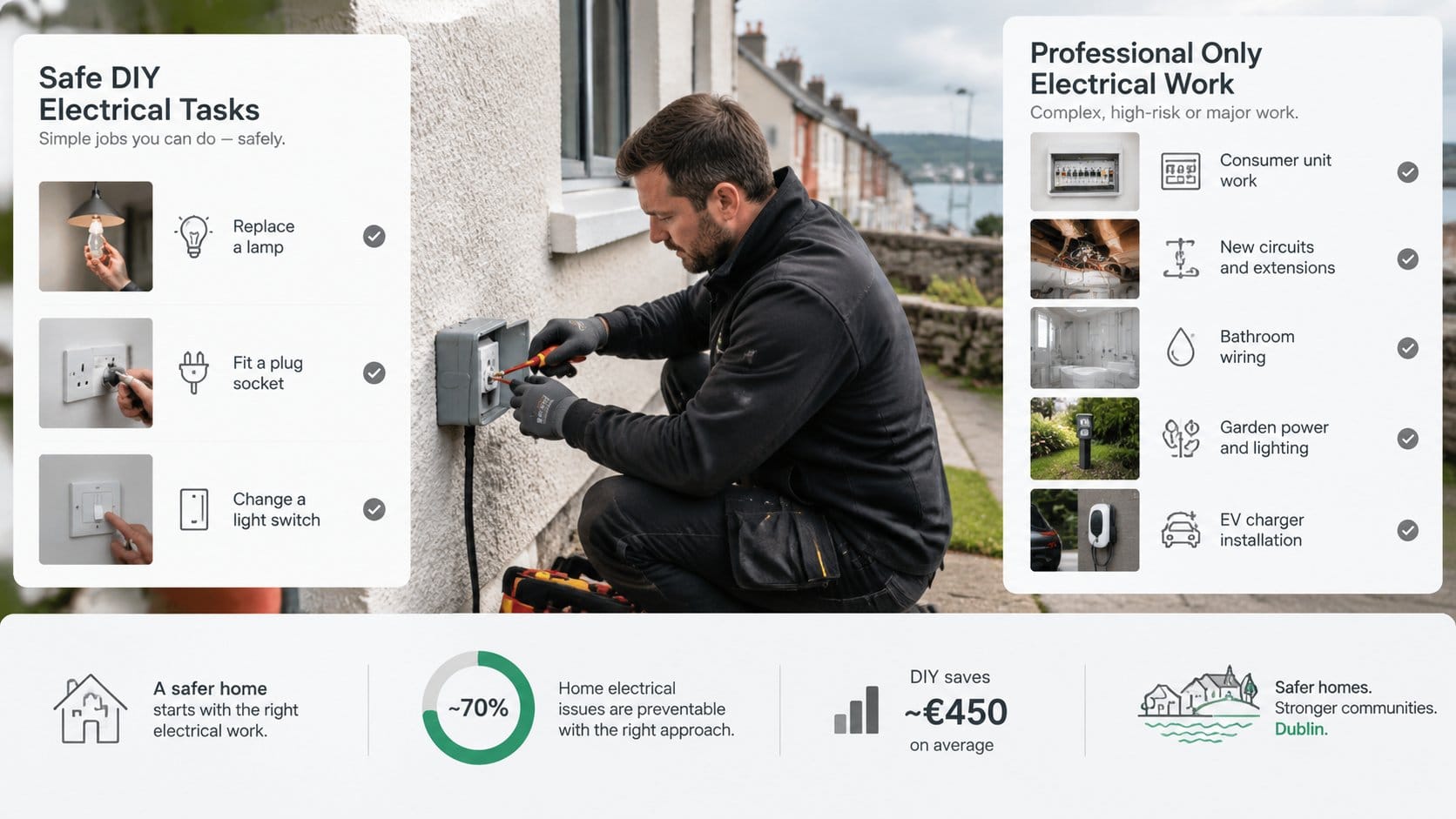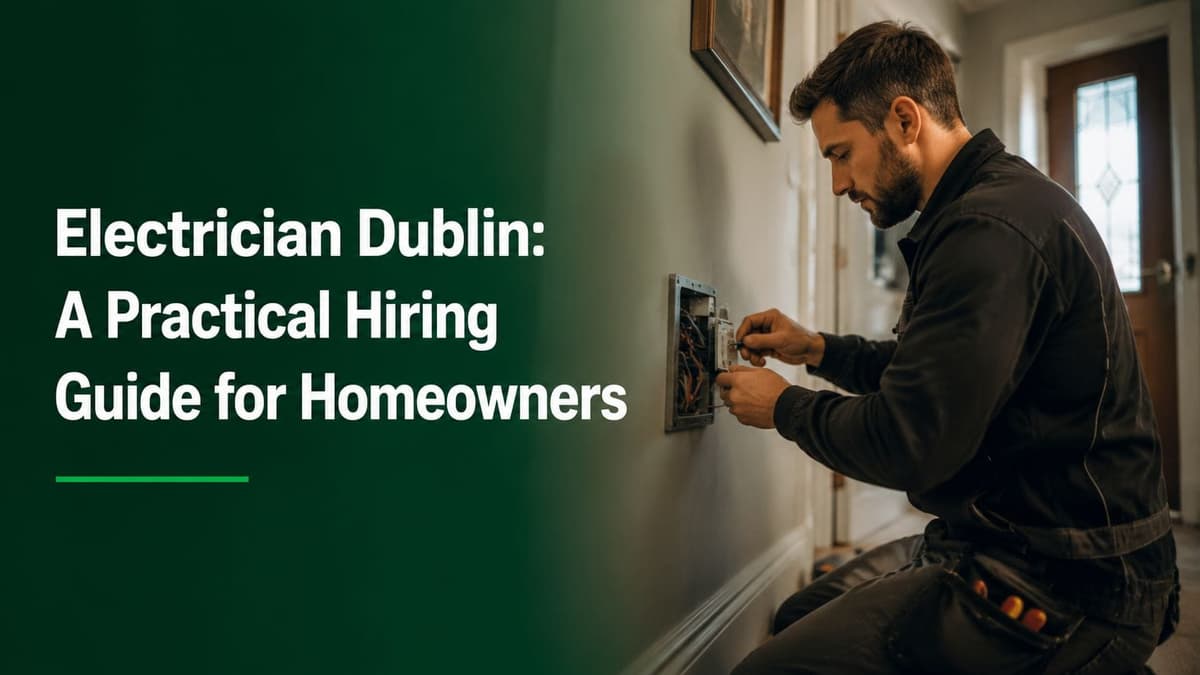
Domestic electrical work in Ireland must be carried out by a Safe Electric registered contractor, and Safe Electric registration requires a qualified certifier, relevant training, insurance and a €75 application fee. For a Dublin hire, that makes registration and certification more important than choosing the lowest quote.
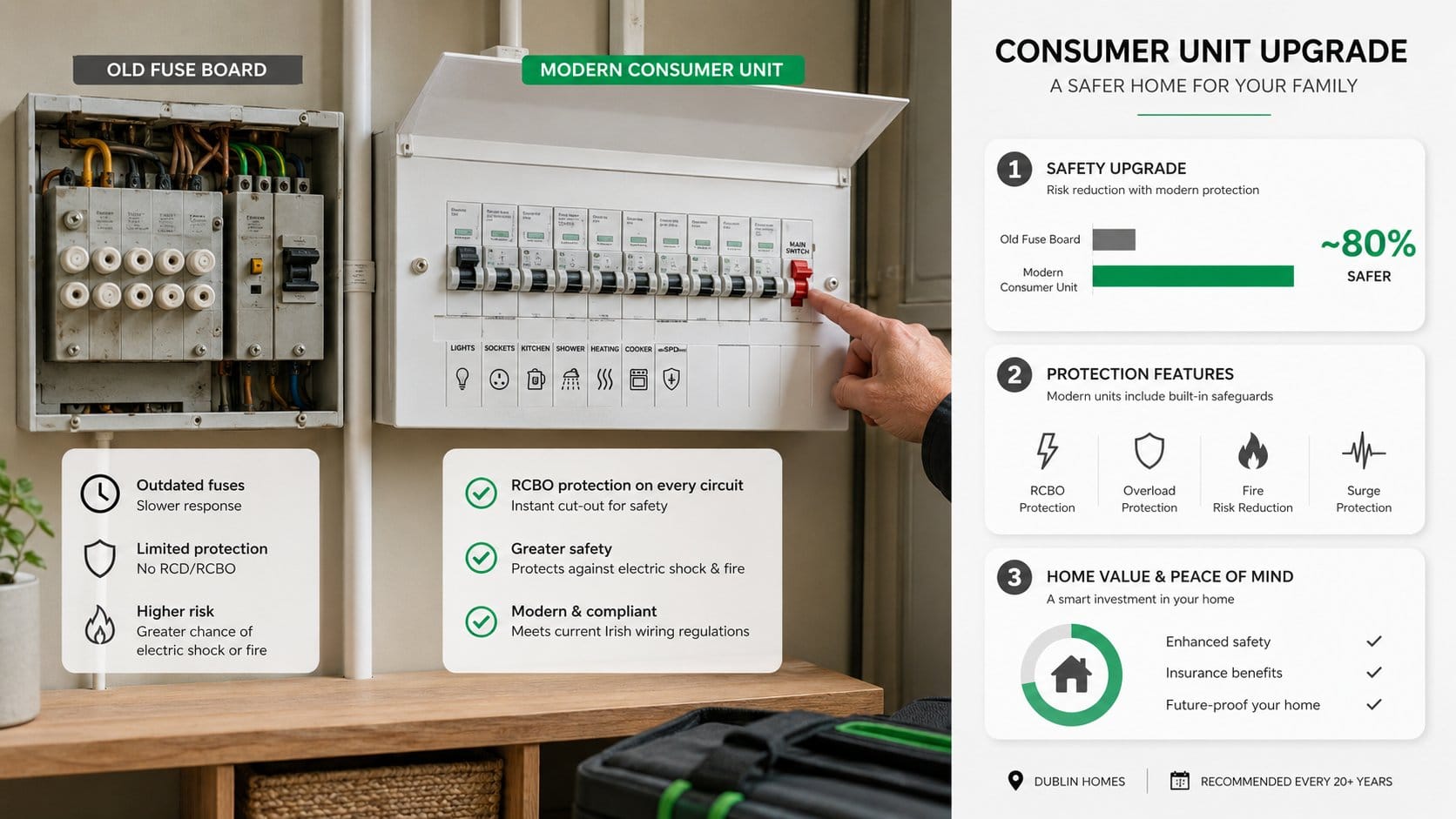
A tripping RCD in a Drumcondra terrace, a warm socket in a Rathmines flat or an ageing fuse board in a Glasnevin semi can all look like small problems. Electrical faults rarely respect the neat boundaries of a quick repair, however. Older Dublin homes may contain concealed cabling, alterations from different renovation periods and consumer units that aren't suited to modern additions such as induction hobs, electric showers or EV chargers.
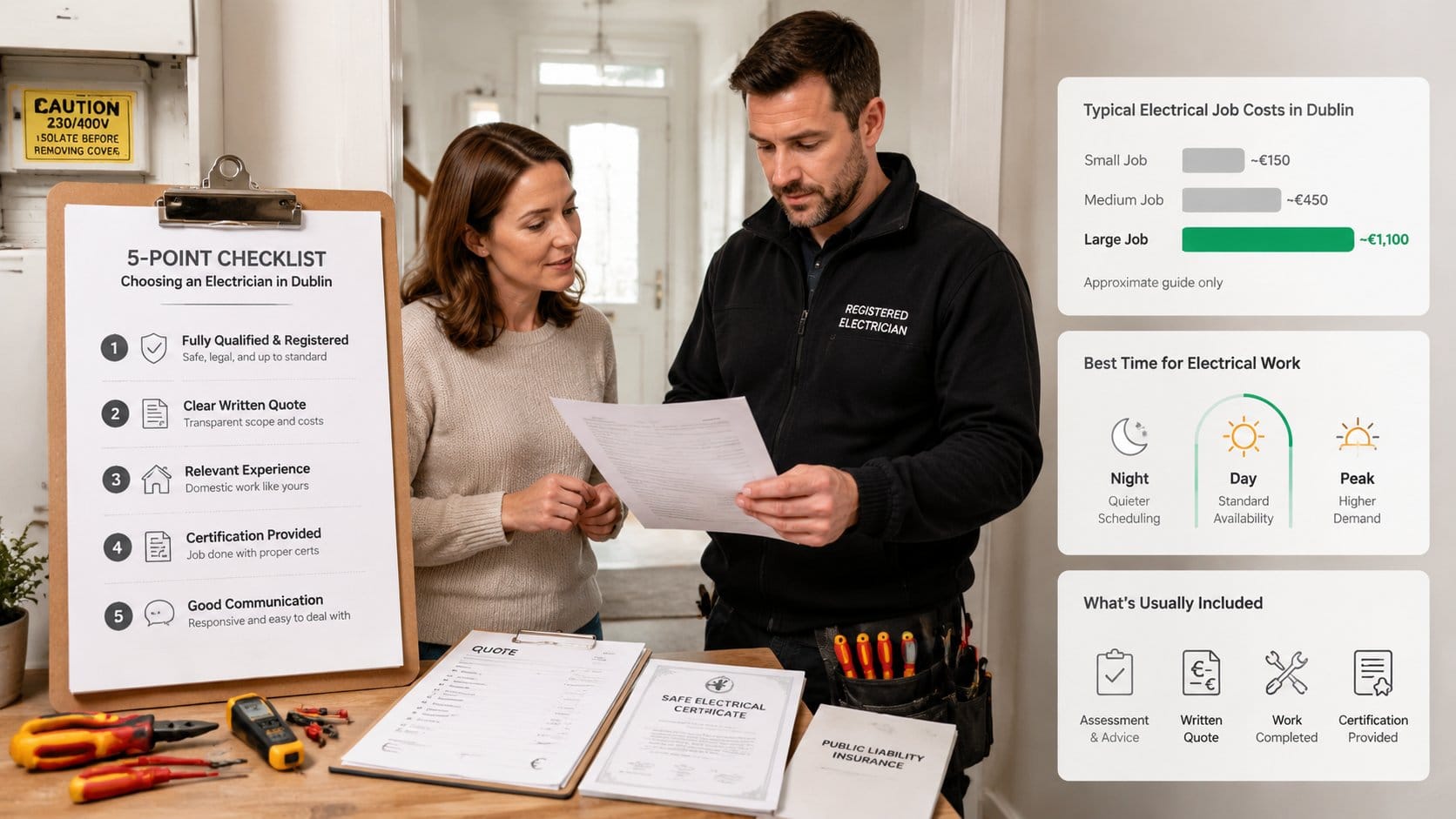
The sensible order is simple: confirm Safe Electric registration, define the work, request a written quote and compare the final price. Reviews help assess communication and workmanship from previous customers, but they don't replace the official registration check.
Finding the Right Electrician in Dublin
A homeowner in Drumcondra might receive three prices for a tripping RCD, one at €90, another at €160 and a third at €260. The tempting response is to book the cheapest person immediately. The better response is to ask what each price includes, whether the contractor is registered with Safe Electric and whether the work will be tested and documented.
Dubliners usually find electricians through neighbour recommendations, residents' groups, Google Maps, local directories or platforms that bring several providers together. Each route can produce useful names, but none should be treated as proof of competence. A recommendation from a nearby terraced house is relevant because the property layout and wiring history may be similar, yet the contractor still needs to pass the same registration check.
A practical shortlist should contain only providers who can supply:
- A registration identity: Ask for the contractor's Safe Electric details before discussing a booking.
- A clear scope: The quote should say whether it covers fault-finding, replacement parts, testing, certification and making good.
- Recent local feedback: Reviews can reveal punctuality, communication and how a provider handled follow-up questions. Guidance on review systems for electricians can help homeowners understand what useful review information looks like.
- A written price: A verbal figure isn't enough for work that may expand once a board or concealed cable is inspected.
The ShamFix guide to finding local tradespeople is another route for organising the search, and homeowners can also compare how a single-trade city guide is structured in the ShamFix tilers Dublin guide. The homeowner remains responsible for checking the electrician's regulatory status. A good search can take less than an hour when the process starts with credentials rather than a long list of names.
Practical rule: A low price is only useful when the scope, registration, insurance and certification arrangements are equally clear.
The strongest Dublin shortlist is therefore not the one with the cheapest callout. It's the one with registered providers, relevant local reviews and comparable written scopes.
Safe Electric and RECI Registration Explained
For domestic electrical work in the Republic of Ireland, Safe Electric registration is the first credential to check. Safe Electric operates within the regulatory framework overseen by the Commission for Regulation of Utilities, and the national register allows a homeowner to confirm whether a contractor is registered before work starts.
RECI is closely associated with the electrical contracting system and operates across the island. For a Dublin homeowner, the practical question remains whether the contractor appears on the Safe Electric register for domestic work in the Republic of Ireland. The name used for quoting, the trading name and the registration details should line up.
How to check a contractor
- Ask for the registered name and registration details. A contractor should be able to provide the information needed to search the register. Don't rely on a logo copied onto a van, invoice or social media page.
- Search the public Safe Electric register. Check that the business or individual appears and that the details match the provider being hired.
- Confirm the work category. Registration must be relevant to the domestic electrical work being proposed, not merely a general claim that the person has electrical experience.
- Ask about certification before booking. Safe Electric states that domestic registration involves a qualified certifier, completion of the Verification and Certification of Electrical Installations course and proof of insurance. The application fee is €75, and Safe Electric says processing typically takes 15 working days. Registration certificates are valid for 5 years, while ongoing renewal or subscription obligations mean registration isn't a once-only formality. These details are set out in the Irish Government registration information.
- Stop if the details don't match. If a name doesn't appear or the contractor refuses to provide usable registration information, don't proceed with controlled domestic work. Suspected unregistered work can be reported to Safe Electric, as advised by the CRU.
The technical reference point is I.S. 10101:2020, which replaced ET 101:2008. The NSAI describes it as covering the design, erection and verification of low-voltage installations, with the purpose of protecting people, livestock and property while ensuring installations function correctly. A Dublin electrician should be able to explain how the proposed work relates to the current standard, particularly where a consumer unit, earthing, bonding or circuit protection is involved.
Homeowners should also ask what completion documentation will arrive after the job. The HSA explains that controlled electrical works require certification, and ESB Networks says a registered electrical contractor must test and certify a new installation, extension or modification and provide the customer with a copy of the electrical completion certificate. The ShamFix guide to finding a tradesman in Ireland can support the search, but the authority's register remains the decisive check.
What Dublin Electricians Typically Charge
Irish pricing guides put ordinary electrician rates around €45 to €95 per hour, with Dublin commonly sitting towards the upper end of that range. The same pricing guidance explains that callout fees, evening work and emergency attendance can make the first hour substantially more expensive than a planned hourly booking. See the Irish electrician rate guidance for the published rate context.
The table below is a sanity check, not a substitute for a quote. The available verified pricing data supports an hourly range, but it doesn't provide reliable Dublin-specific figures for every job type listed in the plan. Those rows are therefore left out rather than filled with false precision.
Typical Dublin electrician pricing ranges
| Job type | Typical Dublin range | Notes |
|---|---|---|
| Standard scheduled labour | €45 to €95 per hour | The upper end is more likely for Dublin, complex fault-finding or specialist work. |
| Emergency or out-of-hours first attendance | Higher than the standard hourly rate | Ask whether the callout includes the first hour, testing and travel. |
| Consumer unit upgrade | Quote required | Price depends on the board, circuit condition, protective devices, access and certification. |
| Partial or full rewire | Quote required | Older cabling, concealed routes, floorboards, plasterwork and making good can change the scope significantly. |
| EV charger installation | Around €900 to €1,400 before grants | The published Irish pricing guidance identifies this as a common range, but the final quote depends on the property and installation design. |
A price comparison is meaningful only when every provider quotes the same job. A consumer unit figure might exclude remedial earthing, while a rewire figure might exclude plaster repairs, decoration, waste removal or difficult access. In a Dublin 2 apartment, parking and communal access may affect attendance. In a Rathmines or Ranelagh terrace, narrow hallways, concealed wiring and period-building constraints can add labour without appearing in the headline rate.
Ask each registered contractor to separate labour, materials, testing, certification, VAT and making good. Construction, renovation and repair work generally attracts 13.5% VAT, so the homeowner should confirm whether the quoted total includes it. A lower figure that excludes VAT or certification isn't cheaper, it is incomplete.
Energy costs also sharpen the need for transparent pricing. RTÉ, citing Eurostat data, reports Irish households paying 40.42 cent per kWh, nearly 40% above the EU average. That makes upgrades and inspections financially important to homeowners, but it doesn't justify accepting vague work or an unregistered contractor.
Emergency Callouts and Out-of-Hours Work
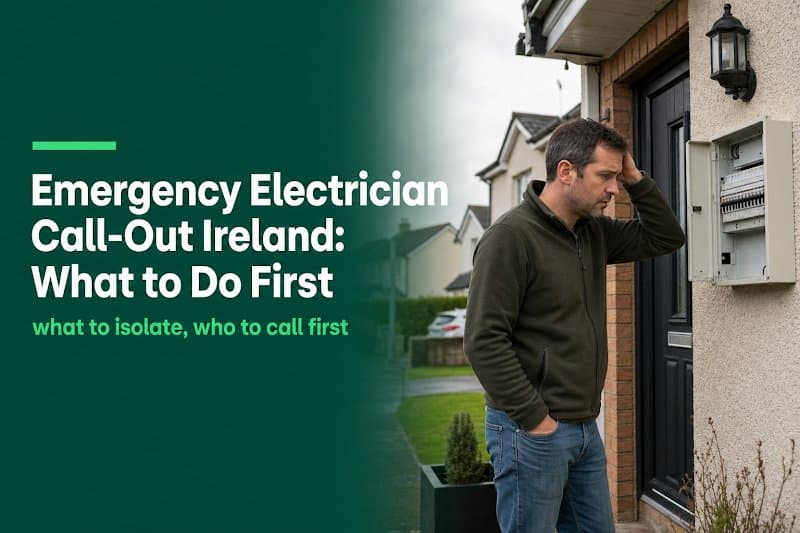
A burning smell from a socket, visible sparking, heat at a consumer unit, water near electrical equipment or repeated tripping deserves urgent attention. A single circuit fault may not mean the entire property has lost power, and an outage affecting the wider area may sit on the ESB Networks side rather than within the house.
The first priority is to keep people away from the affected equipment and avoid contact with water-affected electrical areas. If the affected circuit can be isolated safely at the consumer unit without opening the enclosure, that may limit risk while help is arranged. A suspected supply outage should be reported to ESB Networks, not treated automatically as an internal electrician repair.
Typical Dublin emergency callout pricing
| Time window | Typical callout fee | What's usually included |
|---|---|---|
| Scheduled daytime visit | €45 to €95 per hour | Labour for the agreed attendance, with materials and certification clarified separately. |
| Evening or weekend attendance | Higher than the ordinary hourly rate | Callout, travel and initial diagnosis may be included, but the provider must confirm the arrangement. |
| Genuine emergency attendance | Potentially much higher than scheduled work | Urgent attendance and diagnostic time, with repair materials and follow-on work priced separately. |
Published Irish pricing guidance doesn't provide a reliable universal Dublin emergency fee or response-time promise. That's why a provider who advertises a fixed emergency amount should be asked exactly what the fee covers. Some callouts include the first hour, while others charge travel, diagnosis and parts separately.
Urgency doesn't remove the registration requirement. A registered contractor should still be identifiable, even when the booking happens outside ordinary hours.
Ask for the registration details before allowing work to begin, unless an immediate danger requires isolation first. Once the property is safe, request a written account of the fault, the work completed and any certification that applies.