
ShamFix
Back to insights

Heat Pumps Ireland: A Homeowner's Guide to Costs and Grants

Heat pumps Ireland explained: how they work, real running costs, current SEAI grants, suitability for Irish homes, and what to ask installers.

20 min read
Heat Pumps Ireland: A Homeowner's Guide to Costs and Grants

A homeowner in a 1990s three-bedroom semi-detached house in Cork may be looking at an ageing oil boiler, rising heating costs and the possibility of a heat pump. The obvious question is whether the new unit will replace the boiler neatly. The more useful question is whether the house is ready to use a heat pump efficiently.

That distinction matters across heat pumps in Ireland. The equipment is only one part of the system. Insulation, draughts, radiators, underfloor heating, hot-water storage, controls and the design of the installation all affect performance. A well-sized heat pump in a suitable home can provide steady low-temperature heating. The same unit in a leaky home with small radiators may need expensive remedial work and consume more electricity than the homeowner expected.

Ireland's market has moved quickly. The European Commission Joint Research Centre reported approximately 84,910 heat pumps in stock in 2022, with about 20,185 units sold that year, a figure 140% higher than 2020 sales. The country update also identified air-to-water systems as the most common technology for space heating and reported heat pump density of 165 installed units per 1,000 residents in 2022. The JRC country update shows a market moving from early adoption towards scale, although household penetration remains lower than in more mature European markets.

This guide treats a heat pump as a whole-home upgrade, not a simple boiler swap. It covers how the technology works, how Irish weather affects seasonal efficiency, which homes are more suitable, what SEAI grants can contribute, how to read installation costs and how to compare installers. Homeowners considering the wider renewable-energy sector can also find useful business context in these expansion tips for renewable firms.

Why Heat Pumps Matter for Irish Homes Right Now

You get a heat pump quote for an older Irish house, see a grant on the table, and assume the main decision is which brand to buy. In practice, the bigger question is whether the house is ready to let that heat pump run well.

That matters because Ireland is still a long way from its retrofit goal. More recent reporting stated that 19,583 heat pumps had been installed in existing dwellings between 2020 and July 2026, equal to 4.9% of the 400,000 target for existing homes. The JRC repository publication outlines that gap between policy ambition and delivered retrofit work.

The reason is not hard to see. A heat pump is less like a stronger boiler and more like a steady background heating system. If the home leaks heat quickly, or if the radiators are too small to give out enough warmth at lower water temperatures, the unit can still run, but not in the efficient, low-cost way many homeowners expect.

So the decision starts with the building fabric and the heat distribution system.

The house sets the terms

SEAI makes this distinction clearer than many sales brochures do. The headline lab figure is usually COP, which describes efficiency under set test conditions. The more useful figure for a real Irish home is SPF, or seasonal performance factor, which reflects how the system performs across the heating season. That difference is the heart of the decision. A house can have a heat pump with a respectable brochure COP and still deliver disappointing real-world results if the property needs higher flow temperatures to stay comfortable.

A simple analogy helps here. Putting a heat pump into a draughty house with undersized radiators is a bit like fitting an efficient engine into a van with soft tyres and dragging brakes. The machine may be good, but the rest of the system is forcing it to work harder than it should.

This is why home readiness comes first. Insulation levels, airtightness, window condition, pipework layout, radiator sizing, and hot water design all shape seasonal performance. In one house, a heat pump can be a fairly direct replacement for fossil-fuel heating. In another, the sensible route is fabric work first, then emitter upgrades, then the heat pump.

SEAI's grant rules reflect that reality. Eligibility depends on a technical assessment and on the dwelling meeting the required heat-loss standard. The grant structure also signals that the project is bigger than the outdoor unit alone. The success of the system depends on whether the home can hold heat and release it comfortably at lower temperatures.

Practical rule: A good heat pump quote starts with heat-loss calculations and radiator checks, then moves to equipment selection.

How a Heat Pump Works

A heat pump works like a fridge in reverse. Your fridge pulls heat out of the food compartment and releases it through the coils into the kitchen. A heat pump pulls usable heat from outdoor air or the ground, then moves that heat into your home's heating system.
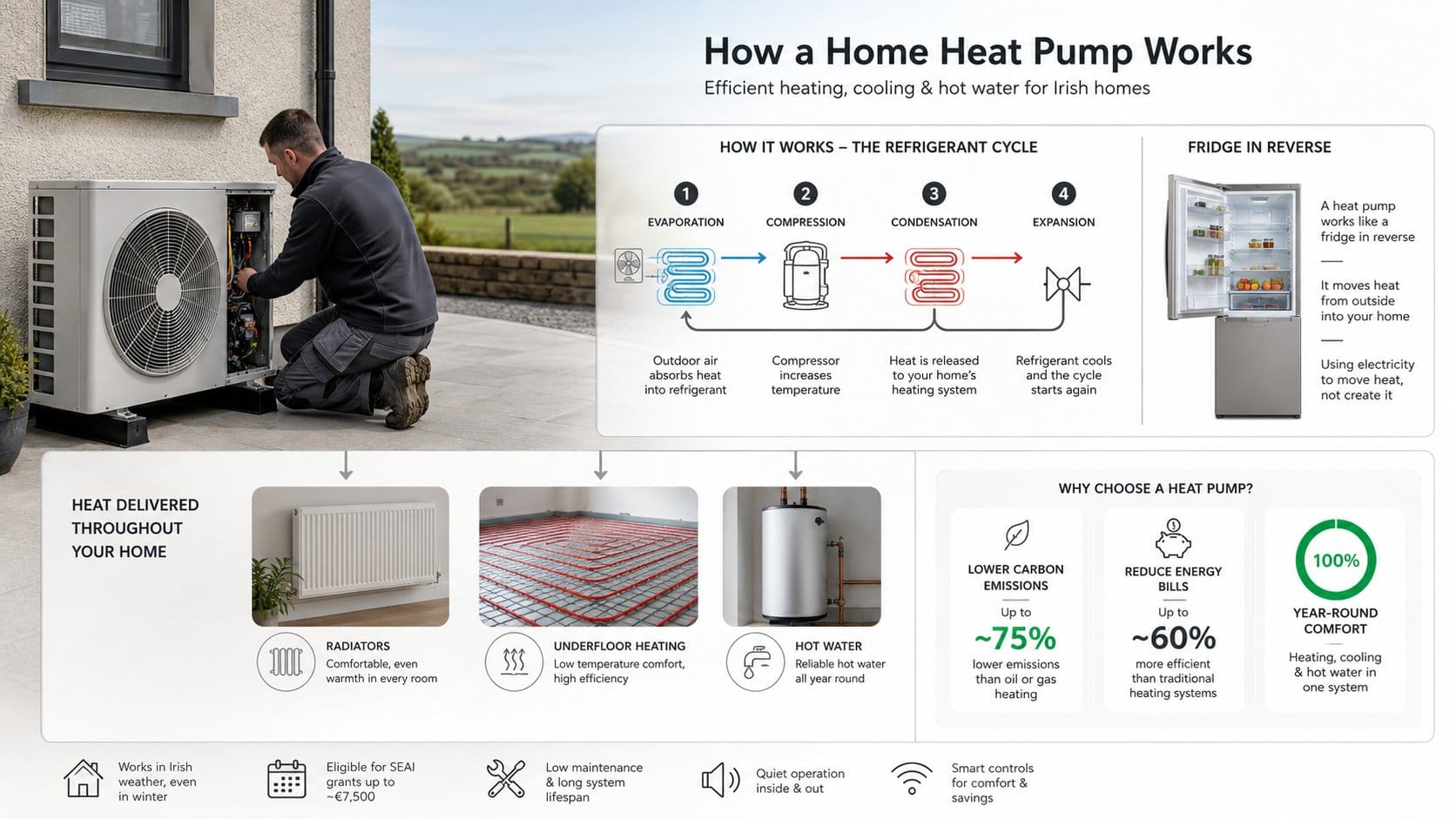
A clear educational illustration showing how a home heat pump works for Irish homeowners, with an outdoor unit extractin

The key word is "moves". A gas or oil boiler makes heat by burning fuel. A heat pump uses electricity to collect heat from a cooler place, raise its temperature, and pass it into water for radiators, underfloor heating, and the hot-water cylinder. That is why the condition of the house matters so much. If the home can stay comfortable with lower water temperatures, the heat pump has an easier job.

The main system types

An air-source heat pump takes heat from outdoor air. This is the type most Irish homeowners will come across. The outdoor unit gathers heat, and the indoor side transfers it into the home's water circuit.

A ground-source heat pump takes heat from buried pipework in the ground. Ground temperatures are steadier, which can help performance, but the installation usually needs more space, more groundwork, or boreholes. The better option depends less on a technology league table and more on the site, the budget, and how ready the house is for lower-temperature heating.

What happens inside the unit

Inside the system, the refrigerant goes around a loop with four main stages:

  1. Evaporator: The refrigerant absorbs heat from the air or ground and turns into a gas.

  2. Compressor: Electricity drives the compressor, which squeezes the refrigerant and raises its temperature.

  3. Condenser: The hot refrigerant gives up its heat to the home's water circuit and cools back into a liquid.

  4. Expansion valve: The pressure drops, the refrigerant cools further, and the cycle starts again.

That cycle explains a common point of confusion. The electricity is not being turned straight into all the home's heat, as with a direct electric heater. The electricity runs the compressor and pumps so the system can transfer heat from outside to inside.

For homeowners, the more useful question is not just "how many kilowatts is the unit?" but "how hard will it need to work in this house?" A heat pump paired with generous radiators, decent insulation, and sensible flow temperatures can run far more efficiently than the same unit fitted into a home that leaks heat and needs very hot water to stay warm.

This is also where COP and SPF start to matter. COP measures performance at a set test condition. SPF looks at heat delivered over a season or year compared with the electricity used over that period. In plain terms, COP tells you how the machine performs in a snapshot. SPF tells you more about how the whole setup performs in lived Irish conditions. That is why home readiness, emitters, controls, and heat loss matter as much as the box outside.

Real-World Efficiency in Ireland's Climate

A common Irish heat pump experience goes like this. The brochure number looks strong, the winter bill arrives, and the homeowner starts wondering why the system is not matching the headline figure. The short answer is that Irish efficiency is shaped less by the badge on the outdoor unit and more by the temperature the house asks it to produce, hour after hour.

SEAI draws a clear line between test performance and lived performance. In SEAI's Heat Pump Implementation Guide, rated COP is based on a standard test condition of 7°C outdoor air and 35°C flow temperature. SCOP and SPF are broader seasonal measures. That distinction matters because Ireland rarely gives a heat pump one steady laboratory condition. It gives damp weather, stop-start heating patterns, hot water demand, and homes with very different insulation levels and radiator sizes.

The easiest way to read the terms is to ask one question: are you looking at the machine in a snapshot, or the home over a season?

Metric What it measures Typical Irish value Why it differs
COP Performance at one controlled test point A rated test result, not a household-year figure The test uses a fixed outdoor temperature and flow temperature
SPF Heat delivered divided by electricity used across the season An SPF of 4 means 4 kWh of heat per 1 kWh of electricity Weather, controls, emitter sizing, defrosting and any backup heating affect yearly operation
DEAP default for air-to-water without accredited test data A conservative modelling input used in energy assessment 250 The value is used when suitable accredited test information is not available
DEAP default for brine-to-water or water-to-water without an auxiliary heater A conservative modelling input used in energy assessment 320 The default reflects that system type in DEAP modelling

Those DEAP defaults matter for a practical reason. A home can look different on paper depending on whether the product data is fully recognised and whether the system is designed around low flow temperatures. In other words, efficiency in Ireland is not just about what the heat pump could do in a test rig. It is about what the whole installation lets it do in an actual house.

A useful analogy is a bicycle in the wrong gear. On level ground, the rider moves easily. On a steep hill in a heavy gear, effort rises fast. A heat pump behaves in a similar way when the house needs hotter water because of heat loss, small radiators, or patchy controls. The compressor can still do the job, but it has to work harder for each unit of heat delivered.

That is why two Irish homes with the same model can produce very different results. A reasonably airtight house with good emitter area may run at lower flow temperatures for long, steady periods. A draughtier house with undersized radiators may need higher temperatures, more cycling, and more electricity use. Defrost cycles and domestic hot water production add to that gap.

Irish field monitoring has shown that manufacturer expectations and real operation do not always match. Research in Ireland found that some air-source systems delivered lower performance in practice than expected under test assumptions, and monitoring by Dundalk Institute of Technology still supported heat pumps as a good fit for Ireland's maritime climate for space heating and hot water. The lesson is straightforward. Mild weather helps, but mild weather does not cancel out poor house readiness.

A heat pump becomes efficient when the home lets it run low and steady for most of the season. That usually depends on fabric, emitters, controls and hot water setup more than on the headline COP alone.

Which Irish Homes Are Ready for a Heat Pump

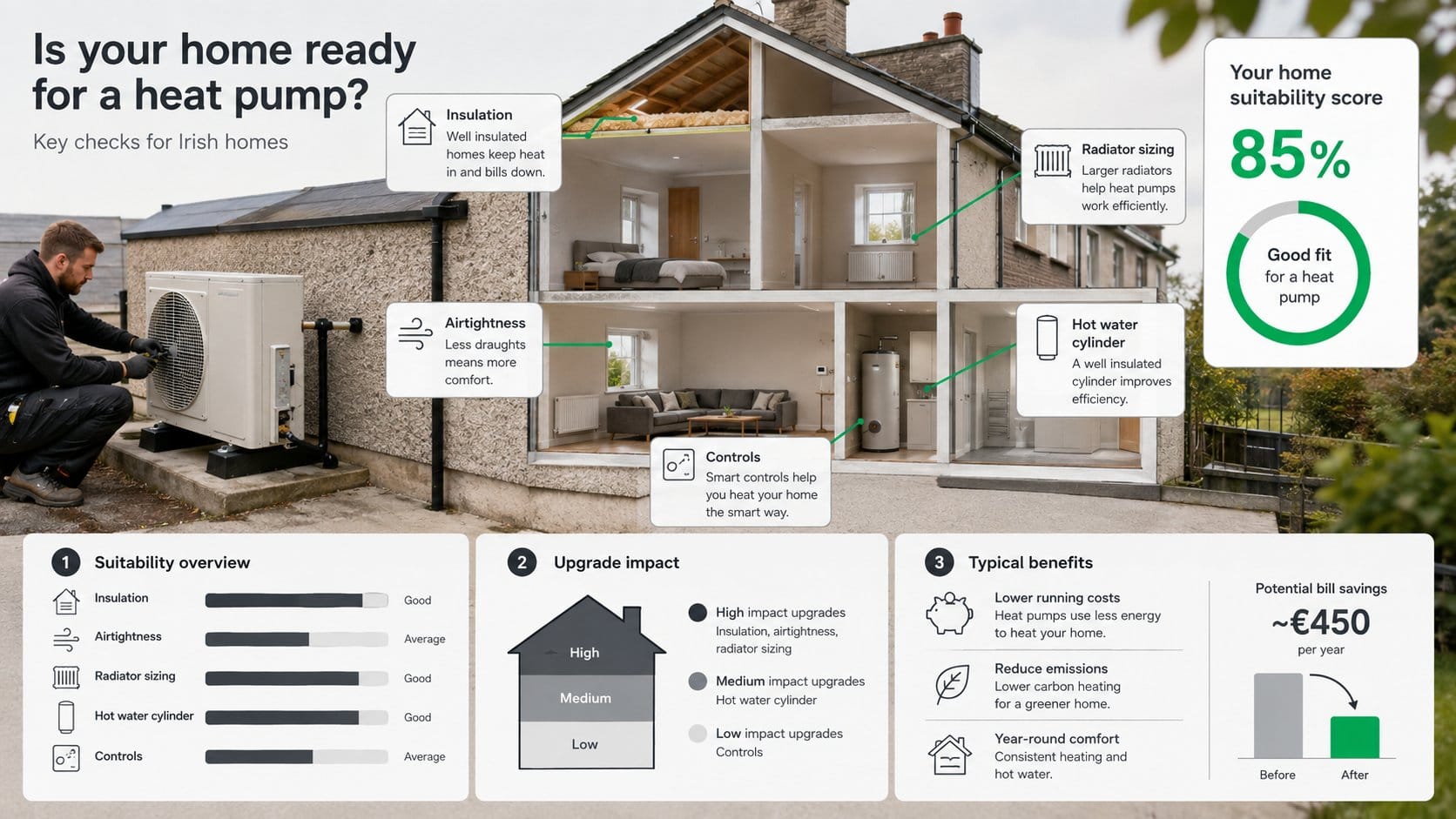
Home readiness is best understood as a chain. The walls, roof, windows and floors limit heat loss. The radiators or underfloor circuits deliver heat. The cylinder stores hot water. The controls decide when and how the system operates. If one link is weak, the heat pump may still run, but it may run less efficiently or require more remedial work.

An infographic for Irish homeowners showing whether a home is ready for a heat pump, with a three-bedroom house cross-se

Three checks before equipment selection

A newer home with good insulation, controlled ventilation and appropriately sized radiators may be relatively straightforward. A post-2010 build isn't automatically suitable, however, and an older home isn't automatically ruled out. The assessor should calculate the actual heat loss rather than relying on the construction date alone.

The fabric assessment should look for:

  • Attic and roof insulation: Missing or compressed insulation can increase heat loss through the roof.

  • Walls and junctions: Cavity construction, solid walls and thermal bridges need different treatment.

  • Windows and doors: Double glazing helps, but draughts around frames can still undermine comfort.

  • Air leakage: Open fireplaces, poorly sealed doors and unsealed service penetrations can affect demand.

  • Extensions: Single-pane windows or lightly insulated additions may dominate the home's heat loss.

The emitter assessment is equally important. Underfloor heating and large radiators can deliver useful warmth at lower flow temperatures. Small panel radiators on external walls may not provide enough output without replacement or redesign. A hot-water cylinder also needs to suit the system, because many existing boiler arrangements don't provide the same storage and control arrangement a heat pump needs.

A fabric-first review may identify cavity wall insulation, attic improvements, draught sealing or emitter changes. Guidance on one common retrofit measure is available in this external wall insulation guide.

A suitable home isn't necessarily a perfect home. The important question is whether the upgrade list is understood, priced and completed as part of the design.

SEAI Grants and Eligibility in 2026

SEAI support can reduce the capital cost, but the grant is conditional. The SEAI heat pump grant guidance says the home must pass a technical assessment and have sufficiently low heat loss. The same page identifies support for associated work, including up to €2,000 for radiators and pipework and a €4,000 renewable heating bonus.

The gov.ie Home Energy Grants service states that the scheme is open to owners of dwellings built before 2006, while homes built before 2011 are eligible for heat pumps, solar thermal and solar PV measures. The exact pathway matters, because different schemes and applicant circumstances can carry different rules.

What the grant structure is trying to achieve

The grant isn't just an equipment discount. It supports the technical work needed to make renewable heating viable, while separate energy-upgrade measures may address the building fabric. The JRC country update reported that grants could cover up to 70% of costs, capped at €6,500, while newer government and SEAI updates in 2025 and 2026 reported heat-pump support bundles of up to €12,500. Homeowners should confirm the live amount and pathway directly with SEAI before signing a contract, because grant rules and packages can change.

Grant component Typical amount Eligibility note
Air-to-water heat pump support Confirm the current amount with SEAI Subject to the applicable scheme, technical assessment and eligible equipment
Ground-to-water heat pump support Confirm the current amount with SEAI Site and system design affect eligibility
Radiators and pipework Up to €2,000 Included where the approved heat-pump works require eligible upgrades
Renewable heating bonus €4,000 Available within the relevant grant bundle and subject to SEAI rules
Overall support reported in the JRC update Up to €6,500, or up to 70% of costs The update describes an earlier support structure, so current applicants should check SEAI

The property generally needs to replace the existing heating system rather than add a heat pump as an unrelated supplementary appliance. The work must follow the relevant SEAI process, use eligible equipment and involve the required registered installer. Homeowners should also clarify which documents are needed for the application, completion and BER records, and whether payment is made after qualifying work is completed.

Better Energy Homes and Warmer Homes have separate rules and may suit different households. A technical assessor or SEAI can confirm the correct route before any deposit is paid.

Installation Costs and VAT in Ireland

An air-to-water installation is rarely just the purchase of an outdoor unit. The system may need a hot-water cylinder, new pipework, electrical work, controls and larger radiators. The supplied installation-cost visual sets out example component ranges for a typical three-to-four-bedroom home, but the figures should be treated as a planning illustration, not a quote.

Where the money goes

The visual breaks the work into four categories:

  • Equipment cost: €8,000 to €12,000 for the heat-pump equipment component.

  • Professional labour: €3,000 to €5,000 for installation work.

  • Electrical upgrades: €1,000 to €2,000 where the property needs suitable electrical alterations.

  • Emitter changes: €2,000 to €4,000 for radiator-related work shown in the example.

These components shouldn't be added blindly to every property. A home with suitable radiators and electrical capacity may avoid some work. Another may need insulation, cylinder changes, controls, plumbing alterations or access work outside the headline breakdown.

VAT and quote exclusions

The provided installation example identifies 13.5% VAT on installation. Revenue treatment can depend on the character of the work and the invoice structure, so the homeowner should ask the contractor to state whether the quoted figures include VAT and which rate applies to each line. A quote that appears cheaper may exclude scaffolding, difficult access, waste removal, making good, meter work or preparatory insulation.

A fair written quote should separate:

  1. Site survey and heat-loss calculation.

  2. Heat-pump equipment and controls.

  3. Cylinder, buffer tank and associated plumbing.

  4. Radiators, underfloor connections or other emitters.

  5. Electrical alterations and zoning.

  6. Commissioning, handover and registration paperwork.

  7. VAT, exclusions and grant assumptions.

Homeowners comparing urban options can use this resource to compare heat pump options in Dublin, while still requesting a property-specific survey and itemised quotation from each installer.

Choosing an Installer and Getting a Fair Quote

The installer should be able to explain the design, not just recommend a brand. SEAI grant work requires the relevant registered installer and eligible equipment, so the homeowner should check the installer's current status through the appropriate SEAI process before work begins.

Several documents deserve particular attention:

  • SEAI registration: Confirm that the installer is registered for the relevant heat-pump grant work.

  • RG01 declaration: Ask how the installer will complete the required declaration for the project.

  • Refrigerant handling: Confirm the required refrigerant-handling registration with the Department of the Environment, Climate and Communications.

  • Approved equipment: Check that the proposed model appears on SEAI's approved-equipment list where the grant requires it.

  • Insurance and warranty: Request current insurance details and written manufacturer and workmanship warranty terms.

The homeowner should receive a design-based quote rather than a single unexplained total. It should identify the heat-pump model, calculated heat demand, design flow temperature, cylinder, buffer arrangement if required, radiator changes, electrical and plumbing alterations, commissioning and aftercare.

Questions that expose weak proposals

Ask the installer to state the expected seasonal performance basis, the assumptions used for insulation and room temperatures, and whether an auxiliary heater is included in the calculation. The quote should also explain who handles the BER documentation, grant paperwork, commissioning records and warranty registration.

Pressure is a warning sign. A homeowner shouldn't need to sign before a site survey, accept a cash-only incentive or rely on verbal promises about savings. A responsible proposal will identify exclusions and explain what happens if the survey finds higher heat loss than expected.

Useful questions include:

  • What heat-loss calculation supports the proposed output?

  • Which existing radiators can remain, and what output will each provide?

  • What flow temperature has been used for design?

  • Is the cylinder included, and where will it be installed?

  • Who will return if controls need adjustment?

  • What maintenance does the warranty require?

  • Which costs sit outside the grant?

For broader guidance on finding a suitable local professional, homeowners can consult this guide to finding a tradesman in Ireland.

Running and Maintaining a Heat Pump in Ireland

A heat pump usually operates differently from an oil or gas boiler. Instead of heating water rapidly to a very high temperature and switching off, it commonly runs for longer periods at a lower flow temperature. Radiators may feel warm rather than extremely hot, and the house may maintain a steadier indoor temperature rather than recovering sharply after a long shutdown.

The outdoor unit needs clear airflow. Leaves, grass, stored materials and accumulated debris can restrict the fan and heat exchanger. Coastal homes should also consider salt exposure during maintenance, while every system should have its pressure, filters, controls and condensate arrangements checked according to the manufacturer's requirements.

Problems that deserve early attention

Short cycling can indicate an oversized system, poor controls or inadequate system volume. Noise may become irritating if the outdoor unit is installed close to a bedroom window or on a poorly isolated wall. Defrosting is normal in suitable weather, but repeated or unexplained faults need professional attention rather than an improvised reset routine.

The homeowner should keep commissioning documents, warranty details, the installer's service recommendations and the final system settings. Guidance on reducing household electricity use is available in this electricity-saving guide.

Common questions

Will the system work during a cold spell? It can continue operating in cold weather, but output and seasonal efficiency depend on the design, the building and the specific system. Manufacturer claims should be compared with seasonal data, not only a single COP.

Can existing radiators stay? Sometimes. Their suitability depends on room heat loss, radiator output and the flow temperature required. An assessor should calculate this room by room.

Is outdoor noise normal? A hum and fan noise are expected, but placement, mounting and maintenance influence how intrusive the sound becomes.

How long will the system last? The useful answer depends on the equipment, installation quality, maintenance and operating conditions. The installer should state warranty terms and service requirements in writing rather than offering an unsupported lifespan promise.

Will bills definitely fall? No universal savings figure applies to every Irish home. Electricity tariffs, previous fuel use, insulation, flow temperature and SPF all affect the result. A qualified assessor can model the specific property, while SEAI's SPF guidance helps the homeowner understand the assumptions behind that model.


ShamFix connects homeowners in the Republic of Ireland with independent local heating engineers and retrofit providers, allowing enquiries to be routed through an Ireland-only marketplace where customers and providers can leave two-sided reviews. Homeowners comparing heat-pump installers can visit ShamFix to explore the available local marketplace options.

Keep reading

Guides