
ShamFix
Back to insights

Heat Pump Cost Ireland: 2026 Prices and Grants

Heat pump cost Ireland breakdown for 2026. Real air-to-water prices, SEAI grants up to €12,500, running costs, and what drives the final bill.

12 min read
Heat Pump Cost Ireland: 2026 Prices and Grants

An air-to-water heat pump in Ireland typically costs €9,000–€14,000 before grant, and a typical 3-bed semi that needs some radiator or fabric work is usually €12,000–€18,000 before grant. Since 3 February 2026, the SEAI grant can take up to €12,500 off that bill, so the key question is not the brochure price, it's what the homeowner ultimately pays out of pocket.

The rest of the bill turns on what the house already has, what the installer has to change, and whether the home qualifies for the full grant stack. That's where most quotes stop being comparable and start looking cheap for the wrong reasons.

What an Air-to-Water Heat Pump Actually Costs in Ireland in 2026

A straight air-to-water install in Ireland usually lands in the €9,000–€14,000 band before grant, while a typical 3-bed semi that needs some radiator or fabric work usually sits at €12,000–€18,000 before grant. The key point is simple, the unit is only one part of the bill, and the house drives the rest.

Home Type Pre-Grant (€) After SEAI Grant (€) Notes
Straightforward air-to-water install €9,000–€14,000 Lower, depending on eligibility and scope Outdoor unit, indoor controller, cylinder upgrade, pipework, electrical connection
Typical 3-bed semi €12,000–€18,000 Roughly €1,500–€5,000 out of pocket Often needs some radiator or fabric work
4-bed detached Toward €14,000–€18,000+ Roughly €1,500–€7,500 out of pocket More emitters, longer pipe runs, larger cylinder, more upgrade work

That table is the honest starting point. It reflects how real Irish installs are priced rather than the brochure number: the final bill depends heavily on retrofit scope and grant eligibility, not on the unit alone.

The figure to keep in mind

The headline price is useful, but it is not the number that matters. Homeowners need the net cost after grant, because that is the figure that decides whether a job is manageable or not.

Practical rule: if a quote looks far cheaper than the band above, it usually means something has been left out, not that the installer has discovered a miracle price.

Irish cost guides also separate capital cost from running cost, and that matters because a heat pump is a system purchase, not a boiler swap. In other words, the upfront number tells only half the story, and the grant changes the rest of it fast.

What Sits Inside the Headline Price and What Gets Left Out

A proper air-to-water quote usually includes the outdoor unit, indoor controller, hot water cylinder upgrade, pipework, and electrical connection. Those are the core parts of the system, and they're the parts homeowners should expect to see written down clearly.

The missing pieces are where the cheap quote tends to break. Radiator upgrades, consumer-unit work, scaffolding, making good, and any fabric work the house needs to run at low flow temperatures often sit outside the headline number, even though they change the final bill materially.
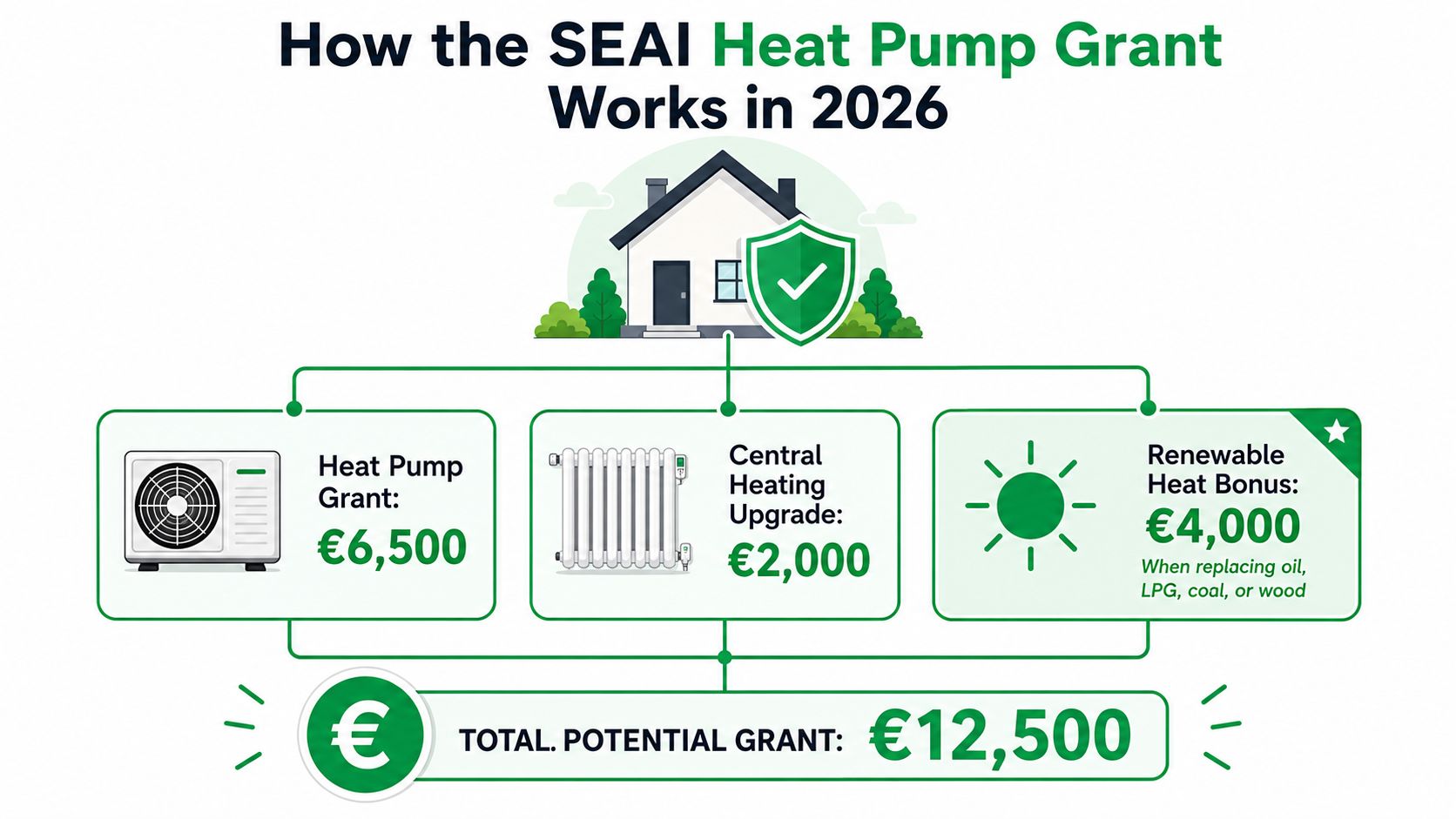
An infographic detailing the SEAI heat pump grant, showcasing a potential total grant of 12,500 euros in 2026.

What the quote should spell out

A homeowner should ask for the following in writing before comparing any two quotes:

  • System scope: What exactly is included, from unit to cylinder to controls.

  • Emitter changes: Whether radiators, pipework, or underfloor work are included or excluded.

  • Electrical work: Whether the consumer unit or other wiring upgrades are part of the price.

  • Commissioning: Whether the installer will set up and test the system properly, not just bolt it in.

  • VAT treatment: Whether VAT is included in the figure quoted.

The cheapest headline price is often the least complete one. A house with poor distribution, old radiators, or a weak electrical setup can easily push extra work into the budget, and that extra work is not optional if the system is expected to run well.

A useful way to think about it is this, the heat pump itself is only the engine. The rest of the quote is the conversion work that makes the engine usable in an existing Irish house. A quote that ignores that is not cheap, it's incomplete.

How the SEAI Heat Pump Grant Works in 2026

Since 3 February 2026, the SEAI Heat Pump System grant can reach €12,500, made up of €6,500 for the heat pump, €2,000 for central heating upgrades, and a €4,000 Renewable Heat Bonus when the home switches off oil, gas, solid fuel or electric storage heating. SEAI also offers €200 for the Technical Assessment and €50 towards the mandatory post-works BER.

The arithmetic is straightforward. If a home lands at €12,000 before grant and qualifies for the full support, the homeowner's out-of-pocket cost can fall sharply. If the same house needs extra emitter work, insulation work, or electrical upgrades, the bill moves back up.
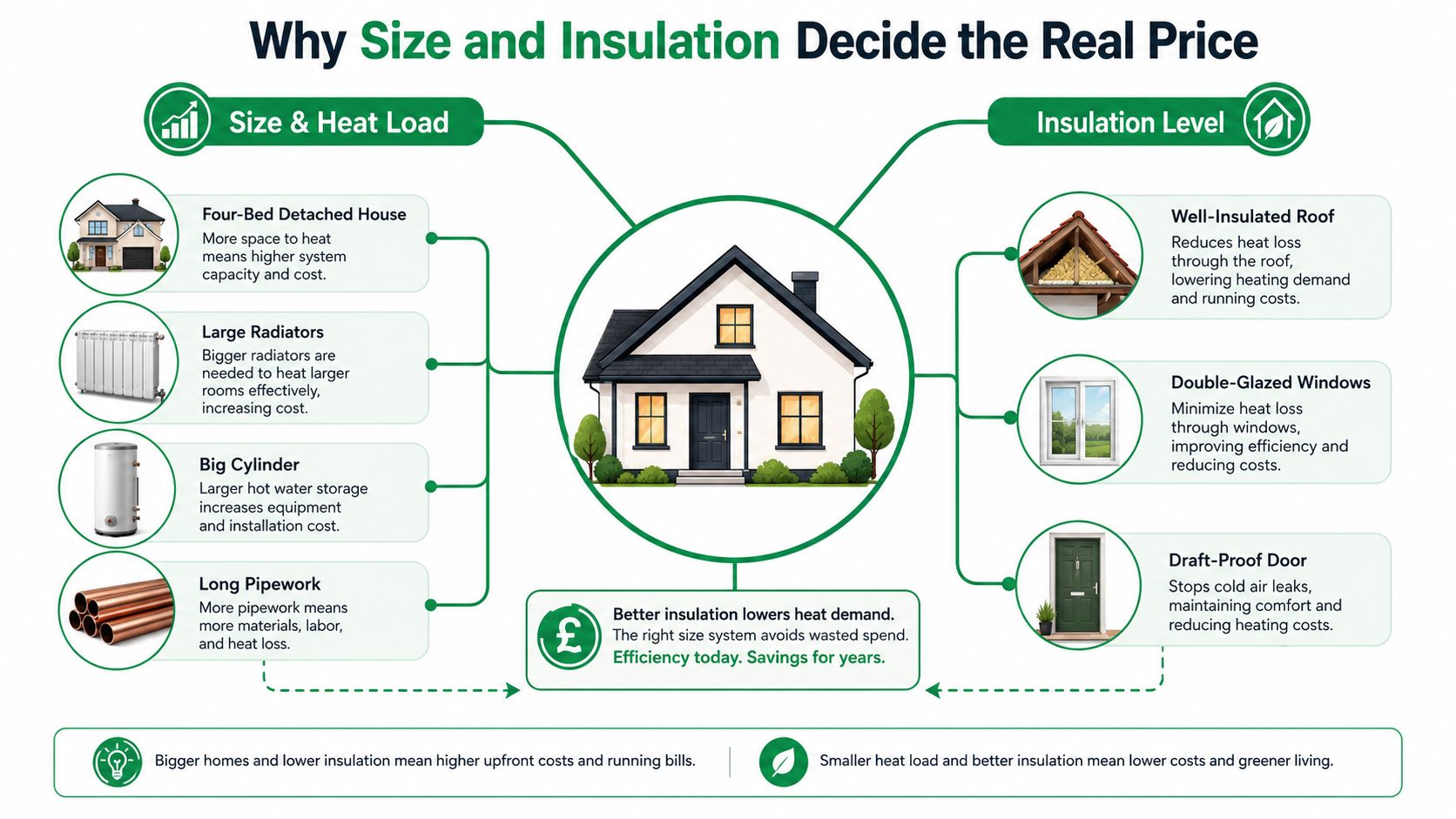
An infographic showing how property size and home insulation levels impact heat pump system costs and efficiency.

The practical rules matter just as much as the money:

  • Approval first: grant approval must be in place before work starts.

  • Approved contractor: the contractor must be SEAI-registered.

  • Home age: the home must have been built and occupied before 2021.

  • Offer window: the offer must be accepted within 30 days.

  • Drawdown window: the grant must be drawn down within 8 months.

There is also a separate rule for replacing an existing heat pump. That is capped at €6,500, or €4,500 for apartments, with no Renewable Heat Bonus and no central heating grant. That's a very different calculation from a boiler-to-heat-pump swap, and it needs to be checked before anyone signs anything.

The clean way to handle the grant is to treat it as part of the project plan, not as a nice rebate at the end. The approval has to exist before work starts, so the homeowner should not let an installer begin on a handshake and hope the paperwork sorts itself out later.

Why Size and Insulation Decide the Real Price

Two levers decide most of the final bill, size and insulation. Size drives the heat load, insulation decides whether the house can run at low flow temperatures without wasting money.

Size changes the hardware

A 4-bed detached usually needs a larger heat pump, more or bigger emitters, a bigger cylinder, and longer pipe runs than a 3-bed semi. That is why a four-bed often sits toward the top end of the quoted range, even when the product choice stays the same.

The cost is not just about square footage. It is about how much hot water the house needs, how far the pipework has to travel, and how much heat the rooms lose in the first place.

Insulation changes whether the system is viable

SEAI's threshold makes this concrete. Homes built before 2007 need a Technical Assessment unless a valid BER shows a Heat Loss Indicator of 2.3 W/(K·m²) or lower, while homes from 2007 use a Self-Declaration Form. A house that fails that basic test often carries a hidden cost, because attic or wall insulation may need to come first.

Practical rule: the cheapest quote on a cold house is often the incomplete one.

That is why homeowners should budget for the building fabric, not just the machine. A heat pump is happiest when the house asks for lower temperatures and steady output, not a frantic burst of heat through undersized radiators in a leaky shell.

The right way to read a quote is simple. If the house is well prepared, the quote can stay near the lower end of the market. If the house still needs insulation or emitter changes, the overall project cost is higher, no matter how tidy the first number looks.

For homeowners thinking about fabric upgrades alongside the heating system, see insulation and exterior works.


Choosing an Installer and What to Ask Them

The cheapest heat pump quote in Ireland is often the one that leaves out the parts a house needs. The installer matters because the grant only works cleanly when the job is done properly and the paperwork is submitted on time. For grant-linked retrofit work, the contractor must be SEAI-registered, and the homeowner should verify that before agreeing to anything.

What belongs in a written quote

A proper quote should spell out the job in plain English:

  • Exact scope: the outdoor unit, indoor controls, cylinder, pipework, commissioning, and any extras.

  • Heat-load sizing: the basis used to size the system for the house.

  • Commissioning plan: how the installer will set the system up and prove it works properly.

  • System suitability: whether the emitters support low flow temperatures.

  • Noise position: where the outdoor unit sits relative to boundaries and nearby rooms.

  • VAT treatment: whether the quoted figure includes VAT.

Homeowners save money or lose it when two quotes look close on paper but differ in reality if one includes cylinder work, emitter changes, or electrical upgrades and the other leaves them out.

Ask a better question than, “Which quote is cheapest?” Ask, “Which quote explains the house properly?”

Check the paper first, not the badge on the van. The registration, scope, and commissioning plan matter more than a glossy brochure.

Ask whether the quote assumes fabric work has already been completed. If the house is still under-insulated, the quote should say so plainly, because the heating system and the building fabric have to work together. Anything less is guesswork dressed up as a price.

A short first-visit checklist keeps the discussion honest:

  • Measure the rooms

  • List the existing radiators

  • Check the cylinder space

  • Ask about electrical capacity

  • Request the grant timeline in writing

A clean quote makes the grant easier to process, the install smoother, and the final bill less painful.

Two Illustrative Installs at a Glance

These are typical illustrations, not real jobs and not invoices. They show how the arithmetic usually looks when the grant and the hidden work are both included.

Typical 3-bed semi

A standard 3-bed semi that needs some radiator work usually lands at €12,000–€18,000 before grant. After grant, the homeowner commonly ends up around €1,500–€5,000 out of pocket, depending on the scope and whether the home qualifies for the wider support stack.

That lower figure is only realistic when the house is already fairly ready for a heat pump. If the installer has to do more emitter work, cylinder work, or electrical upgrades, the total climbs.

Four-bed detached

A 4-bed detached home usually runs toward €14,000–€18,000+ before grant, because the system has to cover more rooms, more emitters, and often longer pipe runs. After grant, the out-of-pocket figure is commonly €1,500–€7,500, with heavier fabric work pushing it higher.

Typical home Before grant After grant What pushes the price up
3-bed semi €12,000–€18,000 €1,500–€5,000 Some radiator or fabric work
4-bed detached €14,000–€18,000+ €1,500–€7,500 More emitters, larger cylinder, electrical work, fabric upgrades

The pattern is the same in both examples. The grant can change the final bill dramatically, but it does not erase the actual work required to make the system fit the house.

The homeowner who wants the best result should read the quote like a scope of works, not a shopping basket. Once the hidden items are visible, the numbers make much more sense.

Running Costs, Savings and Payback

The true test is not the install bill. It is what lands on your electricity statement every winter, and whether that figure stays lower than oil or gas in a house that is set up properly. In a well-insulated Irish three-bed, annual electricity for heat-pump operation is often put at about 4,000-7,000 kWh, roughly €1,200-€2,100 a year at €0.30/kWh, and lower on a night tariff or where the home is well set up. Well-performing homes are often quoted lower still.

What that means in plain English

The running cost is not fixed because the house is not fixed. Insulation, flow temperature, system sizing, and tariff all shape the final bill. If the house leaks heat, the pump works harder and the savings shrink. If the radiators are undersized or the cylinder is poorly matched, the system never gets the easy conditions the brochure assumes.

Heat pumps can run around 40% cheaper than oil or gas in suitable homes, but only where the system is matched to the house and the house is ready for it.

Practical rule: a heat pump that is oversized for a leaky house can eat the savings you expected to make.

Payback should be treated as a range, not a promise. A well-insulated home with a fair grant position can make sense much faster than an older home that still needs insulation, radiator changes, and electrical work. Whole-life cost is the right comparison, because the cheapest quote on paper can become the most expensive job once the hidden work is added.

The strongest cases are usually the homes that already have decent fabric, a sensible emitter setup, and a clean route to the SEAI grant. In those homes, the system stops looking like a premium purchase and starts looking like a disciplined long-term upgrade.

Frequently Asked Questions for Irish Homeowners

How long does the install usually take?
The length depends on scope, especially whether radiator, cylinder, or electrical work is needed. A neat install is one thing, a retrofit with fabric changes is another, so the homeowner should ask for the timeline in writing before signing.

What if I'm replacing an existing heat pump rather than switching from a boiler?
Replacing an existing heat pump is capped at €6,500, or €4,500 for apartments, and that version of the grant does not include the Renewable Heat Bonus or the central heating upgrade grant.

Is VAT included in heat pump quotes?
Sometimes, but not always. Residential renovation and repair work generally sits at 13.5%, so the quote should state clearly whether VAT is included and what else is outside the price.

What if one quote is much lower than the rest?
That quote should be treated with suspicion until the scope is checked line by line. If it leaves out radiator upgrades, cylinder work, electrical changes, or commissioning, it is not really cheaper, it is just less complete.

If a heat pump quote is on the table, compare the full scope, not just the headline price. Ask for the grant position, the radiator work, the cylinder, and the electrical upgrades in writing, then use ShamFix to find local Irish providers whose public details make that comparison easier.


Are you a heat pump installer in Ireland?

List your business free on ShamFix during Phase 1, with 0% commission and no per-lead credits. Be among the first found as local demand grows. There are no promises about lead volume or speed.

Keep reading

Guides