What do solar panels cost in Ireland? A 2026 guide
See what solar panels cost in Ireland before and after the SEAI grant, what changes the price, and what battery storage adds to the bill.
/8 min read
Solar panels in Ireland are quoted at around €1,500 to €2,000 per kW installed, before VAT, and the final figure moves with system size, roof access, hardware and the installer (SEAI). That per-kW guide is the quickest rough check on any offer. Homeowners comparing solar panel installation quotes get further by reading the individual lines than the total on its own.
What a typical solar installation costs
The tax position on top of those figures is settled for most houses: since 1 May 2023 the VAT rate on the supply and installation of solar panels for private dwellings has been zero (Government of Ireland), so no VAT is added to the invoice.
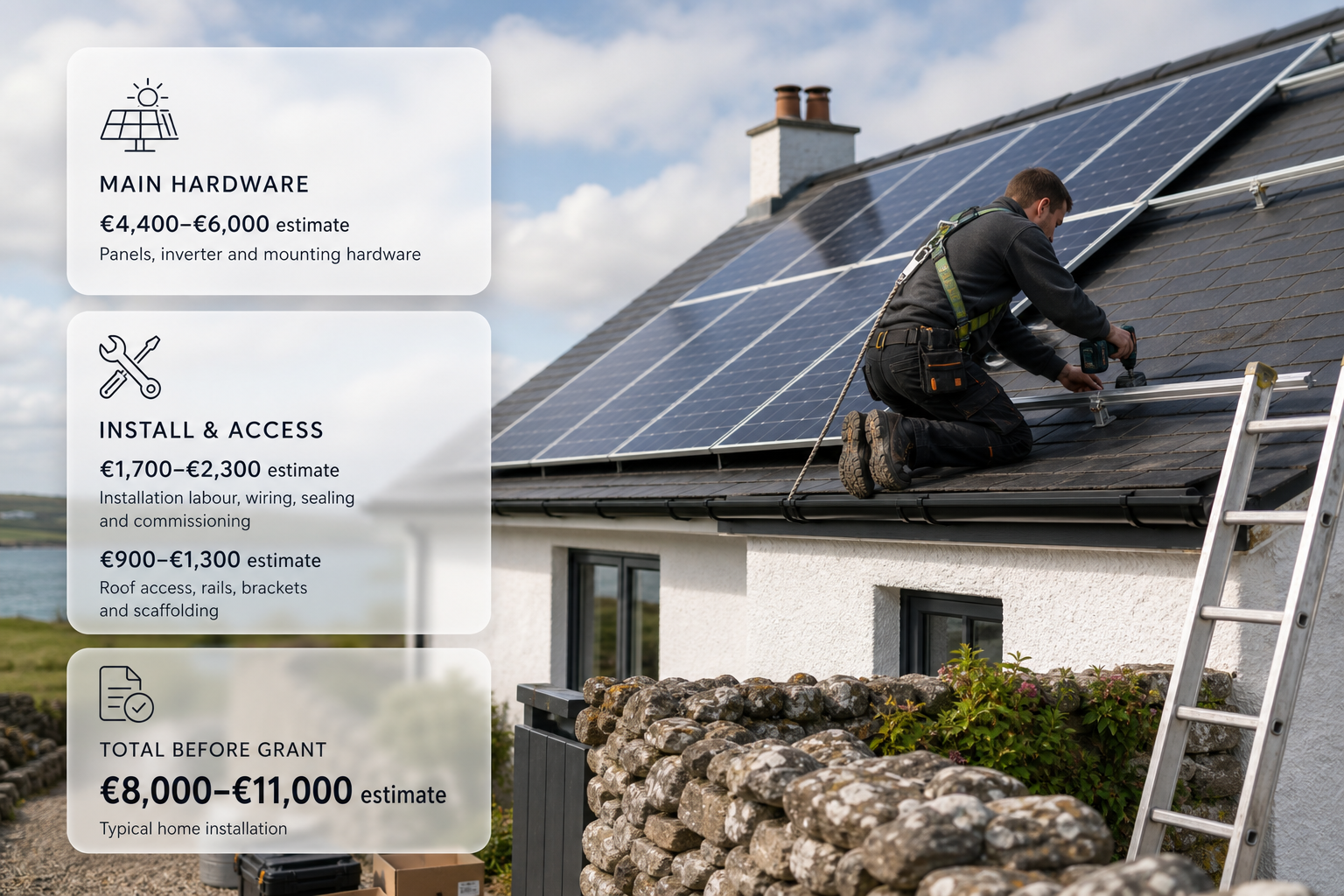
What remains is the job itself. The table below is an aggregate Irish market estimate for a typical home installation, using the lines a written quote normally shows:
Line on a quote
Typical range
Panels, inverter and mounting hardware
€4,400–€6,000
Installation labour, wiring, sealing and commissioning
€1,700–€2,300
Roof access, rails, brackets and scaffolding
€900–€1,300
Electrical certification, grid connection and grant paperwork
€250–€450
Waste removal and contingency allowance, roughly a tenth of the lines above
€750–€950
Total before grant
€8,000–€11,000
A quote that leaves out scaffolding, electrical certification or the grant paperwork is not cheaper than this band; the missing items usually return later as extras. SEAI reports systems above 4 kWp as a separate category, and its median-cost figures for those larger arrays are the next piece of the picture.
Before and after the Solar PV grant
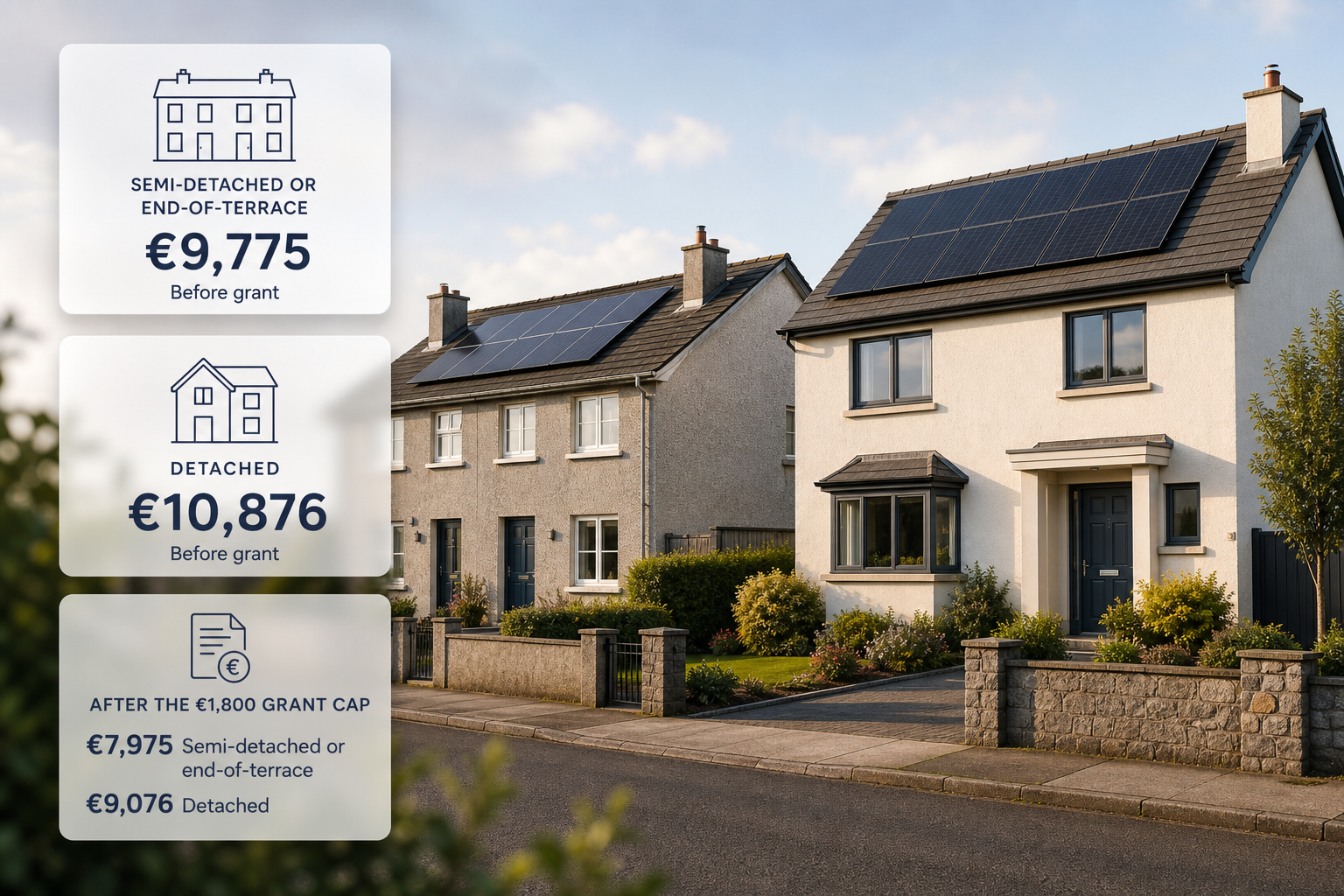
SEAI's median-cost data records €10,876 for detached homes and €9,775 for semi-detached or end-of-terrace homes for Solar PV systems above 4 kWp, and the total Solar PV grant is capped at €1,800 (SEAI). The table below is an aggregate Irish market estimate that sets that cap against the median figures, showing the position before and after grant for two common home types:
Home type (systems above 4 kWp)
Before grant
After the €1,800 grant cap
Semi-detached or end-of-terrace
€9,775
€7,975
Detached
€10,876
€9,076
Both medians sit inside the €8,000–€11,000 itemised band above, which is the usual shape of a larger domestic job once access, hardware and certification are counted. The after-grant column assumes the full €1,800 is drawn; where a smaller amount is approved, the net figure sits closer to the before-grant number. Applied to the itemised band, the same cap takes a typical installation from €8,000–€11,000 to €6,200–€9,200.
How much of the cap a particular house can draw is decided by SEAI. For solar PV, the grant is open to owners of homes built and occupied before 2021 (Citizens Information), so an owner of a newer property confirms the position with SEAI before signing anything. Solar thermal panels heat water rather than generate electricity: they are a separate measure with their own costs and their own grant line, and the two should not be compared on price.
What changes the price
System size comes first, because a larger array means more panels, a larger inverter and more mounting hardware. Roof access is the next big mover, and it is the line that varies most between two similar houses: height, tile or slate covering, dormers, chimneys and the cable route from the roof down to the consumer unit all shift the labour and access ranges in the itemised table above. Hardware class matters as well, since panels and inverters sit in different bands of efficiency and warranty cover, and the installer's own rate and the way the job is packaged account for the rest.
Practical details turn up as quote lines too: extra rails or sealing, a consumer unit that needs attention before the inverter can be connected, a cable run through a solid wall, or panels split across two roof faces. Where other work is being planned at the same time, such as a new roof covering or an attic conversion, scaffolding and access can sometimes serve both jobs, which is where the wider field of construction and home renovation work comes into the picture. When one quote sits above another, the roof access line in the itemised table is usually where the difference started.
Batteries: what they add and which homes they suit
Storage is quoted separately and is not part of the tables above. The table below is an aggregate Irish market estimate for a battery installed alongside a new array:
Line on a quote
Typical range
Battery storage unit
€1,800–€3,300
Integration, wiring, protection and commissioning
€700–€1,400
Fixing, enclosure and labelling
€100–€300
Total installed alongside a new array
€2,600–€5,000
Whether storage suits a particular house depends on when the electricity is used. A household that is out during daylight and draws most of its power in the evening and overnight can use more of what the array stores, while a household at home all day uses much of the output as it is generated and has less to store. A battery also has a shorter working life than the panels, so it is worth pricing against the €2,600–€5,000 band above as a decision in its own right rather than folding it into the main total.
Roof suitability and shading
How much a given roof can produce rests on its orientation, its pitch and the shade that falls across it during the day, and all three are assessed in a survey rather than guessed from ground level. The condition of the covering matters as much as its shape: where it is near the end of its working life, replacing it before the panels go up avoids paying twice for the roof access and preparation line in the first table. A roofer's opinion on the covering and the structure belongs in the plan before a final layout is agreed.
Whether planning permission is needed is decided by the relevant local authority and depends on the property and the exact works, so owners confirm the current position with the local authority before booking anything.
Maintenance, warranties and lifespan
Solar panels have no moving parts, so upkeep is light. Rain clears most soiling; panels under trees or in areas with heavy bird activity are best washed occasionally with water and a soft brush, and a pressure washer should be avoided because it can damage seals and frames. After a storm, a visual check of the panels, a look at the inverter readout and a clear-out of gutters and roof valleys cover most of what is needed.
Warranties arrive in layers rather than as a single cover period: a product warranty on the panels, a performance warranty on their output, a warranty on the inverter, and a workmanship warranty from the installer covering roof penetrations, mounting and wiring. Keeping the commissioning certificate, warranty documents and handover notes together helps at resale, at an insurance claim and when grant paperwork is being finalised.
The panels are the long-lived part of a system and the inverter is the component most likely to need replacement at some point, so its warranty terms are worth reading separately from the panel warranty rather than assuming one period covers the whole installation.
FAQ
Why can two quotes for the same house differ by thousands?
Quotes often cover different scopes. One may include scaffolding, certification and grant paperwork while another lists them as extras, and panel class, inverter choice and whether storage has been assumed all move the figure as well. Setting each quote against the lines in the itemised table, one by one, settles the comparison faster than looking at totals.
Should a battery go in with the panels or wait until later?
Fitting storage at the same time as the array means one visit to the roof and one commissioning session. Adding it afterwards means paying again for access, integration and testing, which is why the battery table gives an installed total rather than a unit price on its own. A household that uses very little electricity in the evening may get more from spending the same money on a larger array, so the decision is best made after the installer has seen the meter and the pattern of use.
What should the installer hand over at the end?
Ask for the commissioning and certification documents, panel and inverter warranty paperwork, the monitoring login details and a simple diagram of what was installed. Grant claims and future repairs both run more smoothly when that folder exists. A short walkthrough of how to read the inverter display is worth asking for while the installer is still on site.
What happens if shading gets worse after the installation?
Output from the affected panels falls, which usually shows up first in the monitoring data rather than as a fault. The practical responses are a change of layout, additional panels or panel-level electronics, rather than anything dramatic on the roof. Checking the monitoring figures before calling anyone out is the sensible first step, and the installer who carried out the survey is normally best placed to advise.
Getting started
Comparing quotes on a like-for-like basis is the practical way to settle what solar will cost in Ireland. On ShamFix, posting a job and listing it is free and there is no commission, and a subscription is planned for the future. ShamFix does not check or certify tradespeople, and profiles are filled in by tradespeople themselves, so homeowners should check registrations themselves and read reviews before appointing anyone. With before-grant and after-grant figures in hand, the quote that matches the scope, the roof and the timing is the one to judge on the details.