Home Insulation Costs: What Irish Homes Pay in 2026
Attic insulation runs from about €1,200 to €1,800 for a typical Irish semi, with wall routes costing several times more before any SEAI grant.
/9 min read
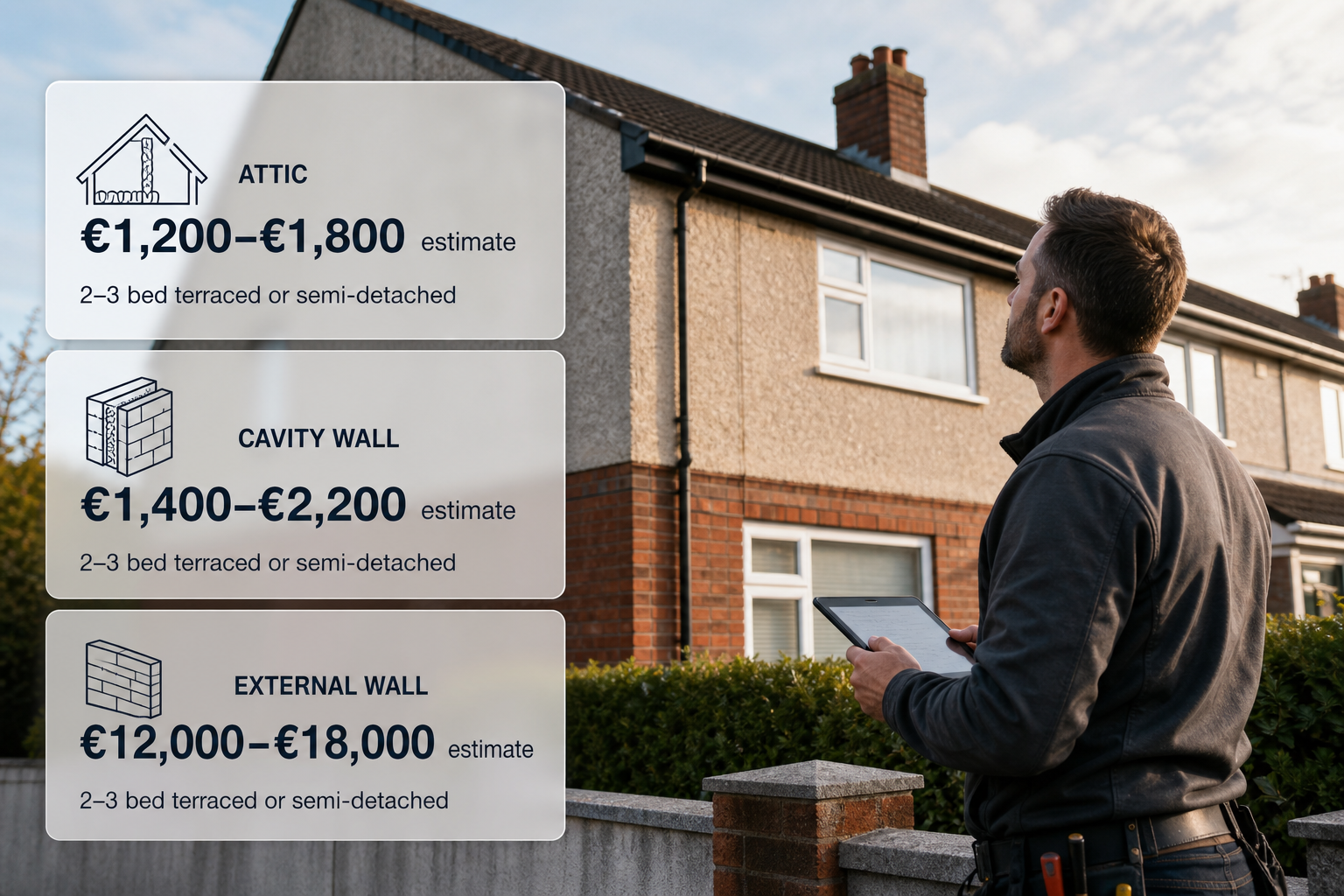
Home insulation in Ireland is priced per job rather than per house type, so the most useful answer is a set of realistic ranges: an aggregate Irish market estimate for a typical 2–3 bed semi-detached home is €1,200–€1,800 for attic insulation, €1,500–€2,200 for cavity wall pumping, €4,000–€12,000 for internal wall lining and €13,000–€19,000 for an external wall wrap. Those are market prices for supply and fit, with no grant deducted. An SEAI grant is applied for and paid separately from the work, so what a homeowner is finally left to pay is the market price minus whatever the measure qualifies for.
What home insulation costs, by insulation type and house type
The table below is an aggregate Irish market estimate for supply and fit on a straightforward house where access is easy and no remedial work is needed. It covers the routes an Irish homeowner is most likely to be quoted for: attic insulation laid between and across the ceiling joists, rafter insulation for a room in the roof, pumped cavity wall insulation, internal dry lining and an external wall wrap.
Insulation route
2–3 bed terraced or semi-detached
4-bed detached
Attic (quilt between and across joists)
€1,200–€1,800
€1,900–€2,900
Rafter (between and under rafters, then finished)
€3,000–€5,500
€5,000–€8,500
Cavity wall, pumped from outside
€1,500–€2,200
€2,200–€3,400
Internal wall dry lining
€4,000–€12,000
€6,000–€15,000
External wall insulation
€13,000–€19,000
€18,000–€27,000
Read across the attic line and a semi-detached with a 30 m² attic is paying roughly €40–€60 per square metre of attic floor, a fraction of the per-square-metre rate on the wall lines below it. Read down the external wall column and the same house is paying many times the attic figure, which is why so much of the gap between two quotes is really a gap in scope. Homeowners comparing several prices for insulation and exterior works should ask each contractor to itemise the quote in the same categories.
The main routes, and what each one changes
Attic. The least expensive measure in the table and the least disruptive. The quilt goes between and then across the ceiling joists, the loft hatch and pipe gaps are sealed, and most jobs are finished in a day without changing how any room looks.
Rafter. The option for a converted attic or a room in the roof. Insulation goes between the rafters and then under them, finished with plasterboard, which makes it the most expensive way to treat a roof space because the finish is part of the job.
Cavity wall. The cheapest wall option, but only where a usable cavity exists. The crew drills small holes from outside and pumps in beads or foam, and the house does not have to be emptied.
Internal wall dry lining. Used on solid or hollow block walls where pumping is not possible, or where only the front and rear walls are treated. It loses a little floor space in each room and is done room by room.
External wall insulation. The largest single outlay. A wrap is fixed to the whole envelope and finished with a render or cladding. It also deals with cold bridging at wall junctions, which the cheaper routes cannot do.
What drives the difference between two quotes for the same house
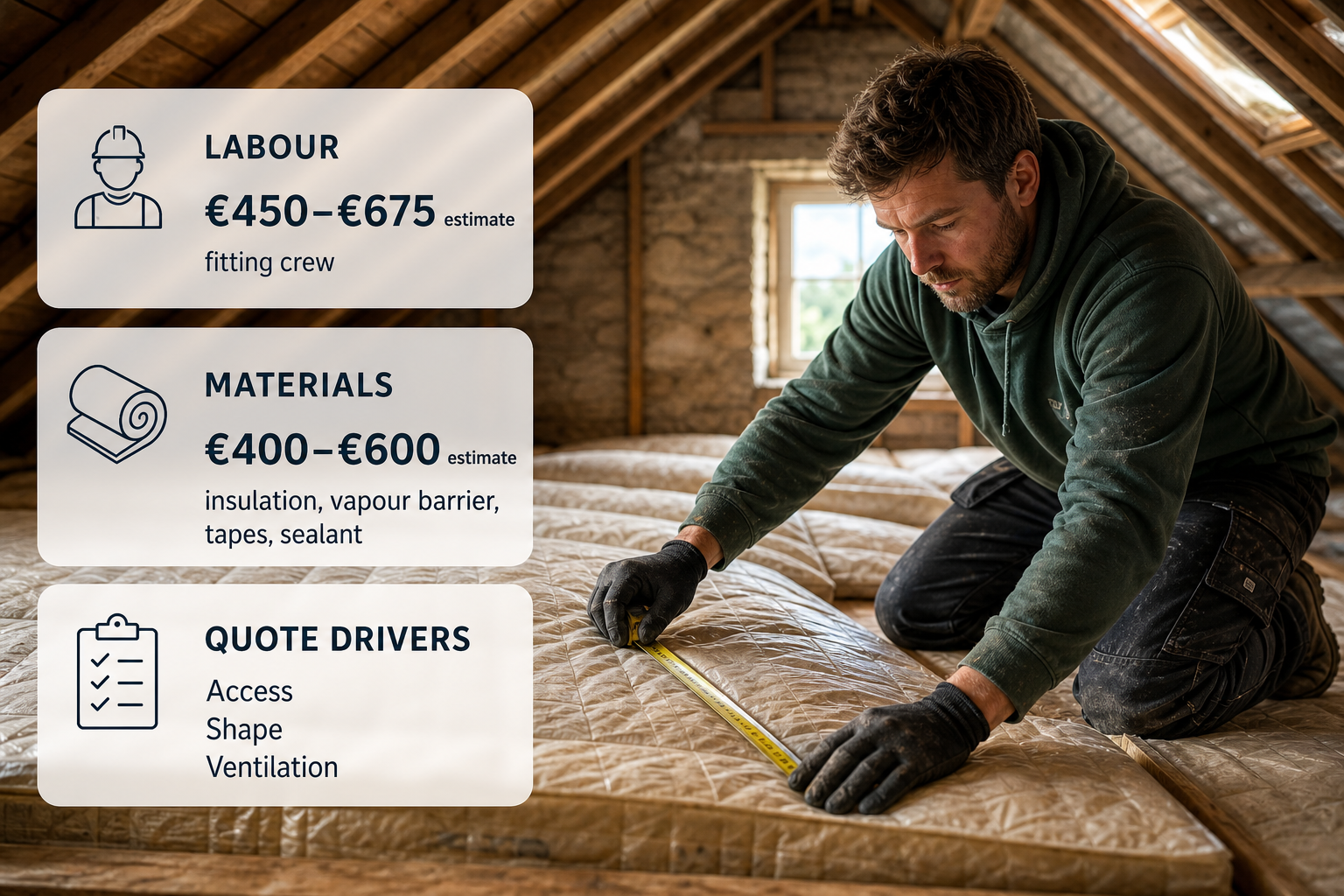
Area is the biggest single factor, and a quote is normally built up from the same few lines. The figures below are aggregate Irish market estimate figures for a mid-range attic job in a 3-bed semi-detached house, the job that sits in the €1,200–€1,800 band above.
Preparation and access (clearing the loft, draught-proofing the hatch, guarding downlights)
€140–€210
Per-item extras (an extra downlight guard, a second loft hatch)
€60–€90
Removal and disposal of old or damp insulation
€90–€135
Contingency and waste, about 5% of the job
€60–€90
The six lines add to €1,200 at the low end and €1,800 at the high end. Beyond area, these are the items that move a quote:
Access. Height, a narrow side entrance, a loft that has to be cleared first, or scaffolding needed for two or three storeys.
Shape. Dormers, roof windows, chimneys, sloped ceilings and boxed-down pipework all add cutting and sealing time.
What is already up there. Downlights without fire-rated covers, a water tank, old mineral wool that has been walked on and has to come out, and boarded floors that must be lifted and relaid.
Ventilation. Airtightness work in an older house usually means adding background vents and extract fans, quoted as a separate item.
Making good. Skimming, new window reveals, skirting and repainting after internal lining or an external wrap.
Timing and occupancy. A house that has to be worked around, or a job squeezed in before winter, is priced higher.
Paperwork. Who deals with the grant application and any BER assessment, and whether that work is inside the price.
Because the wider construction and home renovation market sets the labour and material rates behind every one of those lines, two quotes for the same attic can land at opposite ends of that band with no difference in the work itself.
Which insulation usually pays back best in an Irish home
A home that is not properly insulated loses 20 to 30 percent of its heat through the roof on average, and attic or rafter insulation is generally the most cost-effective energy efficiency upgrade for a house (SEAI).
That combination explains why attic work is nearly always the first job worth doing: it is the smallest outlay in the table above, it targets a large slice of the heat a house is losing, and it leaves the rooms below untouched. Pumped cavity wall insulation is usually the next best value where a cavity exists, because the work is quick and needs no scaffolding or internal finishing. Internal lining and external wraps cost several times more and take far longer to repay out of a heating bill, even with a grant, but they do things the cheaper routes cannot: they deal with solid walls, with cold bridging at junctions, and with houses that will never be comfortable until the walls themselves are warmer. Saving up for a wall wrap while the attic is bare gets the order backwards.
What is left to pay after an SEAI grant
The grant is not a discount applied to the quote. A contractor prices the market rate for the work, the grant is dealt with under the SEAI scheme, and the balance a homeowner pays follows the size of the market price in the table above: a job at the top of the attic range leaves very little to find, while a job in the external wall range leaves thousands. Grant amounts, eligibility and scheme rules change over time, so the current terms are confirmed with SEAI before a contractor is booked.
Two conditions sit alongside the grant. SEAI requires all grant works to be carried out by an SEAI-registered contractor and supported by a formal contract before works commence (SEAI). For external or internal wall insulation started after 1 November 2019, grant payment requires compliance with Building Regulations Part L, and once the works alter at least 25% of the home's surface area the house must reach a minimum B2 BER rating or meet the scheme's heating-system and attic-insulation standards (SEAI).
That B2 condition is the reason wall insulation is seldom priced in isolation. The standard looks at the house as a whole, so the heating system and the attic insulation can decide whether wall work qualifies at all, and an independent BER assessor is the person who confirms where a particular house stands before a contract is signed.
Requirements for planning permission, and for any alteration to the electricity supply or meter position, vary with the age, location and design of the house. The homeowner confirms the current steps with the relevant local authority for planning matters and with the relevant network operator for a supply or meter alteration.
Comparing quotes on a like-for-like basis
Quotes are easiest to compare when every contractor is asked for the same breakdown: the surface area being treated, the insulation type and depth, the preparation included, the extras priced per item, the removal of old material, the waste allowance, and whether making good sits inside or outside the price. It is worth asking too whether the price depends on a BER target being met, and whether the SEAI registration number and insurance details will be confirmed in writing before work starts. A quote that comes in lower because it leaves old insulation in the loft or skips the downlight guards is a smaller job, not the same job for less money, and the removal and per-item lines in the table above are where that difference shows up.
Getting the work started
Posting a job and listing it on ShamFix is free and there is no commission, and a subscription is planned for the future. ShamFix does not check or certify tradespeople; profiles are filled in by tradespeople themselves, so homeowners should check registrations themselves and read reviews. With the ranges above in hand, a homeowner can see at a glance whether a quote sits in the normal band for the work, and which lines have been bundled together or left out.
FAQ
Does a grant reduce the price a contractor quotes?
No. The contractor quotes the market price for the work and the grant is handled separately, so the two figures should never be mixed together when comparing quotes. Anyone given a single figure described as 'the price after the grant' should ask for the gross price and the grant figure to be shown as separate numbers.
How long does each job take, and does anyone need to move out?
An attic is usually done in a day or so, cavity pumping in half a day to a day, internal lining over several days room by room, and an external wrap over one to three weeks with scaffolding up for part of it. Nobody normally has to leave the house, though furniture has to be moved away from walls and there will be dust. It is worth agreeing in advance which rooms are out of use and when the crew will need access to the loft.
The house was built in the 2000s, so is anything still worth doing?
Many homes from that period already have pumped cavity walls and a reasonable attic quilt, so the work that pays is usually topping up the attic depth, sealing the loft hatch and draught-proofing around pipes and the chimney. An extension, a converted attic or a garage conversion added later may never have been insulated at all. A BER assessment shows what the existing certificate assumes about the fabric, which is often what a future buyer will look at.
What happens with ventilation and condensation after the work?
Insulation makes a house tighter, so moist air has fewer routes out, and older homes with open chimneys or unsealed vents can end up with condensation forming on the coldest surfaces. The answer is planned ventilation rather than leaving deliberate gaps in the insulation: background vents, extract fans in the kitchen and bathrooms, and a check that the loft space is still ventilated at the eaves. Any quote for wall or attic work should show how ventilation is being handled.