For a standard three-bedroom semi-detached house in Ireland, external wall insulation usually costs €13,000 to €19,000 before grants, which comes down to roughly €7,000 to €13,000 after the €6,000 SEAI grant for that property type. That's why so many homeowners start by looking for a modest insulation job and quickly realise they are pricing a full exterior retrofit.
That shock is understandable. External wall insulation isn't a small add-on. It changes the outer skin of the house, affects window details, gutters, pipes, cables and finishes, and often brings in extra work that a simple per-metre headline price doesn't fully capture. For many Irish homes, the key question isn't just “what does external insulation cost?” but “what will the whole project really cost once everything around it is included?”
A useful way to look at it is this. External wall insulation is expensive because it's one of the biggest fabric upgrades a homeowner can do. The payback on energy bills alone can be long, but the full return is broader than that: warmer rooms, fewer cold wall problems, lower condensation risk, a stronger BER, better resale presentation, and a house that's far better prepared for low-temperature heating.
Why Is External Insulation So Expensive
A homeowner gets three quotes for external wall insulation, compares them with attic insulation prices, and assumes something has gone wrong. In practice, the quote is usually reflecting the actual scope of the job. External insulation changes the outside of the house, so the cost includes far more than insulation boards stuck to a wall.
The biggest mistake is treating EWI as a simple rate-per-square-metre purchase. It is a full exterior works package. The insulation itself is only one part of it. The contractor also has to prepare the wall, deal with reveals and sills, extend or refit pipes and fittings, provide scaffold, protect the site, apply reinforced basecoat and finish render, and leave the elevations weather-tight and visually clean. For a sense of the wider works involved, it helps to look at the full list of elements a proper job should include.
A lot of the cost sits in labour and detailing.
Older Irish houses rarely give installers a flat, simple surface. There may be cracked render, uneven blockwork, old vents, meter boxes, cables, boiler flues, satellite brackets, soil pipes, or narrow eaves that all need to be handled properly. Every interruption slows the job and adds materials. Good installers spend time on the awkward parts because those junctions decide whether the system performs well and still looks right in ten years.
Scaffolding is another major cost driver, especially on detached homes, gable walls, or sites with poor access. Then there are the items homeowners often do not allow for at the start. ESB meter repositioning, extending downpipes, replacing sills, moving exterior lights, adjusting gates or railings, and making good around paths or porches can all sit outside the headline insulation rate. Those extras are often what push a project from “expensive” to “more than expected.”
There is also a compliance piece to it. Grant-supported work has to meet a set standard. That usually means full-system installation, approved materials, and the right thickness and detailing, not a cheaper patch solution on one cold wall. That is the right approach for performance, but it does reduce the scope for bargain pricing.
Homeowners are right to be cautious about the upfront cost. Payback through energy savings alone can be slow, particularly if the house already has decent heating controls or moderate fuel use. The return is broader than bills. EWI usually improves comfort, reduces cold wall effect, helps with condensation risk, refreshes the outside appearance of the house, and can support resale appeal where BER and finish matter to buyers.
So yes, external insulation is expensive. It is expensive because it is visible, labour-intensive, detail-heavy building work carried out across the whole envelope, with several small ancillary costs that many first quotes do not spell out clearly enough.
Typical External Insulation Costs in Ireland 2026
A homeowner gets quoted €120 per m², multiplies it by the house size in their head, and assumes they have a working budget. That is usually where the confusion starts. External insulation is priced on the external wall area being treated, and the final contract figure often lands well above the quick back-of-envelope estimate once reveals, returns, access details, and finish work are properly measured.
In practice, installed external wall insulation in Ireland is often discussed as a per-metre rate, but homeowners should treat that as a starting point rather than a finished budget. On many standard homes, the job routinely runs well into five figures before any grant is applied. The reason is simple. EWI is not just insulation board fixed to a wall. It is a full exterior upgrade system with labour, detailing, basecoat, mesh, finish coat, and site setup all wrapped into one price.
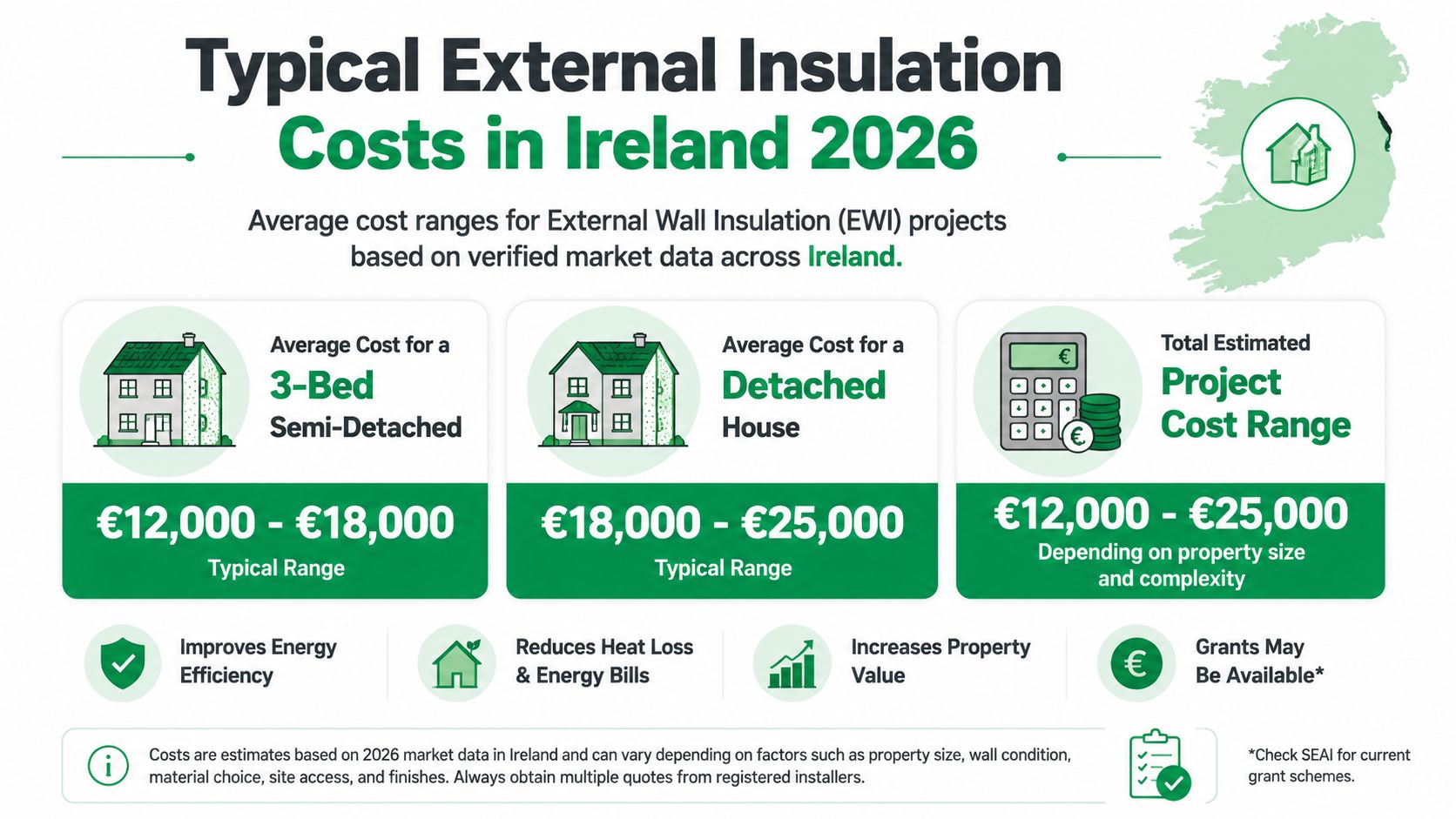
Typical project costs by property type
External wall insulation is priced on the area of external wall being treated, at roughly €110 to €160 per square metre all-in. A three-bed semi typically has somewhere around 80 to 100 square metres of external wall; a detached house has considerably more, which is why the same floor area can produce very different quotes.
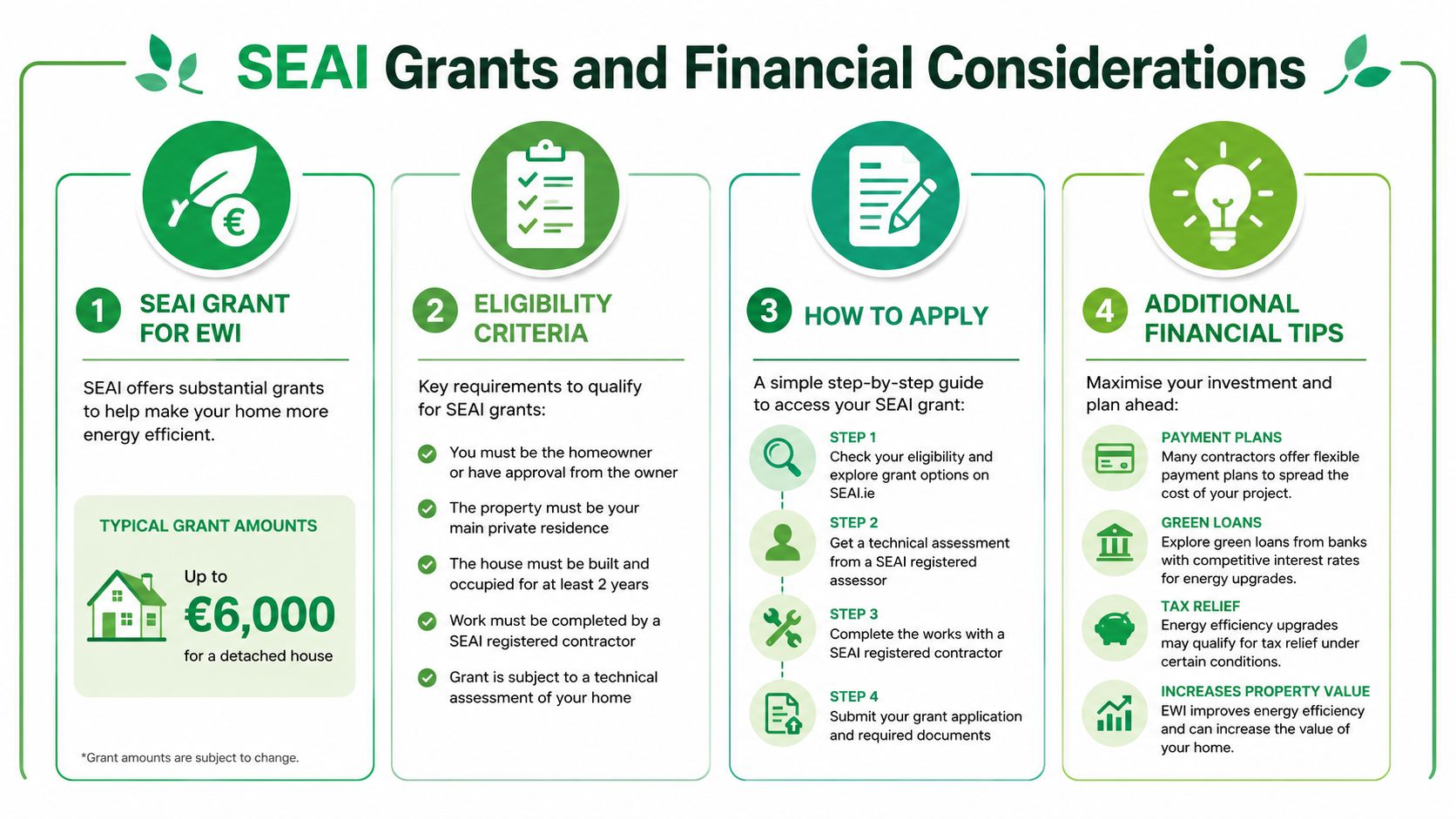
| Property type | SEAI grant | Typical cost before grant | Typical cost after grant |
|---|---|---|---|
| Detached house | €8,000 | Scales with wall area - measure required | - |
| Semi-detached / end-terrace | €6,000 | €13,000 to €19,000 | €7,000 to €13,000 |
| Mid-terrace | €3,500 | Lower - fewer exposed elevations | - |
| Apartment | €3,000 | Lowest - smallest treated area | - |
Those figures are useful as ballpark planning numbers, but they are not a substitute for a measured quote. Two houses with similar floor area can still come back with noticeably different EWI prices because one has a large exposed gable, deeper window reveals, awkward side access, or more detail around porches and boundary walls.
Why headline rates often understate the real budget
The per-metre figure is useful for comparison between quotes. It is less useful for predicting what you will pay unless the contractor has measured the walls and included the site-specific details.
A proper quote usually reflects more than insulation thickness and render colour. It should account for:
The total exposed wall area
Window and door reveal treatment
Number of storeys and scaffold complexity
Repairs or preparation needed on existing walls
Finishing details at eaves, sills, pipes, and meter boxes
That is why cheaper quotes can be misleading. If one installer has priced only the obvious wall area and another has allowed for the awkward parts, the second quote may look expensive while being far closer to the true project cost.
Homeowners comparing insulation and exterior works providers on ShamFix should check whether the quote explains what is included at windows, doors, pipework, and roof junctions. A short one-page figure is easy to read. It is much harder to rely on once the extras start appearing.
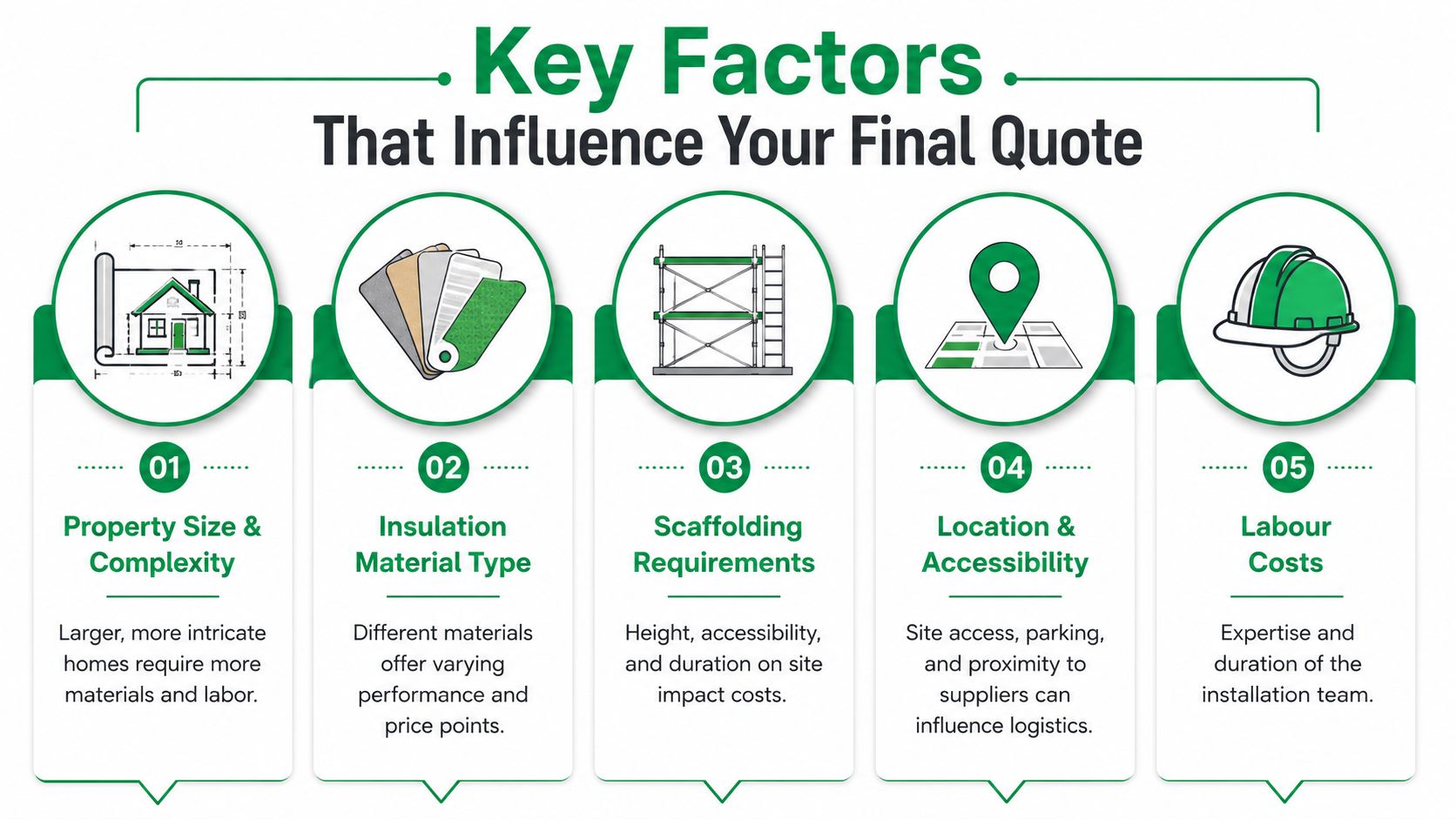
Key Factors That Influence Your Final Quote
The biggest driver of external insulation cost is simple. Wall area sets the baseline. After that, material choice, finish, access, wall condition and detailing around services all move the price up or down.
In Ireland, installed EWI typically runs at €110 to €160 per m² including VAT, with material benchmarks of €50 to €70 per m² for EPS boards, €70 to €100 per m² for mineral wool, €90 to €120 per m² for wood fibre, and PIR up to €150 per m², according to OSBER's guide to external wall insulation cost in Ireland. The same source notes that higher-density wood fibre and PIR can come at a 30 to 50% premium over EPS.
Property type and wall area
A detached house costs more because it usually has more exposed wall. That sounds obvious, but it's the foundation of nearly every quote. A mid-terrace has fewer external elevations. A semi-detached sits in the middle. A detached has the broadest wrap and usually the highest scaffold requirement.
The number of storeys also matters. Once access gets more complicated, labour slows down and scaffolding becomes more significant.
Material choice
Not every system is priced the same, and not every house needs the same board.
| Material | Cost benchmark |
|---|---|
| EPS | €50 to €70 per m² |
| Mineral wool | €70 to €100 per m² |
| Wood fibre | €90 to €120 per m² |
| PIR | Up to €150 per m² |
A few practical trade-offs shape that decision:
EPS: Usually the entry-point system. It's common because it keeps the wrap cost lower.
Mineral wool: Costs more, but some homeowners prefer it where non-combustible performance is part of the brief.
Wood fibre and PIR: These are more specialised choices. They suit projects where moisture behaviour, wall build-up or limited thickness makes the standard option less attractive.
Finish and detailing
Two quotes using the same insulation board can still differ because the finish isn't the same. A basic finish won't cost the same as a more decorative or higher-spec exterior finish. The final appearance, maintenance expectations and weather resistance all feed into that choice.
Then there are the details that slow a crew down:
Window reveals and corners
Sill build-outs
Eaves junctions
Downpipes and service penetrations
Uneven or cracked wall surfaces that need prep
The expensive part of EWI often isn't the flat wall. It's every edge, opening and awkward junction around it.
Access and site constraints
A quote can rise for reasons that have nothing to do with insulation board performance. Tight side access, limited parking, a sloping site, conservatories, overhead obstacles, or a house close to a boundary can all complicate installation.
That's why external insulation cost should never be judged on a single market average alone. The metre rate is only the starting point. The actual price comes from how straightforward, or how awkward, the building is to wrap properly.