Pumped bonded bead cavity wall insulation typically costs €7.50 to €13 per m² in Ireland, including materials, labour and VAT. For a typical 3-bed semi-detached house, that puts the whole job at roughly €1,500 to €2,200 before any SEAI grant.
That is the number homeowners should start from, not the glossy quote or the cheapest number on a flyer. It is also why cavity wall insulation is usually the sharpest-value wall insulation job a house can get, while external wall insulation on the same kind of house runs €13,000 to €19,000, which is a completely different spend bracket.
Typical Cavity Wall Insulation Costs in Ireland
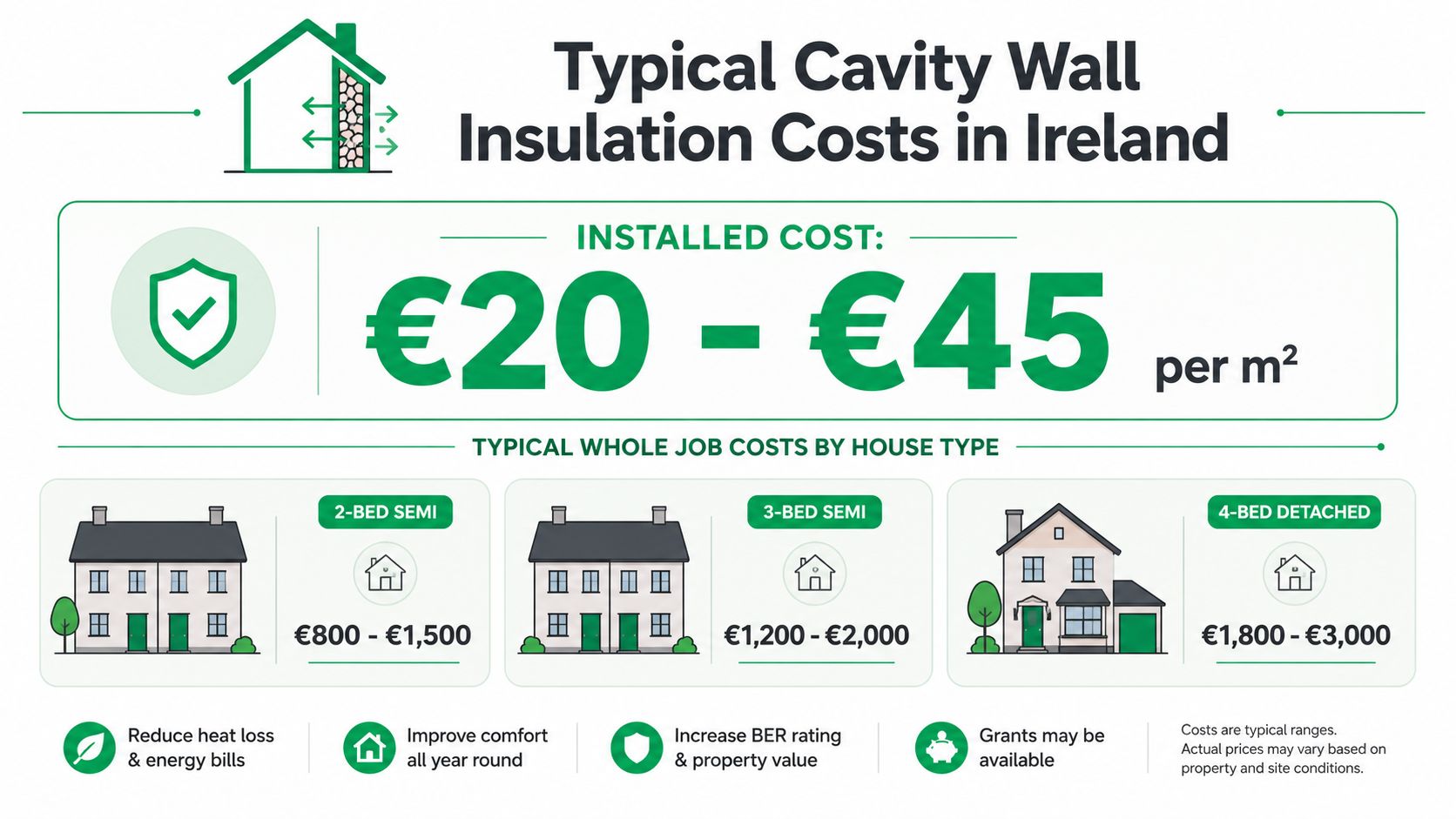
€7.50 to €13 per m² is the installed rate for pumped bonded bead in Ireland, and it already includes materials, labour and VAT. For a 3-bed semi-detached house, the whole-job figure lands around €1,500 to €2,200 before grant, which is the range homeowners should use when judging quotes, not a guess based on floor area alone.
That puts cavity wall insulation in a very different league from the dearer wall-insulation options. External wall insulation on the same house is typically €13,000 to €19,000, so a buyer who is comparing those two systems is not comparing like with like. One is a straightforward fill of a suitable cavity, the other is a full envelope job with much heavier labour and material costs.
What that price actually buys
The price is for a complete installed job, not a bag of insulation material. That matters because the total cost is driven by access, drilling, injection, sealing and making good, not just the product in the truck.
Practical rule: if a quote looks far below the normal installed range, it usually means something has been left out, not that the contractor has discovered a miracle discount.
A fair quote should make sense against the house type. A modest semi with a clean cavity is at the lower end, while a larger detached home or a property with more wall area will climb as the exposed surface grows. The price moves because more wall means more bead, more drill points and more labour hours.
For owners, the useful question is simple. Does the quote sit in the normal installed band for a fillable cavity, or is it really a different product, a partial job, or a number that ignores VAT and remedials? That is how bad comparisons happen.
What Drives the Price Up or Down
Geometry and access do most of the work
Wall area is the main cost driver. A bigger house has more external wall to fill, which means more material, more drilling, more labour, and more time on site.
Access changes the bill in a way that homeowners often underestimate. A straightforward two-storey semi with clear perimeter access is one thing, but a side passage, conservatory, stepped ground level, or blocked wall face can slow the job down and add equipment needs. Even when the insulation itself is cheap, awkward access can push the total quote up.
A neat-looking house can still be an awkward house to insulate. The outside layout matters more than the bedroom count.
The cavity itself can change the job
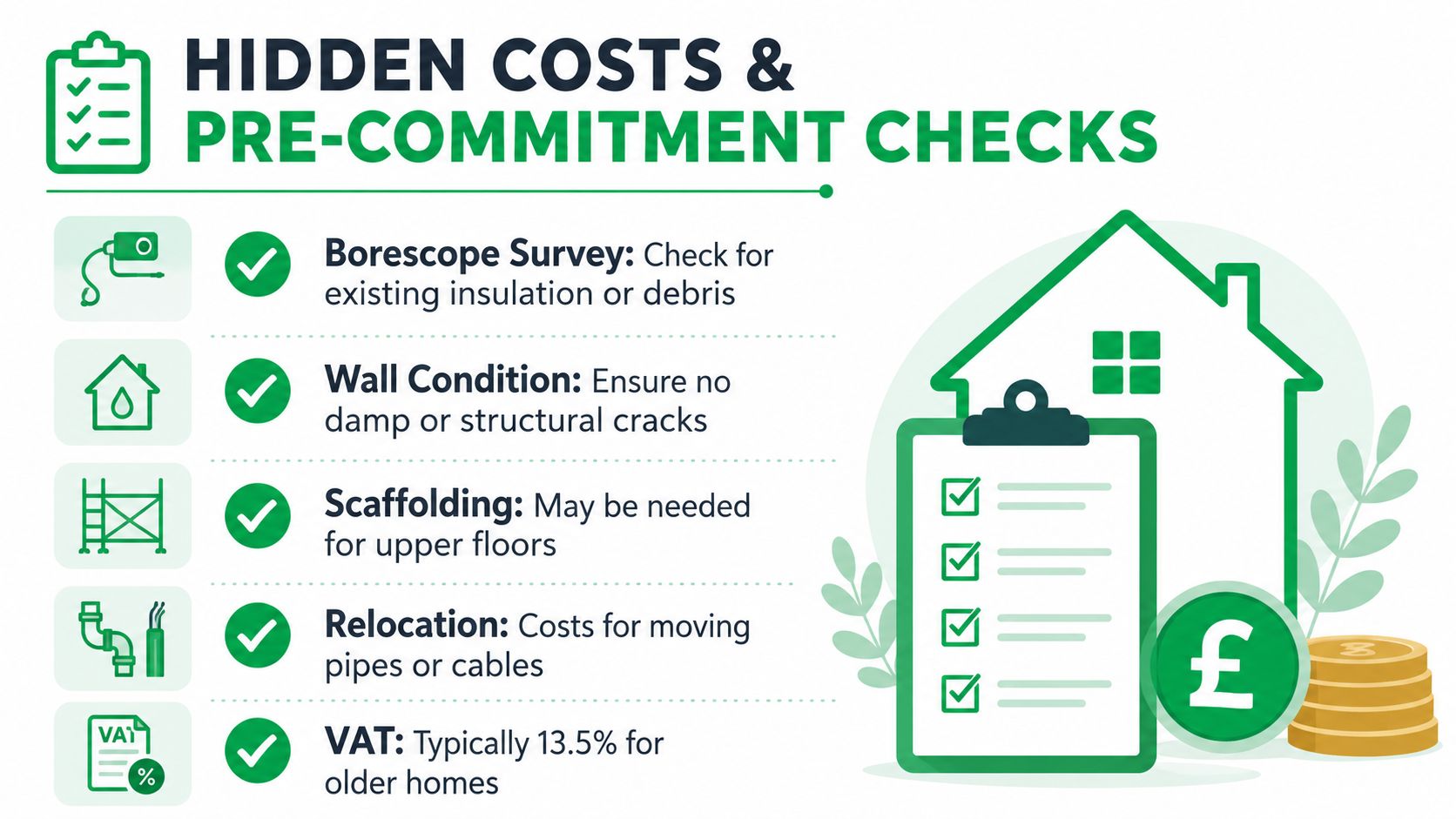
Not every cavity is equal. Narrow cavities, cavities with rubble inside, or cavities that already hold old insulation can all need more checking before a contractor will pump anything in. A poorly conditioned wall doesn't just cost more, it can make the job unsuitable.
Material choice matters too, but homeowners shouldn't obsess over the brochure language before checking the wall. Pumped bonded bead is the standard cavity method in Ireland for suitable walls, while other insulation systems may be used in different situations or on different wall types. The first question is always whether the cavity is suitable, not which label sounds best.
Here's the clean way to consider it:
Simple geometry: lower labour, easier access, cleaner quote.
Complex wall layout: more time, more setup, more cost.
Questionable cavity condition: survey first, because the wall may need repair or may not suit cavity fill at all.
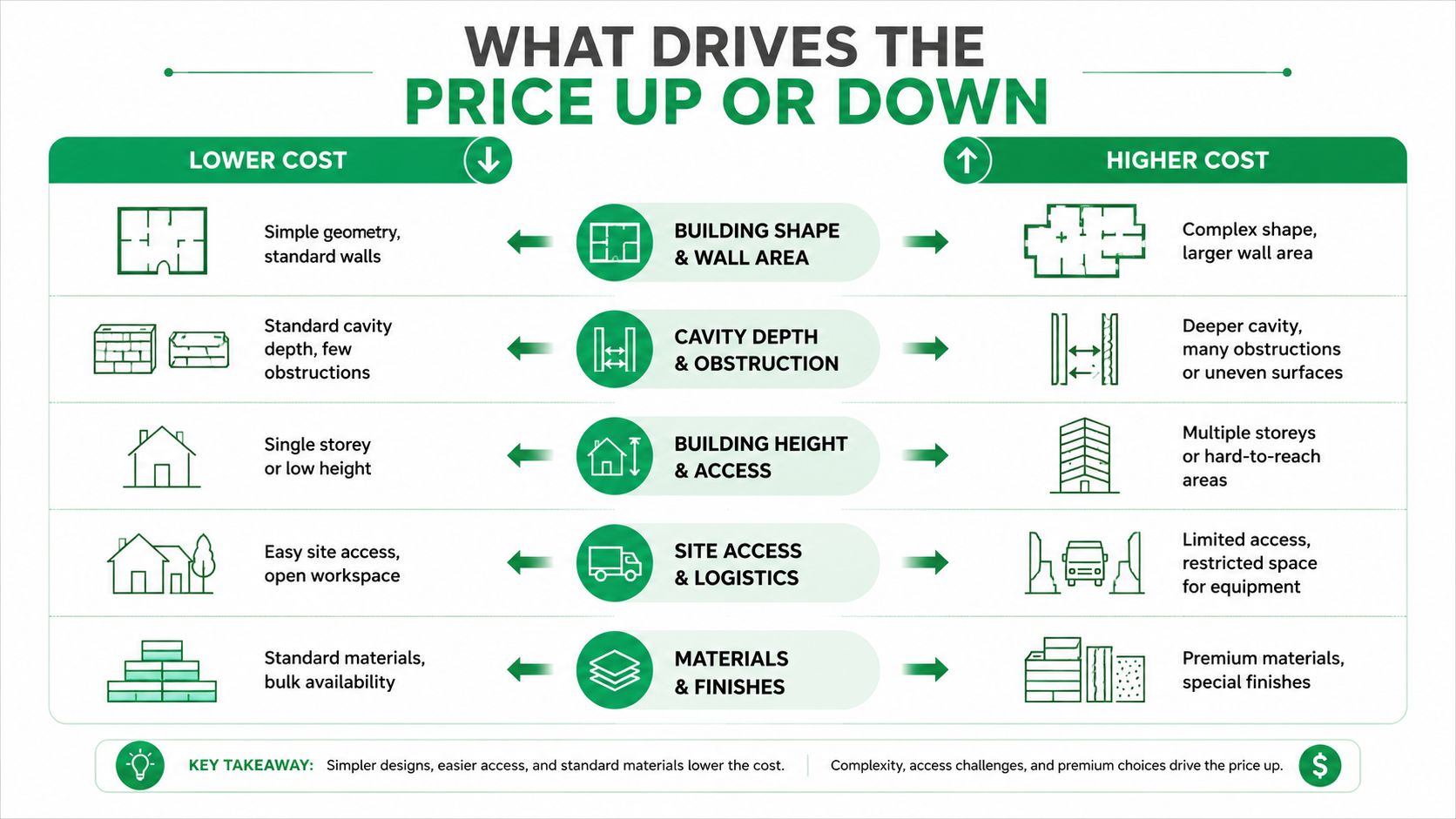
The headline lesson is blunt. Two houses that look similar from the kerb can produce very different quotes once the cavity width, wall area and access are checked properly. That is normal, not a rip-off by itself.
SEAI Cavity Wall Insulation Grants Explained
The SEAI cavity wall insulation grant is part of the Home Energy Grants scheme, and it only applies when the work is done by an SEAI-registered contractor. The home must have been built and occupied before 31 December 2010, and a post-works BER is required, with €50 of grant support toward that assessment.
The current grant values were updated on 3 February 2026. Under reporting on the scheme, a semi-detached or end-of-terrace home is around €1,800 as a guide, with a higher rate for detached homes and lower rates for mid-terrace homes and apartments. There is also a higher rate for homeowners on qualifying welfare payments. Those values matter because cavity wall insulation is a relatively cheap retrofit measure, so the grant can cover a big slice of the installed price.
| Dwelling Type | Grant Value (Approx.) |
|---|---|
| Detached house | Higher than semi-detached |
| Semi-detached or end-of-terrace | Around €1,800 |
| Mid-terrace or apartment | Lower than semi-detached |
| Qualifying welfare payment rate | Higher rate applies |
The practical point is simple. The grant does not turn the project into a free-for-all, but it can pull the after-grant bill down sharply on a suitable semi-detached house. That is why people should always ask for the installed price before grant and the expected figure after grant as two separate numbers.
Grant amounts are set by dwelling type and are updated periodically, so confirm the exact figure for your property type on seai.ie before budgeting.