
ShamFix
Back to insights

What Does Website Design Cost in Ireland?

A starter site runs about €500–€1,200 and a custom build up to €25,000, plus hosting, domain and yearly upkeep.

8 min read
What Does Website Design Cost in Ireland?

Website design in Ireland costs roughly €500 for a simple one-page site and up to about €25,000 for a custom or ecommerce build, with most small business projects landing between €1,500 and €8,000. Those figures are an aggregate Irish market estimate for the one-off design and build fee, and they leave out the domain, hosting and upkeep that run alongside any site. Business owners and sole traders who want to see how local pricing compares before committing can list the project under local web design and build services and weigh up the quotes that come back.
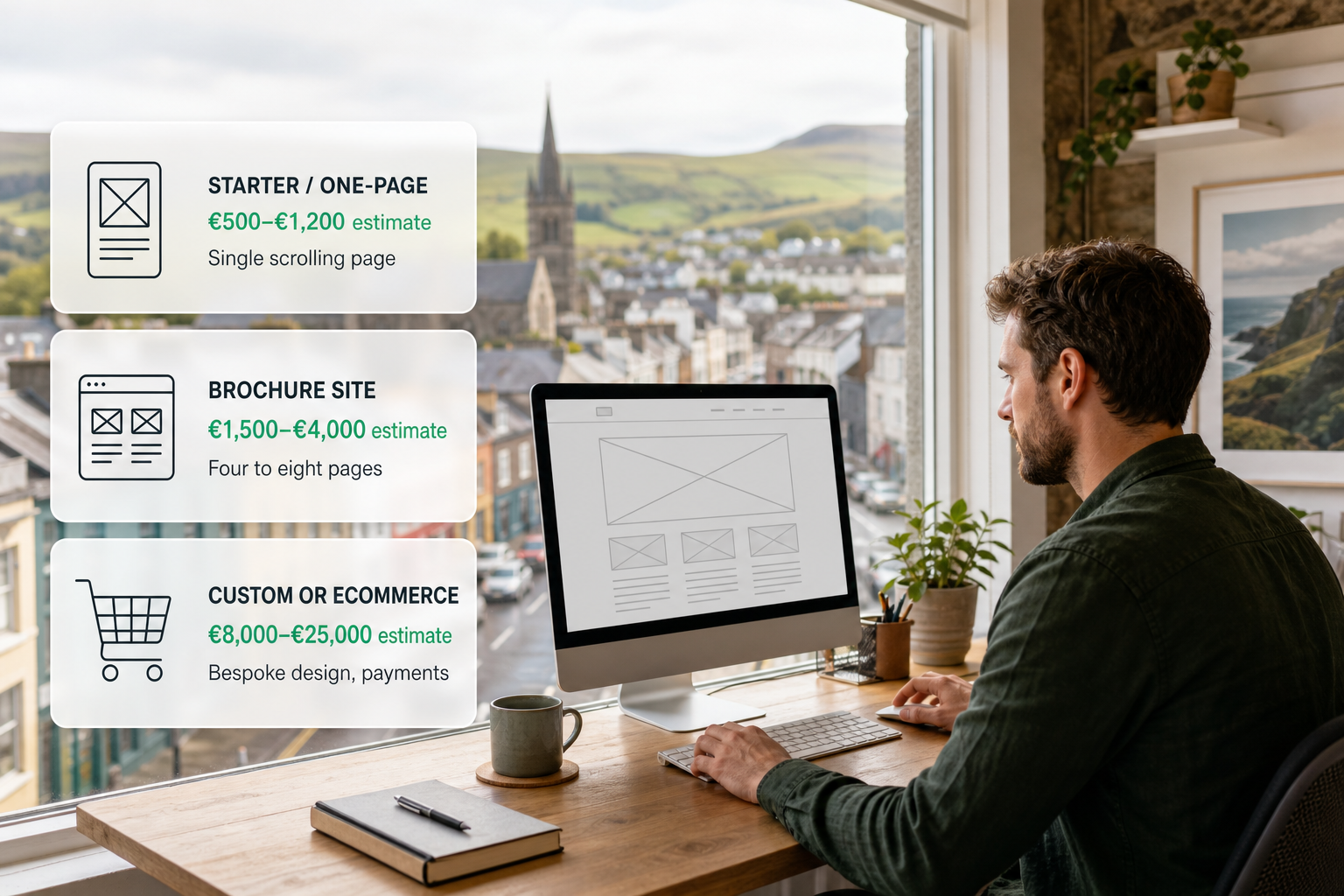
Infographic over an Irish web designer workspace showing the price bands for different website types.

Ballpark ranges by website type

Every figure in this section is an aggregate Irish market estimate, and each one covers the one-off design and build fee only.

  • Starter or one-page site: €500–€1,200. A single scrolling page built on a ready-made theme, with a phone number, a map and a contact form. It suits a sole trader who needs to be found in search results and contacted.
  • Brochure site, four to eight pages: €1,500–€4,000. Home, about, services and contact pages, a mobile-friendly layout and an enquiry form, usually assembled from a template with a moderate amount of custom styling. This is the most common project for a small business trading locally.
  • Small business site, ten to twenty pages: €4,000–€8,000. More pages, service or location pages, a booking or quotation form, a news section, more bespoke layout work and basic search setup.
  • Custom or ecommerce site: €8,000–€25,000. Bespoke design, a product catalogue and card payments, customer accounts, stock, booking or accounting integrations and more testing before launch.

Three things create the gap between those bands: how many pages have to be designed and written, how much of the layout is built from scratch instead of adapted from a template, and how much functionality sits behind the pages.

What a quote is built from

The table below is an aggregate Irish market estimate. A small project sits near the bottom of each line and a large build sits near the top, so the five lines together span the same €500 to €25,000 as the headline figure.

Line item Typical range
Design and build labour — page layouts, responsive build, templates €300–€16,000
Copywriting and content upload €100–€4,000
Photography, graphics or licensed imagery €50–€2,000
Functionality and integrations — bookings, payments, enquiry forms, customer accounts, charged per feature €25–€2,000
Search setup, analytics, handover and training €25–€1,000

A worked example: a five-page brochure site for a sole trader might come back as €900 of design and build, €400 of copywriting, €200 of imagery, €50 for a booking form and €150 of search setup, a total of €1,700. That sits inside the €1,500–€4,000 brochure band and inside every line of the table.

An itemised quote compares far more easily than a single number, because it shows where a provider has trimmed the work — often by leaving out copywriting, imagery or search setup and assuming the owner supplies them.

What changes the quote

  • Pages. Each extra page needs layout, text and testing, so a site growing from five pages to fifteen moves from the brochure band into the small business band.
  • Copy. If the provider writes the words, the copywriting line moves towards the top of its range; if the owner supplies finished text, it sits near the bottom.
  • Design depth. A ready-made theme that is restyled costs far less than a layout drawn from scratch, and the design and build line covers both ends of that choice.
  • Functionality. Booking calendars, card payments, customer logins and stock integrations are charged per feature, which is why that line is quoted as a range rather than a flat fee.
  • Search setup. Basic titles, descriptions, page structure and analytics are part of a launch. A Google Business Profile is free and can help a business show up in search results even without a website (see how to set one up). Ongoing search or content work is a separate, recurring cost.
  • Conversion features. Clear calls to action, short enquiry forms, click-to-call buttons, opening hours and reviews all add a little design and build time.
  • Content upload. Moving existing images, prices and service lists across, or writing fresh copy for each page, is billed either inside the copywriting line or by the hour.
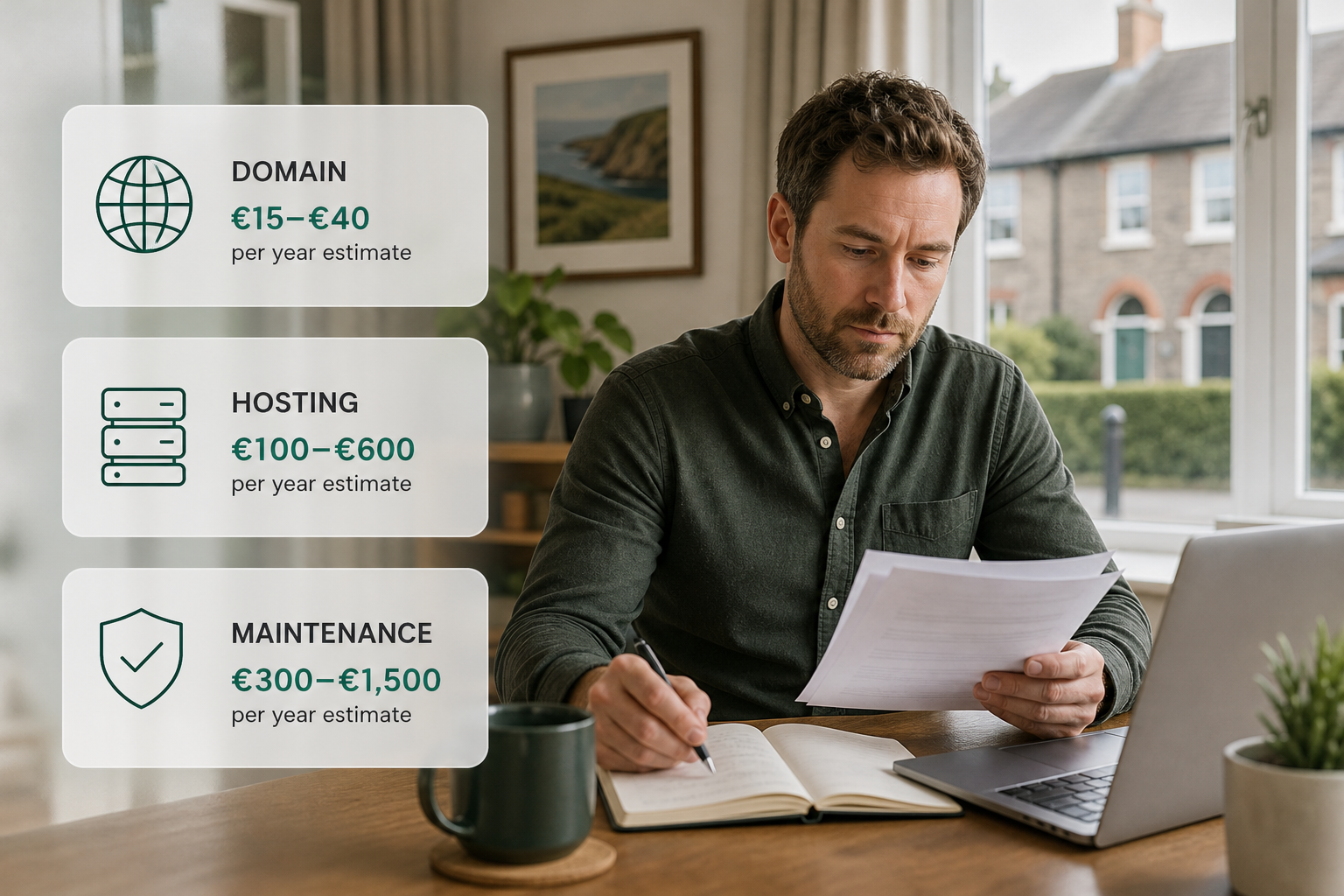
Infographic over an Irish home-office scene explaining one-off and recurring website costs.

One-off costs and recurring costs

One-off costs are the design and build fee, copywriting, photography or licensed images, custom features and the initial search setup. They are paid once and belong to the owner, provided the contract says so.

Recurring costs are charged again every year or every month. The figures below are an aggregate Irish market estimate.

  • Domain name: €15–€40 per year
  • Hosting: €100–€600 per year
  • Maintenance, updates, backups and security checks: €300–€1,500 per year (more in website maintenance cost)
  • Occasional content changes: €50–€120 per hour
  • Ongoing search or content work, if wanted: €200–€800 per month (see how much SEO costs)

Domain and hosting renewals are the items most often forgotten when a budget is set, and a lapse in either can take a site offline for a day or more.

Quotes may be written with or without VAT, and whether VAT appears at all depends on the provider's own registration position, so readers should confirm with each provider whether a figure includes VAT before comparing it with another.


Upfront, staged or monthly pricing

Three payment models are common: payment on completion, or a deposit before work starts with the balance on launch; staged payments tied to milestones such as written brief, approved design and live site; or a monthly subscription where the provider builds, hosts and maintains the site for one fee.

The monthly figure is an aggregate Irish market estimate of €75–€250 per month, which over a three-year term works out at €2,700–€9,000. The monthly route spreads the cost but usually costs more over the life of the site, and it can leave the domain, the hosting account and the files with the provider. The total over the term, not the monthly figure, is the number to compare against an upfront quote.

How to compare quotes fairly

Two quotes rarely cover the same work, so the comparison has to start from the same list.

  • Send every provider the same brief: the page list, the features wanted, who writes the copy and who supplies the images.
  • Ask for the quote broken into the five lines used above, so the differences show up in one place.
  • Ask what is excluded, and what the provider charges for work outside the agreed scope.
  • Ask whether the figure is inclusive or exclusive of VAT.
  • Ask who owns the domain, the hosting account and the site files, and how easily they can be moved.
  • Ask how many rounds of changes are included and what extra rounds cost.

Where the site is part of a wider identity project — logo, colours, printed material — the quote may bundle several disciplines, so it is worth asking separately about design and creative services and comparing that figure against a standalone site quote.

What a fair website design contract should include

In plain English, a fair contract sets out:

  • Scope. The number of pages, the features, who writes the copy, who supplies the images and how many rounds of design changes are included.
  • Dates. A start date, a launch target and what happens if content arrives late.
  • Payments. The deposit, the milestones each payment relates to and the final balance on handover.
  • Ownership. That the domain, hosting account, site files and content transfer to the owner on final payment, or clear terms if they stay with the provider.
  • Changes. How extra work is priced once the included rounds are used.
  • Third-party costs. Stock images, fonts, plugins, licences and any payment gateway fees, and who pays them.
  • Support after launch. What is covered, for how long, and the rate afterwards.
  • Handover. Logins, files, and a short session showing the owner how to edit pages.
  • Data and privacy. Who handles enquiry forms, analytics, cookie notices and stored customer details.
  • Exit. What happens if either side stops early, and what has been paid for at that point.

Where to get quotes for a website

Posting a job and listing it on ShamFix is free and there is no commission, and a subscription is planned for the future. ShamFix does not check or certify tradespeople, and profiles are filled in by tradespeople themselves, so homeowners should check registrations themselves and read reviews before hiring. A short written brief — page list, must-have features, who writes the copy and the budget band — attracts far more useful quotes than a one-line request.

FAQ

Is a cheaper website quote always better value?

No, because the lowest figure often covers less work. Two quotes can differ by thousands because one includes copywriting, imagery and search setup while the other assumes the owner supplies all three. Comparing the itemised lines, and the exclusions listed beside them, gives a fairer picture of what each provider is actually offering.

Who owns the website, the domain and the content at the end?

That depends on the agreement, not on who paid the most. An owner who may want to move to another provider later should have it in writing that the domain, hosting account, site files and content belong to them and transfer on final payment. With a monthly subscription, ownership often stays with the provider, and files may be released only on agreed terms.

Can the cost be reduced by supplying copy and photos?

Yes. Supplying finished text and good-quality photographs removes the copywriting and imagery lines, which is where a large share of the labour sits. The saving is real, but a provider still needs time to lay text out, resize images and check that pages read well on a phone. Asking what can reasonably be prepared before the quote is issued is the quickest way to trim the total.

What should happen on the day the website goes live?

The owner should receive the domain and hosting logins, a way to edit pages, and confirmation that backups and security updates are running. It is worth checking the site on a phone, testing the enquiry form and reading the privacy and cookie notices. The launch date is also when the after-launch support period usually starts, so those terms should be clear in advance.

Keep reading