A standard 10-panel solar PV system of about 4.4 kWp in Ireland typically costs €5,500 to €7,500 after the SEAI grant. In most cases, that same system lands somewhere between €7,300 and €9,300 before grant, depending on the roof, access, inverter choice, and installation complexity.
That's the point most homeowners start from. They've looked at a few quotes, noticed that two installers can price the same-sized system very differently, and now want to know what's normal, what's inflated, and what drives the final bill.
The tricky part is that bundled prices can hide two separate issues. First, there's the base system price for panels, inverter, mounting, labour, and scaffolding. Second, there are the site-specific factors and Irish incentives that can push the net figure up or down. Once those are separated, the maths gets much clearer, and quotes become easier to judge fairly.
Typical Solar PV System Costs in Ireland 2026
The market benchmark most homes should use
A homeowner in Dublin, Cork, or Galway can collect three quotes for what appears to be the same solar job and still see a difference of several thousand euro. In many cases, the gap starts with a simple issue. One quote reflects a standard bundled system for a straightforward roof, while another already includes site-specific complications, extra electrical work, or upgraded inverter equipment.
For pricing purposes, the clearest benchmark for an Irish home is usually a 10-panel system at about 4.4 kWp. That size is common on three-bed semis and, under the current grant structure, it also lines up with the point where the full €1,800 SEAI solar PV grant is typically reached, as outlined in Solar Generation's 2026 SEAI solar grant guide.
That makes it a useful reference point, not because every home should buy 10 panels, but because it gives homeowners and installers a fair starting line for judging value.
Practical rule: Separate the quote into two questions. What is the normal bundled price for the system size itself? What installation factors explain any amount above that benchmark?
2026 Irish Solar PV System Cost Estimates Post-Grant
Residential solar PV supply and installation in Ireland remains subject to the 0% VAT rate, so a standard domestic quote should already reflect that treatment under Revenue rules. For comparison, homeowners should focus on four items only: system size in kWp, panel count, grant applied, and final net cost.
| System size | Typical panels | Typical pre-grant cost | SEAI grant | Typical net cost |
|---|---|---|---|---|
| 4 kW | 8 to 9 panels | around €6,500 | €1,800 | around €4,700 |
| 4.4 kWp | 10 panels | €7,300 to €9,300 | €1,800 | €5,500 to €7,500 |
Across the market, installed cost runs at roughly €1,689 to €2,000 per kWp before the grant, and smaller systems cost more per kWp because scaffolding, inverter and labour are largely fixed.
The table is deliberately cautious. It avoids treating every 4.4 kWp or 20-panel quote as directly comparable, because they are not. Two installers can both describe a system as “10 panels, post-grant” while pricing very different jobs. One may be quoting a clean, south-facing roof with short cable runs. Another may already have priced in scaffolding, split roof planes, a consumer unit upgrade, or bird protection.
That distinction matters more than homeowners often expect.
A fair reading of solar PV panels cost in Ireland starts with the bundled system price, then separates out the reasons a particular house falls above or below that level. That approach is more useful than comparing panel count alone, and it gives both homeowners and installers a clearer basis for judging whether a quote is expensive, realistic, or missing key items.
What Makes Up the Total Solar Panel Cost
The hardware inside the quote
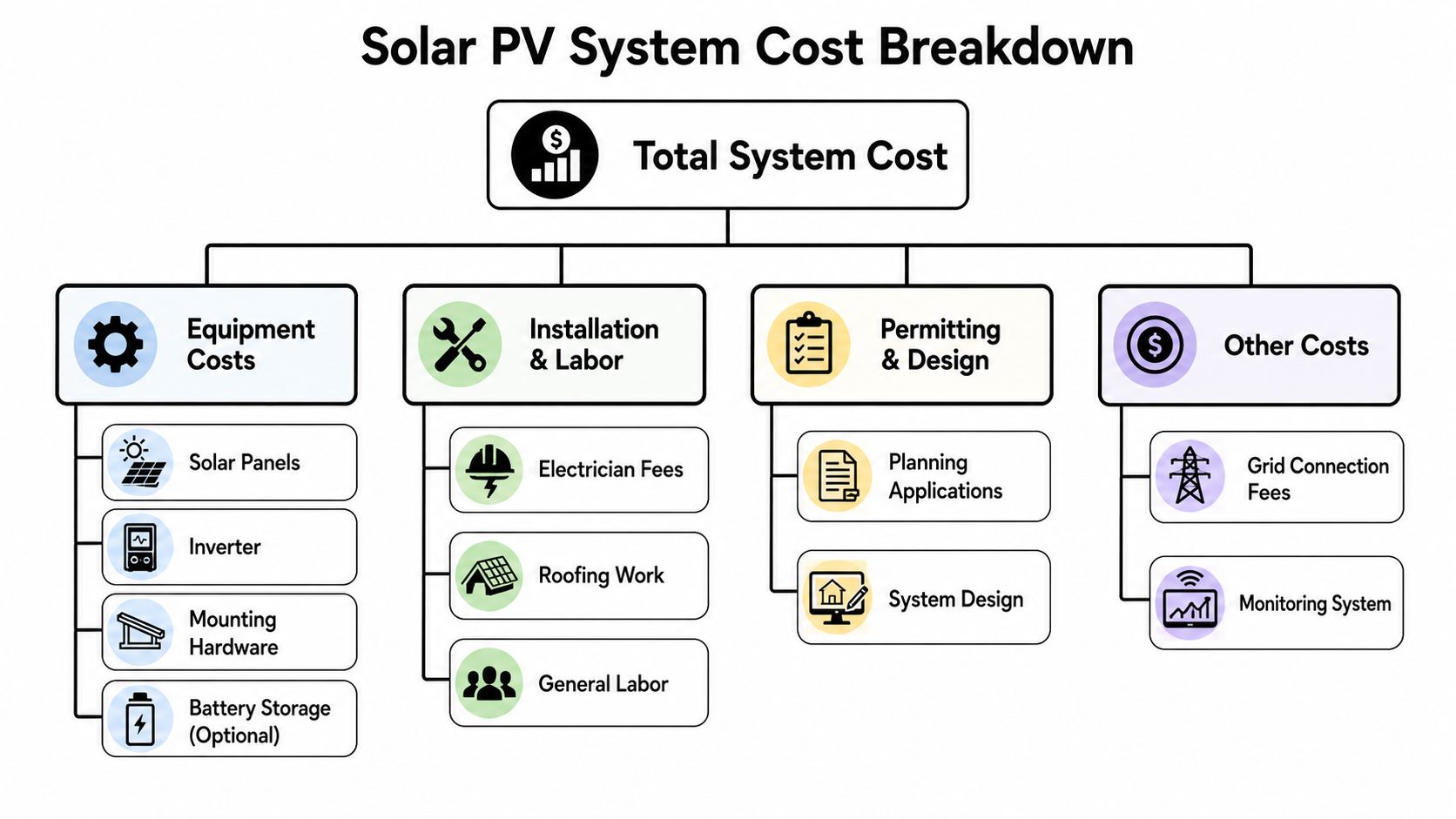
A solar quote looks simple from the outside. In reality, it bundles several separate equipment choices that affect both price and performance.
The obvious line item is the solar panel array itself. Installers may offer well-known Tier 1 panel brands or less established alternatives. The key point for a homeowner isn't brand prestige on its own. It's whether the panel model, product warranty, and expected output have been clearly identified in writing.
The next major decision is the inverter setup. Some jobs are priced around a standard string inverter, which suits clean, unshaded roofs. Others use power optimisers or microinverters, usually where shade, split roof planes, or more complex layouts would reduce the output of a simpler system. That upgrade can be sensible, but it should be justified by the roof, not slipped into the quote without explanation.
The installation work homeowners often underestimate
Hardware is only half the bill. A large share of cost comes from what has to happen around it: roof fixing points, cable routes, connection to the fuse board, isolators, scaffolding, commissioning, and the electrician's final sign-off.
That helps explain why Irish installed costs have fallen in a meaningful way. Residential solar dropped from €2,762 per kWp in 2020 to €1,689 per kWp in 2025, a decline of more than €1,000 per kWp, according to Energy Efficiency Ireland's home solar report for 2026. The important conclusion isn't just that panels got cheaper. It's that the Irish market has become more efficient at delivering complete systems.
A low quote can mean good buying power. It can also mean vague equipment specifications, minimal allowance for access, or a stripped-back scope of works.
For homeowners, the most useful question is: what exactly is included? A proper quote should make these points visible:
- Panels and model numbers: The quote should identify the exact panel brand and model, not just “10 solar panels”.
- Inverter strategy: It should say whether the system uses a string inverter, microinverters, or optimisers, and why.
- Mounting system: Roof fixings and rails matter, especially on slate or awkward roof lines.
- Labour and electrical work: The installer should include connection work, testing, and commissioning.
- Scaffolding and access: Many pricing surprises come from this line, not from the panels.
Battery storage is often discussed alongside solar, but it's best treated as a separate decision. It can change the overall project value significantly, yet it isn't part of the baseline residential system prices above.
Key Installation Factors That Influence Price
Roof shape, covering and access
Two homeowners can ask for the same 4 kWp or 4.4 kWp system and receive very different quotes because the roof dictates the labour.
A concrete tile roof is usually more straightforward than slate, which takes longer and demands more care. A flat roof often needs tilted or ballasted mounting frames, adding both material and labour. A roof in poor condition can also slow the job because installers have to work around defects or recommend repairs before fitting panels.
Access matters just as much. Two-storey and three-storey homes, steep roof pitches, limited side access, and awkward scaffold positions can all raise the installation cost. These aren't optional extras. They're the practical realities of getting installers and equipment onto the roof safely.
Orientation, shading and electrical layout
Orientation affects output more than upfront price, but it still changes the economics. In Irish conditions, south-facing roofs at roughly 30 to 35 degrees are generally the strongest fit for simple, efficient generation. East-west layouts can still work well, especially where households use electricity across the day, but they may need more panels to achieve the same annual production. That pushes up the cost per unit of generation.
North-facing roof pitches are generally poor candidates for residential PV. Even if an installer says panels can be fitted, that doesn't automatically mean they should be.
Shading is another major cost driver. Chimneys, dormers, neighbouring trees, and roof features can force a move away from a plain string inverter towards optimisers or microinverters. That can be a smart design choice, but it should be tied to a clear shading problem.
If two quotes differ sharply, the homeowner should ask the installer to explain the roof assumptions. The answer often sits in access, shading, or mounting complexity rather than in the panels themselves.
There's also the internal electrical route. Long cable runs, awkward meter locations, or fuse board upgrades can all add work. An installer who surveys only from satellite imagery may miss those details.
That's why site visits still matter. A remote quote can be a useful starting point, but the fair price usually emerges only after someone has looked at the roof covering, access points, likely scaffold setup, and where the inverter and cabling will go.
Irish Grants and Financial Incentives Explained
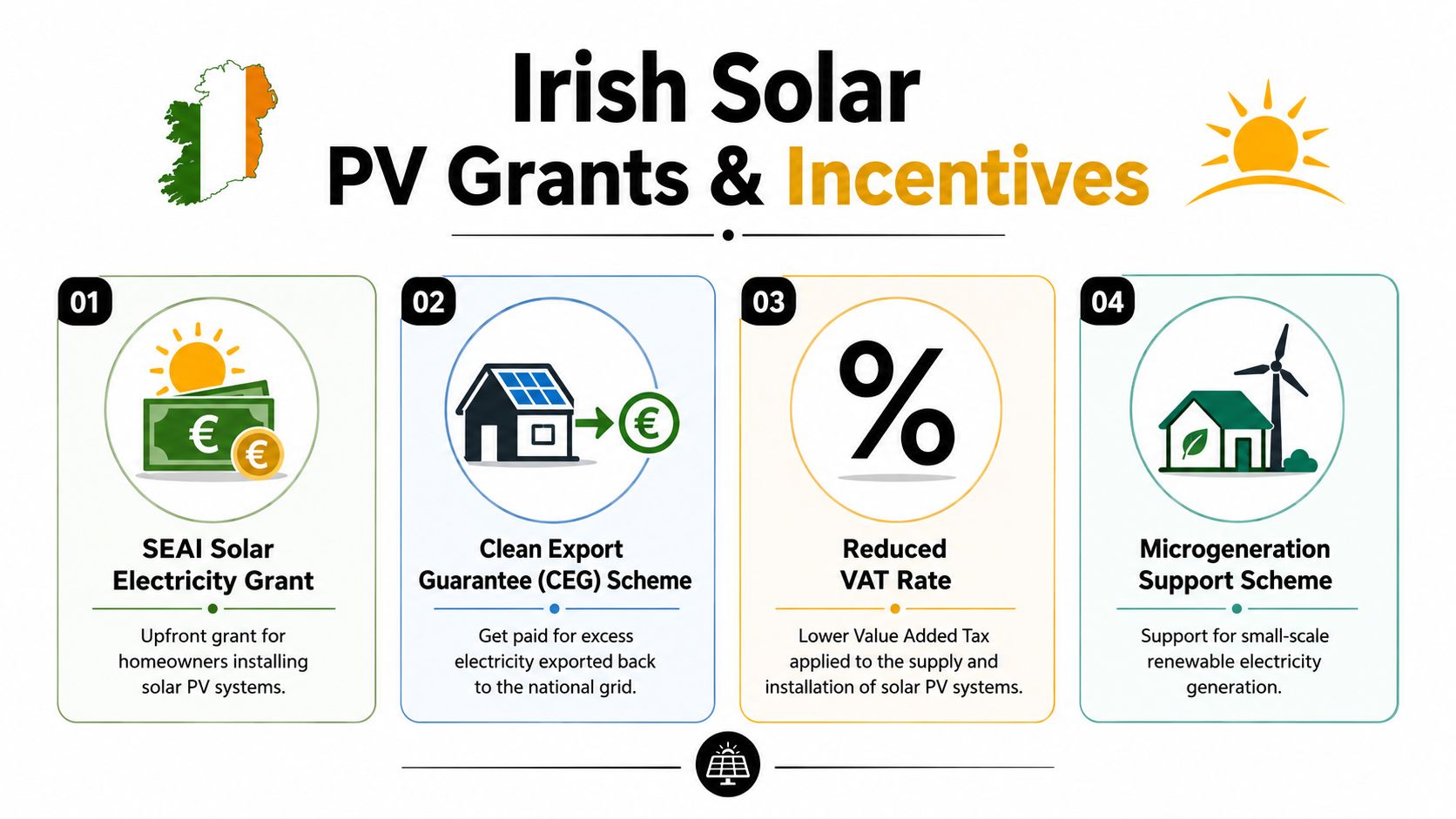
A homeowner compares two quotes for the same 4 kWp system and sees a difference of several thousand euro in the net cost. In many cases, the gap is not about the panels. It comes from whether the quote separates the base system price from the supports, tax treatment, and export income assumptions that sit around it.
The first support to check is the SEAI Solar Electricity Grant. SEAI sets the payment structure and the grant only applies when the work is carried out by a registered installer and the application process is followed correctly. The grant is tiered rather than flat: €700 per kWp for the first 2 kWp, which is €1,400, then €200 per additional kWp up to 4 kWp, capped at €1,800. A 2.5 kWp system therefore draws €1,500. The grant is scheduled to fall by up to €300 a year and to end in 2029. The current residential grant rates are published by the SEAI home energy grants scheme for solar electricity. For pricing purposes, the practical point is simple. A modest system may not draw the full grant, while many standard family-home systems reach the cap.
The second support is the 0% VAT rate on the supply and installation of qualifying residential solar panels. That relief reduces the invoice immediately, unlike the SEAI grant, which is claimed through the grant process. Homeowners should still ask the installer to show the gross price, the VAT treatment, and the grant deduction separately. That makes it much easier to compare one bundled quote against another on a like-for-like basis.
Homeowners planning wider retrofit works should also understand how energy performance is assessed across the property. A BER assessor and energy rating service can help frame solar within the broader efficiency picture, especially where insulation, heating upgrades, and electricity use patterns all interact.
Long-term return depends on two different mechanisms. One is export payment. The other is tax treatment.
Under the Clean Export Guarantee, suppliers pay for eligible electricity exported back to the grid. The framework sits under CRU rules, but the actual rate is set by each supplier, so installers should be careful about presenting any single export figure as standard. The most reliable way to check current treatment is the CRU guidance on microgeneration and clean export arrangements.
Revenue also affects the economics. Income from selling excess electricity to the grid qualifies for a €400 per year income tax exemption, which runs from 1 January 2024 to 31 December 2028 following the extension in Finance Act 2025. Revenue sets out the current position in its manual on the income tax treatment of microgeneration receipts.
The useful distinction is this. SEAI lowers the purchase cost. Revenue affects the after-tax value of export income. CRU governs the supplier payment framework for exported electricity.
That separation matters for both sides of the transaction. Homeowners can judge whether a quote is competitive on system cost, and installers can price jobs more fairly without inflating savings by blending grant support, VAT relief, and future export income into one vague headline number.
Calculating Your Payback Period and ROI
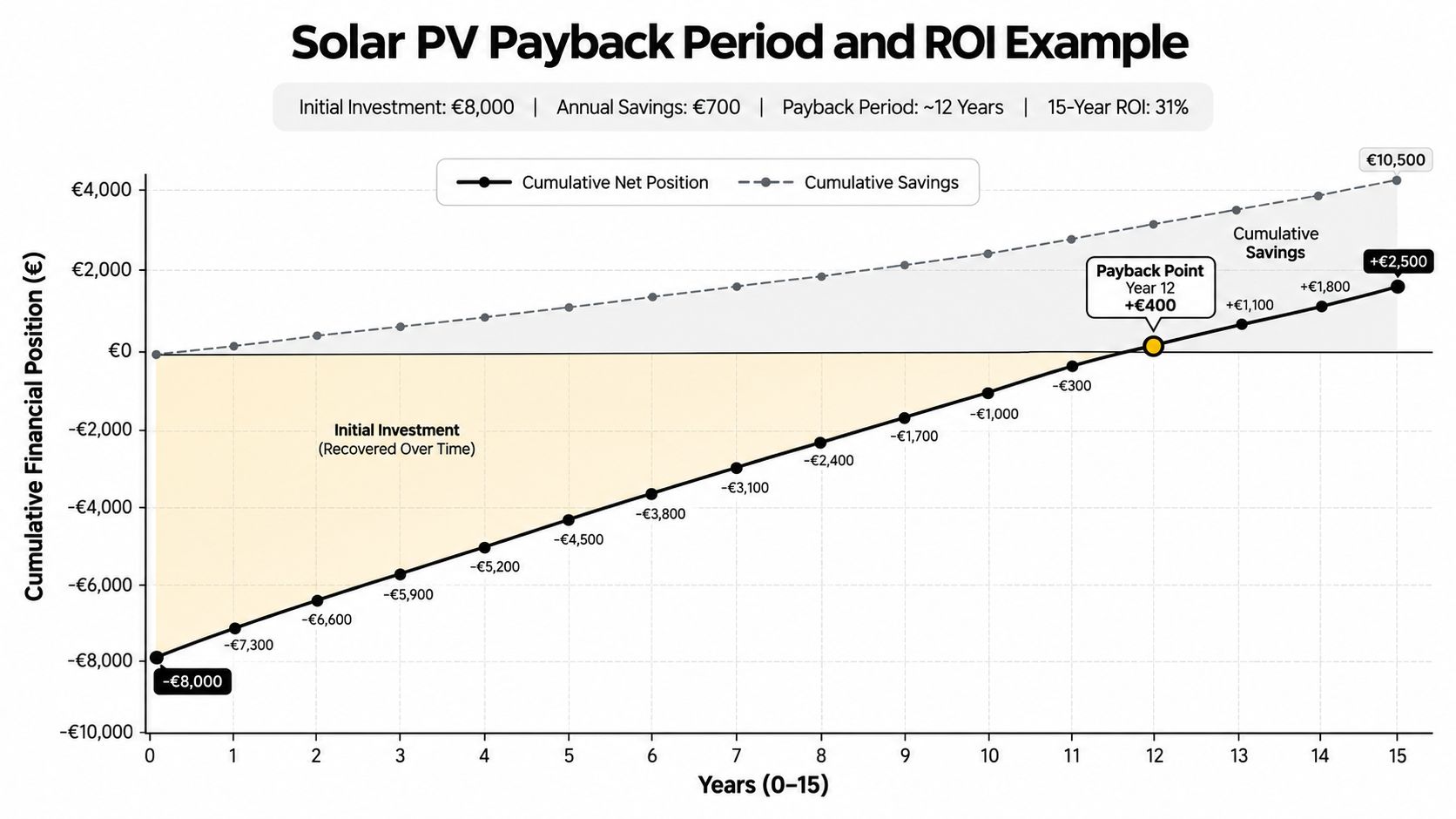
A Dublin homeowner pays roughly €7,000 net for a solar PV system after grant support. One installer promises payback in five years. Another says eight. Both quotes can be reasonable. The gap usually comes down to assumptions, not panel quality.
Payback is the number of years it takes for cumulative bill savings and export payments to recover the net upfront cost. ROI goes further. It asks what return the system produces over its working life after that cost has been recovered. For an Irish homeowner, the cleanest way to assess both is to separate three things that are often blended together in sales material: the installed price, the share of generation used in the home, and the value of exported electricity.
That separation matters because self-consumed electricity is usually worth more than exported electricity. Every kilowatt-hour used directly at home avoids buying electricity at the retail rate. Exported electricity is paid at a supplier tariff set within the CRU framework discussed earlier, and that rate is usually lower than the import price. A household that runs appliances, hot water, or EV charging during solar production hours will therefore see faster payback than an otherwise identical household with low daytime demand.
The basic calculation is straightforward:
- Start with net system cost. Use the quoted price after the SEAI grant and any VAT treatment already reflected in the installer's figure.
- Estimate annual self-consumption savings. Multiply the electricity you expect to use directly from the panels by your unit import rate.
- Add annual export income. Use your supplier's current clean export tariff and a cautious estimate of exported generation.
- Allow for modest degradation and maintenance. Panels slowly produce less over time, and inverters may need replacement within the project life.
- Divide net cost by annual benefit. That gives a simple payback estimate.
For example, if two homes buy the same sized system at the same net price, the home with higher daytime usage can recover the cost materially sooner without adding a single extra panel. That is the non-obvious part of solar economics in Ireland. Price matters, but usage timing often matters more once a system is sensibly sized.
A sensible quote should therefore show the assumptions behind the savings figure. Annual generation should be based on orientation, shading, and expected performance. Self-consumption should be stated clearly rather than implied. Export income should be shown separately, not folded into one headline saving number. Installers trying to price jobs fairly, and homeowners comparing proposals, can use that framework alongside practical benchmarks from the SEAI's homeowner guidance on solar electricity and typical grant-supported system setup.
One more point affects ROI. Revenue's tax treatment can improve the after-tax value of export income, but it does not change the physical performance of the system. A strong ROI case still rests mainly on avoided electricity purchases. That is why the best financial outcome often comes from matching system size to actual daytime demand rather than buying the largest array the roof can hold.
The practical test is simple. If a quote gives one payback number without showing import rate, export rate, expected generation, and assumed self-consumption, the estimate is too thin to trust.
A Practical Checklist for Homeowners
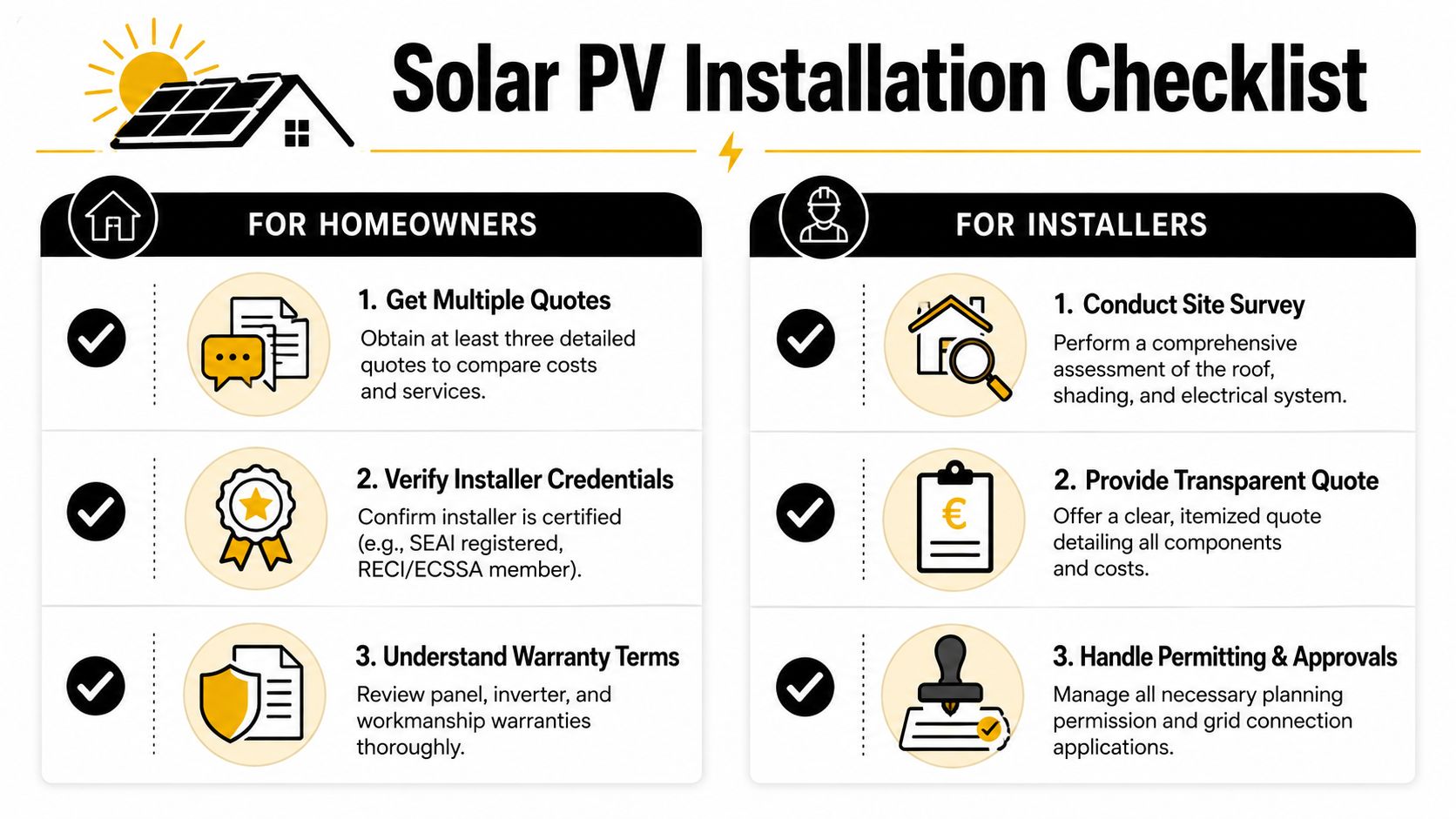
A homeowner in Cork gets two quotes for what looks like the same solar job. Both mention 10 panels. One is thousands higher, includes a battery in the background, and shows a single payback figure with little detail. The other separates the array, inverter, scaffolding, battery option, grant assumption, and expected export setup. The second quote is easier to test, and usually easier to trust.
That is the practical standard for this market. Good solar quotes separate the bundled system price from the roof, electrical, and incentive factors that change the final cost. Homeowners can then compare proposals fairly. Installers can price jobs without creating disputes later.
As noted earlier, a typical grant-supported Irish home system sits in a fairly established range. The problem is not usually the headline price. The problem is poor breakdown. A checklist helps both sides see whether the quote reflects a straightforward install or a more expensive roof and wiring job.
What homeowners should insist on
A homeowner does not need every engineering detail. They do need enough information to compare one installer with another on the same basis.
- Get like-for-like quotes: Ask each installer to quote the same approximate system size and state the panel model, inverter model, panel count, and total kWp.
- Ask for a clear price breakdown: The quote should separate the solar array, battery if any, scaffolding, and any extra electrical work. If one number covers everything, it is harder to judge value.
- Check grant eligibility directly: For SEAI-backed work, confirm the installer can carry out grant-supported installations under the relevant scheme requirements on the SEAI solar electricity grant page.
- Check export setup and meter position: If export payments matter to your payback, ask whether any meter or supplier setup steps are still needed after installation.
- Ask what is roof-specific: Cable runs, attic access, roof covering, chimney shading, and scaffold complexity can all raise labour time and cost.
- Read the savings assumptions carefully: The quote should show expected generation, assumed self-consumption, and export treatment separately, rather than presenting one large saving number.
What a quote should make clear
A homeowner should expect a quote to make the scope, assumptions, and optional extras easy to understand. Clear quoting reduces confusion and makes it easier to compare one proposal with another.
retrofit installer leads in Ireland
- Itemise the main cost components: Panels, inverter, mounting system, electrical labour, scaffolding, and optional battery storage should be listed as separate lines or clearly grouped items.
- Explain why the job is not a standard install: If optimisers, split arrays, extra cable protection, or difficult access are pushing up the price, say so in plain language.
- State inclusions and exclusions: Monitoring upgrades, bird protection, roof repairs, battery backup capability, and BER-related extras should not be left ambiguous.
- Keep incentive assumptions accurate: Show the gross price, the expected grant treatment where relevant, and the customer price after that adjustment. Do not present the maximum support as automatic.
- Set out post-install steps: Customers should know who handles commissioning documents, electrical certification, and export-related follow-up.
A strong checklist does one job well. It turns a sales quote into a document both sides can test. That usually leads to fairer pricing, fewer surprises on site, and a better basis for deciding whether the system is good value.
Finding a Qualified Solar PV Installer in Ireland
Price matters, but the installer still determines whether the project is smooth, grant-compliant, and technically sensible.
A homeowner should look for a company that can explain system sizing in plain language, justify the inverter choice, and show that the quoted design fits the actual roof. For grant-backed work, the homeowner should confirm the installer is eligible for the relevant scheme. For the electrical connection, the final electrical work should be checked through the proper Irish authority rather than taken on trust.
A good installer also won't force a one-size-fits-all answer. On one roof, the right move is a simple string inverter and a clean south-facing array. On another, the correct answer may be fewer panels, more careful placement, or a decision not to use a north-facing pitch at all.
That's why reviews matter, but they should be read with care. The most useful feedback usually mentions communication, punctuality, clarity of quote, snag resolution, and whether the final installation matched the original promise. Homeowners comparing local options can also benefit from reading broader market commentary on Ireland's retrofit installer landscape in 2026, particularly where solar sits alongside insulation, heat pumps, and BER improvement work.
The strongest buying position is simple. Understand the normal price range, know which roof factors change it, separate the grant from the export supports, and insist on a quote detailed enough to be checked line by line.
Homeowners who want to compare local, rated tradespeople can explore ShamFix, an Ireland-only marketplace founded in 2025. It connects customers with local providers across the Republic of Ireland and uses a two-sided review system, so reputation is built through completed work rather than platform approval badges.