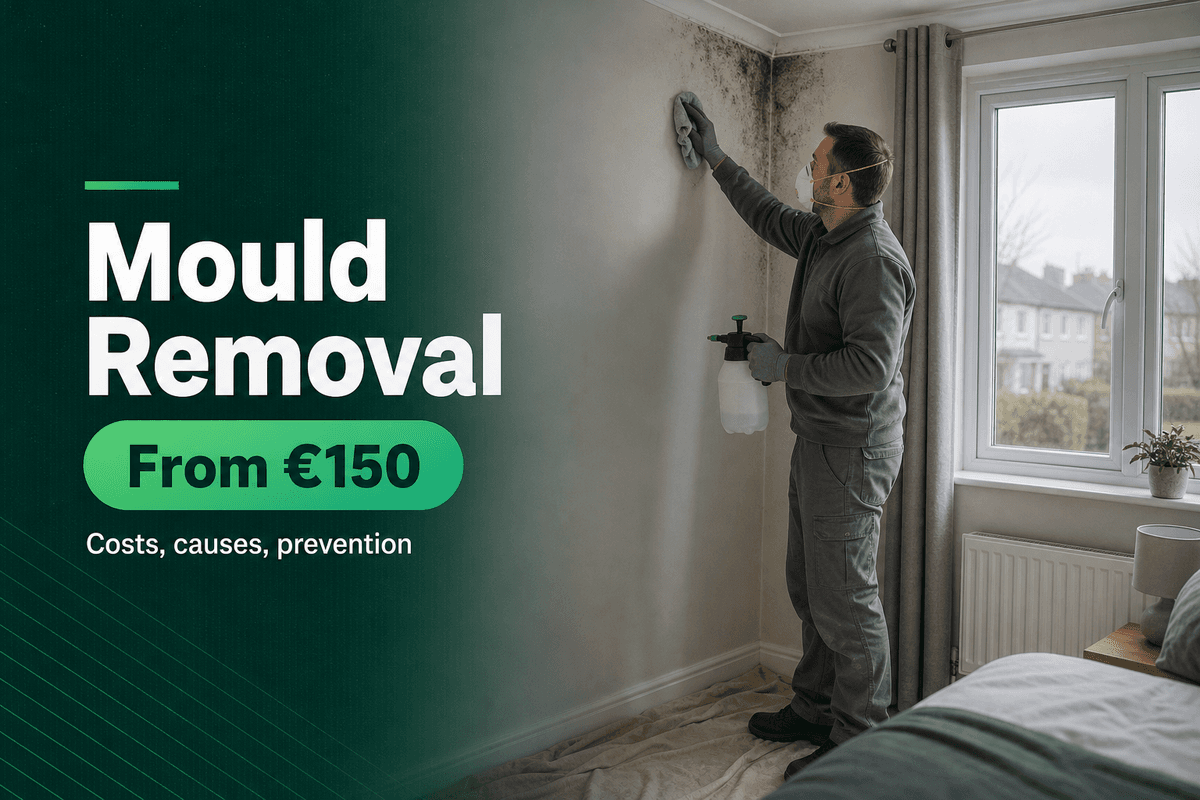
Professional mould removal in Ireland usually costs €150 to €350 for a small area such as a bathroom ceiling or one wall, €300 to €700 to treat a whole room and €1,200 to €3,500 or more for several rooms or a whole house, as an aggregate Irish market estimate including VAT. A survey to find the cause of the mould usually costs €150 to €350, and fixing that cause, for example fitting an extractor fan or a ventilation unit, is often the part that stops the mould from coming back. Mould left behind by a leak or a flood, where plasterboard or insulation has to be removed, can cost €2,000 to €8,000 or more. Households who need mould treated can post the job under damp proofing and mould treatment and compare quotes from local specialists.

Mould removal prices at a glance
The figures below are an aggregate Irish market estimate, VAT included.
| Job | Typical price |
|---|---|
| Mould and damp survey with moisture readings | €150–€350 |
| Small area, such as a bathroom ceiling or one wall | €150–€350 |
| Full treatment of one room | €300–€700 |
| Several rooms or a whole house | €1,200–€3,500+ |
| Attic or roof space mould treatment | €600–€2,000 |
| Anti-mould paint, per room, after treatment | €150–€350 |
| Extractor fan fitted by an electrician | €200–€450 |
| Positive input ventilation unit, fitted | €600–€1,200 |
| Mould clean-up after a leak or flood, with plasterboard removal | €2,000–€8,000+ |
| Dehumidifier hire, per week | €40–€80 |
A professional treatment usually includes protecting the room, cleaning the mould off with a fungicidal treatment, drying the area, sealing stains with a stain-blocking primer and, in many cases, repainting with an anti-mould paint. Removing and replacing damaged silicone, wallpaper or plasterboard costs extra.
A worked example: a 1990s semi-detached house in Dublin has black mould in the corners of two bedrooms and on the bathroom ceiling. A survey at €200 to €300 finds condensation from poor ventilation rather than rising damp. Treating the two bedrooms costs €600 to €1,200, the bathroom ceiling €200 to €400, and a new extractor fan with a humidity sensor €250 to €400. The total comes to roughly €1,250 to €2,300. Without the fan and better ventilation, the mould would very likely return within a winter or two.
What causes mould in Irish homes
Mould needs moisture. In Irish homes it usually comes from one of three sources:
- Condensation. The most common cause. Warm, moist air from cooking, showers, drying clothes and breathing meets a cold wall, window or ceiling and turns to water. It is worst in winter, in corners, behind furniture and in bedrooms with closed windows.
- Penetrating damp. Rain getting in through defective gutters, flashing, render, pointing or window seals.
- Rising damp or leaks. Moisture coming up from the ground in older houses without a working damp-proof course, or water from a leaking pipe, roof or shower.
The treatment only lasts if the cause is fixed. Cleaning mould caused by a leaking gutter or a failed shower seal without repairing them is money wasted. For damp in walls, the cost of damp proofing is covered separately.
Ventilation: the key to stopping mould coming back
Insulating and draught-proofing a home makes it warmer, but also more airtight, so moist air has fewer ways out. According to SEAI, a well insulated home is warmer and more airtight, good ventilation reduces the chance of condensation or mould, and wet rooms should have a mechanical extract fan. In very airtight homes, SEAI advises that mechanical ventilation should be used.
Simple steps that help:
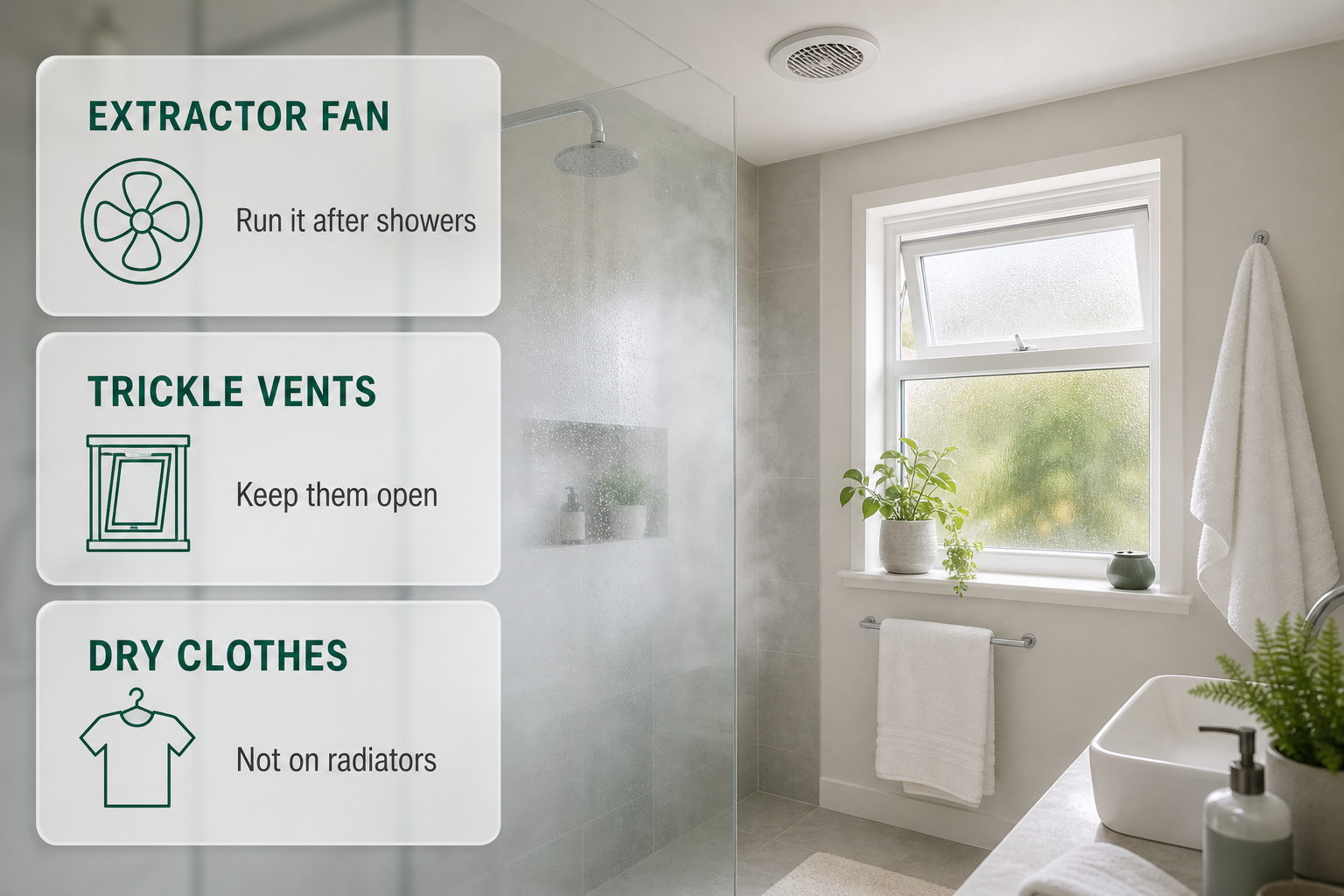
- Use the extractor fan when cooking and showering, and leave it running for a while afterwards.
- Keep trickle vents in windows open.
- Dry clothes outside, in a vented dryer or in a closed room with the window open, not on radiators.
- Keep furniture a little away from cold outside walls.
- Heat the home steadily rather than in short bursts, so walls stay warmer.
When to call a professional
Small patches of mould on a bathroom ceiling or window frame can often be cleaned by the householder; the guide on removing mould from a bathroom ceiling explains how. A professional is worth calling when:
- the mould covers a large area, roughly more than a square metre, or several rooms;
- it keeps coming back after cleaning;
- there is a musty smell but the source cannot be seen, for example behind units or under floors;
- the mould followed a leak or a flood;
- the attic, insulation or plasterboard is affected;
- someone in the house has asthma, allergies or a weakened immune system.
Anyone with health concerns about mould at home should talk to their GP.