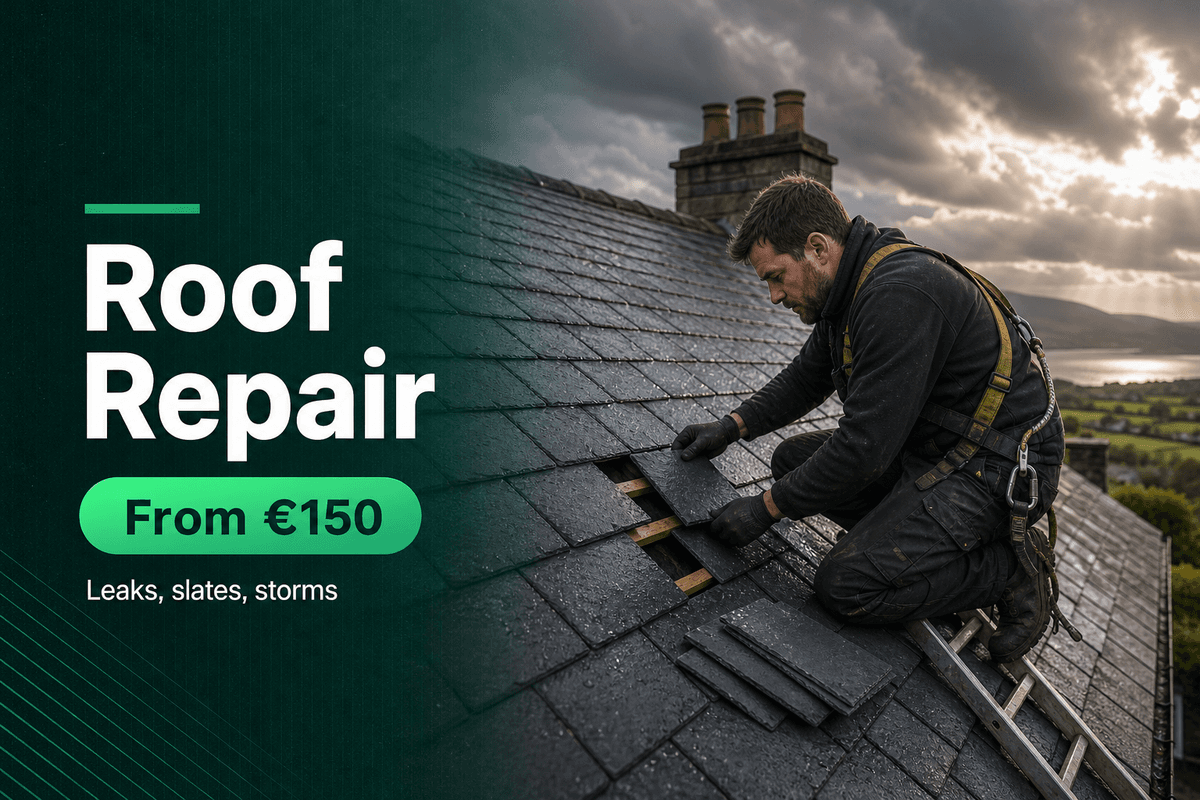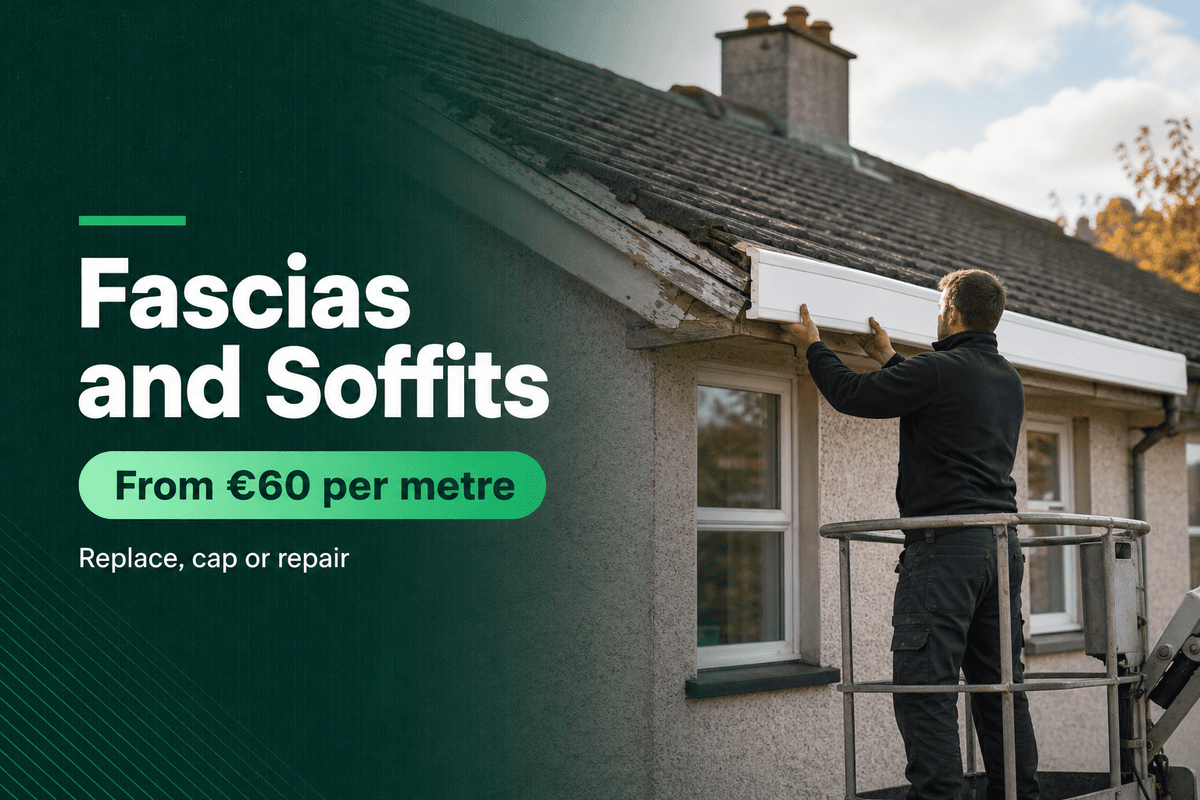
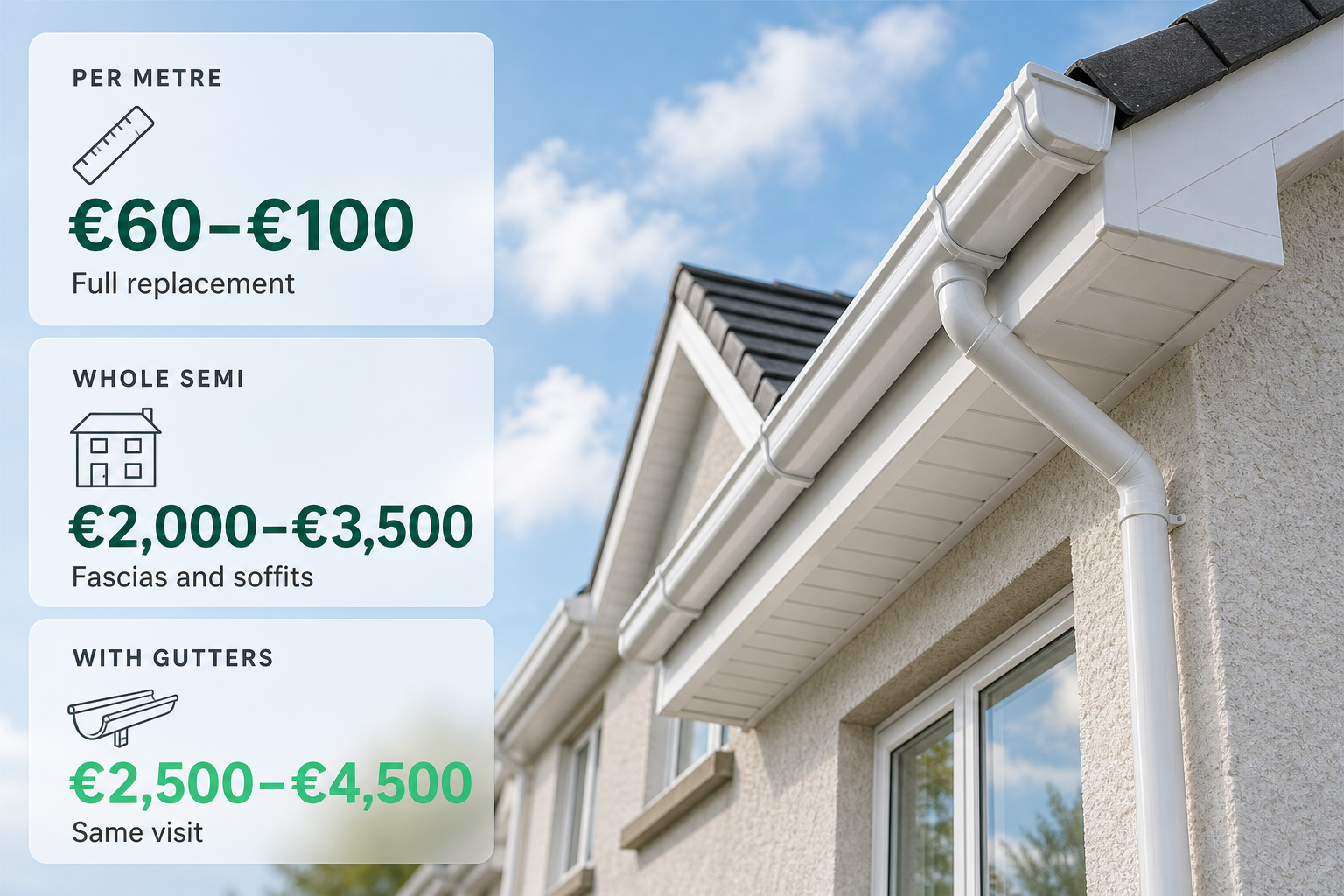
Replacing fascias and soffits in Ireland usually costs €60 to €100 per linear metre for new uPVC boards fitted after the old timber is removed, as an aggregate Irish market estimate including VAT. That puts the front of a typical semi-detached house at around €800 to €1,500 and the whole house at €2,000 to €3,500, or €2,500 to €4,500 if new gutters are fitted at the same time. Detached houses and bungalows with long rooflines usually cost €3,000 to €7,000. Access is a big part of the price: a cherry picker or scaffolding adds €250 to €1,500 depending on the height and the number of days. Homeowners who want their roofline replaced can post the job under gutter cleaning and repair and compare quotes from local tradespeople.
Fascia and soffit prices at a glance
The figures below are an aggregate Irish market estimate, VAT included, for uPVC boards in a standard white or woodgrain finish.
| Job | Typical price |
|---|---|
| Full replacement, per linear metre (fascia and soffit) | €60–€100 |
| Capping over existing timber, per linear metre | €40–€60 |
| Front elevation of a semi-detached house | €800–€1,500 |
| Whole semi-detached house, fascias and soffits only | €2,000–€3,500 |
| Whole semi-detached house, with new gutters | €2,500–€4,500 |
| Detached house or bungalow | €3,000–€7,000 |
| Bargeboards on one gable end | €300–€700 |
| Repairing a short rotten section | €150–€400 |
| Painting existing timber fascias and soffits | €400–€1,000 |
| Cherry picker, per day | €250–€500 |
| Scaffolding for a two-storey house | €600–€1,500 |
Coloured finishes such as anthracite grey or black usually cost 10% to 20% more than white. Houses with dormers, bay windows or complex rooflines take longer and cost more per metre.
A worked example: a three-bed semi-detached house in Kilkenny has rotting painted timber fascias at the front and back, about 20 metres in total, and one gable end. Full replacement with white uPVC costs about €1,200 to €2,000, new bargeboards on the gable €300 to €700, and a cherry picker for two days €500 to €800. The total comes to roughly €2,000 to €3,500. If the old gutters are cracked or sagging, replacing them at the same visit is cheaper than coming back later, because the access is already paid for.
What fascias and soffits do
- Fascias are the boards fixed along the ends of the roof rafters, just below the roof edge. They carry the gutters and close off the roof.
- Soffits are the boards underneath, between the fascia and the wall. They close the gap under the eaves and often include vents that let air into the roof space.
- Bargeboards are the sloping boards on a gable end.
Together they keep rain, wind and birds out of the roof structure. When they rot or come loose, gutters can sag, water can get into the rafters and the top of the walls, and birds or rodents can get into the attic.
Signs the roofline needs attention
- Paint flaking and wood that is soft or crumbling when pressed.
- Gutters sagging, leaking at the joints or pulling away from the fascia.
- Damp patches or staining at the top of outside walls.
- Gaps between the soffit and the wall, or boards hanging loose.
- Birds nesting or wasps gathering under the eaves.
- Water marks or mould in the attic along the eaves.
Gutter problems are often the first sign. For leaks and sagging that do not involve rotten boards, gutter repair costs are usually far lower than a full roofline replacement.
uPVC or timber?
uPVC is the most common choice in Ireland. It does not rot, does not need painting and usually comes with a long manufacturer's guarantee. It costs more upfront than repainting timber, but very little afterwards.
Timber suits older and period houses and is sometimes required on protected structures. It looks traditional but needs painting every few years, and rot sets in quickly where paint has failed.
Full replacement or capping?
There are two ways to fit new uPVC boards:
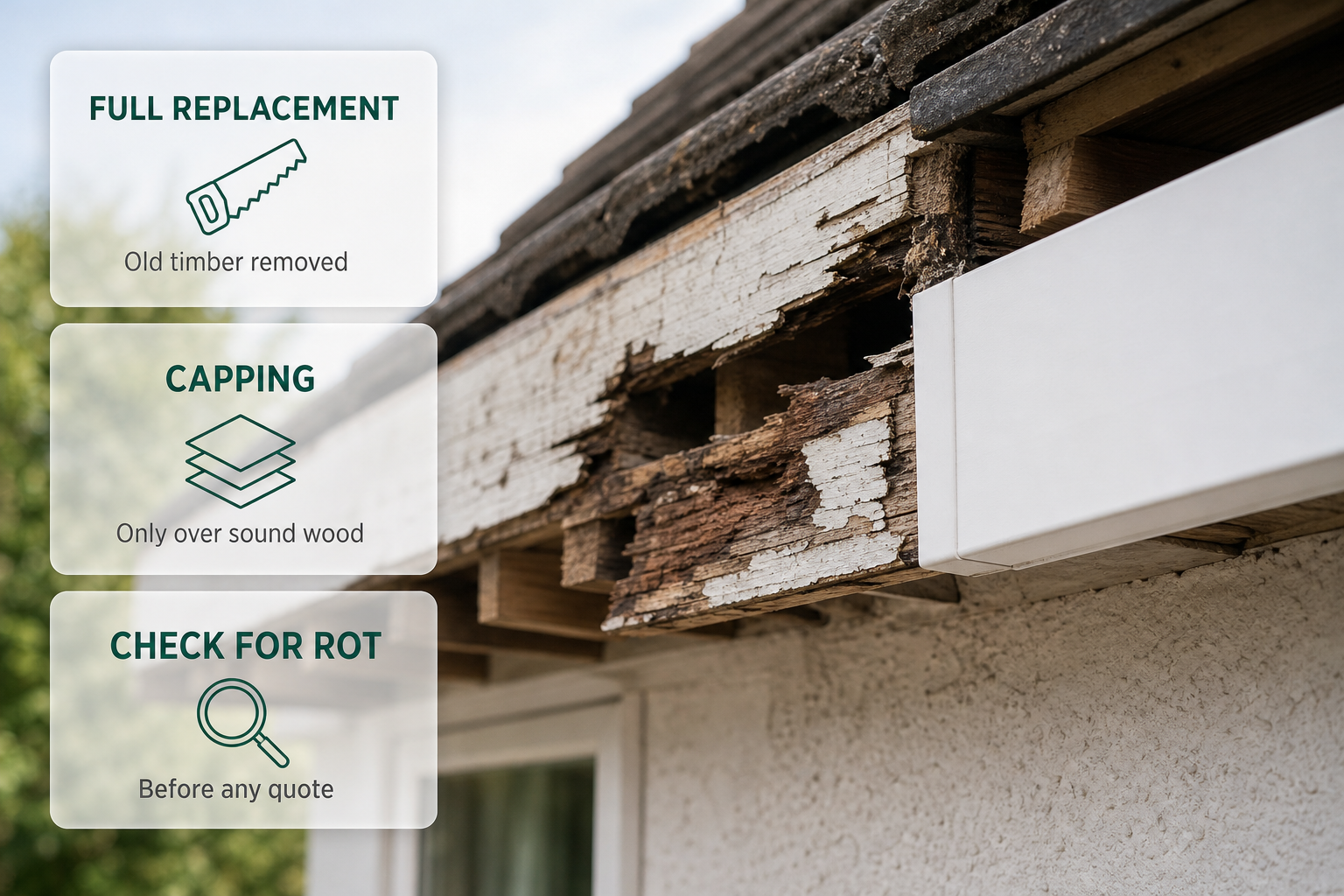
- Full replacement means removing the old timber fascias and soffits, checking the rafter ends, and fixing new boards to sound timber. It costs more but deals with any rot.
- Capping or overboarding means fitting thin uPVC boards over the existing timber. It is cheaper, but if the timber underneath is already rotten, the rot carries on unseen and the new boards can come loose.
Capping only makes sense when the existing timber is sound. Any quote for capping should say how the condition of the timber has been checked.