
Damp proofing in Ireland usually costs between €250 and €6,000, as an aggregate Irish market estimate including VAT, and the type of damp decides where a house lands in that range. Condensation is the cheapest to fix, often €250 to €1,500 for better ventilation. Penetrating damp from gutters, render or pointing typically costs €500 to €3,000 to repair. Rising damp treated with a chemical damp proof course and new plaster usually runs €2,000 to €6,000 for the ground floor of a typical house. The first step is finding out which kind of damp it is, because paying for the wrong treatment is the most common way money is wasted. Homeowners who need the damp diagnosed and treated can post the job under damp proofing and mould treatment and compare quotes.
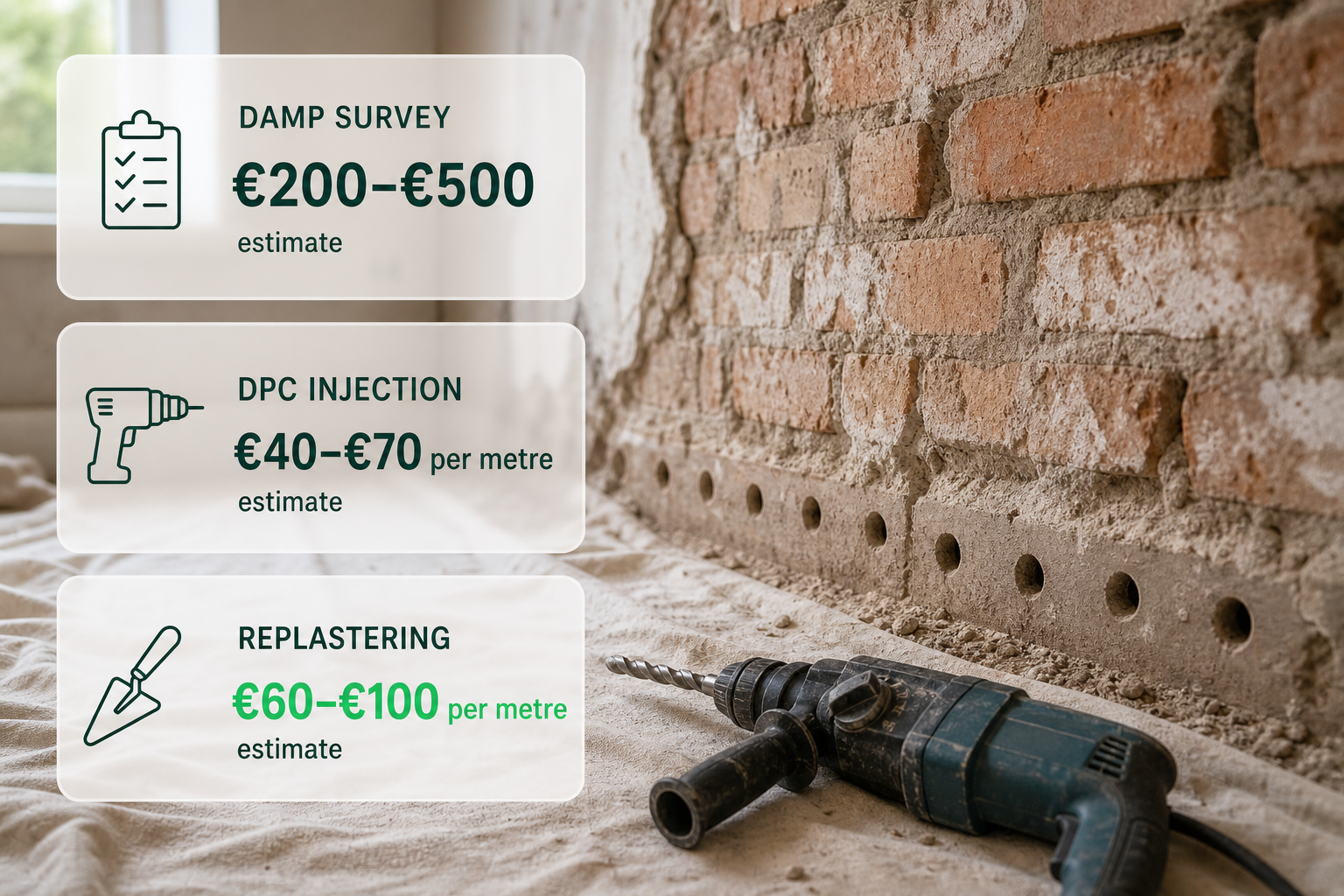
Damp proofing prices at a glance
The figures below are an aggregate Irish market estimate, VAT included.
| Work | Typical price |
|---|---|
| Independent damp survey with written report | €200–€500 |
| Chemical damp proof course injection | €40–€70 per linear metre |
| Hacking off and replastering with salt-resistant plaster, about 1 m high | €60–€100 per linear metre |
| Tanking or cavity membrane on a below-ground wall | €80–€150 per m² |
| Gutter and downpipe repairs | €150–€600 |
| Repointing brickwork or stonework | €40–€80 per m² |
| Render repairs | €40–€90 per m² |
| Extractor fan, supplied and fitted | €250–€500 |
| Positive input ventilation (PIV) unit, supplied and fitted | €800–€1,500 |
| Mould treatment and redecoration of one room | €200–€600 |
A worked example shows how a rising damp job adds up. Take a semi-detached house with about 15 metres of ground-floor wall affected. A survey costs €200–€500, injecting a new damp proof course costs €600–€1,050, replastering the same length costs €900–€1,500, and redecorating the affected rooms adds €400–€1,000. The total comes to roughly €2,100–€4,050. Longer walls, solid stone walls and lifting kitchen units or floors push the price higher.
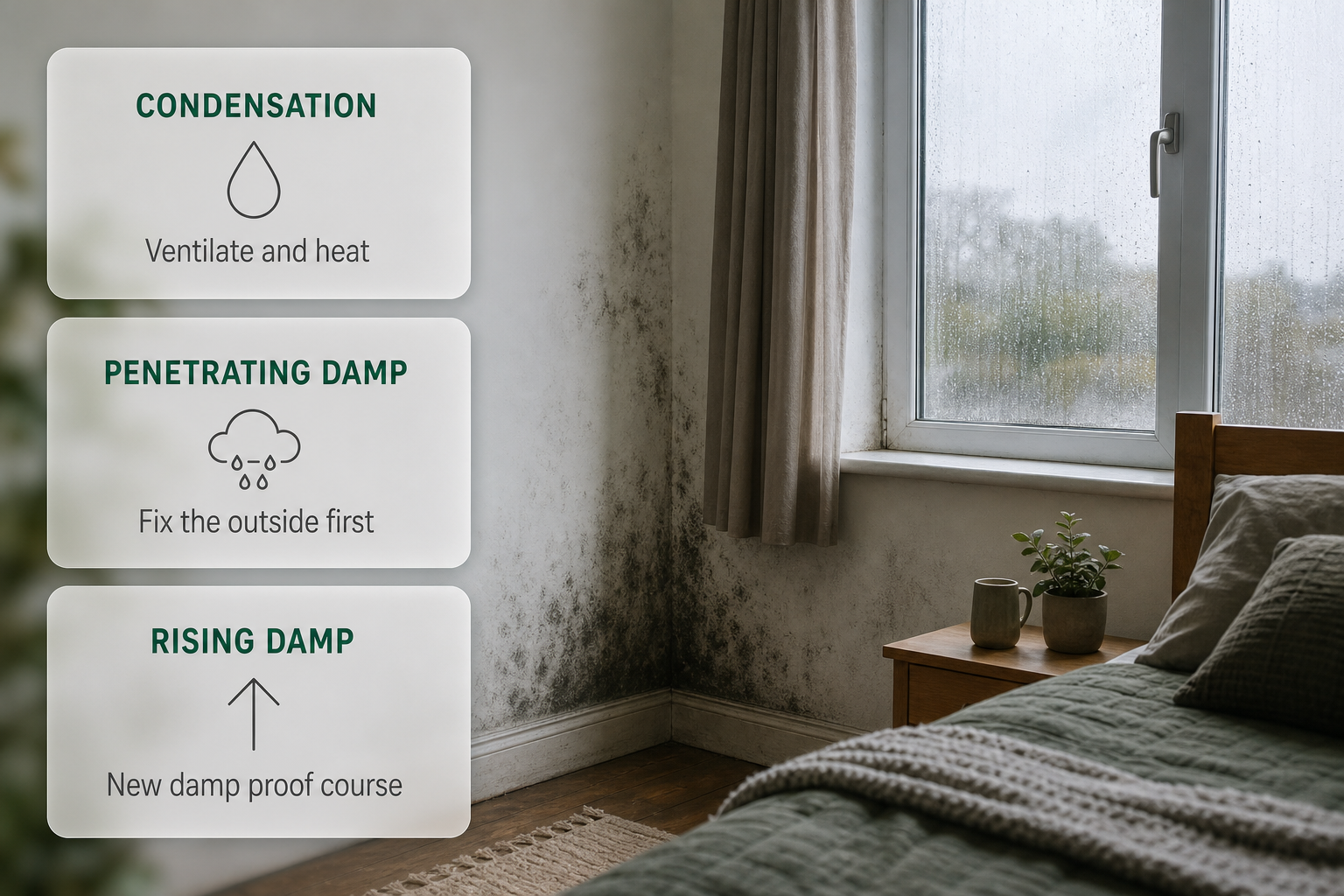
The three kinds of damp, and why the cause matters
Condensation is the most common damp problem in Irish homes. Warm, moist air from cooking, showers, breathing and drying clothes meets a cold wall or window and turns to water. It shows as streaming windows, black mould in corners, behind furniture and on bathroom ceilings, and it is usually worst in winter. It is not a building defect, and no amount of damp proofing will stop it. Better ventilation and steadier heating do.
Penetrating damp is water getting in from outside, through a blocked gutter, a cracked downpipe, failed render, worn pointing, a leaking roof or a badly sealed window. It shows as patches that grow after heavy rain, often high on a wall or around openings. The fix is the outside repair first, then drying out and making good inside.
Rising damp is ground moisture drawn up through a wall that has no working damp proof course. It leaves a tide mark up to about a metre above the floor, salts that bubble the plaster, and damaged skirting boards. It is less common than many quotes suggest, and is most often found in older houses with solid walls, or where the ground outside or a path has been raised above the original damp proof course.
Do not pay for treatment before the diagnosis
Damp is easy to misread. Condensation and penetrating damp are regularly mistaken for rising damp, and a chemical injection will do nothing for either. A few checks help before booking any treatment:
- Look at where and when it appears. Black mould in cold corners in winter points to condensation. A patch that spreads after rain points to penetrating damp. A tide mark along the bottom of a wall points to rising damp.
- Check the outside. Blocked gutters, overflowing downpipes, cracked render and ground or paving higher than the floor inside are common culprits.
- Be careful with free surveys. A survey offered free by a company that also sells the treatment is not independent. An independent surveyor or engineer charges for the report but has no reason to recommend more work than is needed.
- Ask for the evidence. A good report explains the cause, shows readings and photos, and recommends the simplest fix first.
Rising damp treatment: what the job involves
Where rising damp is confirmed, the usual repair has three stages:
- Removing the damaged plaster, usually to about a metre high, because plaster loaded with salts keeps drawing moisture even after the cause is fixed.
- Installing a new damp proof course, most often by drilling the wall and injecting a water-repellent cream or fluid along its base.
- Replastering with a salt-resistant plaster and leaving the wall to dry before redecorating.
Lowering outside ground or paths that sit above the old damp proof course is sometimes enough on its own and is far cheaper, which is another reason to have the cause checked first. Solid stone walls in older Irish houses need extra care, because sealing them with the wrong materials can trap moisture rather than let it out.